Scott: “Did anybody see objects that are Red, Blue, Purple, Green, and Gray? Those are the different lines on the transit map in the first room and they probably match up with something else.”
Jeremy: “I don’t think it’s the colors. The calendar on his desk has the first letter of the station, and then the date it’s on is the number of stops from there.”
Marni (yelling from the first room): “Remember the video said he’s traveling to a different place each day! Try Jeremy’s thing.”
Fletch: “I got the third padlock.”
Everybody: “HOW?!?!”
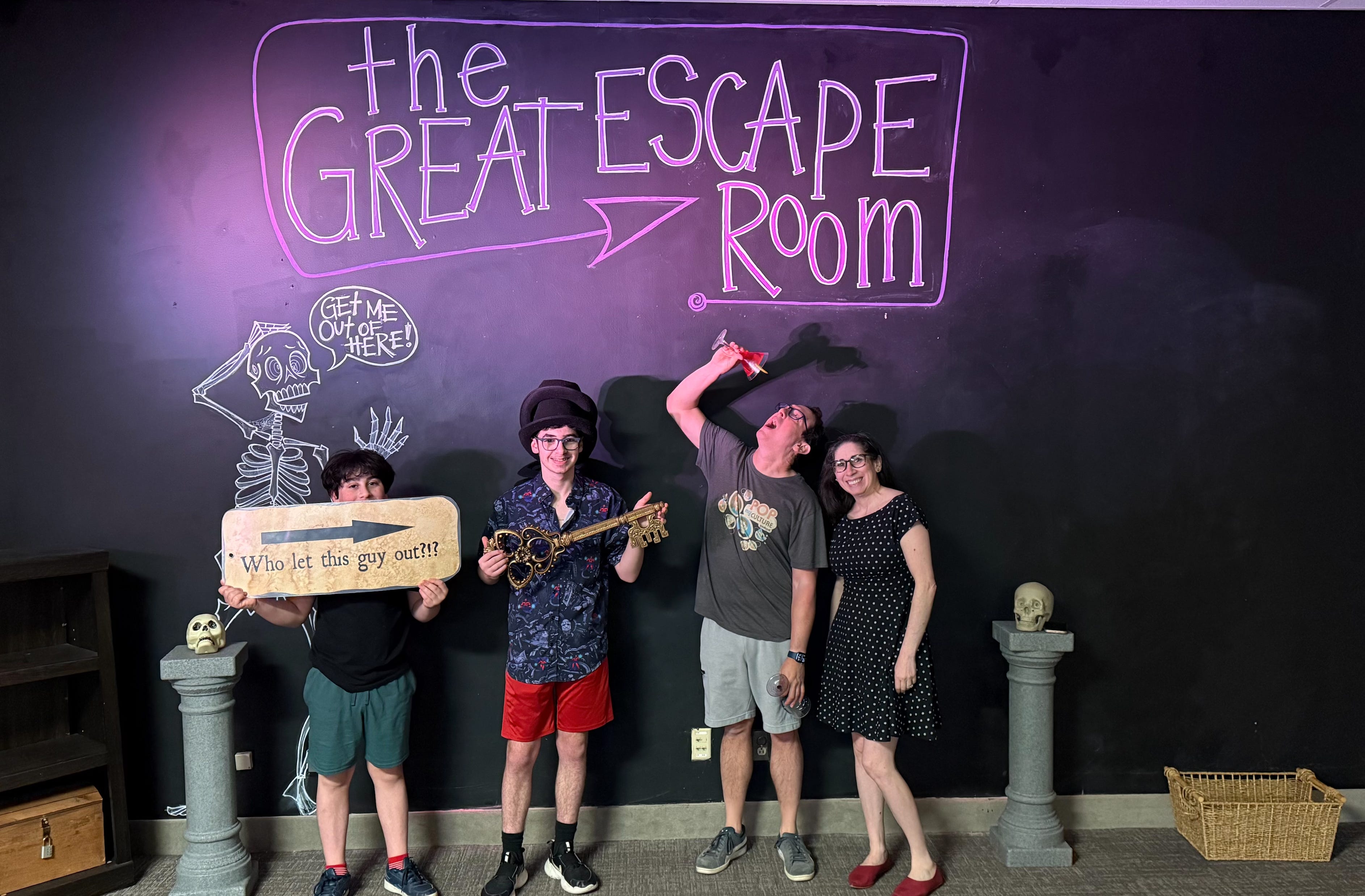
For some reason, “locked” in a room together is where we thrive as a family. Whatever dynamics might be driving bickering, whining, complaining, animosity, or general angst at home melt away when we’re in an escape room. It has become Our Thing.
It wasn’t a no-brainer that this would be the case. We’re not really a “puzzle family” or particularly competitive (except Jeremy). The first escape room we did as a family was while we were visiting my parents in Florida. I think we simply ran out of things to do, so I convinced everyone to try it. I wanted to show my wife, Marni, what an escape room was like (I had done several with friends or at work offsite) and we figured the kids would, at worst, be a minor distraction. They were 11 and 6 at the time — an age gap that rarely found them collaborating or playing together.
That first experience (at a now defunct outlet called “Try-n-Escape”) wasn’t life changing, but it at least established that this was an activity we could do where nobody would freak out or complain. It was a short time commitment, air conditioned, pleasantly themed, and physically undemanding. Even if we weren’t successful solving any puzzles, we at least had something we could all focus on to pass an hour. Over subsequent escape room experiences, though, our Escape Personas emerged.

Scott: The Vulcan. I put my Computer Science degree to use as self-appointed logician. If there’s a symbol, I look for a way to interpret it. Every padlock I see, I announce whether it uses letters or numbers and how many reels it has. When we’re stuck on something, I’ll mentally run through the core types of escape room puzzles we’ve seen over and over to see if something fits.

Marni: The Glue. You know the scene-setting story they tell you before your time starts? Neither do I — it’s in one ear and out the other. That’s why we need Marni. She ties everything together. She’ll remember details from that story that are important to solving a puzzle. She’ll remember something from the first room that we need to reference in the third room. Most importantly, she allocates one ear to listening to what everyone else is working on. She’ll lead us all towards the synchronicity that makes us successful as a team.

Fletch: The Cipher. Visual discernment was always his thing, going back to the wooden US State puzzle he had as a baby (“Wyoming, where are you????”) Any time we open a locked bag and find puzzle pieces, it’s time for Fletch to shine. He has a knack for brute forcing combinations or making educated guesses. With Fletch around, you only need 2 letters of a 5 letter password.

Jeremy: The Wildcard. Jeremy’s mile-a-minute creative mind comes up with theories nonstop and makes connections that seem doubtful at first but end up saving the day. When our puzzle host says, “I don’t really understand how you guys escaped without solving this one puzzle,” the answer is always that Jeremy saw several steps ahead and didn’t need the interim puzzles.
The Team. No single one of us would have a prayer of getting out of most of these rooms alone. On my own, I’d be too logical, immediately ditching the type of random brilliance that makes Jeremy so effective. It’s great that we have such complementary skills that generally serve us well in escaping, but I think escape rooms would be Our Thing even if our success rate was zero.
Escaping the room, at least for us, is a just the means to the end of getting out of the house and doing something collaborative as a family. I truly don’t care if we escape — in that first room six years ago, we certainly didn’t expect our kids to solve any puzzles. Yet, regardless of whether we “win”, the dynamic is different after an escape room. We’re talking about something other than what’s for dinner or who needs to clean their room. We feel closer to each other, even if just for a little while. It’s like we get all of the benefits of a traumatic shared experience but without the trauma.
Escape rooms, for us, are an escape from the roles we normally fall into at home. Believe it or not, I don’t usually feel like a stoic Vulcan, approaching all of life’s puzzles with a calm and rational logic. Our child who most struggles with asking for help in real life was the one who (correctly) advocated for using a clue during our most recent experience getting stuck. In the faux-high-stakes setting of an Escape Room, we get to shed any prior baggage and emerge as our best selves.
I’ve wondered, at times, if this is a universal form of Family Therapy, or if there’s something unique to us that makes an escape room so cathartic. I know of other families that do escape rooms together from more of a competitive angle — trying to get the best time they can — but most other parents I’ve spoken to about it say something like, “Our kids would kill each other” or “I already feel trapped with these people.” To me, that’s the biggest irony of the whole thing — in an escape room, you’re not trapped in your family, you’re trapped with your family.
Well, except for that one time…
In our dozens of escape room experiences, we had one that didn’t go so well. My recollection was that we arrived grumpy, but maybe I was the only grumpy one at first. The room itself was good, but I remember it being the only time we were yelling at each other. There was one puzzle that didn’t work correctly — we had solved it, but the effect wasn’t triggered. So that was a source of frustration, though also a teachable moment if we had only thought to see as such at the time. Sometimes, in life, you do everything right and the lock still doesn’t open.
The room was also, I later realized, a non-linear room. So rather than collaborating on one or two puzzles, everyone was in their own little fiefdom (it was, after all, a castle-themed room) getting frustrated that nobody was working with them.
The positive surprises far outweigh the negative ones, however. On a drive in Florida, we stopped at Doldrick’s Escape Room, a highly rated independently owned room outside Orlando. The room started with us split into pairs, locked in separate jail cells. Getting to the next room required solving puzzles that each pair only had half the information for. We had to communicate between the groups without being able to see what the other group could see.
That room had some really unique visual effects, and I was able to chat with the owner a bit before we left. The feeling of accomplishment and togetherness that we had getting back on the road stands out more in my mind than the prior 3 days we had spent at Universal Orlando — and I love Universal Orlando!
If you’re thinking about giving it a shot, here are some tips for making escape rooms Your Thing.
We share a tacit understanding that we’re not looking to get on the leaderboard in the lobby (fun fact: last week, we unintentionally got on the leaderboard in the lobby!) Particularly for a first escape room experience, be prepared to take in the theming, ask for help, and don’t stress the younger participants. Try not to get into a mode where you’re so focused on escaping that you find yourself being like, “Yeah, okay, Little Billy. It’s time to shut up so daddy can translate this morse code.”
Start with a room rated as Easy or Medium, and don’t expect to complete it.
In an escape room, the kid who is usually over pedantic will parlay that into noticing all the little clues. The adult who usually takes controls will be able to let go and follow someone else’s lead. Outside anxieties go away in the confines of an artificial threat. I don’t know why — I’m not a psychologist. My best guess is that in an environment that’s purely for play, we can all try on personality traits without fear, like we’re all kids on the playground.
Escape rooms tend to require a certain way of thinking and tend to repeat a handful of puzzle tropes. As you do more rooms, you’ll notice the subtly underlined letters on a poster, or the very deliberately placed fake spiders of different colors. The more rooms you do, the more quickly you’ll turn those underlined letters into a word you need, or the number of spiders into a colored padlock combination. People aren’t escaping in half your time because they’re smarter than you. It’s because they’ve seen most of these puzzles before. Also, you don’t care about your time — it’s a better value if you’re in the room longer!
We are lucky to have a number of local escape rooms here in Rochester, NY. They are mostly independently owned, with completely original puzzles and stories. We’ve also done escape rooms when we’ve traveled to Orlando, Las Vegas, and New York. They’re different.
The rooms in places like Las Vegas tend to be a lot more high tech and sometimes much more themed. Some even use licensed IP or have live actors.
I love both the local rooms and the crazy elaborate destination ones. I love the rooms in Rochester because you can tell that they were built with love. When we’re just looking for something to do, a local escape room is perfect. When we travel, we usually pre-book an escape room so we know that, regardless of what else happens, we’ll have that one hour where we did Our Thing.
You only have to pay for the hour that you’re in the room, but you can still get value from talking about it and recapping afterwards. The car ride home is when we piece together all of the puzzles that some of us might not have witnessed — “How did you know that…? What was the deal with…? So did we ever use the… ? Have you ever seen such detailed…?”
Praise for genius puzzle solving is handed out freely and everyone is (except that one time) happy, energetic, and not complaining about what’s on the radio or begging for screen time.
Memes develop naturally. At this point, it’s basically a tradition on the way to an escape room for someone to say, “Remember that time we did an escape room with Aunt Beryl and she screamed when that mummy popped out of the coffin?”
Oh, Beryl.