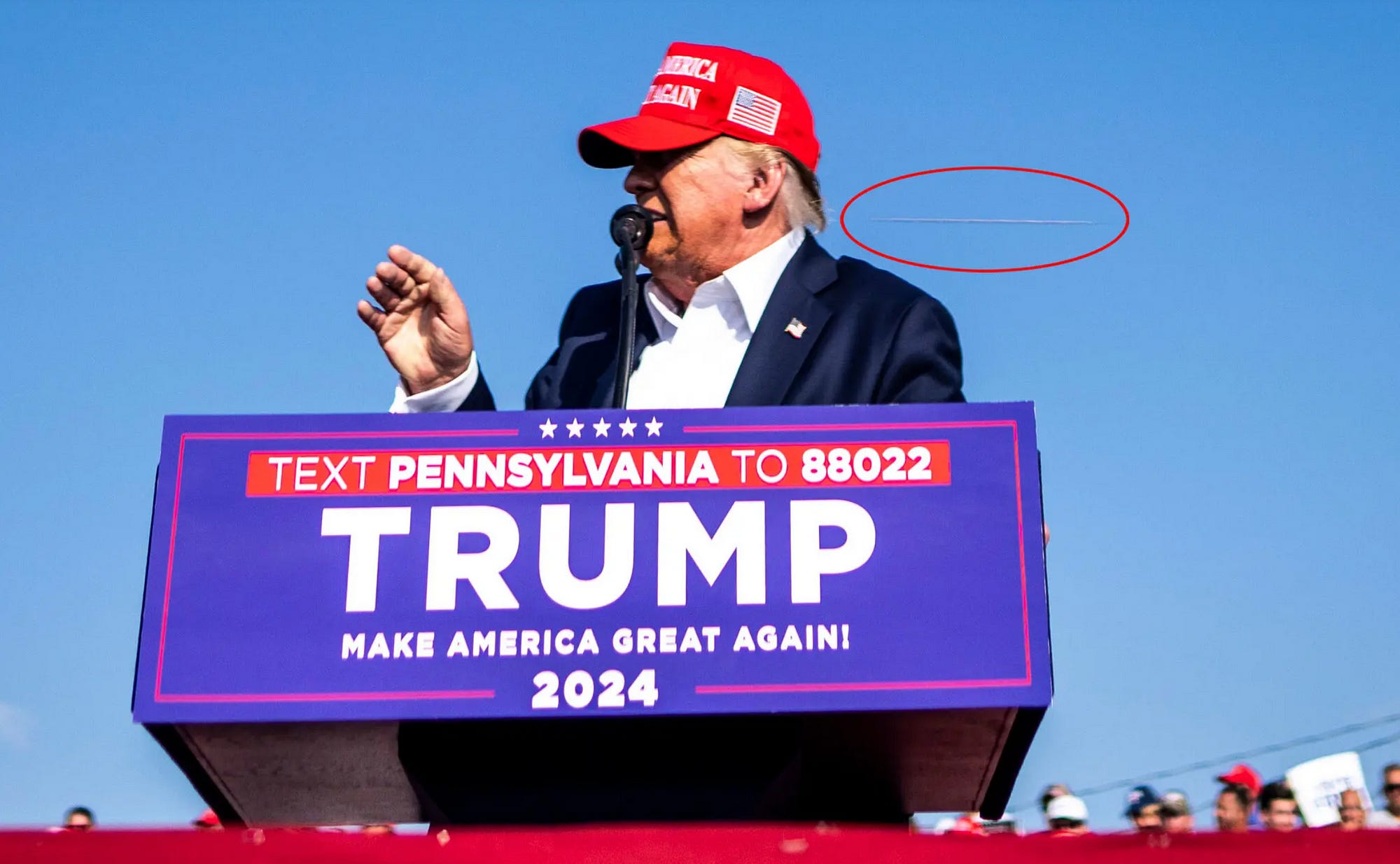
Seen this photo? I am sure you have. It was taken by Doug Mills, a photojournalist working for the New York Times. What is truly astounding about this photo is that it supposedly captured the actual bullet that almost killed Donald Trump, just as it passes just a few millimeters from his skull.
This photo is part of a series that was recently circulated in the media once again, after Mills won the Pulitzer Prize for them. When I saw this photo again, I started thinking about all the conspiracy theories that have surrounded the Trump assassination attempt. Rumours about the whole thing being staged – history’s most advanced and dangerous PR stunt.

I personally do not think there is any conspiracy here, as it would have to involve a complex explanation with many people coordinating across several institutions, and too much risk (not to mention, two people’s deaths). To keep something like that secret would be extremely hard.
My next thought was that we should be able to use the bullet trace photo to prove that the official story is the true one. I remembered that the EXIF metadata from the photograph was published by the New York Times, so from there we can learn the shutter speed that was used.
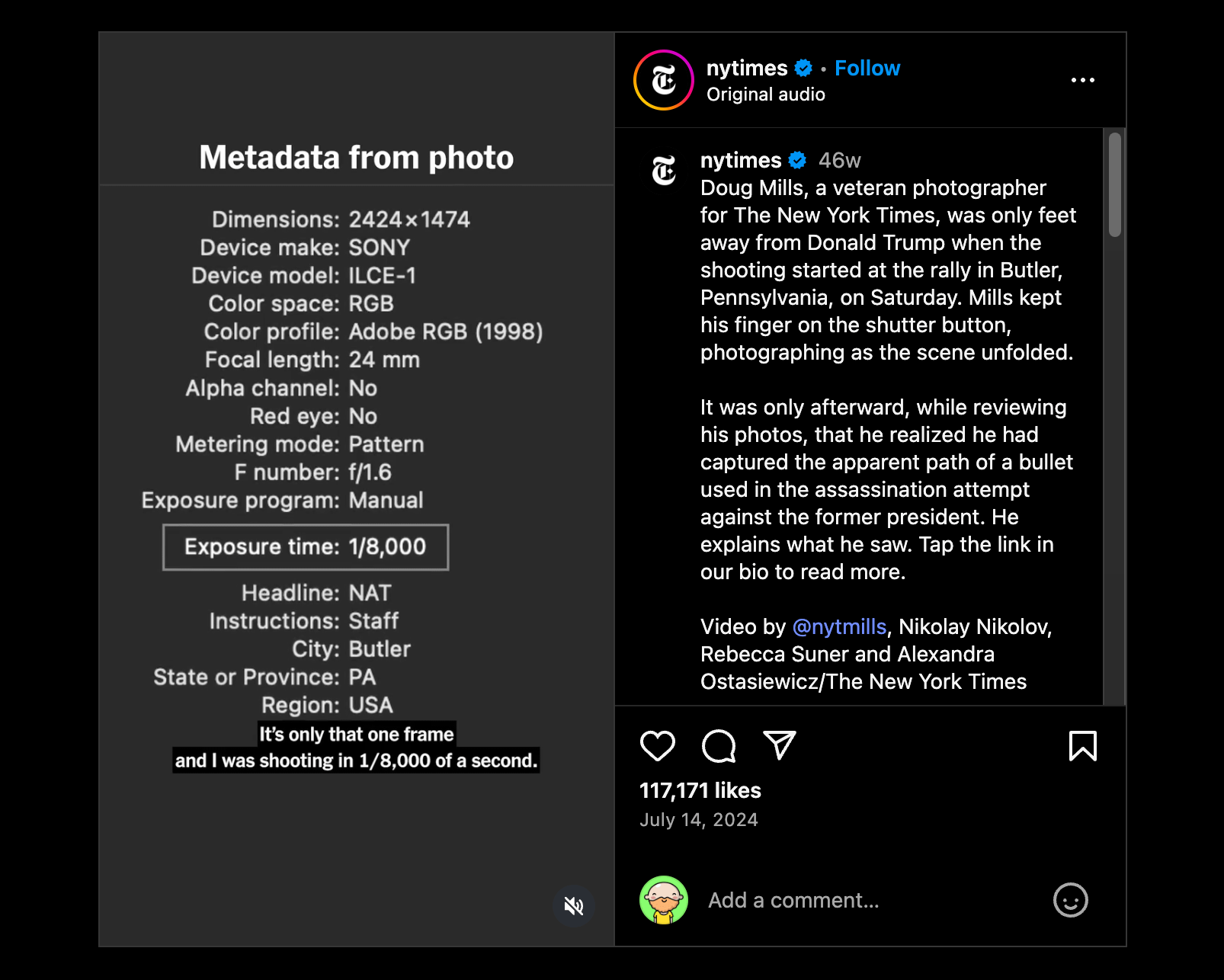
We can then estimate the length of the bullet streak in the image, and combine that with the known shutter speed of the camera, to estimate the speed of the bullet. And since the type of gun and ammunition has also been publicly disclosed, we can see if all these match each other. If they do – that would add credibility to the official story.
We can see in the EXIF metadata above, that Doug Mills used a Sony A1 mk1 camera (also known as ILCE-1), and that the shutter speed was 1/8000 s.
The would-be assassin used a DPMS DR-15, an AR-15–style semi-automatic rifle chambered in 5.56mm. I asked ChatGPT for the expected speed of the bullet when passing Trump’s head.
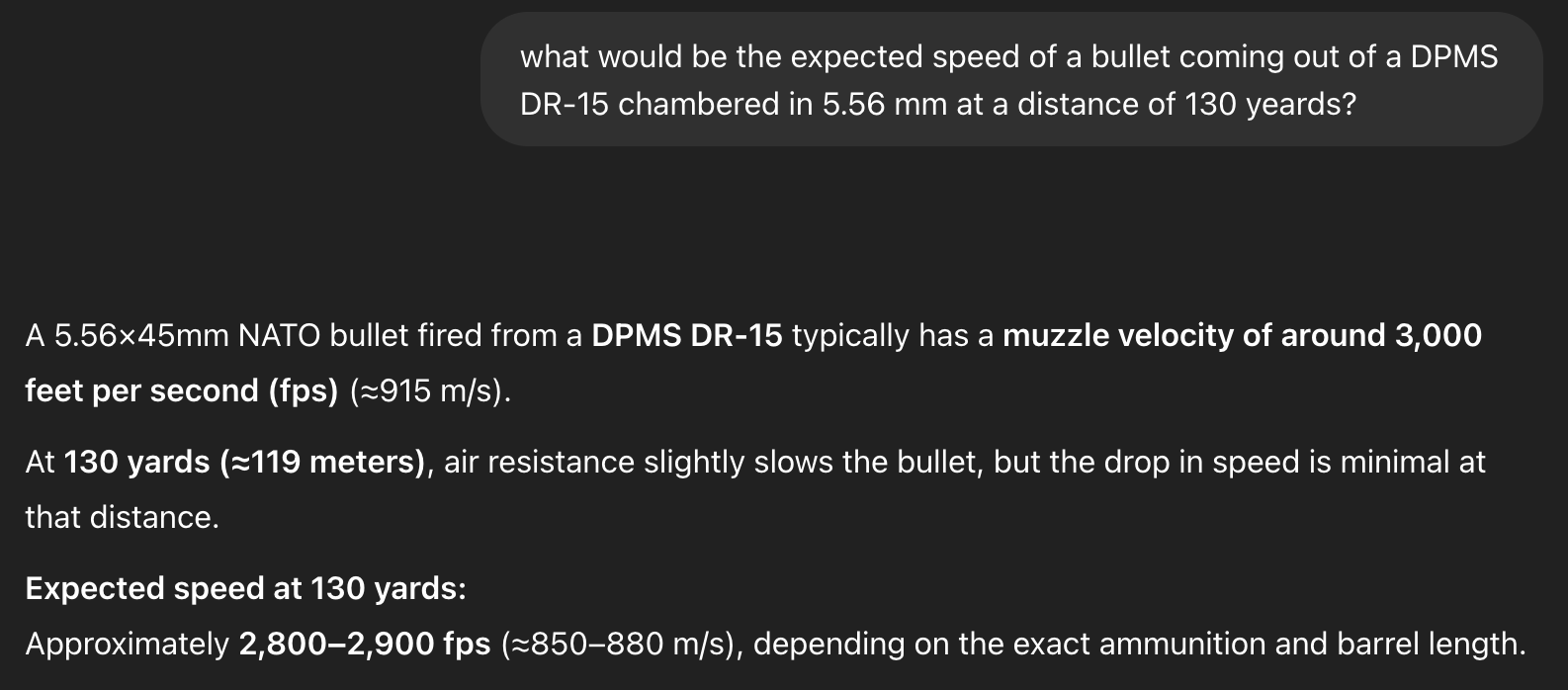
Okay, so we know the shutter speed, ie. the amount of time the camera exposed the photo to capture the bullet trace – and that was 1/8000 s. We also know that the bullet would have travelled at a speed of around 850 m/s.
This means that we can calculate how long a bullet streak should be in the photo. I asked ChatGPT to calculate this for me, and I was very surprised and a bit shocked when I saw the answer:
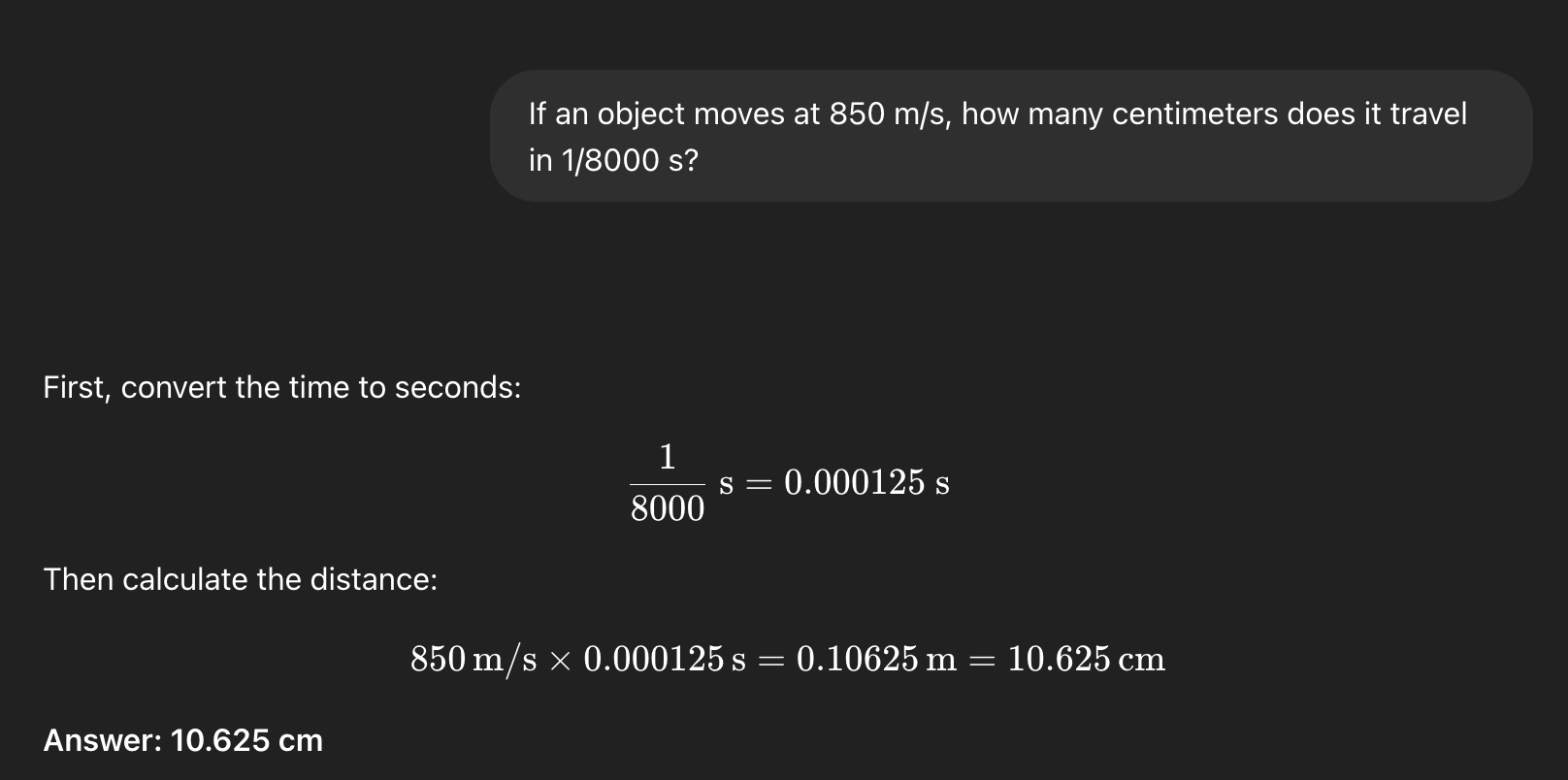
10 cm!? In the photo it looks like the bullet streak is around 25 cm, maybe even more. A human head is typically around 20-25 cm from nose tip to back, and it looks like the bullet streak is slightly longer in the photo. Definitely a lot more than 10 cm in any case. Does this mean that there actually was a conspiracy? Or was I missing something else here?
I started googling and ChatGPT’ing around furiously, trying to come up with a plausible explanation. After a while I found it (I think!).
In modern cameras, the mechanical shutter is actually made up of two separate shutter curtains called the front and rear curtain. Before taking a photo, the front curtain covers the sensor. When you press the shutter button, the front curtain starts sliding down to reveal the sensor and let light onto it. And when the exposure should end, the back curtain comes down after to cover the sensor again.
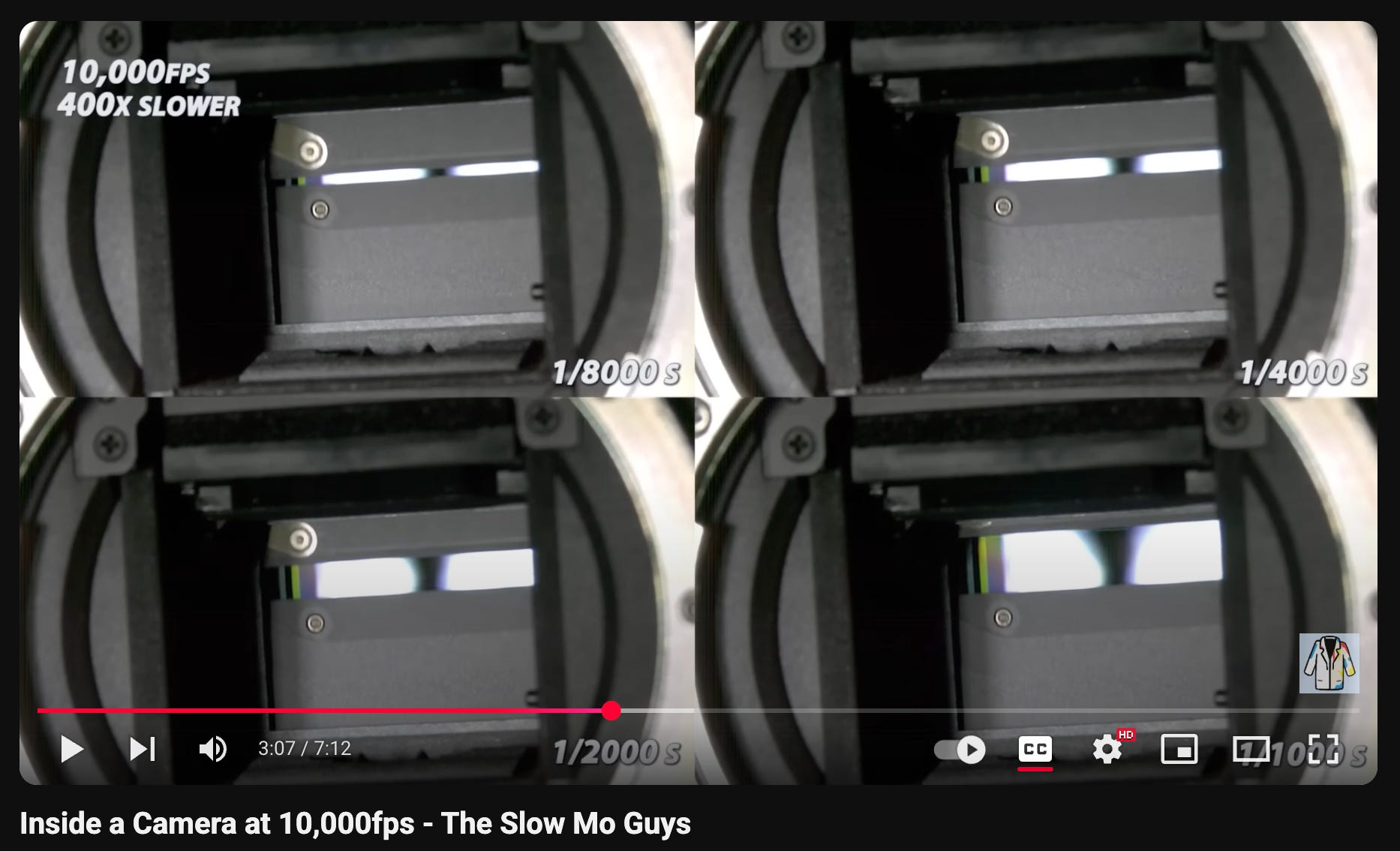
The thing is though, that at very high shutter speeds, both the front and back curtains move at once, revealing only a thin slice of the sensor at any given moment. To understand exactly what I mean, watch this video at 3:06. This is a “hack” used in all modern high end cameras to allow for very high shutter speeds.
And even if one would use only electronic shutter, a similar thing would happen, as the sensor is read pixel row by pixel row, and the readout often takes a few milliseconds. The only exception is if you are using a global shutter camera, such as the cutting edge Sony A9 mk3. A global shutter means that all pixels on the sensor are read at the same moment in time.
What does all this have to do with the Trump Bullet Photo? Well, if Doug Mills would have been equipped with the brand new Sony A9 mk3 with a global shutter, the bullet should have matched our calculation exactly, by showing up as a 10 cm streak at 1/8000 s shutter speed.
But he did use a Sony A1 mk1 with a regular mechanical shutter. This means that each pixel by itself exposed for only 1/8000 of a second, but the whole process of moving the front and rear shutter curtain slit takes longer than that. I asked ChatGPT about the movement time and height of this slit: The slit is 3.6% of the sensor height and moves from top to bottom in 3.5 ms.
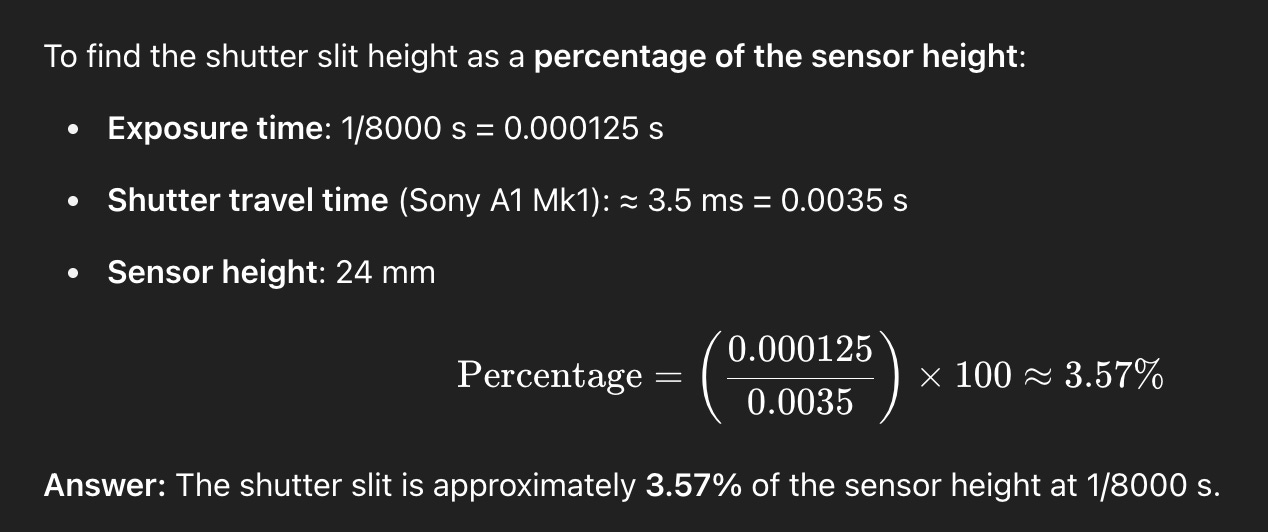
And here’s the core of this whole mystery: When the shutter slit reaches the upper edge of the bullet, it would capture that upper edge of the bullet on the sensor – the next fraction of a second, the bullet would have moved a bit longer, and the shutter slit would expose the middle of the bullet – and a fraction of a second later, the shutter slit would have reached the bottom of the bullet, and the bullet would have moved even further. All in all, we would expect a drawn out, long streak. This is called rolling shutter effect.
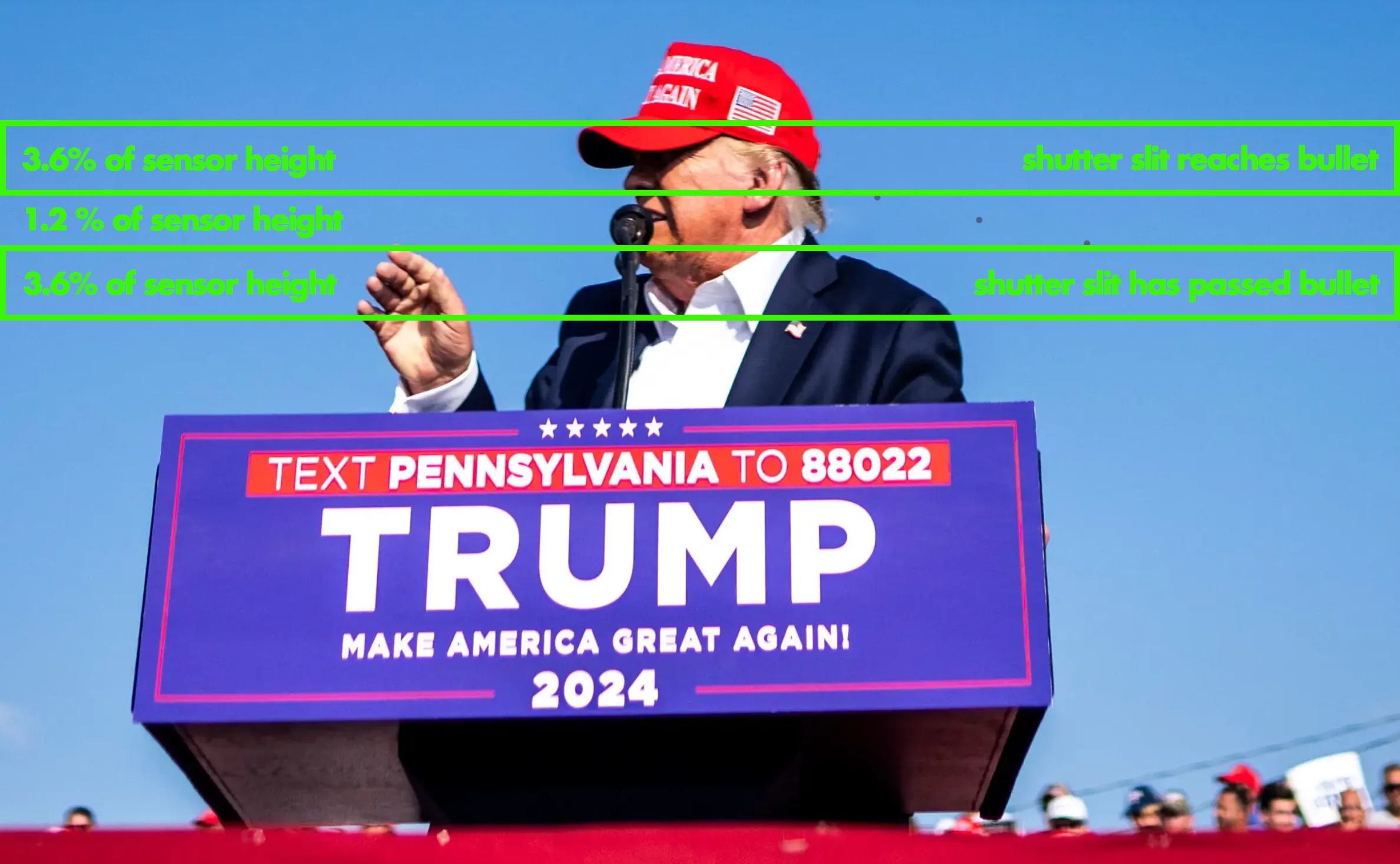
The travel time of the shutter from top to bottom is 3.5 ms on the Sony A1 mk1. Since the shutter slit height is 3.6% of the sensor height, and since the shutter slit will expose the bullet from the point in time where its lower edge reaches the top of the bullet, all the way until the slit’s upper edge leaves the bottom of the bullet, we need to add these two heights together to get the percentage of the 3.5 ms travel time that the bullet is actually exposed. We also need to factor in the height of the bullet travel path (greatly exaggerated in my graphic above) which I estimate to 1% of the sensor height (could of course be even less if the photo was heavily cropped).
So if we then add these up we get the time the bullet was actually exposed, despite the 1/8000 s shutter speed. 3.6 + 3.6 + 1.2 gives us that the bullet was exposed during 8.4% of the 3.5 ms shutter travel time, which means 0.294 ms, which is approximately 1/ 3400 s. We can now ask our original question again, but with 1/3400 s as the time the bullet was exposed:
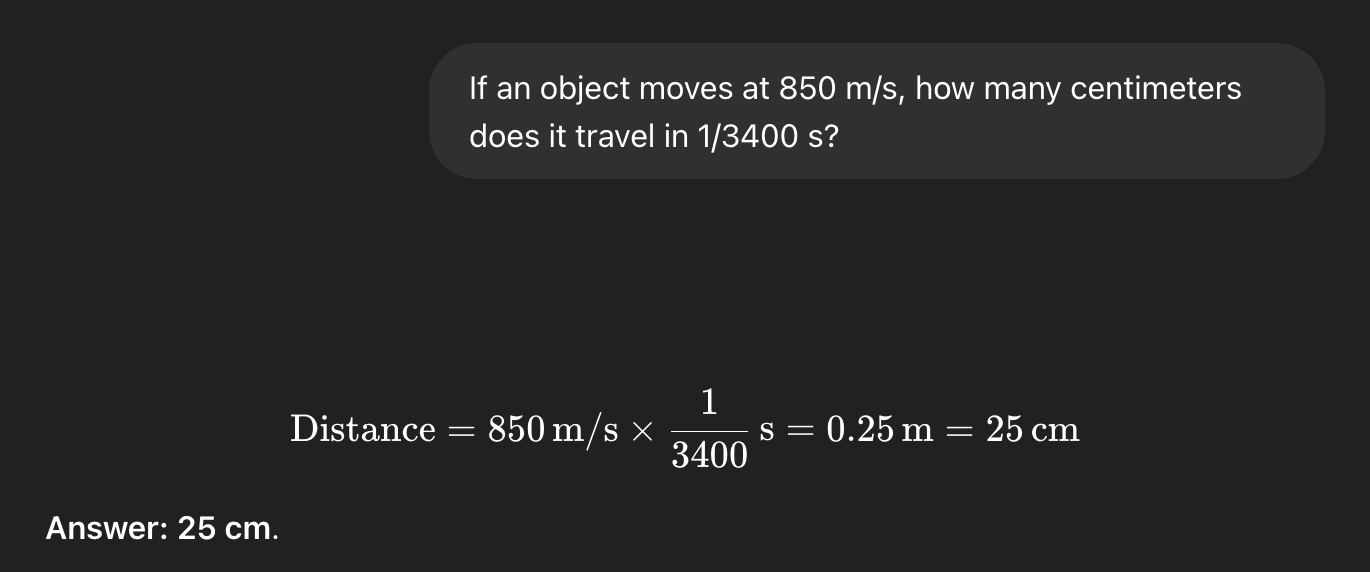
Nice! Lines up perfectly with what we see in the photo. For me at least, the case is now closed. We have one more piece of evidence that this was indeed a real assassination attempt. Or at least we have evidence that it was a real AR-15 bullet passing very close to Donald Trump’s head, photographed by a real camera. Or, I messed up somewhere in my calculations or thought patterns above, in that case let me know! In the process of getting to the bottom of this, we have also learned a lot about how the shutter of a modern camera functions. 🤓
In other news, my Macro Photography Handbook, a 113 page PDF e-book containing everything I know about macro photography, an easy read if you want to get 8 years of macro photography experience loaded into your brain in a couple of hours, has sold for over 10 000 USD in the first 30 days! Whoah! I did not expect it to sell this well. Thank you so much to everyone who bought it. It means the world to me, and frankly it is a bit life changing. The success of this book inspires me to continue making macro photography content on youtube, and also to write more e-books! Stay tuned.
