The human brain is incredibly fascinating, especially its ability to adapt to novel situations and change its underlying structure to support new functionalities. The phenomenon of a brain changing itself is called neuroplasticity.
Scientists used to believe that our brains are fixed at birth, both structurally and functionally. Later it was thought that only children's brains were plastic, while mature brains acquired a rigid structure. Fortunately, these assumptions were debunked in the last decades, and while I could go on and on about the biological changes that occur in active brains, I will focus on the main message: Our brains are highly plastic and restructure in response to to our environment.
Like paths are made in nature, they are made in our nervous system. With this I mean that paths walked repeatedly will strengthen over time and the effort and energy put into walking the path decreases considerably (e.g. by removing overgrowth or flattening bumpy grounds). But the “paths” formed in our brains are actually much more sophisticated than a simple connection from A to B. Let’s look at the important features in more detail.
We will start this discussion by introducing an example. One of the first thinking structures that I learnt about in chess is to scan positions for checks-captures-attacks. The concepts are ordered by their respective values; checks are the most forcing moves and therefore should be considered first, then captures (material gain) and then attacks (gaining activity and initiative). Therefore this concept includes three locations and a directional path between them.
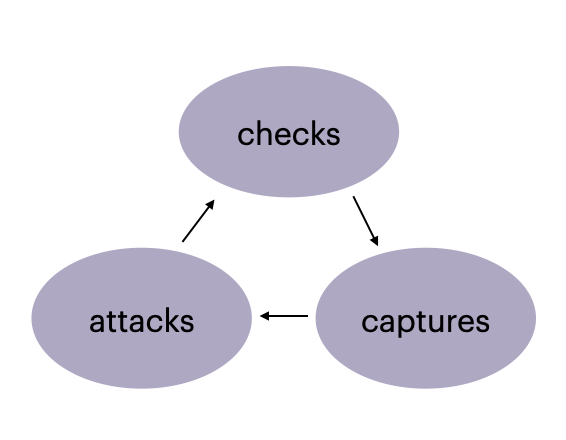
Notice that I included an arrow from attacks to checks, connecting the last location to the first. This is to emphasise the idea of a closed concept that can be looped over easily. Theoretically, we can add as many locations as we want, however I generally like to keep the number small to reduce confusion and mistakes.
Our nervous system is made out of vast network of excitable nerve cells that are connected to each other to transmit electrical signals. An electrically ‘firing’ neuron is considered active. As we strengthen the pathways between checks-captures-attacks we strengthen the connections between relevant neurons to create functional neural cell assemblies. As Hebb theorised in 1949, neurons that wire together fire together.
In lay terms this means that as we create new thinking patterns these wire together (build paths) and will become the default pattern for future thinking. But there is another hidden gem: activating a sub-part of the concept (e.g. attacks) will also activate the whole concept, reinstating the pathways and “loading it” for further use.
The learning brain has a fascinating property: consciously learnt information is consolidated into long-term memory and becomes more and more automatic. Imagine you just started to learn the example concept. Remembering to apply it when evaluating positions will be imperfect and the retrieval will require cognitive effort. Upon repeated exposure, however, the pathways will be strengthened and retrieval will become a natural response to the cue of evaluating a position. Soon you may not even notice that you apply the ideas, as the pathways guide your subconscious thinking.
So what can we learn from this? We can use conscious learning to build appropriate cognitive scaffolds that can guide our thoughts and reduce cognitive efforts when analysing positions.
I used this idea to string together smaller pieces of information and improve my skill of evaluating positions and plans, which I will present in future articles. Do you employ cognitive scaffolds or have ideas for some? I would love to hear your thoughts!