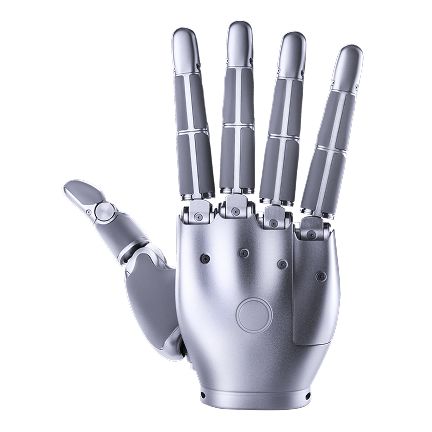
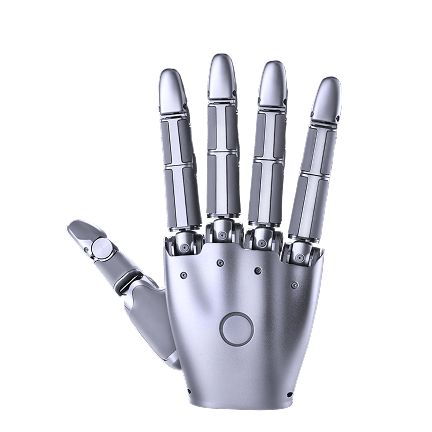
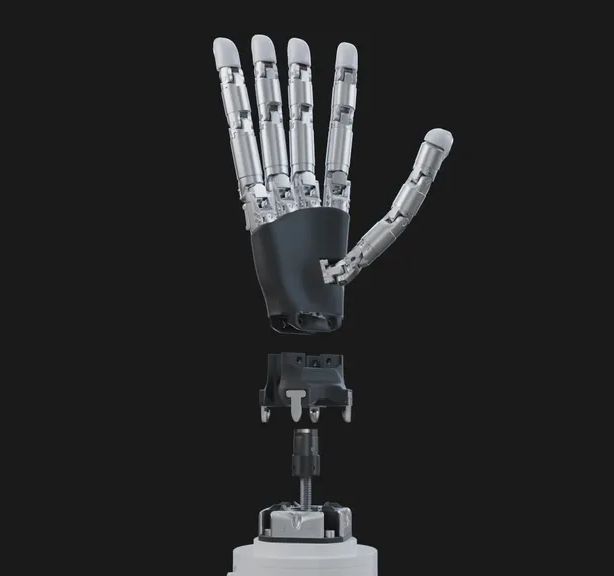
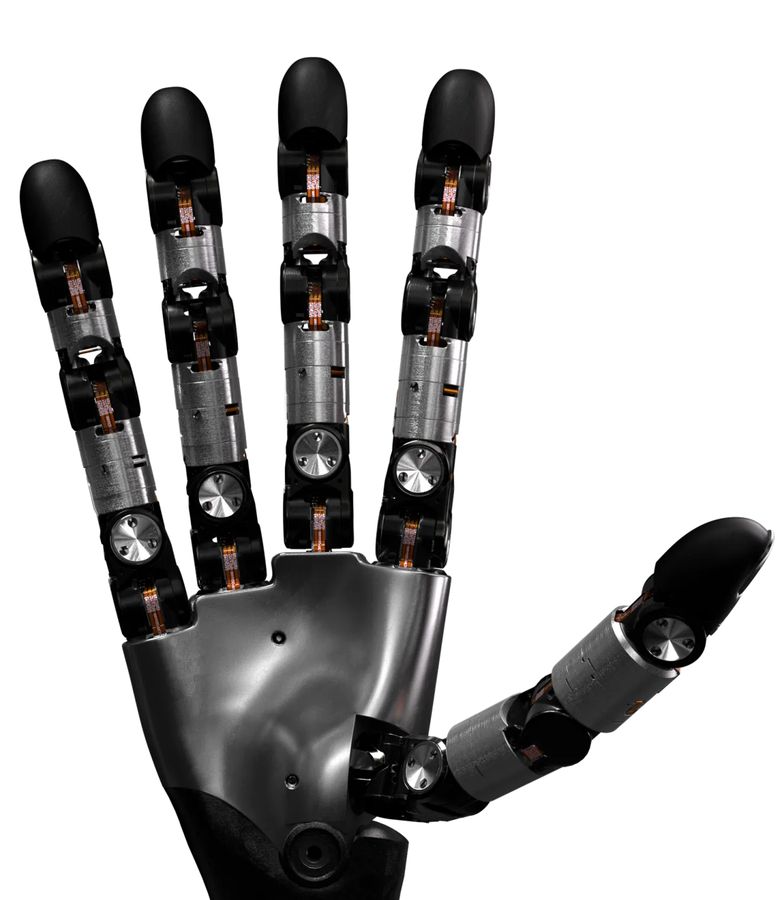
Hands: how a robot hand works, why it is so hard to build, and what it costs

22 min read Original article ↗

An illustrated explainer · Stormy · November 2026

How a robot hand works, why it is so hard to build, and what it costs.

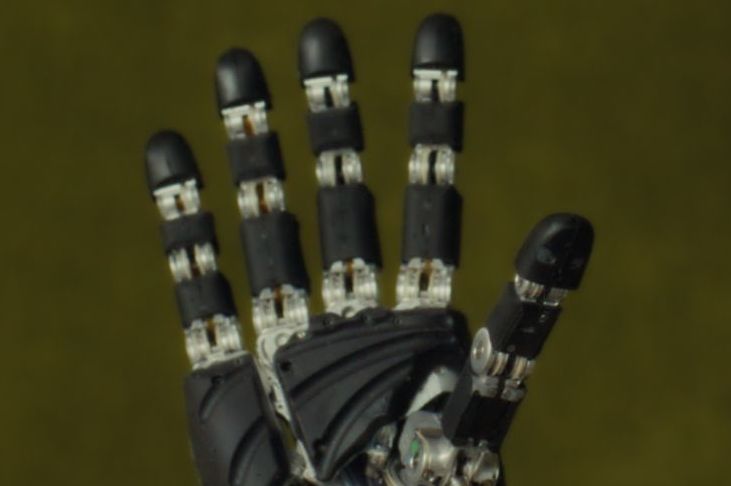
Render of a simulation

Idea 01 / 6

A hand is hinges, and every hinge needs something to turn it

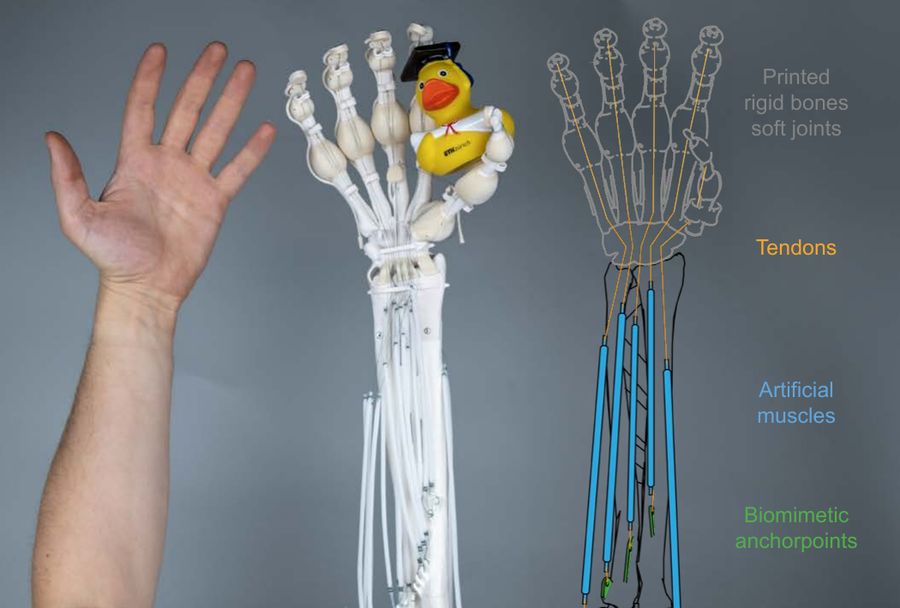
Your hand has 27 bones, and most of the muscles that close it sit in your forearm. paperan encyclopedia

Our drawing of the 27 bones of a human hand, and five of the tendons that run to muscles in the forearm.

For size, at one scale: a fingertip 14 mm wide, as on our simulated hand, beside a tendon 0.4 mm thick, the size one research hand uses. paper

Show the full tableTable 1 · Twenty robot hands and one human one
HandJointsDrivenMotors sitTendonsTip force, NMass, gPrice, USDOrigin
Human hand27 bonesabout 21forearm and handyespaper
On sale or announced
1X NEO hand, 202622 + 3 wrist22 + 3 wristforearmyes45maker
Tesla Optimus hand, 202422 + 3 wristforearm (patent)yesmaker
Figure 02 hand16maker
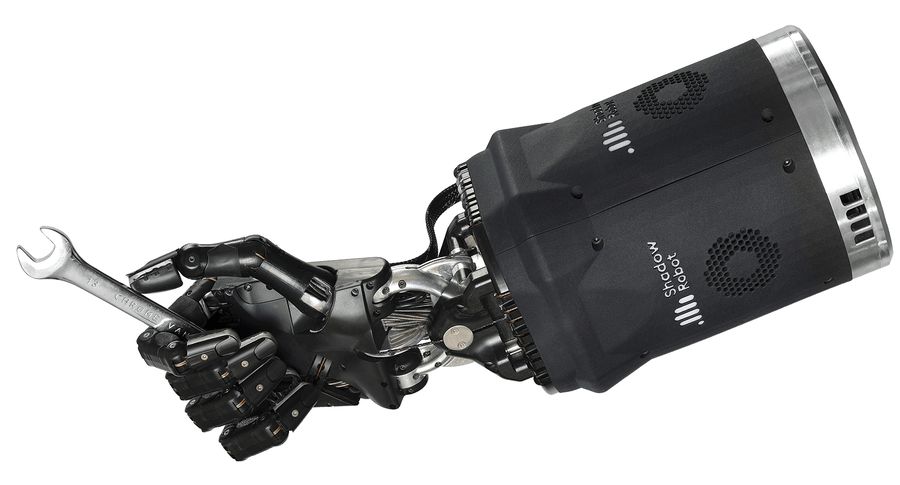
Shadow Dexterous Hand E2420hand baseyes4,300 aon requestmaker
Sharpa Wave2222not publishednot published201,300on requestmaker
Sharpa W0221not publishednot publishedunder 750maker
Wuji Hand v12020in the jointsno15580on requestmaker
Wuji Hand 22020in the jointsno1265019,500 bmaker
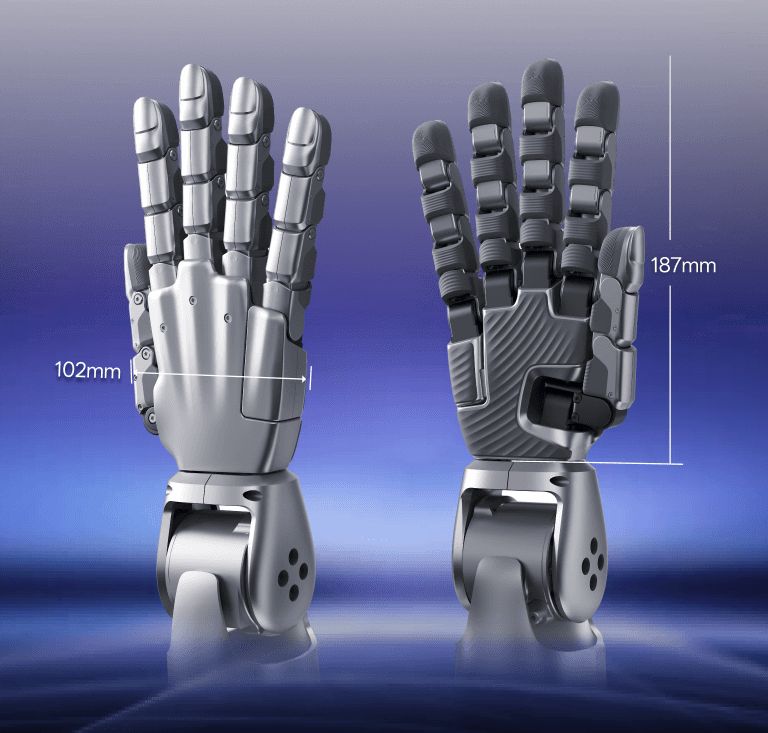
Unitree Dex5-S2222in the handno6206,350maker
Unitree Dex5-12016in the hand, gearedno1016,450 bmaker
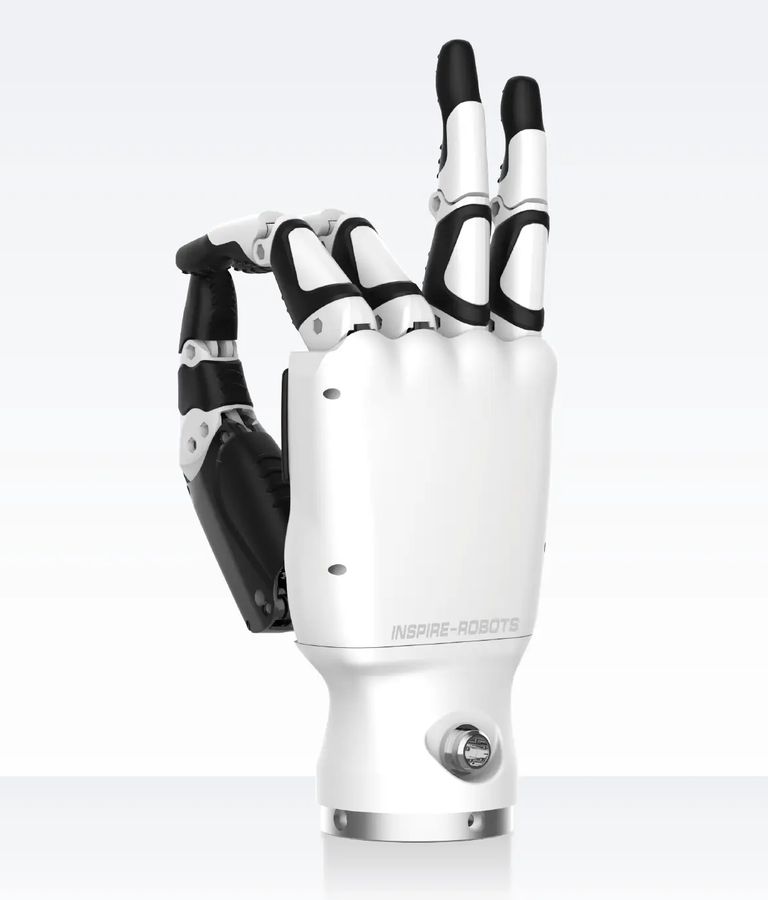
Inspire RH56126in the handno2,641 cmaker
Research hands
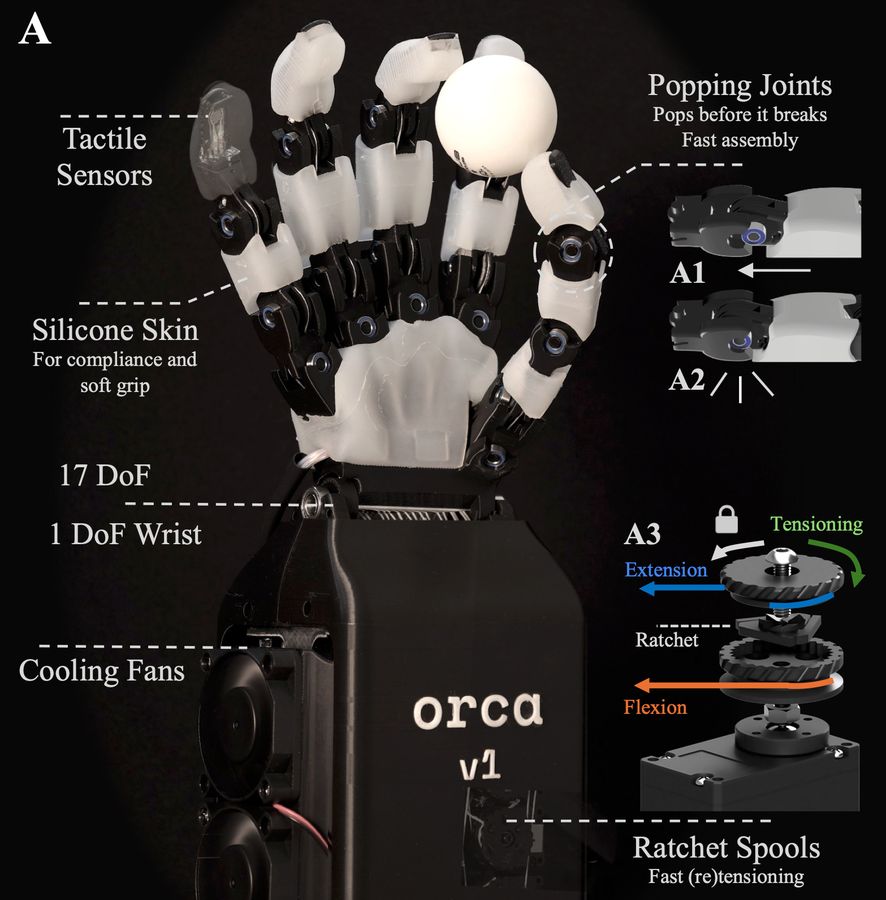
ORCA v11717outside, in a toweryesunder 2,000 CHF dpaper
LEAP v2168in the handyes300 dpaper
ISyHand1818at the jointsno1,300 dpaper
DexLink2016390 dpaper
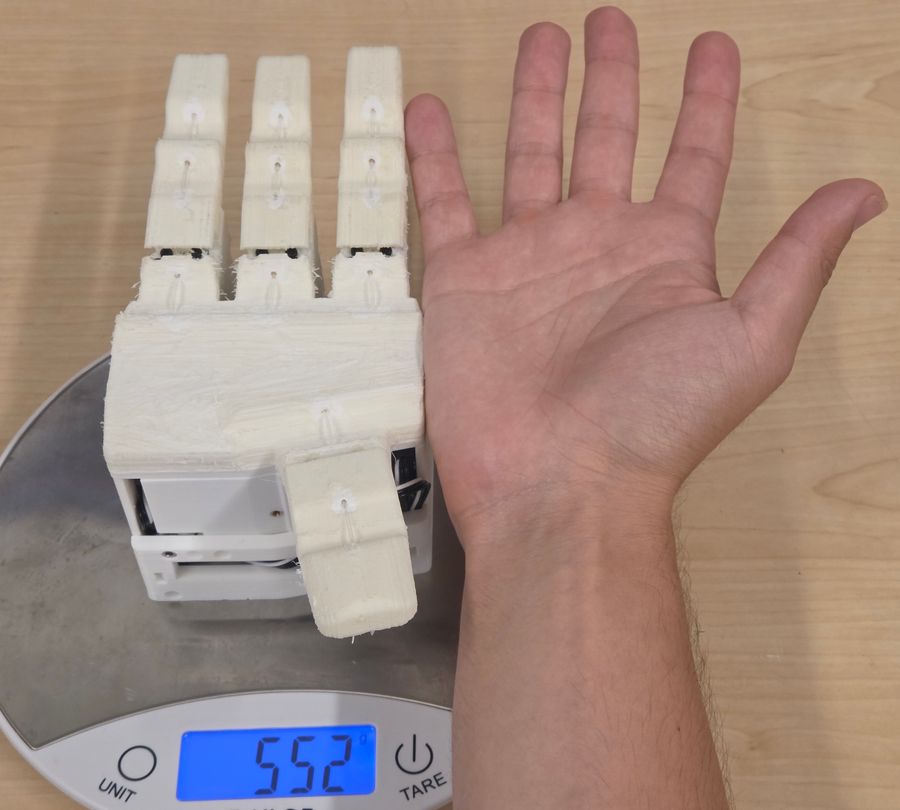
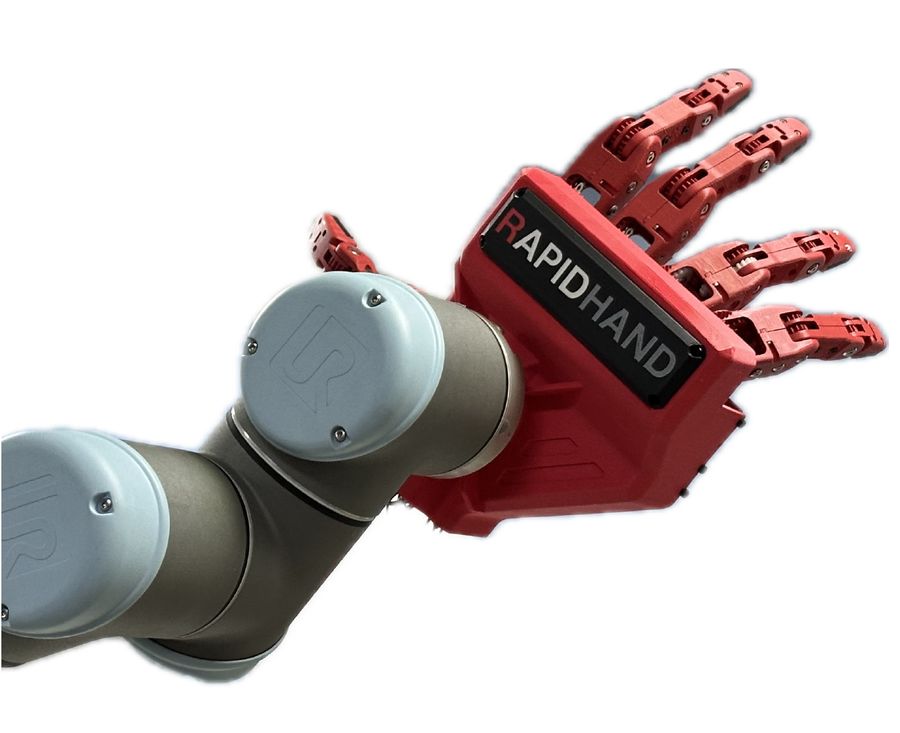
RAPID Hand2020palm, through gearsno1,500 dpaper
ETH / Inkbit printed hand22forearm, air musclesyes1.95paper
USTC shape-memory hand1919forearm, 38 springsyes370paper
Ours, in simulation only
Six-servo hand166forearmyesour sim
22-joint hand2222forearmyesour sim

An empty cell means the number is not published. It never means zero. a Includes the forearm that holds the motors. b One US reseller’s listing press; the Dex5-1 price is without touch sensing. c ¥18,000, given as about $2,641 press. d A parts bill, not a price. The human count of about 21 moving finger joints is our inference from how one maker, Shadow, models the hand.

NextOne string can close a finger, in the order the finger chooses

Idea 02 / 6

One string can close a finger, in the order the finger chooses

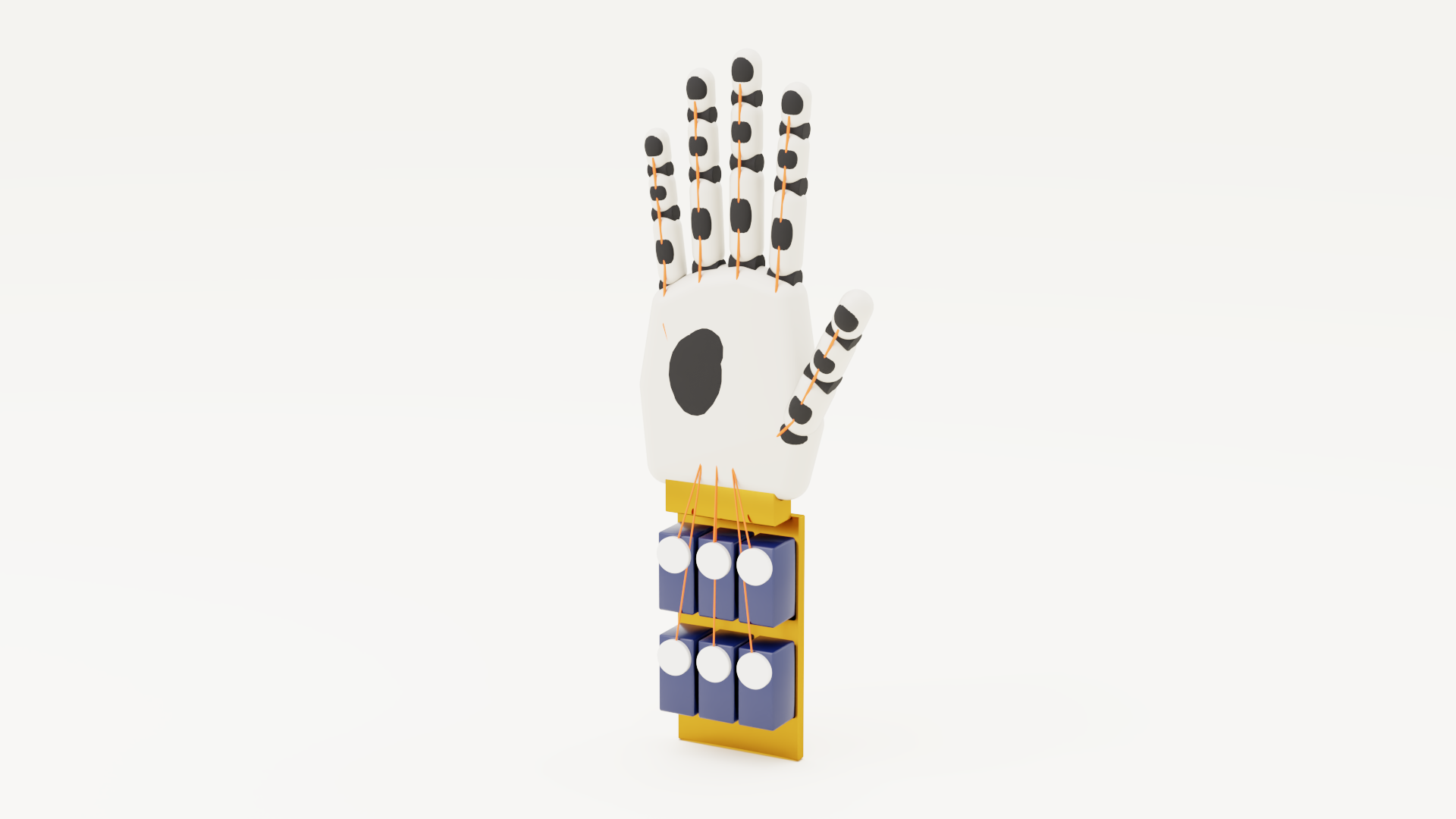
Render of our design

One cord can close a whole finger. In our simulations its shape and springs set the order, not the motor. simulationfive studies; no real finger

One tendon, three joints, one motor. The metal is a rendering choice: our design is a printed part, and nothing was built.

Base joint closes first

Part held. The finger wraps round it.

Fingertip closes first

Part falls. The finger makes a fist beside it.

simulation · a flat sketch · the same full pull in both

NextEvery bend takes a share of the pull

Idea 03 / 6

Every bend takes a share of the pull

Render of a simulation

Routing stopped the tendons tugging each other in our model. Friction stayed. simulationfriction assumed, not measured

Our simulated knuckle, curled 90°. Shown in metal for the render; our design is a printed part, and nothing was built.

Idea 04 / 6

The motors go in the forearm or in the hand, and nobody has shown which is better

Render of a simulation

Figure, a US humanoid maker, built the tendon kind and dropped it. 1X, another, ships it. makers’ claims [2]

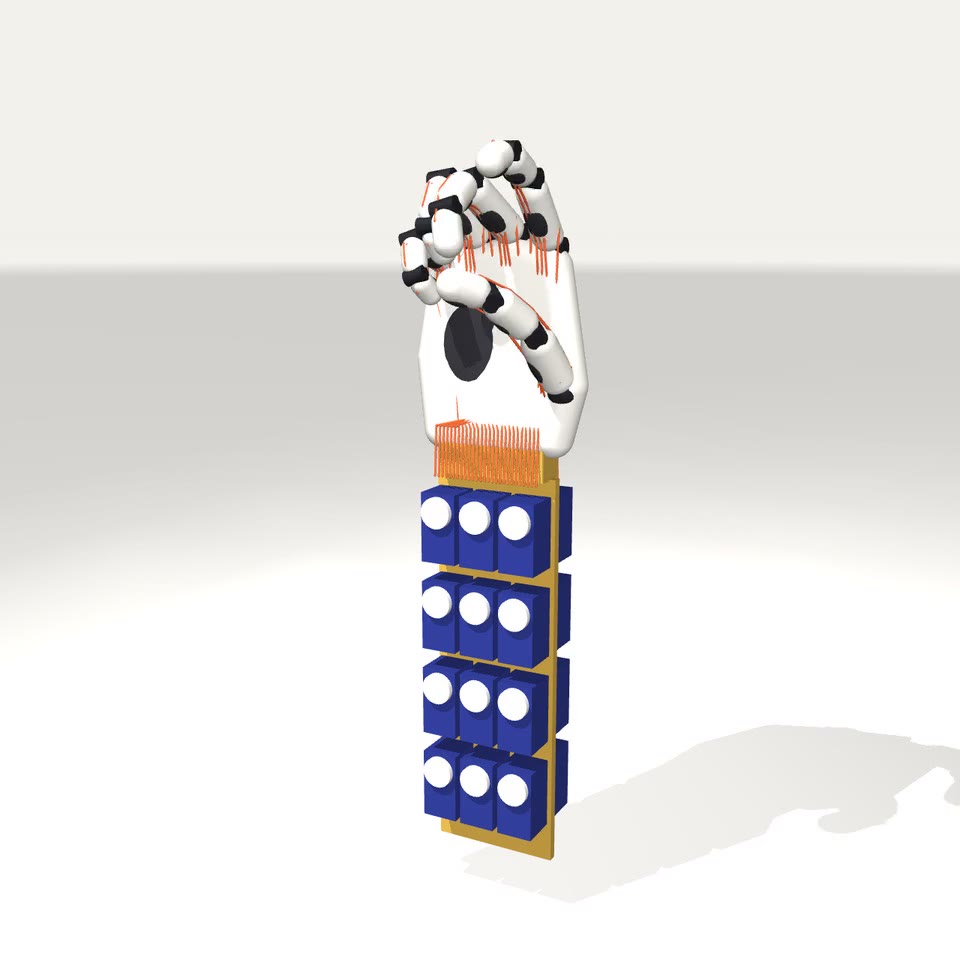
One of our simulated hands: every tendon runs to a motor in the forearm.

Teardown · Unitree Dex5-S

How Unitree’s hand works

Our reconstruction

Every one of its 22 joints has its own small motor and its own set of gears inside the hand, so nothing is pulled by strings.

Our reconstruction from published specs, not the maker’s design.

How it works, in five steps

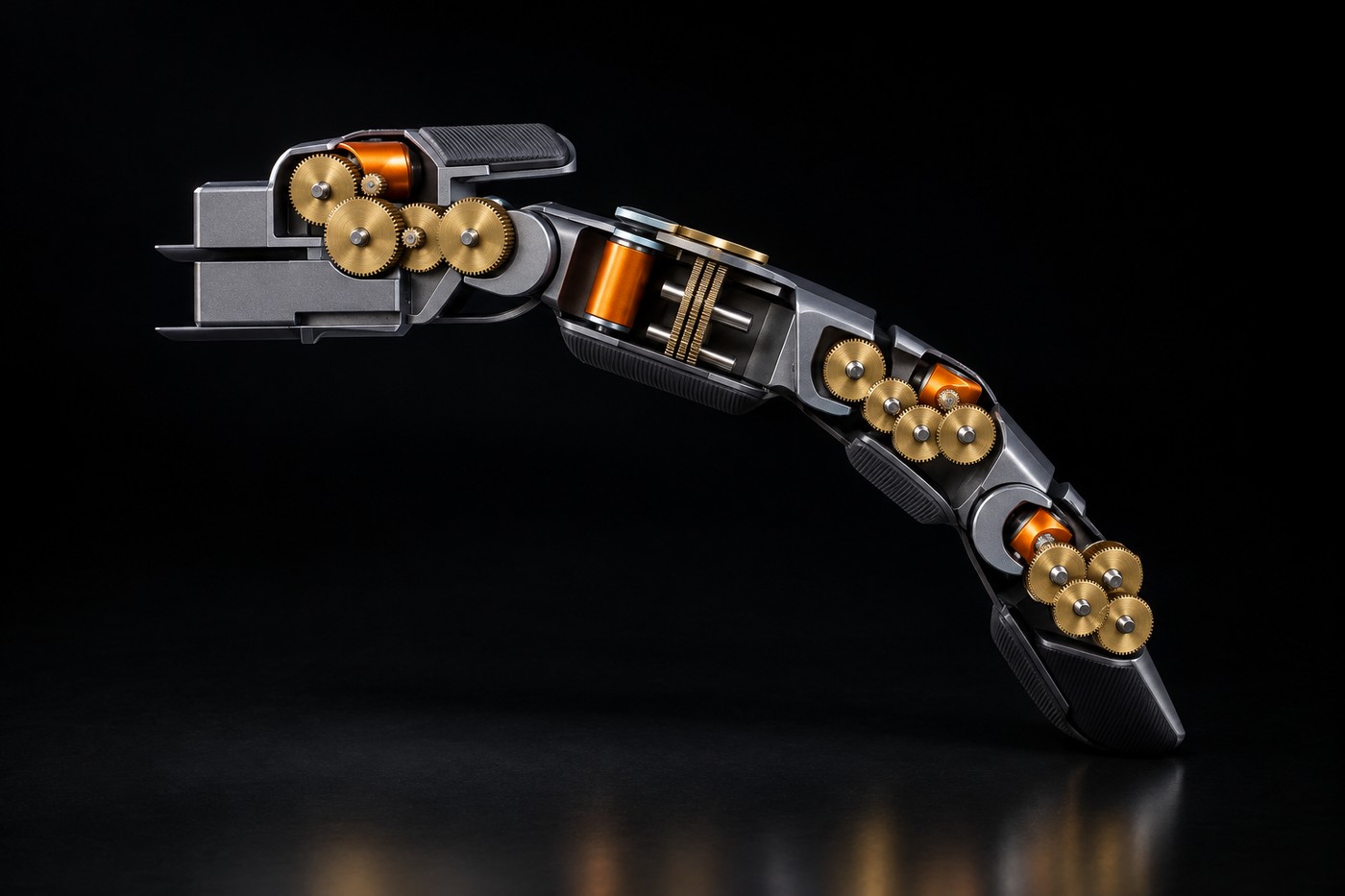
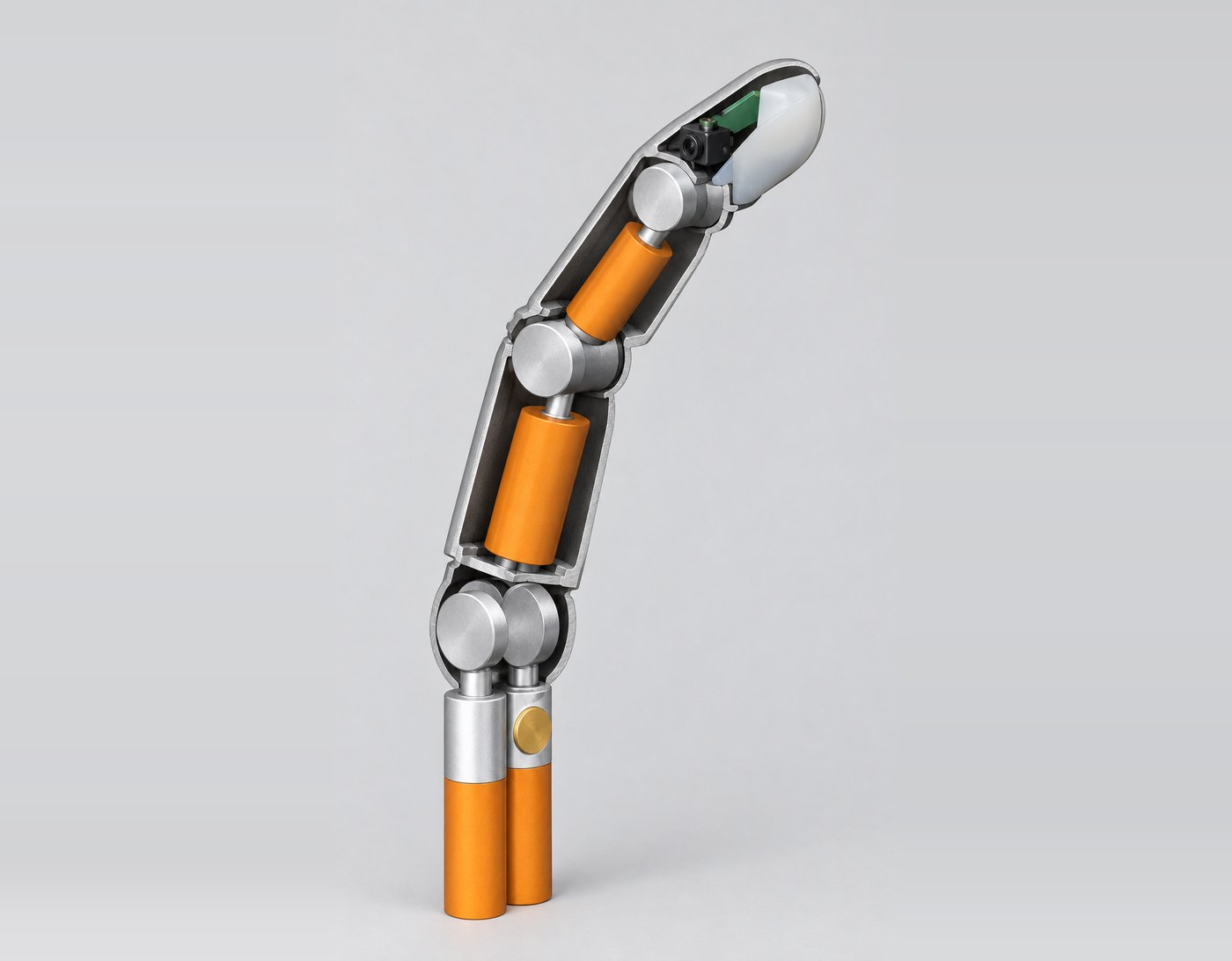
One robot finger lying on its side with the near half of its housing cut away. At each of its four joints sits a small orange motor and a stack of small toothed wheels.

One finger with the near half of its housing cut away: four joints, each with its own motor and gear stack. Guessed: the size and place of each motor, the number and size of the gear wheels, the brass colour of the gears, the cut itself. Published or seen: four joints in this finger, one motor and one gear set at each, the outer shape. AI generated, for reference. Not a photograph; our reconstruction, not the maker's design.

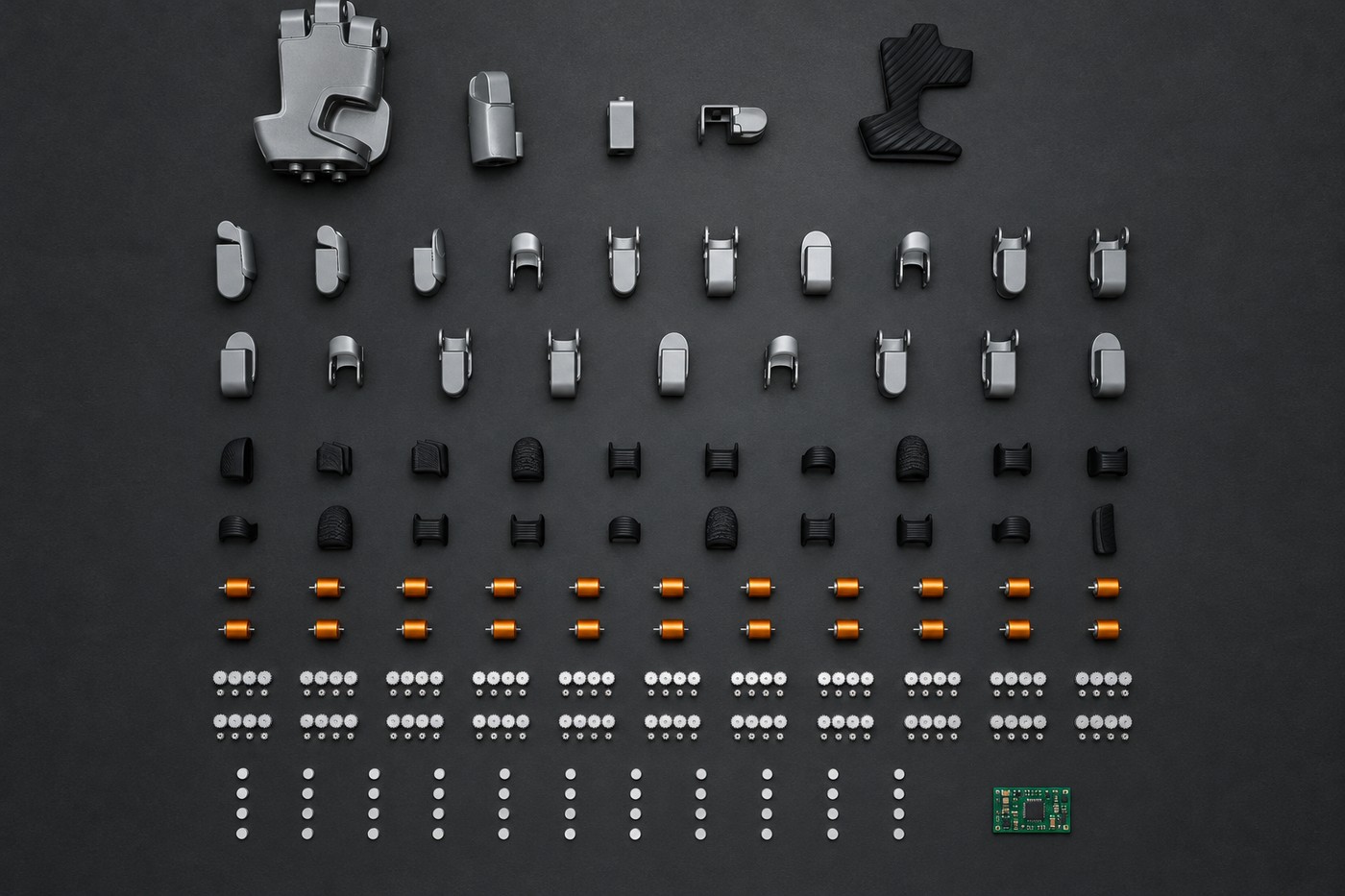
All the parts of one robot hand in neat rows on a dark bench, seen from above: grey frame pieces, black rubber pads, two rows of orange motors, two rows of gear sets, four rows of small sensor discs and one green circuit board.

The counts follow our parts list: 23 frame pieces, 21 silicone skins, 22 motors, 22 gear sets, 44 angle sensors, one board. Guessed: what each motor, gear and sensor looks like, four large and four small wheels in a gear set, and the single board. AI generated, for reference. Not a photograph; our reconstruction, not the maker's design.

The parts, in the order they go together

  1. Silicone skins × 21

    Soft ribbed pads on the palm and on the inside of every finger segment; they are what touches the object.

    published
  2. Frame × 23

    The aluminium skeleton: one palm and 22 moving pieces joined by 22 hinges.

    published
  3. Gear sets × 22

    A set of small toothed wheels at every joint that trades the motor's speed for strength.

    seen
  4. Motors × 22

    One small electric motor for each joint, sitting in the hand itself.

    published
  5. Angle sensors × 44

    Two small discs a joint that report its angle, one on the motor and one on the joint.

    published
  6. Circuit board × 1

    The electronics that take power and commands at the wrist and run the 22 motors.

    guessed

published the maker or a paper says soseen visible in the maker’s own pictures or filmsguessed our inference; not confirmed

Where the money goes our estimate

Parts, our estimate$900 to $3,100

List pricefrom $6,350maker

  1. Motors (22)$220 to $700guessed
  2. Gears (22 sets)$176 to $660guessed
  3. Electronics and encoders$172 to $452guessed
  4. Structure$150 to $450guessed
  5. Assembly and test$180 to $850guessed
  6. Margin and unknown$3,250 to $5,450guessed

Every figure is our estimate, built from public prices of comparable parts, not from the maker's books. Cross-check: the maker's stock-exchange filing reports a gross margin of 48.76 % to 60.43 % on its parts business; at that margin this hand would cost $2,510 to $3,250 to build, the top of our range. Hands are not broken out in the filing.

Read the detailthe sources behind this reconstruction

Teardown · Sharpa Wave W01

How Sharpa’s hand works

Our reconstruction

This hand has no cords: each of its 22 joints is turned by its own small motor and gears inside the hand, and each fingertip feels by filming its own soft pad from the inside.

Our reconstruction from published specs, not the maker’s design.

How it works, in five steps

Cut-away picture of one robot finger: orange motor cans in the palm and in two finger links, silver gearboxes on the joints, a small camera and a white pad in the fingertip

One finger with its shell cut away: two motors under the knuckle, one motor in each finger link with a gearbox on the joint, and the camera behind the soft fingertip pad. The placement of the drives is our guess. AI generated, for reference. Not a photograph; our reconstruction, not the maker's design.

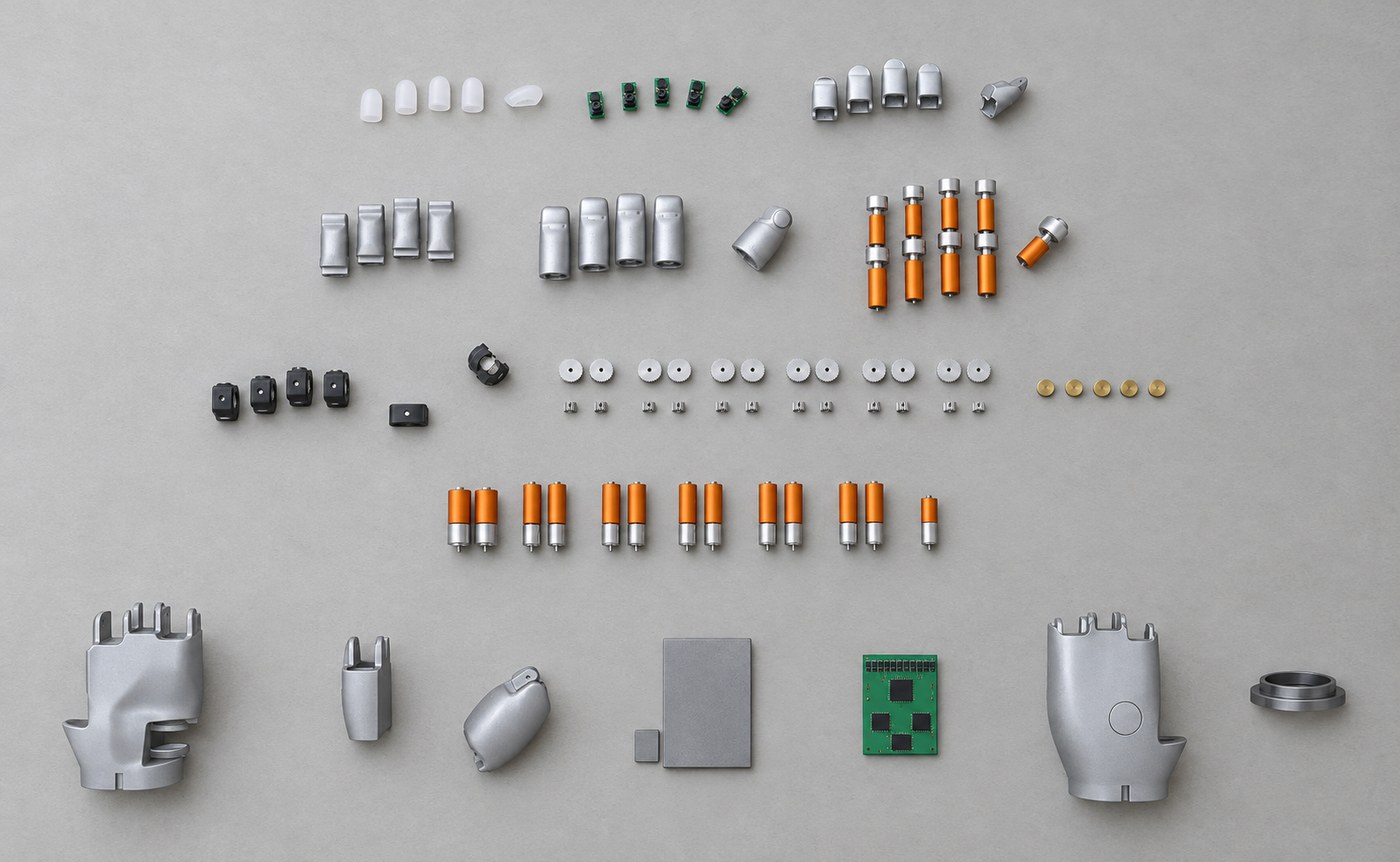
Top view of robot hand parts in five rows on a grey bench: white pads, small cameras, grey shells, orange motors, silver gears, brass discs, a green circuit board and two palm covers

Every part of our reconstruction laid out on a bench: 5 fingertip pads, 5 cameras, 14 finger shells, 9 finger drives, 6 knuckle blocks with 12 gears and 12 pinions, 5 torque sensors, 13 knuckle drives, then the palm covers, two base shells, the chassis, the main board and the wrist ring. The placement of the drives is our guess. AI generated, for reference. Not a photograph; our reconstruction, not the maker's design.

The parts, in the order they go together

  1. Tactile skin × 5

    A soft pad on each fingertip that dents where it touches something.

  2. Fingertip camera and board × 5

    A tiny camera inside the fingertip films the pad from behind, so a dent becomes a picture.

  3. Fingertip shell × 5

    The hard last link of each finger; it carries the sensor.

  4. Middle shell × 4

    The middle link of each of the four fingers.

  5. Proximal shell × 5

    The first link of each finger and of the thumb.

  6. Finger joint module × 9

    A motor lying along the link, a pair of angled gears, and a small gearbox sitting on the joint itself. One bends each middle joint and each end joint.

  7. Knuckle cross and its four angled gears × 6

    A small cross at the root of a finger lets it bend forward and swing sideways about one point; four gears round it mix two motors into those two moves.

  8. Palm cover, palm side × 1

    The front shell of the palm.

  9. Thumb base and little-finger base shells × 2

    Two moving blocks of the palm: the ball of the thumb and the edge under the little finger.

  10. Knuckle module × 12

    Two motors side by side under each two-way joint. Both turning the same way bend the finger; turning against each other swing it sideways.

  11. Little-finger root module × 1

    One small motor folds the edge of the palm so the little finger can meet the thumb.

  12. Joint torque sensor × 5

    A strain gauge at the root of each finger measures how hard the finger pushes.

  13. Chassis plate × 1

    A metal plate that the palm's motors bolt to.

    guessed
  14. Main board × 1

    The electronics: one drive circuit for each of the 22 motors, a processor that also reads the touch pictures, and the network link.

  15. Palm cover, back × 1

    The back shell of the hand.

  16. Wrist flange × 1

    The ring that bolts the hand to a robot arm and carries power and network.

published the maker or a paper says soseen visible in the maker’s own pictures or filmsguessed our inference; not confirmed

Where the money goes our estimate

Parts, our estimate$1,595 to $6,770

List pricenot published

  1. Motors$330 to $1,760
  2. Gears$440 to $1,540
  3. Drive electronics$200 to $670
  4. Tactile sensors and cameras$200 to $600
  5. Joint torque sensors$75 to $500
  6. Structure$300 to $1,200
  7. Assembly, calibration and test$50 to $500

Our estimate of what the parts and the assembly of one hand cost the maker. It is not a price. The maker publishes no price; the press reports about USD 50,000 for a W01, which the maker calls a custom quote, not a list price. The difference is not profit: it pays for engineers, software, test rigs, scrapped gears, warranty and a production run of unknown size.

Side by side

Unitree Dex5-SSharpa Wave W01Ours, a simulation
Joints22 (thumb 5, index 4, middle 4, ring 4, little 5)2222
Driven joints22: every joint has its own motor22, each with its own motor22
Where the motors sitInside the hand, at the joints (maker). Which segment holds which motor is our guess.all inside the hand: in the palm and inside the finger links (the maker says "inside the hand"; the exact seats come from a patent and our guess)forearm
TendonsNonenoneyes, 44
Fingertip forceNot published. The maker gives a whole-hand load: 1 kg continuous, 2 kg peak.20 N—
Mass620 g1.3 kg—
List pricefrom $6,350not publishednot a product: a simulation

A dash means not published. Ours is the 22-joint model from this article, which exists only in a simulator.

Read the detailthe sources behind this reconstruction

Idea 05 / 6

Parts grow in step with the joints. Postures explode.

Render of a simulation

What it costs to build a hand as joints are added, nobody has published. our inferenceour audit

Our simulated 22-joint hand with its bones made clear: 44 tendons.

Idea 06 / 6

Motors are the biggest line on every parts bill that shows the split

From 52.6 % to 81 % of the bill, wherever the bill splits it out. papers [2]

52.6–81 %of a published parts bill is motors, wherever the bill splits it out papers [2] [3]and one maker’s parts page

Idea 06 / 6, continued

“Millions of cycles” describes parts, not whole hands

Render of a simulation

The longest test of a whole hand to a real failure that we found: 494,000 cycles. paper

What you can measure this weekend

Start here

  • Friction of a string in a printed channel. A 3D printer, a string, a weight and a force gauge. Vary the plastic, the liner and the bend radius. It is the cheapest of the five. chapter 7

And with more than a weekend

  • Life of one whole hand under load. A hand, a load, a counter and patience. Report the cycles to failure and what failed. chapter 10
  • Build hours against joint count. One family of hands at three sizes, timed with a stated method. chapter 6

Where we could be wrong

  • Everything of ours is a simulation, with stiffness and friction that we assumed. One research group had to retune a tendon hand by 20 to 30 % when it moved from simulation to the real thing. paper
  • Most of our results are one run.
  • “Nobody has published” means we did not find it. A company may have measured what it does not print.

Stormy is a small team building robot workcells. If you have measured any of these, we would like to read it: stormy.ai.

The film

Watch it in seven minutes

  • From zero to how a robot hand works, with the numbers we trust.
Things people say about robot hands, and what we foundtwelve common claims, each with what decided it and its sources
No.The claimWhat we foundHow strong the evidence is
01The hand is just the last 10 percent of the robot.Two hands with wrists carry 50 degrees of freedom on two makers’ own figures.Busted. two makers’ own figures; the sum is ours
02Six motors are enough for a hand.Enough to hold a 150 g bar; 0 of 6 pinches.Plausible. our simulation: one grasp, one run, a weak thumb model
03More force gives a better grip.More pull never changed the closing order. No real finger tested.Plausible. our simulation, five studies; no real finger tested
04Artificial muscles can replace motors today.The strongest fingertip of twelve families: 6.5 N, then 13 s to let go.Busted. a paper; the comparison with a motor is our inference
05Tendons are the wrong engineering choice.Figure left them, 1X ships them, and no matched test is public.Plausible. the makers’ own words; the matched test is missing
06It gets exponentially harder with every joint.No build hours at three joint counts exist; our counts grew 5.9 times.Plausible. our audit of the sources; counts from our simulation
07Cross-talk is what kills a many-tendon hand.Geometry took 18.87 mm to 0.38 mm; friction still took up to 59 %.Plausible. our simulation; the friction value of 0.3 is assumed
08Hands are expensive because they are hard to assemble.Motors are 52.6 % to 81 % of every parts bill that gives the split.Busted. papers and makers’ parts pages; no commercial maker publishes its bill
09Motor prices are not coming down.Gearboxes fell 37.4 % in two years; one small servo rose 15.1 %.Plausible. one maker’s prospectus and one shop’s listing; our audit
10These hands last millions of cycles.Claimed for parts and wrists; the longest run to failure is 494,000.Plausible. a maker’s statement and one paper
11You can print a hand already assembled.Bones and tendons, yes; muscles, air and motors are still added after.Plausible. papers; the reading is ours
12This is a solved problem for big companies; small teams have nothing to add.A public reversal, and no loaded whole-hand life test from nine companies.Busted. the maker’s own statement; our audit of nine companies
Busted. “The hand is just the last 10 percent of the robot.”the builders’ own words, the count, the 100 screws
Busted. “Artificial muscles can replace motors today.”all twelve kinds with one number each, table 2, two motors for comparison
Plausible. “Motor prices are not coming down.”table 8, a slider for the yearly change, whole-hand prices, China’s volumes
Plausible. “You can print a hand already assembled.”the printed-hand papers, the patents a printed hand would meet, what printing leaves alone
Busted. “This is a solved problem for big companies; small teams have nothing to add.”what is public, who publishes measured work, where we would start
Our own modelsWhat we built: three hands that exist only in a simulatoreach model in numbers, more renders, every limit

Four busted, eight plausible, none confirmed. Most are “plausible” because most of the evidence is a simulation, one run or a maker’s word. That count is the honest summary of the field as we found it: many confident claims and few published measurements.

Sources

Read the detailevery source, grouped by the chapter that uses it

Grouped by the chapter that uses them. We opened the pages in November 2026. Where a link is missing, our notes hold none. Statements marked “measured by us in simulation” and “our inference” rest on our own models and arithmetic and have no outside source.

Before chapter 1

1 · The hands are not the last tenth of a robot

2 · A hand is hinges, and every hinge needs something to turn it

3 · One string can close a finger, in the order the finger chooses

4 · None of twelve artificial muscles matches a small motor yet

5 · The motors go in the forearm or in the hand, and nobody has shown which is better

6 · Parts grow in step with the joints. Postures explode.

7 · Every bend takes a share of the pull

8 · Motors are the biggest line on every parts bill that shows the split

9 · Gearbox prices fell at one maker. Small motors have no price record.

10 · “Millions of cycles” describes parts, not whole hands

11 · A printer can make the bones and tendons, not yet the muscles

12 · Our three hands exist only inside a simulator

13 · Five plain measurements are still missing

Back toThe top

Building robot hands, or want to talk about this? Write to us at founders@stormy.ai.