How I VIBE CODED a custom DAW in a few months with Tracktion EngiNe
I’ve been an audio programming hobbyist for a long time.
Like a lot of people in this space, I’ve built a graveyard of half-finished VSTs, strange Max/MSP experiments, and tools that technically worked but never quite escaped my own hard drive. Vaporware in the most affectionate sense. Each project taught me something, but they all shared the same invisible ceiling.
This time is different.
This time I’m not building a plugin.
I’m building the whole thing.
The old reality: you don’t build a DAW
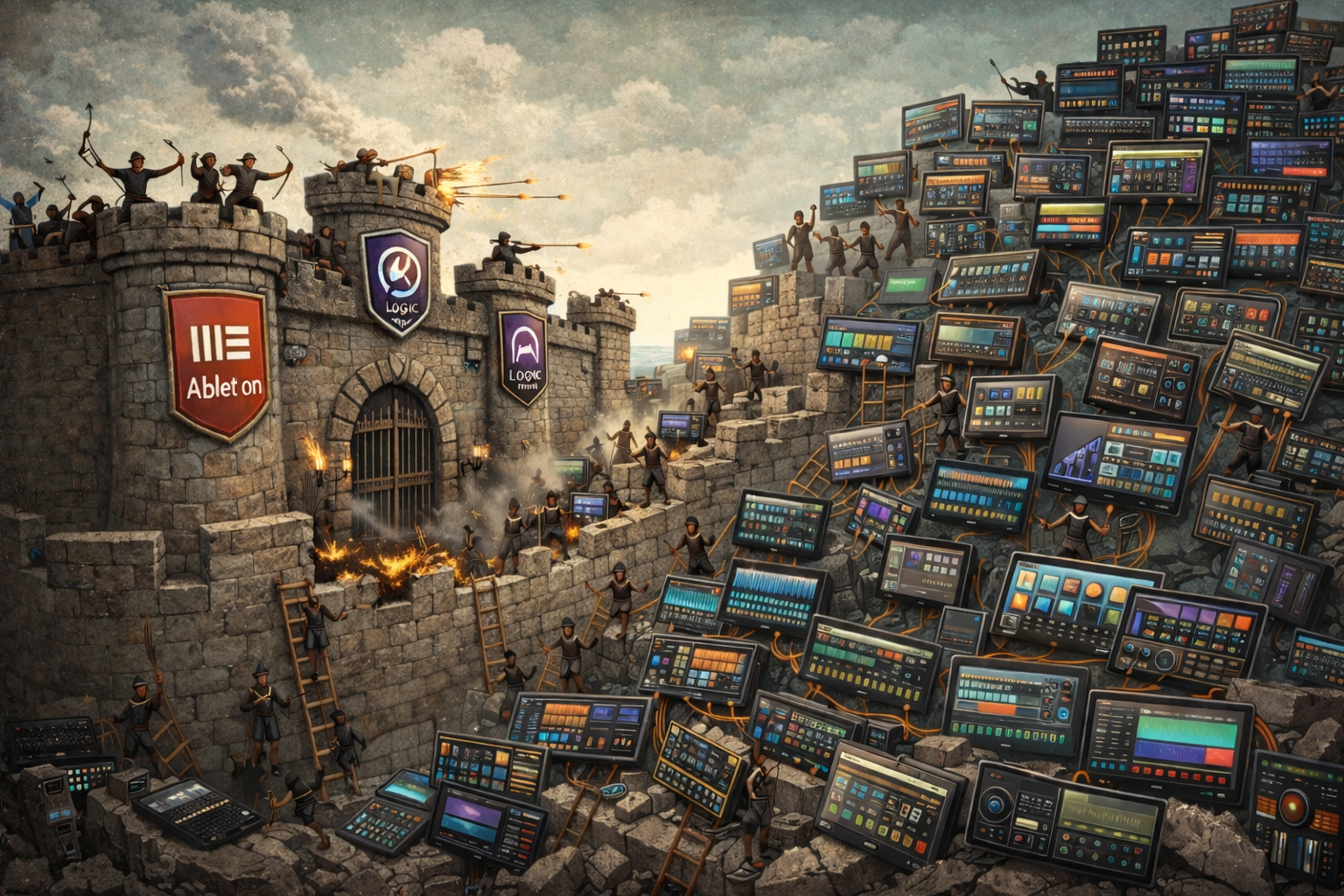
For most of modern music software history, a single developer could not realistically build a full DAW stack.
If you haven’t tried, it’s hard to appreciate the scale. DAWs represent decades of accumulated work. Audio engines, plugin hosting, routing graphs, editing models, realtime safety, file formats, UI frameworks, cross-platform abstractions. Entire companies have spent their existence refining these systems.
So if you had an idea for a new workflow, you lived inside someone else’s platform.
You used the SDK.
You respected the API boundaries.
You accepted the rules.
And if you were interested in generative or orchestration-level tools, you constantly felt the walls closing in. Because the interesting problems are not just signal processing. The interesting problems are:
How clips relate to each other
How arrangements evolve
How performance flows
How systems make decisions
That lives above the plugin layer.
You could feel the deeper access you wanted, but you couldn’t reach it.
2026: vibe coding changes the scope
We’re now in a moment where the cost of building large systems has collapsed.
Call it vibe coding, AI assisted development, or just better tools. The label doesn’t matter. The outcome does.
The comfortable moat of complexity around DAWs is disappearing.
Not because DAWs are getting worse. The major DAWs are not going anywhere. They are incredible pieces of software and they will continue to dominate traditional production.
What is changing is who gets to build.
Why limit yourself to a small SDK when you can build the platform that the SDK would have lived inside?
What used to take a funded team and multiple years can now be done by a single focused developer in a few months of evenings.
I am not saying it is trivial. I am saying it is now possible.
Tracktion Engine is the unlock
This is where Tracktion Engine enters the
🔗 https://www.tracktion.com/develop
Tracktion Engine is a fully featured, open source C++ audio engine that already powers a commercial DAW. It gives you:
Multitrack audio and MIDI
Plugin hosting
Realtime safe processing
Editing model and transport
Routing and rendering
Cross-platform foundation
In other words, the part that used to be impossible.
You are not starting from a blank screen. You are standing on a production-grade engine that has shipped to real users.
Tracktion Engine is not new. But the context around it has changed completely.
In the era of vibe coding, it becomes explosive.
Because now a single developer with a strong idea can build a full, opinionated music environment instead of a plugin that politely asks the host for permission.
Signals & Sorcery: proof that this is real
I built Signals & Sorcery in a few months after work.
🔗 https://signalsandsorcery.com
It is a generative DAW focused on rapid prototyping and performance workflows.
It supports:
Multitrack audio
Plugin hosting
Loop based composition
Generative systems
Custom performance flow
A few years ago this would have been unthinkable as a solo side project.
Now it exists.
Not as a toy, but as a real environment with its own philosophy about how music should be created and performed.
And the most important part is not the feature list.
It is the freedom.
I am no longer asking “how do I fit this idea into someone else’s DAW?”
I am asking “what is the best possible workflow for this musical concept?”
That is a completely different creative headspace.
The coming wave of custom workflows
I do not believe we are heading toward a world where everyone abandons Ableton, Logic, or Pro Tools.
I believe we are heading toward a world where:
Artists have personal DAWs
Performers use systems designed for their exact stage setup
Generative musicians build orchestration-first environments
Developers ship niche production tools as full platforms
A flood of custom audio production workflows.
Not replacements for the incumbents. Extensions of the ecosystem.
If I were building products for a major DAW today, I would take this very seriously and invest in supporting real builders. Not gated, expensive add-ons. Real access. Real extensibility.
Because the creative energy is moving toward platform ownership.
Why this is fun again
Building your own DAW sounds like an engineering flex.
It is not.
It is pure joy.
You get to:
Design a workflow that matches your brain
Remove features you never use
Invent performance models
Let generative systems live at the core instead of the edge
It feels closer to building an instrument than building software.
And for the first time, it is accessible.
The takeaway
Tracktion Engine gives us the foundation.
Modern AI assisted development gives us the speed.
Projects like Signals & Sorcery show it is real.
We are entering an era where music tools are not just chosen.
They are built.
And there is nothing more fun than making the instrument that you have always wanted to play.