I spent most of 2024 in Davos, isolating gut bacteria in an anaerobic lab set up in the basement of the Swiss Institute for Allergy and Asthma Research. I mostly stayed in my lane and in my lab—having enough work to keep six people busy—but through journal clubs and my colleagues’ progress reports, I managed to pick up a little knowledge of immunology…emphasis on the “little”.
Immunology is dizzyingly complicated; I don’t think I can even tell you how many different kinds of interleukin there are, let alone what they do. But one of my colleagues, Duygu, was researching peanut allergy, and she gave a talk where she cited a statistic that absolutely floored me.
Before 1980, she said, there were a total of zero known fatalities from peanut allergy.1
Now, it's common knowledge that the incidence of peanut allergy is on the rise, but zero?
What happened? What changed?
The epidemiology of peanut allergy is interesting to begin with. It's not much of a problem in most of the world. Only in America—where roughly 1% of children are thought to be affected, and maybe a dozen people die annually from it—are schoolchildren forbidden from bringing a PB&J to lunch, for fear of endangering a classmate’s life.
So what makes the USA different? In a nation of immigrants, it’s unlikely to be genetics. It’s not just exposure, either…peanuts are native to the Americas,2 but they’re enjoyed around the world—albeit not often in such quantities as here. US public health guidelines nowadays recommend waiting until children are a little older, to introduce peanuts as a food, and some people have theorized that this is somehow responsible: Early life is a time when your immune system is dynamic, plastic, learning. If you don’t introduce a food early enough, the thinking goes, you start to miss your chance to teach the body “This is food, not a pathogen”.
There’s a certain appeal to that theory, and perhaps the delayed exposure isn’t helping—but those guidelines were a response to the growing peanut allergy epidemic, so there’s got to be more to the story than that.
Aside from the incidence of allergy, though, there’s one other unique aspect of Americans’ relationship with peanuts.
One glaringly obvious thing that sets us apart.
Peanut butter.

It was obvious to everyone else at the Swiss Institute, anyway.
I, the lone American in the crowd, was surprised to learn that peanut butter is not a universal phenomenon: a fish who has made it all the way to 32 years of age without ever once being told he’s wet. It might be different these days, but growing up in the ‘90s, peanut butter was like one of the four fundamental elements of childhood—and nowhere else is it considered as much of a staple food as here.
And this was the thrust of my colleague’s research: why would peanut butter be more likely than whole peanuts to lead to peanut allergy? Her hypothesis (well, really the institute director’s hypothesis, which Duygu was assigned to investigate) was that the blame lay with emulsifiers: processing aids like soy lecithin or polysorbate 80, which help keep the final product from separating into an oily top-layer and sludge on the bottom. In cell-culture based tests, a lot of emulsifiers are toxic at moderate concentrations, and there’s been speculation that they might cause “leaky gut”: disrupting the epithelial barrier of the intestine and allowing proteins—both bacterial and dietary—to slip into circulation and trigger the immune system’s invader alert.
But the data doesn't really bear this out, or at least not the data Duygu was presenting that day. Turns out exposing intestinal cells in a petri dish to the kind of emulsifiers you find in peanut butter doesn't do them much harm.
I was barely listening by the time she got around to her “Results” slide, though—I had found something more interesting.
Regular readers will know that I’m skeptical of some modern industrial agricultural practices, e.g. killing plants with chemical herbicides and then eating them. So naturally, my first instinct was to wonder: did they approve a weird new pesticide for use on peanuts in 1980? Maybe eating peanuts laced with some chemical toxin could train the body into thinking they're bad business.
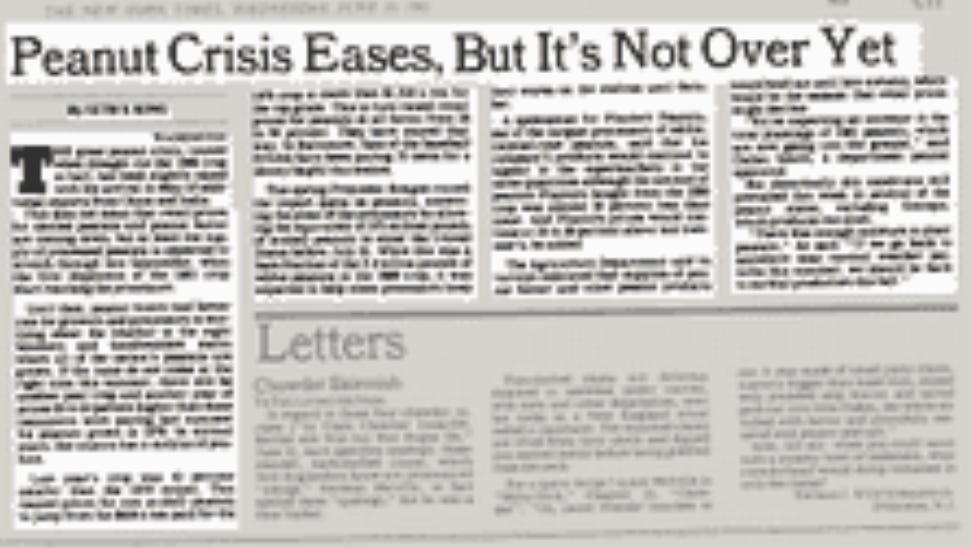
I did a quick search along those lines—something like peanut agricultural approval 1980. I didn't find anything like what I was expecting. Instead, I got a slew of hits in the form of old newspaper articles, all reporting on something called the “Great Peanut Crisis of 1980”.
Sounds like a lead. Was it a crisis because that was the year people started dying from eating peanuts?
Nope! Turns out the peanut crisis was mostly an economic one: the result of a drought that hit the Southern US that summer, killing about half the crop and causing prices to triple. To make matters worse, the dead and dying plants became a breeding ground for an agricultural pathogen—a fungus called Aspergillus flavus—so something like 15% of the surviving ones ended up too moldy to eat.
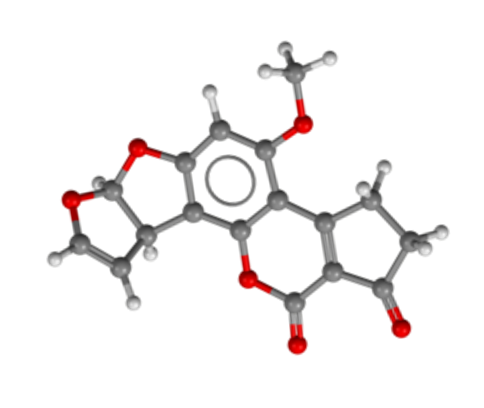
And suddenly everything started to click into place, because Aspergillus flavus is known for producing one of the absolute gnarliest chemicals in existence: aflatoxin.
I first learned about aflatoxin back in undergrad, in a Radiation Biophysics class. The professor used it as an example: some certain dose of x-rays (maybe a standard dental x-ray, I don’t remember) would increase your risk of cancer by about the same amount as eating a jar of peanut butter. The vast majority of jars are fine, of course, but every now and then a moldy batch of peanuts sneaks through the quality control process. If you get one that had a few aflatoxin-tainted peanuts in it, that’s often enough to give a person liver cancer.
And if that seems as weird to you as it did to me then, consider: the x-rays don’t want to hurt you. They’re just very high-energy, and as they stream through your body they’re bound to knock a few bits loose from your DNA. And while there’s a chance this indifferent damage can break one of the genes that tells a cell when to stop growing—causing it to become cancerous—you have to be pretty unlucky.
Aflatoxin, by comparison, is malice incarnate. It distinctly wishes you ill. Its creator, Aspergillus flavus, does not want to be digested. Nor does it have any interest in joining the human gut microbiome. It would rather do anything besides help you ferment rice like its cousin Aspergillus oryzae. It wants to be left alone with its peanuts, thank you very much. And so it produces one of the most carcinogenic substances on Earth. A chemical weapon honed by a million years of evolution into a shape that can effortlessly pop bases out of your DNA, causing your liver cells to go haywire in any number of horrific ways.
We typically think of cancer initiation as something that happens quietly, without our noticing (Will this be the cigarette that does it? There’s no way to know…) but aflatoxin is potent enough to often make the victim acutely ill—usually with a kind of hepatitis—as random gene mutations cause some cells to grow distended and misshapen, while others simply die en masse. Aflatoxin wants you to feel the hurt, because its whole purpose, its raison d’etre, the thing that gets it out of bed in the morning, is to make sure that—if you ever see a moldy peanut and think “eh, probably fine to eat?”—you never make that mistake again.
So it would not surprise me if aflatoxin were capable of causing the immune system to do some buck-wild things, e.g. developing such a strong response against a harmless food protein that—the next time you’re exposed to even a crumb of that food—you literally die of anaphylactic shock. And while I don’t know much about immunology, this model jibes with my understanding of how things like attenuated vaccines work: you inject somebody with a bit of pathogen which, on its own, wouldn’t trigger much of an immune response, because the thing is practically Dead on Arrival. So you throw in an adjuvant, a chemical that induces a local inflammatory response—usually some kind of aluminum salt, these days. Immune cells pick up the distress signal, the metaphorical cops arrive to the scene and find a bunch of broken windows and this one unconscious ruffian, they come to the obvious conclusion, and load him into the back of the wagon hollering about how he’s been set up.
Here, I guess, the role of “pathogen” is played by some peanut protein sturdy enough to survive the stomach intact,3 the “adjuvant” is the aflatoxin, and instead of a few “broken windows”, the crime scene is so spectacularly gory that, next time there’s a confirmed sighting of the suspect, the president doesn’t hesitate to call down the nukes on his own soil.
To my mind, this is consistent with the narrative that’s been taking shape over the past few years, in the form of books like Blind Spots by Marty Makary. The argument—backed up by some pretty solid interventional trials—is that we’ve been making the problem worse by giving in to fear: that deliberate, early, and extensive exposure can prevent a lot of peanut allergy. And yeah, the body is pretty good at discerning friendly from unfriendly molecular signatures as long as it has enough training data; that’s how your immune system knows not to attack your own cells. So you’d expect the problem to be worst in people who had little or no exposure to peanuts before getting a tainted batch of butter, and whose parents then decided to play it safe and switch to almonds.
Could it be that simple? That obvious—that the first few hits when you google “peanut agriculture 1980” contain all the information we need to make sense of this societal-scale medical mystery? Anyone who says “no” has lost sight of the uniqueness of the present moment in time, where all the world’s knowledge is suddenly at our fingertips.
I asked about it at that lab meeting. Was anyone looking into this? The institute director waved it away; “Aflatoxin is a problem of heat and humidity and poor food storage. In the developed world, exposure has probably been trending downward for all of human history.”
I put my hand down. It sounded sensible enough, and I had learned not to argue with Cezmi.
Two seconds later, I was kicking myself silently: Wait, no, it’s the peanut butter! That’s your whole shtick, isn’t it? A uniquely American problem, because everywhere else on Earth, if you crack open a peanut shell and see mold, you don’t fucking eat it!
And this is what makes it a compelling fit with the epidemiology, to me—with the fact that peanuts never killed anyone before 1980, and still rarely do except in the USA.4 I mean, put yourself in the shoes of a farmer living through that crisis year. Half your usual crop never materialized, and half of what’s left is somewhere between “spotty” and “lousy” with Aspergillus. Imagine you were in a tough spot financially, even before the drought. And imagine that you’re genuinely ignorant about how bad aflatoxin can be for the people exposed to it.
Might you not try and find a way to recoup a little, in this disaster of a year? Unload the more passable fraction of the spoiled ones, whether or not they’d technically pass muster with a USDA inspector (who almost certainly has his hands full this year anyway)? They’re paying triple what they usually do.
And what better way to take a half-bad batch and make it saleable than by turning it into a homogeneous, undifferentiated mass? What better way to cover your tracks than…peanut butter?
It seems right, in a way, that a societal ill as weird and capriciously deadly as peanut allergy should be a consequence of an equally weird sin. “Bundling toxic assets”; refusing to eat the loss when fate deals you an unlucky hand. Imagining that, if you spread it around, maybe you can thin it out enough that it doesn’t do anyone real harm.
But of course it doesn’t work like that. Maybe it would, if you just had to fool the eye: a quick trip through the blender and, to someone looking at it, there’s none of the instinctive revulsion that you get from the thought of eating a green peanut. But that instinct is there for a very good reason: because one of your ancestors dealt with an Aspergillus or something very much like it—and the experience left them sweating and retching and writhing in such agony that, countless generations later, you can still feel the echo of their misery: a chill down your spine when you unwrap the tinfoil around a mysterious hunk at the back of your fridge to find colorful fuzz.
A lot of times in posts like this, I’ll finish by talking about how you’d test the hypothesis, but I’m not even sure how you would go about investigating this one. Maybe kids with peanut allergies would also have antibodies against aflatoxin in their system at a higher rate than controls. Then again, maybe not: part of what makes aluminum sulfate a good adjuvant is that, for whatever reason, the immune system has a hard time recognizing it. It wouldn’t surprise me if aflatoxin were similarly slippery, especially given that it’s tailor-made to mutate DNA and disrupt cellular functions. You might be able to test for the toxin itself in individual jars, if you catch it the first time a kid has a bad reaction to peanut butter.
But that brings us to the practical takeaway: if this hypothesis is correct, it shouldn’t be that hard to give your kid a pretty good shot at avoiding the ignominy of having “The Goobers Got’em” on their tombstone. Just start feeding them peanuts—actual whole peanuts—early. Because the core conceit here is that a lot of the problem with “processed” foods has less to do with the processing, and more that you don’t get to really see the food before you eat it, and so you end up eating things you wouldn’t otherwise: rancid oil, spoiled grains, etc.
So if you want peanut butter—at least for the first couple of years, while your kid’s immune system is still figuring things out—make it at home. Buy roasted peanuts at the store and chuck them in the blender. But have a look at them first. You probably don’t need to—ones slated to go to the consumer whole are held to much higher QC standards than ones destined for processing…but it can’t hurt to pick out any weird ones.
—🖖🏻💩
Tremendous thanks to Gautam Panakkal for encouraging me to get this one out.