By Stephen G. Barr
The Cyber Security Report
An SGB Media Group Publication
Cybersecurity has entered a new era.
For years, security professionals focused on building stronger digital walls around networks and systems. Firewalls became smarter, antivirus software evolved, and organizations invested billions in defensive technologies. Yet in 2026, the cybersecurity battlefield looks dramatically different than it did just a few years ago.
The rise of artificial intelligence, the explosion of cloud computing, the growth of machine identities, and the increasing sophistication of cybercriminal organizations have fundamentally changed the nature of digital risk. Today’s attackers are faster, more automated, and more capable than ever before. At the same time, defenders have access to unprecedented tools powered by AI and automation.
The result is an arms race unfolding at machine speed.
Organizations that fail to adapt risk financial losses, reputational damage, regulatory penalties, and operational disruption. Those that embrace modern cybersecurity principles may emerge stronger and more resilient than ever.
Here are the most important cybersecurity trends shaping 2026.
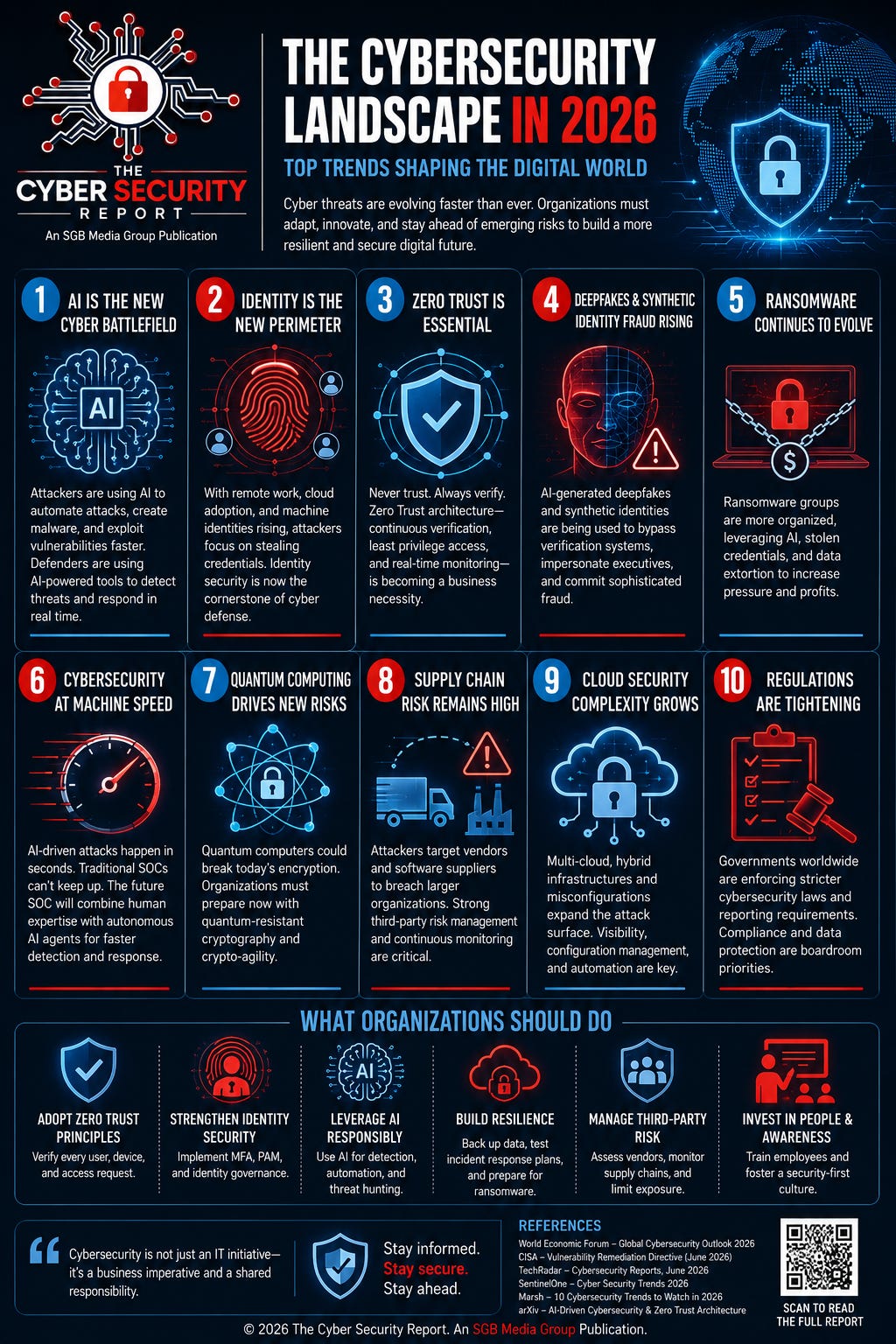
Perhaps no trend is more transformative than the emergence of AI-driven cyber warfare.
Artificial intelligence is now being used by both attackers and defenders. Cybercriminals are leveraging AI to automate reconnaissance, generate phishing emails, identify vulnerabilities, and even create malware capable of adapting to its environment. Meanwhile, security teams are deploying AI-powered systems that can analyze millions of events per second and respond to threats faster than any human analyst. (TechRadar)
What makes AI especially disruptive is speed.
Traditional cyberattacks often required weeks of planning and execution. AI-enabled attacks can unfold in minutes or even seconds. Security researchers increasingly warn that organizations are entering an era where machines attack machines while humans attempt to supervise the battle. (TechRadar)
The challenge for businesses is no longer simply detecting threats. It is responding quickly enough to stop them.
For decades, cybersecurity revolved around protecting networks. Today, cybersecurity revolves around protecting identities.
As organizations move applications and data into the cloud, the traditional network perimeter has largely disappeared. Employees work remotely, contractors access systems from around the world, and software applications communicate constantly with one another.
In this environment, identity has become the primary target.
Attackers increasingly prefer to steal credentials rather than break through firewalls. Industry reports indicate that compromised identities and credentials remain among the most common pathways into corporate systems. (Inspira Enterprise)
Adding complexity is the rise of machine identities. Automated systems, AI agents, APIs, cloud workloads, and software bots now vastly outnumber human users in many organizations. These non-human identities often possess powerful privileges and create entirely new attack surfaces. (TechRadar)
As a result, identity security is becoming the cornerstone of modern cybersecurity strategies.
The phrase “Zero Trust” has been circulating in cybersecurity circles for years. In 2026, it is becoming a business necessity.
The principle behind Zero Trust is straightforward:
Never trust. Always verify.
Rather than assuming users or devices inside a network are safe, Zero Trust requires continuous authentication and authorization. Every access request must be verified regardless of location or device. (the-cyber-guy.org)
Organizations implementing Zero Trust architectures are focusing on:
Multi-factor authentication
Least-privilege access
Continuous monitoring
Identity governance
Micro-segmentation
Real-time risk analysis
While implementation remains challenging, security leaders increasingly view Zero Trust as one of the most effective frameworks for reducing cyber risk in cloud-first environments. (SentinelOne)
One of the most alarming developments in cybersecurity is the rise of AI-generated deception.
Deepfake technology has advanced rapidly. Criminals can now create convincing voice recordings, videos, and images that closely mimic real individuals. These synthetic identities are being used to conduct fraud, impersonate executives, bypass verification systems, and manipulate employees into transferring funds or sharing sensitive information. (worknest.com)
The danger extends beyond financial fraud.
Deepfakes can be used to spread misinformation, disrupt elections, damage corporate reputations, and conduct sophisticated social engineering campaigns.
Organizations are increasingly investing in biometric verification, identity-proofing technologies, and AI-powered detection systems to combat this growing threat.
Despite years of defensive efforts, ransomware remains one of the most profitable forms of cybercrime.
What has changed is how ransomware groups operate.
Modern ransomware organizations function much like legitimate businesses. They maintain customer support systems, recruit affiliates, negotiate payments, and continuously improve their attack methods.
Many groups now operate under the Ransomware-as-a-Service (RaaS) model, allowing less-skilled criminals to launch attacks using professional-grade tools. (TechRadar)
Recent trends include:
Targeting backups before encryption
Stealing data before locking systems
Using AI to identify vulnerable targets
Leveraging stolen credentials rather than malware
Conducting insider-assisted attacks
The focus has shifted from merely encrypting files to maximizing leverage against victims.
Organizations that maintain strong backup strategies, incident response plans, and identity controls remain significantly better positioned to withstand ransomware events. (streaver.com)
One of the most significant developments of 2026 is the realization that traditional Security Operations Centers (SOCs) may no longer be fast enough.
Many cybersecurity teams still rely heavily on manual workflows, ticket queues, and human analysis. Unfortunately, AI-powered attacks can compromise systems in less than a minute. (TechRadar)
To address this challenge, organizations are building “Agentic SOCs” that combine human expertise with autonomous AI agents capable of:
Investigating alerts
Correlating threat intelligence
Prioritizing incidents
Recommending remediation
Executing automated responses
The future SOC will likely feature humans overseeing intelligent systems rather than manually handling every security event.
This shift represents one of the most profound transformations in cybersecurity operations since the creation of modern security monitoring.
Although practical quantum computers capable of breaking modern encryption remain several years away, security leaders are increasingly preparing for the transition.
The concern centers on “harvest now, decrypt later” attacks.
Adversaries may steal encrypted data today with the expectation that future quantum computers will eventually decrypt it. Sensitive information with long-term value—including government records, healthcare data, and intellectual property—could remain vulnerable. (TechRadar)
As a result, organizations are beginning to explore:
Quantum-resistant cryptography
Crypto-agility frameworks
Post-quantum encryption standards
Long-term data protection strategies
While quantum threats may seem distant, forward-thinking security leaders are already preparing.
Organizations are increasingly interconnected through software vendors, cloud providers, managed service providers, and open-source software.
This interconnectedness creates opportunities for attackers.
Rather than targeting a large company directly, cybercriminals may compromise a smaller supplier and use that access to reach downstream victims. Recent attacks have demonstrated the devastating impact of supply chain compromises. (Splashtop Inc.)
Security teams are responding by:
Assessing third-party risk
Strengthening vendor management
Monitoring software dependencies
Improving software bill of materials (SBOM) practices
Conducting continuous supplier assessments
Trusting a vendor is no longer enough. Verification has become essential.
Cybersecurity in 2026 is defined by one central reality:
The pace of change is accelerating.
Artificial intelligence is reshaping both attack and defense. Identity has replaced the network as the primary security perimeter. Deepfakes are challenging trust itself. Ransomware groups continue to evolve. Quantum computing looms on the horizon.
Yet there is reason for optimism.
The same technologies empowering cybercriminals are also helping defenders become more capable, efficient, and proactive. Organizations that embrace Zero Trust principles, strengthen identity security, leverage AI responsibly, and invest in resilience will be better equipped to navigate the challenges ahead.
Cybersecurity is no longer simply an IT issue.
It is a business issue.
It is a leadership issue.
And increasingly, it is a matter of national security.
In the years ahead, the organizations that thrive will not necessarily be those with the largest budgets. They will be the ones that adapt fastest, learn continuously, and recognize that cybersecurity is not a destination but an ongoing journey.
The digital future belongs to those prepared to defend it.
World Economic Forum, Global Cybersecurity Outlook 2026. (World Economic Forum)
CISA, Vulnerability Remediation Directive (June 2026). (WIRED)
TechRadar Cybersecurity Reports, June 2026. (TechRadar)
SentinelOne, Cyber Security Trends 2026. (SentinelOne)
Marsh, 10 Cybersecurity Trends to Watch in 2026. (Marsh)
Academic Research on AI-Driven Cybersecurity and Zero Trust Architecture. (arXiv)
© 2026 The Cyber Security Report. An SGB Media Group Publication.
Suggested Tagline:
“Tracking the threats, technologies, and trends shaping the digital frontier.”
#CyberSecurity #InfoSec #CyberThreats #ArtificialIntelligence #ZeroTrust #IdentitySecurity #Ransomware #CloudSecurity #CyberDefense #DataProtection #Deepfakes #QuantumComputing #CyberRisk #TechnologyNews #SGBMediaGroup #CyberSecurityReport