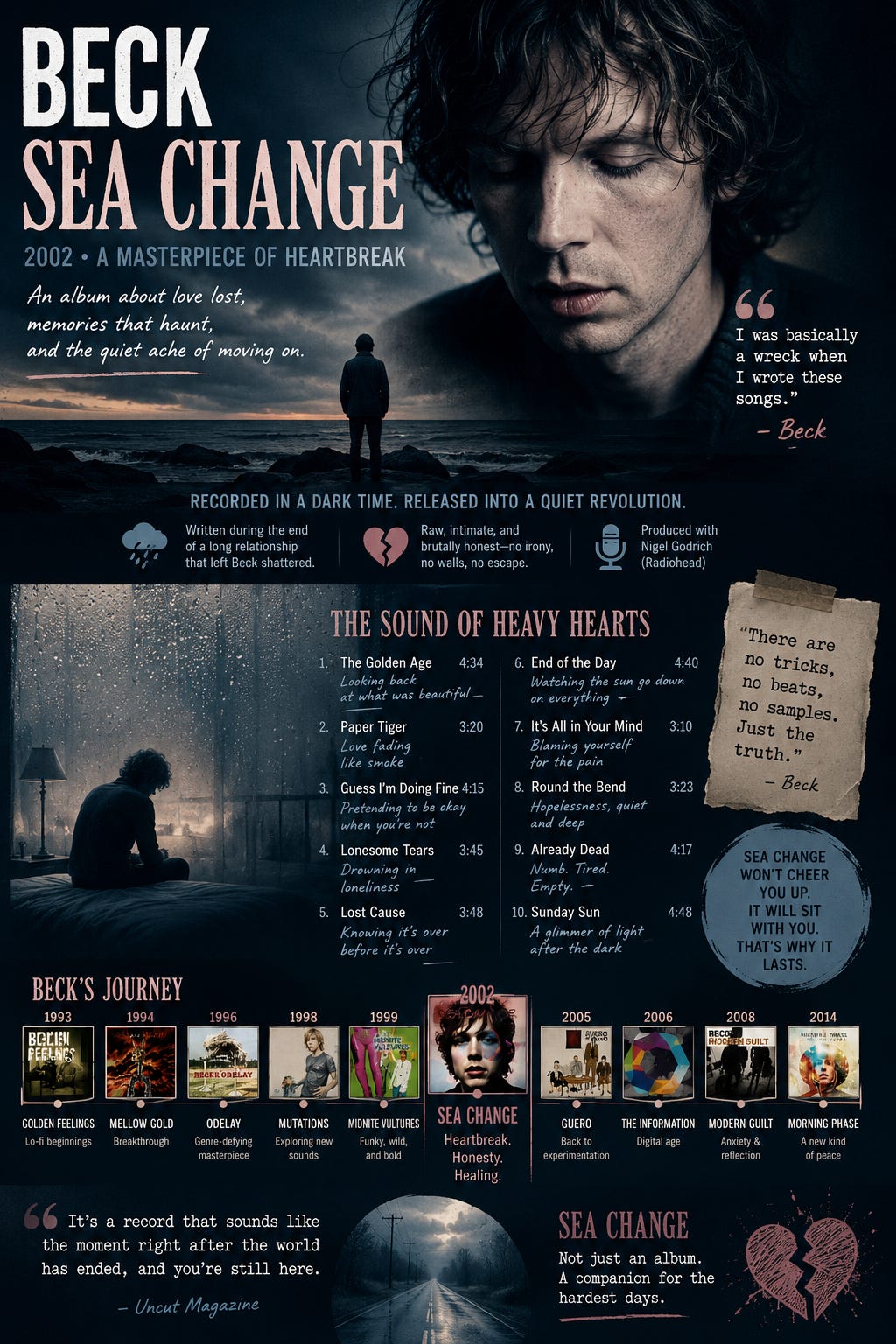
There are albums that produce hit singles, albums that define an era, and albums that become milestones in an artist’s career. Then there are those rare works that transcend the idea of an album altogether. They become immersive emotional experiences—works that are best understood not as a collection of songs but as a single, uninterrupted journey. Beck’s Sea Change belongs in that rare company.
Released in 2002 after the collapse of a long-term relationship, Sea Change represented a dramatic departure from everything audiences thought they knew about Beck. Throughout the 1990s he had cultivated the image of alternative rock’s great musical shape-shifter. His records bounced effortlessly between hip-hop, folk, funk, blues, electronic experimentation, psychedelic rock, and absurdist humor. Albums like Odelay and Midnite Vultures celebrated unpredictability. Every song seemed determined to surprise the listener.
Sea Change does exactly the opposite.
Rather than constantly changing direction, it commits itself to a single emotional atmosphere and never lets go. It moves patiently, deliberately, almost cinematically, inviting listeners into an intimate world where heartbreak unfolds in real time. The album asks something increasingly rare in modern music: that you listen from beginning to end, without interruption.
And when you do, something extraordinary happens.
The songs cease being individual compositions and instead become chapters of one larger story.
<iframe width=”560” height=”315” src=”
title=”YouTube video player” frameborder=”0” allow=”accelerometer; autoplay; clipboard-write; encrypted-media; gyroscope; picture-in-picture; web-share” referrerpolicy=”strict-origin-when-cross-origin” allowfullscreen></iframe>
Listening to Sea Change is remarkably similar to watching a beautifully photographed independent film. There are no obvious scene changes or dramatic plot twists. Instead, each song flows naturally into the next, carrying emotional threads that continue long after the previous track has ended.
The album opens with “The Golden Age,” not with excitement or anticipation, but with quiet resignation. It feels like the first morning after everything has fallen apart. Beck isn’t yet trying to understand what happened. He’s simply standing in the silence, looking backward.
That emotional uncertainty carries seamlessly into “Paper Tiger,” whose sweeping orchestral arrangement feels almost like memories drifting through the mind. The listener begins to understand that this isn’t simply an album about the end of a relationship. It’s about the collapse of certainty itself.
By the time “Guess I’m Doing Fine” arrives, the emotional numbness has settled in. The title itself functions almost as dark irony. It’s the phrase people use when they’re exhausted from pretending they’re okay.
There is no emotional reset between songs.
No fresh beginning.
Only forward movement.
Like grief itself.
One of Sea Change’s greatest achievements is that its production mirrors the emotional state of its narrator. Producer Nigel Godrich doesn’t simply record songs; he creates an environment.
Every instrument seems chosen not for technical brilliance but for emotional resonance.
Acoustic guitars shimmer like sunlight breaking through heavy clouds.
String arrangements drift in and out like distant memories.
Pianos echo through empty spaces.
Drums rarely dominate because heartbreak rarely arrives with explosions. More often, it arrives quietly, settling into everyday life almost unnoticed until everything feels different.
Even silence becomes an instrument.
There are moments where Beck’s voice hangs alone in the air, surrounded by almost nothing. Those spaces are as emotionally important as the melodies themselves. They allow listeners to breathe, reflect, and absorb what has just been heard before moving deeper into the journey.
The result is an album that feels less produced than inhabited.
You don’t simply hear Sea Change.
You step inside it.
Unlike many records built around obvious singles, Sea Change gains strength through continuity.
“The Golden Age” introduces loss.
“Paper Tiger” wrestles with uncertainty.
“Guess I’m Doing Fine” reveals emotional exhaustion.
“Lonesome Tears” sinks into despair with breathtaking honesty.
“Lost Cause” quietly acknowledges what the listener has already begun to suspect—that some endings cannot be repaired.
“End of the Day” captures the slow passing of time when every day feels nearly identical.
“It’s All in Your Mind” explores self-doubt.
“Round the Bend” introduces a fragile sense of acceptance.
“Already Dead” strips away whatever emotional defenses remain.
Finally, “Side of the Road” offers something that resembles peace—not joy, not celebration, but the realization that life somehow continues after loss.
None of these songs would possess the same emotional impact if heard in isolation.
Their true power comes from their relationship with one another.
Each one answers questions raised by the previous song while introducing emotional complexities that will only be resolved several tracks later.
That level of narrative architecture is extraordinarily rare in popular music.
Many breakup albums eventually seek revenge, redemption, or closure.
Sea Change refuses all three.
Beck never positions himself as either victim or hero. He simply observes his own emotional landscape with remarkable honesty. There are no villains. No dramatic confrontations. No declarations of personal triumph.
Instead, he allows confusion to remain confusing.
Sadness remains sad.
Loneliness remains lonely.
In doing so, Beck accomplishes something profoundly human.
He trusts the listener enough to recognize these emotions without explaining them.
That restraint is precisely what gives the album its emotional weight.
Nothing feels manipulated.
Nothing feels exaggerated.
Everything feels lived.
Today’s streaming culture encourages fragmented listening. Songs are shuffled into playlists, favorite tracks are replayed endlessly, and albums often become little more than containers for individual hits.
Sea Change quietly resists that entire philosophy.
Its pacing depends upon uninterrupted listening.
The emotional transitions are gradual.
The atmosphere deepens almost imperceptibly.
Themes introduced early in the album quietly echo throughout later songs, creating emotional connections that only reveal themselves over time.
Listening halfway through and stopping feels similar to leaving a novel unfinished.
You’ve experienced individual scenes but missed the transformation.
The complete journey matters.
Perhaps the greatest achievement of Sea Change is its ability to transform sadness into something strangely beautiful.
The album never romanticizes heartbreak.
It never suggests suffering is desirable.
Instead, it acknowledges that loss changes people—and sometimes those changes produce greater empathy, deeper understanding, and unexpected wisdom.
The title itself captures this perfectly.
A “sea change” is not merely change.
It is complete transformation.
The ocean reshapes everything it touches.
By the album’s conclusion, the listener realizes that Beck has not simply documented the end of a relationship.
He has documented the slow reconstruction of identity after love disappears.
The transformation is subtle.
Almost invisible.
But it is there.
More than twenty years after its release, Sea Change has lost none of its emotional power. If anything, time has only strengthened its reputation. As listeners grow older, many return to the album after experiencing their own losses—failed relationships, grief, personal transitions, or moments when life no longer resembles the future they imagined.
Each return reveals new details.
New emotional shades.
New interpretations.
The songs evolve because we evolve.
Few albums possess that kind of lasting depth.
Many records remind us of a specific period in our lives.
Sea Change seems to accompany us through multiple chapters of life, revealing something different each time we revisit it.
Calling Sea Change a breakup album doesn’t begin to capture its significance. It is an emotional landscape painted with extraordinary subtlety and remarkable patience. It is an album that values atmosphere over spectacle, honesty over performance, and emotional continuity over commercial convention.
Every note serves the larger narrative.
Every lyric deepens the emotional journey.
Every arrangement reinforces the quiet ache running beneath the surface.
By the time the closing moments arrive, the listener hasn’t simply heard eleven songs. They’ve traveled through grief, memory, loneliness, reflection, acceptance, and finally something resembling hope.
That is why Sea Change remains one of the greatest albums of the twenty-first century.
Not because it contains Beck’s finest individual songs—though many are exactly that—but because it achieves something even rarer.
It becomes one uninterrupted emotional experience.
One cohesive trip through the landscape of heartbreak.
One breathtaking reminder that the finest albums don’t merely entertain us.
They change us.
And, fittingly, few records embody the meaning of their own title more completely than Sea Change.