In 2011, my LSE professor Christopher Pissarides arranged for our class to listen to Ronald Coase. Pissarides had won the Nobel Prize the year before for his work on unemployment, so this was one laureate calling in a favor from another. Coase was 100 years old, still sharp, and willing to give back to his alma mater. He had won the Nobel Prize, founded a school of economic thought, and watched the entire postwar corporate economy organize itself around an idea he wrote as a homework assignment as a young man at LSE in 1937. What I remember most is that he laughed at himself when asked about the relevance of the paper in 2011. He told us technology had moved so far past the world he wrote about that his original paper might already be a museum piece.
That paper was “The Nature of the Firm,” and Coase was being too modest. The paper aged better than almost anything written in economics that century. But the joke has aged beautifully too, because we are now living through the moment he was gesturing at, and most people are drawing exactly the wrong conclusion from it.
The conclusion floating around right now is the one-person billion-dollar company. Sam Altman has talked about a betting pool among his tech CEO friends over which year the first one will appear. The framing is irresistible. AI writes the code, designs the product, drafts the contracts, runs the support queue, builds the deck, and handles the books. So why would you need anyone else? One brilliant founder, a stack of models, and a billion dollars.
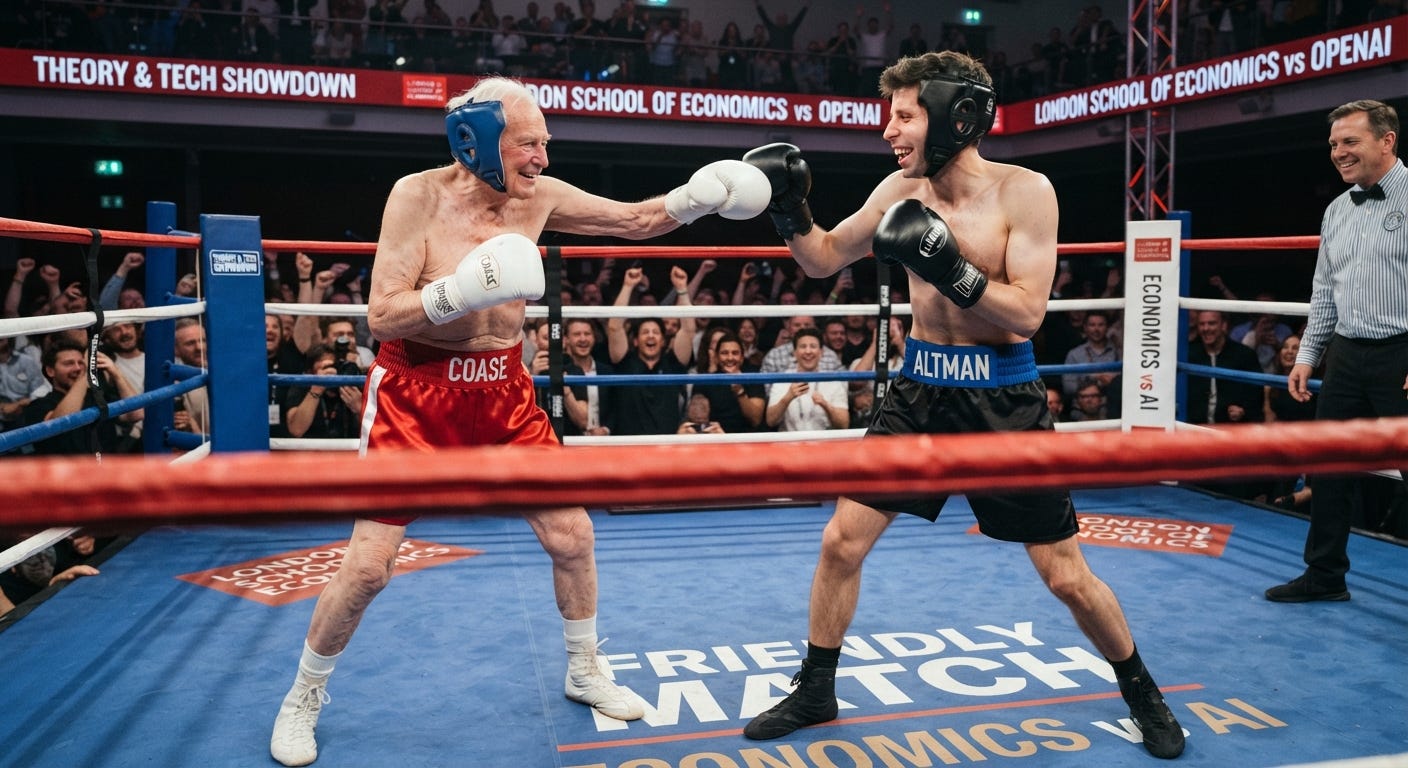
It is a great story. It is also mostly wrong. Not because AI is overhyped, but because the people telling the story have confused a product with a company, and confused a cap table with a business. AI will shrink the firm dramatically. It will not delete it. The firm is not disappearing. It is being compressed.
Start with a distinction that the whole debate tends to skip. There is a world of difference between a one-person company valued at a billion dollars on a cap table and a one-person company producing a billion dollars of durable annual revenue.
The first is a financing artifact. A handful of investors agree on a number, the number goes in a press release, and a unicorn is born. You can get there on a demo, a narrative, and a good week. The second is an economic organism. It has to survive customers, competitors, procurement departments, churn, security reviews, renewals, regulation, failed implementations, board members like myself, and the ordinary cruelty of market cycles. One of these can happen to a solo founder in a quarter. The other has to be earned every year against people actively trying to take it from you.
The paper unicorn is a cap table story. The durable unicorn is a systems story. When Altman’s friends bet on the first one-person billion-dollar company, I suspect they are mostly betting on the first kind, and the first kind tells you almost nothing about how companies actually work. A valuation is a snapshot. A business is a decade.
This is where Coase earns his Nobel. He asked a question so simple it sounds naive until you sit with it: if markets are so efficient, why do firms exist at all? Why isn’t the entire economy just independent people contracting with each other for every task, hour by hour?
His answer was that using the market is not free. It costs something to find the right people, negotiate terms, verify quality, coordinate the work, settle disputes, and build enough trust to do it again next week. Coase called these transaction costs, and he argued that firms exist because sometimes it is simply cheaper to do things inside an organization than to keep running back out to the open market for every transaction. A firm grows, he said, until the cost of organizing one more thing inside it equals the cost of buying that same thing outside. That boundary, the line between what you own and what you rent, is the whole game.
Now you can see why Coase laughed in 2011. AI takes a sledgehammer to the right side of that equation. Finding talent gets cheaper. Drafting documents gets cheaper. Producing software, coordinating workflows, managing internal knowledge, standing up a new business function, running an experiment, all of it gets cheaper, and in some cases it falls toward zero. Every one of those was a reason to hire someone. Every one of those is now, at least partly, a subscription or a prompt.
So the solo-unicorn crowd has the first half of the argument completely right. AI pushes production and coordination costs toward zero. Where they go wrong is assuming that all transaction costs are the same kind of cost. They are not. AI pushes production costs toward zero. It does not push trust costs toward zero. And trust is the one Coase would have told you mattered most.
Here is the move that almost every breathless AI take gets wrong. It treats a company as if it were a production machine, a device for converting inputs into outputs. Feed it enough compute and the machine runs itself. But a company is not a production machine. Production is the easy part now.
A product can be built in isolation. A company has to survive contact with the world. The product is the thing you make. The company is the thing that makes people trust you enough to buy the thing, keep buying it, stake their own careers on it, and forgive you when it breaks. A company is a trust system, an accountability system, a distribution system, a compliance system, and a reputation system, all wearing the costume of a product. AI is extraordinary at producing things. A business is not a pile of produced things. It is a system that earns trust over and over, captures value, absorbs failure, and keeps the customer coming back. That part does not automate.
This is the line between a science project and a business, and it is worth being blunt about it. A science project can have brilliant technology, beautiful benchmarks, a slick demo, a clever architecture, and a crowd of early fans. A business needs paying customers who renew, expand, file support tickets, demand references, pass you through procurement, and own a budget they will defend to their boss. The science project impresses people. The business survives them. The AI-enabled solo founder can absolutely build the science project. I have watched several do it, and the demos are genuinely stunning. The wall they hit is not technical. It is the wall where the thing has to become a company. I have invested in a few science projects that I thought were companies, so I know from (painful!) experience.
If you want to find that wall, watch a small vendor try to sell into a large enterprise or a government agency. It is brutally hard today for a polished 20-person startup. The notion that a one-person company will do it casually, at billion-dollar scale, reveals that the person making the claim has never sat on the buying side of the table.
Large buyers do not buy products. They buy confidence. The champion inside the company might love your demo, but the champion does not write the check alone. Before money moves, a procurement department wants to know who supports this, who is accountable when it fails, what happens if the founder gets sick or hit by a bus, whether you can pass a security review, whether you carry insurance, whether you can meet compliance requirements, whether you can survive a botched deployment, and whether you will still exist at renewal. A one-person company can dazzle a champion in a 30-minute call. It can terrify the procurement team in about 30 seconds, because the buyer is taking career risk on you, and a single human with a fleet of agents reads as a single point of failure.
AI helps here, and it helps a lot. It can fill out the security questionnaire, draft the data-processing addendum, summarize your architecture, and respond to legal redlines faster than any associate. What it cannot do is be the throat to choke. It cannot sit across from a nervous buyer and absorb the institutional risk that the buyer is desperate to offload onto someone with a name, a reputation, and something to lose. Procurement is not paperwork. It is institutional risk management dressed up as paperwork. At scale, the buyer stops asking “does the product work?” and starts asking “can I trust this company?” That second question is the one a solo founder cannot answer, because the honest answer is “trust me,” and “trust me” does not clear a vendor risk committee.
The same gap shows up in enterprise sales and in customer success, for the same underlying reason. Selling a serious contract is not information processing. It is reading a room, navigating internal politics, knowing when to push and when to wait, and helping a buyer feel safe enough to bet their reputation on you. Keeping that customer after the sale means onboarding, implementation, the 2 a.m. escalation, and a human who picks up when something is on fire. A chatbot can apologize all day. A company has to be accountable. Those are not the same thing, and your biggest customers know the difference.
Marketing is the other place the inevitability story falls apart, and it falls apart in a way people find counterintuitive. Yes, AI can generate content. It can generate an ocean of it, on demand, in any voice you want. The solo-founder fantasy reads that capability as a marketing department in a box.
But the internet was already drowning in content before any of this. The bottleneck was never the ability to produce words, images, and videos. The bottleneck is resonance, the rare moment when something you made actually lands with someone who matters. Producing more average content does not create more demand. It mostly creates more noise for everyone to ignore, including your own. Real marketing still runs on taste, positioning, timing, narrative, and the judgment to know what should exist and what should be killed before it ever ships. In a world of infinite average content, that judgment gets more valuable, not less. The machine can write a thousand posts. It cannot tell you which one is worth publishing, or why anyone should care, and being wrong about that is how you spend a fortune saying nothing.
The debate keeps offering two options. On one side, the bloated legacy corporation with its 14 layers of management and a meeting to schedule the meeting. On the other, the lone genius with a laptop and a billion-dollar idea. We are told to pick our future.
It is the wrong binary. The real future lives between those two poles, and it is the more interesting place to build. Call it the fractional enterprise: small but not solo, automated but not empty, lean but not fragile. It owns its strategic core and fractionalizes nearly everything else. The bloated company is vulnerable because it pays for coordination it no longer needs. The solo company is fragile because it cannot carry the trust that real customers require. The fractional enterprise is the durable middle, and durability is the only thing that turns a valuation into a business.
The old startup shorthand was the three Hs: the Hacker who built the product, the Hipster who owned design and taste, and the Hustler who sold the vision and found distribution. People keep predicting the death of that team. I think it matters more than ever. What changed is not the number of roles. What changed is the size of each role’s command surface. The Hacker no longer just writes code. That person now commands coding agents, infrastructure, automated testing, security scanners, and a roster of contract specialists, running a software production system that used to require a department. The Hipster does not just have good taste. In a world where AI generates infinite average design, taste becomes the scarce input, and that person now steers prototyping tools, research agents, and the entire product experience. The Hustler still does the one thing no model can do, which is create trust where none exists yet, but now with AI-assisted research, outreach, and proposals behind them.
So the new minimum viable company is not one person. It is a compact team of full-stack executives, each owning a major domain and orchestrating agents, platforms, contractors, and fractional specialists to operate at a level that used to take fifty people. At the seed stage it might still look like those three founders. As it grows it becomes maybe six to twelve of them. The defining feature is not headcount. It is leverage. Each person is not managing a department. Each person is managing a system, and quietly commanding an army that does not appear on the payroll: agents, APIs, agencies, outside counsel, expert networks, embedded finance tools, and partner ecosystems. The old firm internalized labor because coordination was expensive. The new firm externalizes labor because coordination is cheap. But someone still has to decide what matters, own the customer, make the tradeoffs, and know when the machine is confidently wrong. That command layer is exactly why the firm survives. It just gets smaller, denser, and far more leveraged.
If this is right, the metric we have used for thirty years is about to mislead us badly. We have treated headcount as a proxy for ambition. Big hiring plans signaled speed and scale, and investors rewarded them. In the fractional enterprise, the best companies will look suspiciously small, and the old reflex will read that smallness as a lack of ambition rather than the whole point.
The number that matters is revenue density: revenue and value per employee. This is not a hypothetical. When Facebook bought WhatsApp in 2014 for around nineteen billion dollars, the company had roughly fifty-five employees. That was a preview, not an outlier. Expect more companies where ten people do what a hundred used to do, where fifty do the work of five hundred. A business with forty employees and a hundred million in revenue is not underbuilt. It may be the new model. A business with two thousand employees and the same revenue is not scaled. It may be structurally obsolete and not yet aware of it.
It changes the shape of work, too, not just the size of the company. The fractional enterprise does not eliminate work so much as it kills a particular kind of job: the coordinator whose main function was moving information from one meeting to the next. Those middle layers thin out. What grows in their place is demand for high-agency operators with real domain depth, people who can own an outcome across agents, contractors, customers, and external networks without being told how. The career ladder starts to look less like climbing a hierarchy and more like becoming a full-stack executive inside a high-leverage shop. That is a better deal for the talented and a worse one for the people who built careers on being the connective tissue.
For investors, this rewrites the diligence checklist. The right questions are no longer about the hiring plan. They are: what does this team uniquely own, which functions are automated, which are fractionalized, which are outsourced, where is human trust still load-bearing, what is the revenue per employee, and where would the company break if demand doubled tomorrow? The best companies will stop looking like miniature versions of big companies. They will look like command centers. Funding headcount instead of leverage will become the expensive mistake of this cycle, the way funding growth at any cost was the expensive mistake of the last one.
For balance, small is not automatically good. A fractional enterprise can fail by becoming too thin, too dependent on contractors who answer to someone else, too reliant on fragile automations, or too concentrated around two or three irreplaceable people. The danger is no longer only bloat. The danger is also brittleness. A company can be too large to move. It can also be too small to trust. Getting that balance right is the entire art, and it is genuinely hard.
Which brings us back to the man who laughed at his own paper. Coase was right that firms exist because of transaction costs, and right, by implication, that when those costs change, the firm changes shape. AI is changing them more violently than anything since the internet, maybe since the corporation itself became the default way humans organize work. But the old Coase question was “why do firms exist?” The new one is sharper: “what must this firm uniquely own?” Answer that honestly and you will know what to automate, what to rent, what to fractionalize, and what to keep close.
The firm is not vanishing into a single founder and a prompt window. It is being compressed into something denser and more powerful than what came before. The next great company will not be one person staring at a blinking cursor. It will be a small number of exceptional people, each commanding a vast cloud of agents, tools, and contractors, and each personally accountable for a slice of the trust that holds the whole thing together. Not solo founders. Full-stack executives. Not unicorns of headcount. Unicorns of leverage.
So what do we tell the tinkerer, the one with a day job and a side project that is starting to look suspiciously like a company? Tell them to go build the billion-dollar business. The fact that nobody will get there entirely alone is a terrible reason to stay at the desk, because a founder today gets further solo than anyone in the history of company-building. Five years ago the same idea needed a co-founder, a seed round, and fifteen hires just to learn whether anyone wanted the product. Today it needs a few subscriptions and some stubbornness.
Most of these companies would never have existed at all. Quitting used to mean betting a mortgage on the ability to hire a team before the money ran out, so the tinkerer stayed put and the idea died in a notebook. AI collapsed the cost of finding out. The solo-unicorn myth, wrong as it is about the destination, is doing something useful along the way: it is talking thousands of people into starting.
And when the tinkerer hits the wall this essay is about, the trust wall, that is not the dream dying. That is the company being born. A handful of full-stack executives come aboard, the team grows to six or ten instead of the two hundred it would have taken in 2020, and every one of those jobs exists at a company that otherwise would not. The job for the rest of us, investors especially, is simple: encourage the audacity, then have the help ready when they ask for it. Multiply that by every tinkerer who takes the leap, and the future is not one company with no employees. It is thousands of companies with a few, and that arithmetic runs in one direction: more jobs, not fewer.
We have heard the opposite prediction before. Malthus warned that the machine age would leave people with nothing to do, and the loom, the tractor, and the spreadsheet each got the same eulogy. Employment rose every time, because making production cheaper has always meant more firms, more products, and more work to go around. The tinkerer plus AI is the economic growth engine of the twenty-first century, and it will create jobs the same way it creates companies: in volume. Coase saw the shape of this in 1937, and had the grace to laugh when the future arrived early. The rest of us should at least manage a smile.