Works with your existing Terraform/OpenTofu
Stategraph replaces the flat state file with a database-backed graph. Independent changes can run in parallel, and the state becomes queryable and auditable. No code changes.
Parallel teams No lock waiting Audit-ready state
What Stategraph makes possible
| ∥ |
Teams run in parallelIf resources don't overlap, everyone ships |
| ? |
Query your infrastructureSQL-queryable state, not JSON parsing |
| ◉ |
Resource-level controlResource-level locking & RBAC |
∥
Teams run in parallel
If resources don't overlap, everyone ships
?
Query your infrastructure
SQL-queryable state, not JSON parsing
◉
Resource-level control
Resource-level locking & RBAC
From flat files to dependency graphs
State as a file
Global locks
Serial execution
Audit via CI logs
→
State as a database
Resource ownership
Parallel where safe
SQL queries and diffs
Under the hood: API and database
Stategraph has two parts: a CLI that provides the same interface as Terraform, and a backend that fundamentally reimagines how state is stored and processed—as a dependency graph in PostgreSQL, not a flat file. The CLI doesn't orchestrate Terraform; it executes graph-aware operations directly against the database.
stategraph plan
stategraph apply
stategraph query
STATEGRAPH CLI
| Replaces | Terraform & OpenTofu CLI |
| Manages | Graph-aware execution |
| Provides | Query interface |
Replaces
Terraform & OpenTofu CLI
Manages
Graph-aware execution
HTTP API SERVER
POST /transactions
GET /transactions/{id}
GET /graph
POST /query
POSTGRESQL DATABASE
id
type
name
depends_on
status
1
aws_vpc
main
NULL
active
2
aws_subnet
public-1a
1
active
3
aws_subnet
public-1b
1
active
4
aws_security_group
web-sg
1
active
5
aws_instance
web-server-1
2,4
active
6
aws_instance
web-server-2
3,4
pending
7
aws_alb
main-lb
2,3
active
8
aws_db_instance
postgres-prod
3
active
Resources as rows • Dependencies as foreign keys • Graph traversal via SQL joins
Parallel-safe
Disjoint ops run together
SQL-queryable
Direct database access
Graph-native
Dependencies as edges
Audit-ready
Every change tracked
Visual interface
Visualize the dependency graph, run SQL queries, and browse transactions — all in one place.
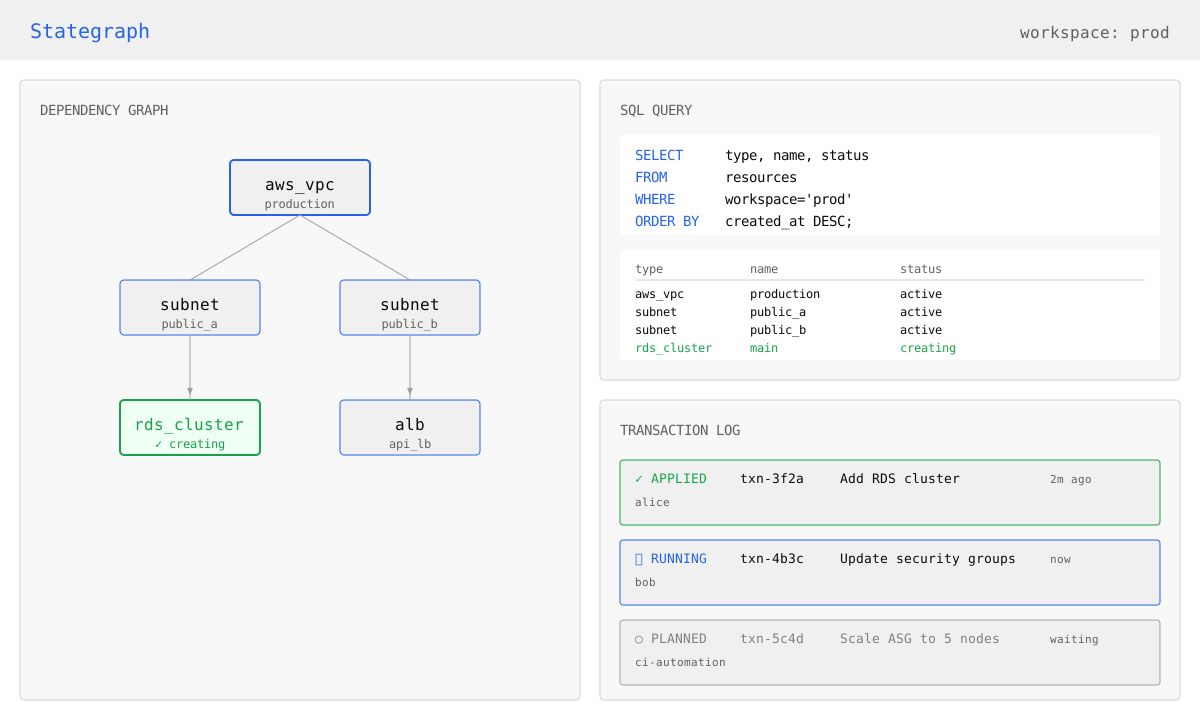
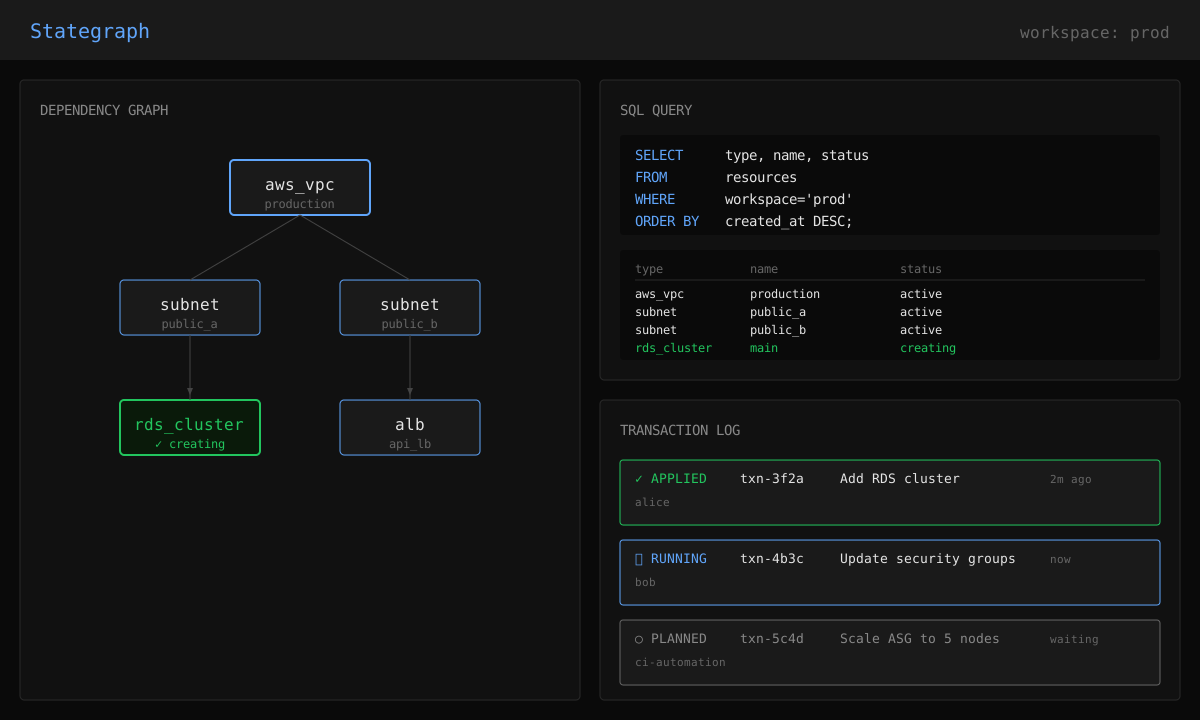
Graph explorer SQL results Transaction log Resource ownership
shell
$ # Want this in your hands? $ echo "Notify me when Stategraph launches" | \ mail -s "Launch Updates" hello@stategraph.dev
See the difference
Watch how Stategraph parallelizes your infrastructure operations
Traditional Backend
[VPC ] waiting
[Subnets ] waiting
[Security ] waiting
[RDS ] waiting
[ALB ] waiting
[ASG ] waiting
[Route53 ] waiting
[CloudFront ] waiting
Stategraph
[VPC ] waiting
[Subnets ] waiting
[Security ] waiting
[RDS ] waiting
[ALB ] waiting
[ASG ] waiting
[Route53 ] waiting
[CloudFront ] waiting
Parallel Team execution
Graph Dependency aware
SQL Queryable state
Get launch updates
Be the first to know when Stategraph launches.
Why Terraform & OpenTofu need a new backend
FILE
State is stored as a monolithic JSON file. Every plan loads the entire file. Result: slow plans at scale.
LOCK
Global lock blocks all teams. Even those working on unrelated resources. Result: teams queue behind each other.
BLIND
State is opaque binary data. No queries. No insights. No audit trail. Result: Debugging via CI logs.
SERIAL
Resources execute one at a time. Even when operating on completely separate parts of the tree. Result: Wasted time waiting for unrelated changes.
Two ways to deploy Stategraph
Use Stategraph as a Terraform backend for inventory and queries, or add the CLI for faster plans.
5-minute setup
Terraform Backend
Point your Terraform/OpenTofu backend configuration at Stategraph. No CLI installation needed.
What you get:
- ✓ Infrastructure inventory & CMDB
- ✓ SQL-queryable state
- ✓ Resource change history
Full power
Backend + CLI
Install the Stategraph CLI for drop-in Terraform/OpenTofu replacement with performance enhancements.
All backend features, plus:
- ✓ Subgraph-based execution
- ✓ Parallel team operations
- ✓ Incremental resource refresh
Frequently Asked Questions
No code changes required. Your Terraform/OpenTofu configurations, modules, and providers remain exactly the same. You just use the Stategraph CLI (a drop-in replacement for the Terraform/OpenTofu CLI) and update your backend configuration to point to Stategraph.
Stategraph imports your existing .tfstate file on first run. Every resource, every attribute, every piece of metadata is preserved and migrated into the database. The import process is non-destructive, and you can always export back to standard .tfstate format if needed.
Stategraph builds a complete dependency graph of your resources and only parallelizes truly independent subgraphs. We enforce explicit barriers for dependencies and use transactional writes. If resources depend on each other, they run in order. If they don't, they run in parallel.
You need PostgreSQL 14+, but you have options: self-hosted on your infrastructure, managed services like RDS or Cloud SQL, or local PostgreSQL for development. The database requirements are minimal — any PostgreSQL instance can handle thousands of resources.
Your infrastructure state becomes queryable data. Find all EC2 instances in production, track resource changes over time, identify unused resources, or build custom dashboards. This is real SQL against normalized data, not parsing JSON blobs.
Terraform/OpenTofu's pg backend just stores the state file as a blob in PostgreSQL. Stategraph actually parses and normalizes the state into a proper database schema. Every resource becomes a queryable entity with relationships, history, and ownership. The pg backend stores a file in a database — Stategraph IS a database.
All state data is encrypted at rest (AES-256) and in transit (TLS 1.3). Provider credentials are never stored in state. Resource-level RBAC means teams only see what they need. Every access and modification is logged with full attribution.
We're targeting our first release early Q1 2026. Design partners get early access starting soon. Sign up above to be the first to know when we launch.
We're looking for teams running Terraform or OpenTofu at scale to co-build with us. As a design partner, you'll get early access, direct engineering support, and influence over the roadmap. Apply to be a design partner.
Contact
Stategraph is under active development.