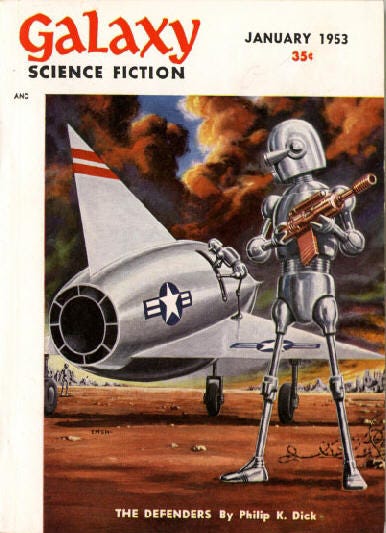
In “The Defenders,”1 Philip K. Dick describes a world where robots fight our wars for us, while we live safe but unfulfilling lives underground. In the story, a war renders the planet’s surface unlivable. Each side builds its own underground habitat where they strategize and invent new weapons. Everyone assumes the robots are following all orders to the letter, gleefully bombing the hell out of the enemy and defending home.
If you are a recent graduate trying to find a job, this story may sound vaguely familiar. All the big companies want you to submit your resume to tools like Workday (their robotic army). Some students are fighting back, using AI to generate custom resumes that can bypass this defense. This battle is destroying the internet, the landscape we depend on for communication. It is forcing us into private bunkers where we cannot be directly reached. Except, of course, for the honest students, who wander unarmed in the apocalypse.
Last week, I attended a mixer bringing together a professional AI discussion group and data science students from the University of Virginia. I enjoyed meeting the students. Some of them were delightful. They had hopes and dreams. These can be difficult to come by in corporate America. It’s hard out there right now for everyone. It feels great to talk to people who are excited about the future.
That’s part of why we hired Jacob, who is working towards a transfer degree at a community college. Jacob is one of the most intelligent people I have ever met. He mined enough money in bitcoin to buy an airplane kit, got his pilot’s license and an FAA certification, built the plane, and now flies it – all before age 21. We are a bootstrapped startup, lean as hell, but we’d be foolish not to have this guy working with us.
In “The Defenders” - the folks in the bunkers get suspicious and go to the surface to see what the robots are doing. They discover there is no war! When the people left, the bots realized the war was pointless and developed a large scale video production of a fake war. In the end, the AI creates a situation where members from each side have to work together in order to feed themselves.
We aren’t blessed with benevolent robots. But the solution holds. We have to talk to each other. Creating a bunch of robots to do our communication work for us - to fight our battles - is a fruitless endeavor. In the absence of that benevolent AI, we enrich profit-seeking corporations that benefit from both sides of the battle.
–
If you are a small or mid-size company about to hire a full-time employee or a contractor, what you absolutely should not do is make it public knowledge on social media. The onslaught of automated noise is truly deafening. If you are a student, don’t design or buy a tool that will send out 100 resumes a day. Both are just ways to live inside a nightmarish cautionary short story. I cannot imagine the chaos that must be happening inside LinkedIn and Workday right now.
Adam Ward’s podcast “How to win the AI talent war”2 describes a method for going after talent the same way you go after customers - do your research, find the people you want, and woo them.
We have to go fight our own battles. If you work for a company you care about, regardless of your job title, go find ways to talk to recent graduates. Some of them are devastatingly smart, motivated, and passionate people. AI can’t show up at an event. It’s just going to be human beings. Go be a human being.
–
Our software company, SpiffWorks, specializes in building collaborative workflow software, and we are well positioned to help you build workflows that take Adam Ward’s recommendations and then tailor them to meet your own specific needs. We build software that improves communication and fosters collaboration between human beings.
Special thanks to Owen Zanzal, Nish Tahir, and Ben from the Charlottesville AI Explorers group for the great discussion that led to this article.