In the first four months of 2026, a whopping 68.01% of Google searches ended without a click. Thanks to AI features, instant answers, UI elements that keep searchers in the results, and shifting user preferences, Google is becoming a walled garden. Their financial and stock performance suggests that these changes boosted both ad revenue and investor confidence, and thus, it’s unlikely this evolution will slow or reverse. Credit to the team at Similarweb, whose exceptional mobile and desktop clickstream panel illustrates how the AI age has shifted post-Google-search behavior.
In 2024, US zero click searches on Google stood at 60.45%. That means we’ve seen 12.5% growth (7.5 percentage points) in clickless queries over the last two years. That’s the fastest acceleration of this phenomenon in the last decade, almost certainly driven by the massive growth in AI Overviews (now found on 20%+ of all searches), which, when present, reduce CTR by nearly 60%.
(UPDATE: We’ve also published data on Zero-Click searches in the UK, Italy, Germany, France, and Canada here)
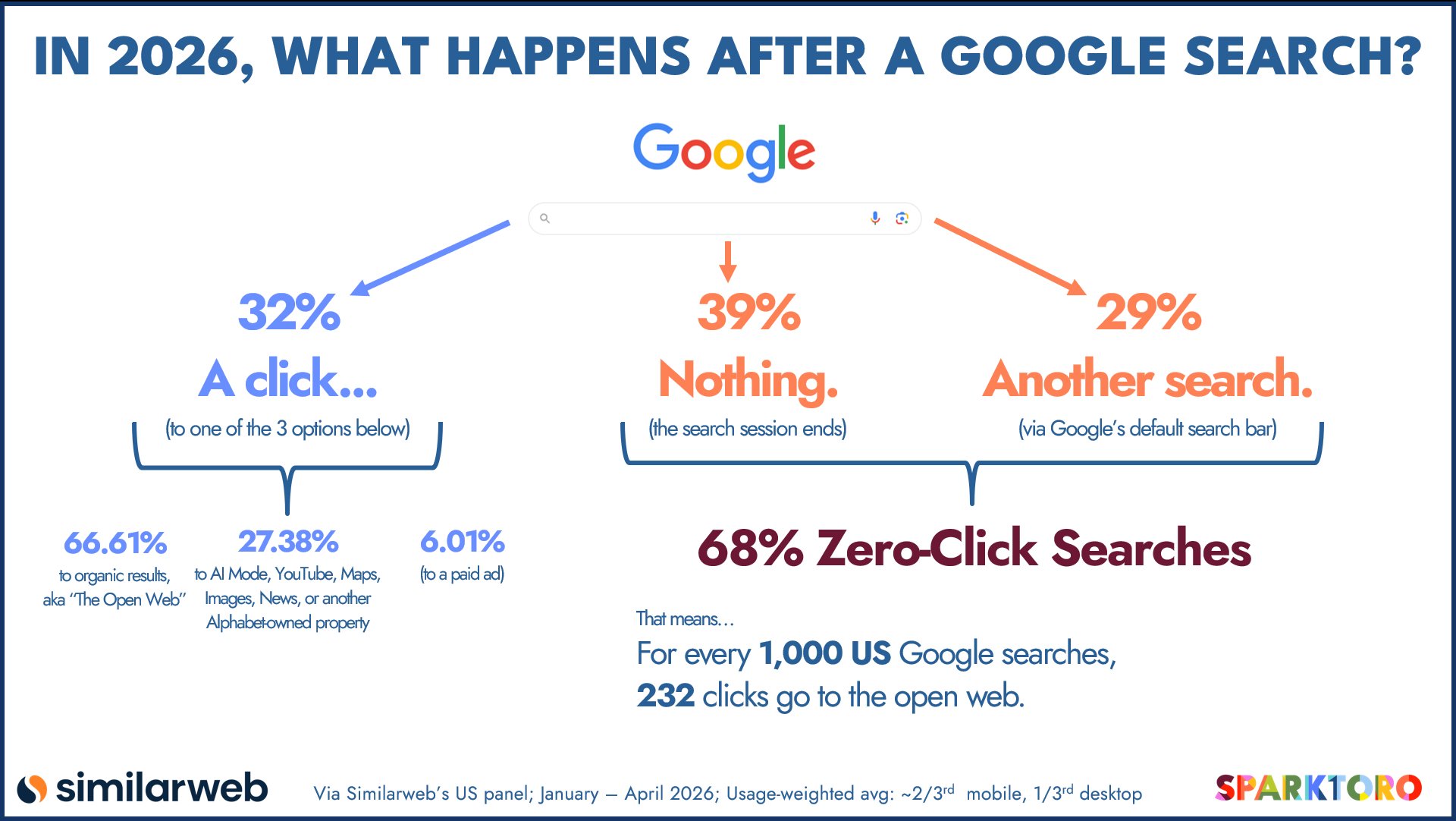
In 2019, SparkToro first published research showing that 49% of Google searches ended without a click. That data inspired my colleague, Amanda Natividad to describe the “Zero Click Web,” an emerging era of platforms (search engines, social networks, and now AI tools) discouraging users from clicking out and reducing the ability of site owners to earn traffic from the places where a majority of online time is spent. That trend has continued, unabated, since.
Similarweb’s panel is far from the only data source telling this story.
In fact, this data likely comes as little surprise to anyone in the world of search — thousands of sites have reported significant losses in traffic, and millions have experienced it. Large-scale studies have been performed to analyze the handful of sites who’ve grown traffic despite the last few years’ decline in referrals. Numerous stories of traffic falling off a cliff have gone viral. The latest, from AllAboutBerlin, showed a decline even more precipitous than what we’ve shown here.
Last year, the Ahrefs team built a monthly tracker illustrating how web traffic flows to over 75,000 domains who’ve opted in to have their metrics aggregated and published.

The decline from June 2025 to May 2026 is 8 percentage points, a ~22% drop in the traffic share Google sends to these tens of thousands of websites. And this panel is far from representative – these are sites with professional marketers actively working to grow traffic!
Since we’ve been advocating for and publishing data about this zero-click search issue for a long time, we’ve got a particular collection of historic numbers to share. Fair warning: the numbers we uncovered from 2016 and 2019 are from the now-defunct Jumpshot clickstream panel. Those from 2024 were provided by Datos, now a Semrush company. And 2026’s are from Similarweb, who had a sizable-enough mobile panel to conduct the cross-device research we required. Thus, the graph below compares a bit of apples and oranges — these aren’t the same users or devices, they’re not even necessarily perfect demographic matches — but they’re the closest we’ve got to a look inside Google’s rising obsession with keeping searchers on their platform.
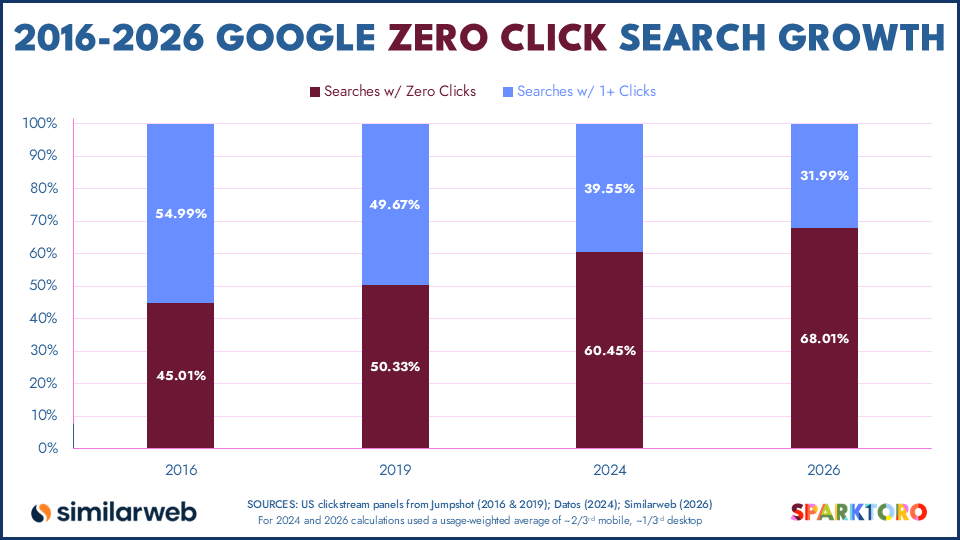
Ten years ago, ~45% of Google searches were zero-click. Today it’s 68%. That’s a 33.8% increase (23 points) in a decade. And it’s difficult to see a reason Google would slow down the pace of answering questions directly in their results given:
- The popularity of AI tools (which send less than 1% of all traffic out) has grown dramatically. 20%+ of Americans now use an AI tool 10X+/month. Google fears being left behind, and has thus pushed heavily to make AI central to their search experience.
- The adoption of social networks (especially YouTube, Instagram, and TikTok) as replacements for traditional search engines continues unabated — as our research in March showed: search happens everywhere.
- Google knows that the more instant answers they give users, the more users return and search again.
- Ad revenue has only increased as Google’s found ways to answer “organic” kinds of queries while growing both paid clickthrough rate and average cost per click.
- The US antitrust case against Google was resolved without significant impact on their business, freeing the search giant to aggressively pursue technological and UI changes that keep searchers inside their ecosystem.
For those curious about exactly what’s changed and how, I’ve dug into those details in the chart below, comparing every major metric that reasonably aligns across the two panels/studies/years.
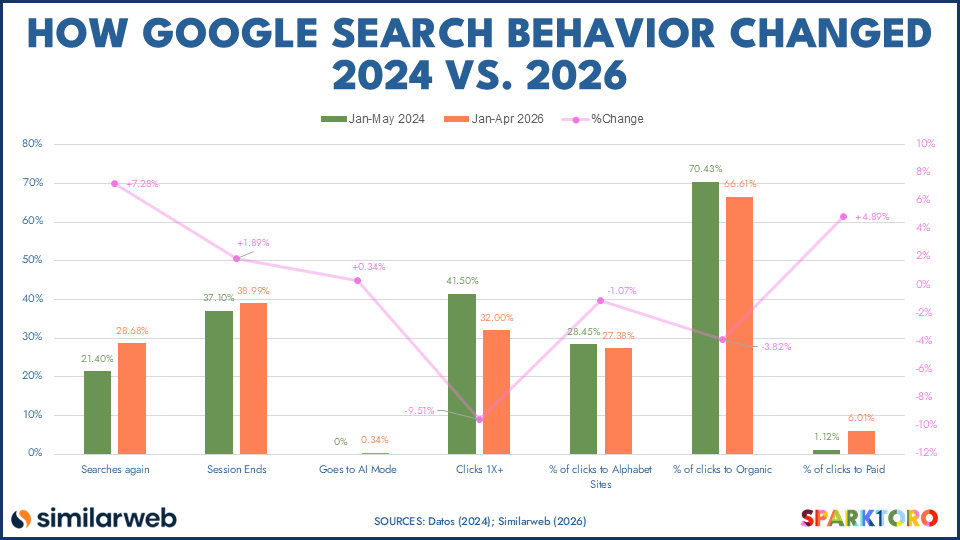
The metric “Clicks 1X+” is the largest and most meaningful change. It includes clicks of any kind (save for another search in the default search box): Google’s other properties (like a search in Google Maps or a visit to YouTube), clicks on organic links to the open web, and clicks to paying advertisers in the search results. That’s where the biggest change occurred: -9.51 points, a 22.9% decline.
The second-largest delta is exactly where you’d expect given Google’s incentives and choices: the percent of searchers who perform another search. It’s up 7.2 points from 2024 to 2026, showing the search giant’s success at persuading searchers to perform ever more queries. Paid clicks also grew tremendously, though an important caveat noted in our 2024 study applies here: we saw a higher-than-average percent of Datos’ panel using ad blockers that either hid, minimized, or diminished the subtlety of Google’s search ads. It’s quite likely that the true paid clicks number in 2024 would have been higher without this artifact.
For those who theorized that AI Mode caused this change, it’s not there yet. Only 0.34% of searches made their way to AI Mode from January–April 2026. That number is almost certainly growing fast — Google said at I/O 2026 that AI Mode had surpassed 1 billion monthly users and that queries were more than doubling every quarter — and it could well be the feature that drives the next decade of zero-click increases.
What Can Website Owners Do to Fight Back?
Much as it pains me to say, there’s not much point (nor any hope) of fighting back by simply getting better at SEO. Don’t take that the wrong way — your SEO still matters as much or more than ever before, it just won’t earn you traffic the way it once did. Traffic can fall precipitously even as revenue rises. Our belief and advice is to invest in Zero Click Marketing: earning influence and growing your brand’s awareness without requiring a visit to your website.
I wrote more about this two weeks ago: Inimitable Product is the New “Make Great Content” and am also publishing a book with Amanda Natividad on the same topic: Zero Click Marketing.
Here’s the shortest TL;DR I can give:
- Replace traffic as a KPI for your digital marketing efforts. Build a correlation dashboard instead.
- Conduct audience research to find out where your audience pays attention. Surveys, interviews, and yes, tools like SparkToro, are all helpful here. You need a deep understanding of not just the platforms, but the individual sources (people on LinkedIn, creators on IG/TikTok, subReddits, YouTube channels, podcasts, email newsletters, et al.) that reach your ICP.
- Invest in marketing on platforms you don’t own or control. Free yourself from the goal of directly driving traffic back to your website. Promote your brand (subtly). Mention your product (when relevant). But don’t obsess over link inclusion. The people who are truly interested will seek you out.
- Don’t neglect your website in all this. Even as traffic falls, the influence your site’s content has on AI responses and all of Google’s zero-click features remains. You still need to publish that support article so Google’s AI Overview gets it right. You probably need to make video on YouTube and a post on LinkedIn and reply on Reddit with that info, too. And AI answers draw extensively from what ranks highly in Google, so even if you’re not earning clicks you’re still creating critical brand influence.
- Learn how to storytell, entice, promote, and educate in short-form content: video, audio, images, and text that can live on the walled gardens that dominate our online experiences.
- All this being said, there are still some categories that benefit from SEO, including branded searches, local businesses, and high-intent transactional or tactical queries. Our friend Cyrus Shepard recently found that the websites still winning in Google offer one or more of those features.
Obviously, the book goes into far more depth and detail.
What’s Next?
For those curious about Europe, the UK, and Canada’s rates of zero-click searches, great news — Similarweb has generously provided me with those numbers as well, and I’ll be publishing them in the days ahead (possibly as soon as next week). I also hope to repeat this research in 6-12 months, when we’ve seen more of the AI-centric changes Google promised . If you’ve got other requests, please leave them in the comments and we’ll do our best.
Methodology
Data for this study comes from Similarweb’s desktop and mobile web panel for January – April 2026 (US). In order to make the calculations for this publication, we did a few things that are worth mentioning on top of the raw clickstream data:
- To calculate the split of mobile and desktop search, we used the multiple–data–source–informed figure of 2/3rds mobile, 1/3rd desktop. Similarweb’s Sam Sheridan also looked at some of their own panel patterns to validate that this is roughly accurate.
- For mobile behavior, we assumed the end of a search session to come after 10 seconds of inactivity. After this point, the navigation patterns suggested entirely new user journeys rather than those related to the search.
- Because of how mobile clickstream data is collected, we couldn’t directly calculate the percent of clicks on paid links, and so used the ratio of 3.12% desktop to 3.81% mobile from DigitalApplied’s 2026 benchmark panel to make this estimate.
It’s also worth noting that this data is not inclusive of the Google mobile search application, but rather mobile searches within the browser. Given that Google’s use of zero-click features happens even more aggressively within the search app, it’s likely the percentage of zero-click searches is even higher than what we’ve found here.
Licensing, Usage, and Closing Notes
Feel free to quote, cite, and use the images from this report anywhere you’d like so long as you provide linked credit back to this post and to Similarweb.com as the data source provider.
Thank you to SparkToro’s Amanda Natividad and Kristy Bolsinger, and Similarweb’s Sam Sheridan and Adelle Kehoe for their respective help editing this report and providing the data/validating my analysis.
No AI was used in the authoring of this post (all mistakes and em-dashes are mine alone). I consider it disrespectful and unethical to use AI for such purposes and thus, nothing I write employs this technology.