 Space Time
A working model of the universe, in your browser
Space Time is a free 3D universe explorer. Check where the planets are tonight, or stand on the Moon and look up. Then keep zooming out: past millions of stars, the Milky Way, and the cosmic web. Nothing to download, no account.
🚀 Launch Space Time Runs in any modern browser · Works on desktop, phone & VR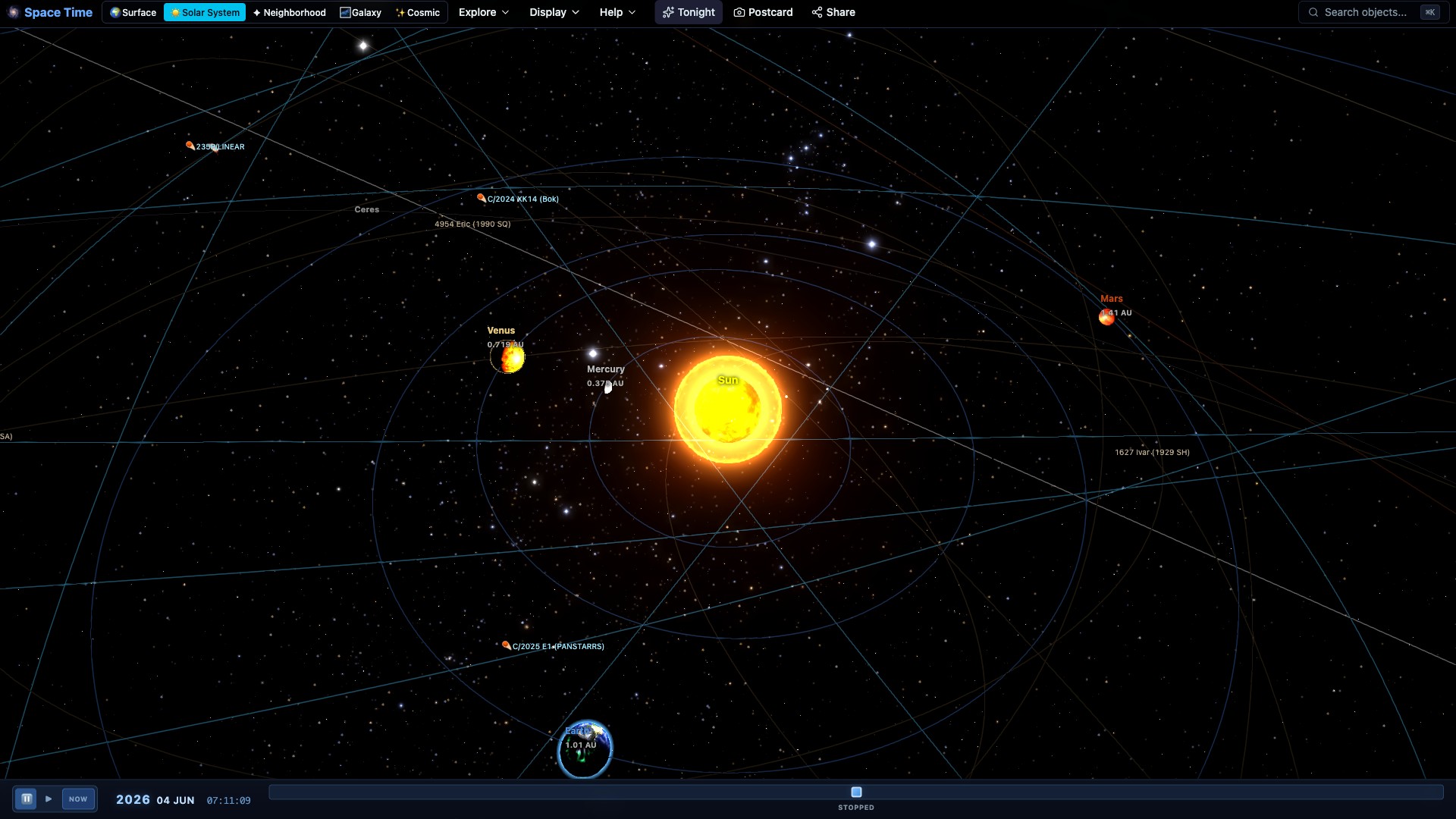
A real-time 3D model of the solar system
Every planet, moon, dwarf planet, asteroid and live comet rides its true orbit, rendered with real surface maps at 60fps. Positions come from the astronomy-engine library, which is built on JPL ephemeris data, so what you see on screen matches the actual sky.
🪐 All the planets & moons
Mercury through Neptune, plus Pluto, Ceres and Eris with their major moons. The asteroid belt is in there too, along with live comets and near-Earth asteroids pulled from JPL.
🛰️ Apollo & spacecraft
Replay the Apollo missions on their historical trajectories. You can also ride along with the ISS, Hubble, JWST and the Parker Solar Probe.
⏱️ Travel through time
The clock scrubs forward and back through any date. Speed it up and alignments, conjunctions and retrograde loops play out in front of you.
Stand on any world and look up
Drop to the surface of Earth, the Moon or Mars. The Sun, Moon, planets, constellations and the Milky Way appear exactly as they would from that spot at any date and time, so it doubles as a what's-up-tonight view. You can trace the Sun's analemma figure-8 onto the sky, or a planet's retrograde loop. Deep Time goes further: scrub through 28 millennia of axial precession and watch the pole star pass from Thuban, the pyramid builders' north star, to Polaris and on toward Vega.
Watch eclipses & sky events
The eclipse view predicts solar and lunar eclipses for any date and place, then plays them out: totality with the Sun's corona, or Earth's shadow turning the Moon blood-red, viewed from the ground or from space. There's a full sky events calendar too. Lunar occultations are computed for your location, and Jupiter's moons transit and cast shadows at the real times, including the rare double shadow transits. Every event opens in 3D with one click and exports to your calendar.
From the solar system to the edge of the universe
Zoom out and the planets give way to the nearby stars, then the full Milky Way, then the cosmic web of galaxies, all the way to the cosmic microwave background. It's one continuous powers-of-ten pull-back, with no loading screens between scales.
An observer's toolkit
Tools for people who actually haul a telescope outside. There's an ephemeris generator with almanac tables, brightness and distance graphs, and CSV export for any planet. A Moon phase calendar flags supermoons, and the clickable Moon atlas puts 277 named craters, maria and landing sites on the 3D globe.
🔭 Telescope & eyepiece simulator
Check how a target fits your scope, eyepiece or camera sensor before you set up. The field-of-view overlay is drawn to scale on real sky imagery.
📈 Ephemeris generator
Generate almanac tables for any body: position, brightness, apparent size, over whatever date range you want. Export to CSV. Oppositions and best nights get flagged automatically.
📡 ISS & satellite passes
Visible-pass predictions for the ISS, Tiangong and Hubble, computed from live TLEs with SGP4. It tells you when to go outside.
📷 AR camera sky
Turn on your phone camera and the star chart overlays whatever the lens is pointed at. It labels what you're looking at, and it works in daylight too.
🌙 Moon calendar & atlas
Daily phases, exact full-moon times, supermoon flags. The atlas side lets you fly to Tycho, the maria or any Apollo landing site on the 3D Moon.
🌌 Deep sky & 2.5M stars
Search galaxies, nebulae and clusters against a sky of 2.5 million stars. Zoom in and fainter stars keep appearing; click any one for its name and real distance.
🪐 Exoplanet systems
TRAPPIST-1, Kepler-90 and other real systems, with planets on their measured orbits. Habitable zones are shaded so you can see which worlds sit inside.
🌞 Live aurora & space weather
NOAA's live Kp index and aurora data, plus current comets and asteroids streamed from JPL.
Who uses it
Teachers run it in class. Stargazers use the planner before a night out, astrophotographers use the framing tools, and plenty of people just like flying around the planets. I built it because I wanted the orrery and the planetarium in one place; it grew from there. Free for classrooms, museums and home.
Explore Space Time
Pick a starting point:
Frequently asked questions
Is Space Time free?
Yes. Free, no account, nothing to install. It runs in your web browser.
Do I need to download anything?
No. It runs in any modern browser with WebGL, on desktop, tablet and phone.
What planets are visible tonight?
Set your location, then open the observing planner or the surface view. You get rise, transit and set times for the planets, the Moon and deep-sky objects.
Can I watch a solar or lunar eclipse?
Yes, for any date and location. Solar eclipses show totality with the corona; lunar eclipses get the blood-red umbra.
Can I stand on the Moon or Mars?
You can. The surface view is a first-person planetarium from Earth, the Moon or Mars, with the sky computed for that world and moment.
Is it scientifically accurate?
Positions come from the astronomy-engine library (JPL ephemerides) and land within about an arcsecond. Satellite tracking uses real SGP4, and small-body data comes from JPL.
Can I see the ISS and other satellites?
Yes. Passes of the ISS, Tiangong and Hubble are predicted from real TLE data with SGP4, and you can jump the clock straight to one.
Does it work on mobile and in VR?
It does. The interface adapts to phones, there's an AR sky compass, and WebXR / VR headsets are supported.