A REPORT FROM THE FRONT
Today, solo founding is considered odd. Soon it will be the default.
This report features exclusive Carta data alongside commentary from solo founders who have raised over $250M and the investors who backed them.
By submitting your information, you agree to the processing of your personal data by Carta as described in Carta's Privacy Policy and Terms of Service.
For the first time in history, solo founders start over one-third of new companies.
This milestone represents a 53% increase from 2019, when solo-founded companies accounted for less than one-quarter of startups.
When we began reviewing the data for this report, what we discovered confirmed what we suspected — solo founding was a small part of the past, but a big part of the future.
For this report, Carta graciously shared their proprietary dataset of tens of thousands of companies to help us compare solo- and multi-founder companies across fundraising, dilution, ownership, hiring, and outcomes.
In addition to the data, we’ve included commentary and interviews from solo founders who are leading the way. They’ve raised hundreds of millions in funding, and we’ve also included perspectives from some of the top investors who have backed them.
The State of Solo Founding shows that solo founders are growing in number and are performing on par with their co-founding peers. They’re raising comparable rounds, hiring amazing teams, and building iconic companies.
This is just the beginning — join us.
Julian Weisser
December, 2025
Today, solo founding is considered odd. We believe it's the future.
The increase in solo-founded startups appears to be attributable to a number of significant developments: AI-driven productivity gains providing increased leverage to individuals, continuously decreasing startup costs, and successful solo-founded startups like Polymarket and Midjourney acting as role models.
Solo has always been possible, as companies like Amazon and Dell show, but now, more founders are catching on to that fact.
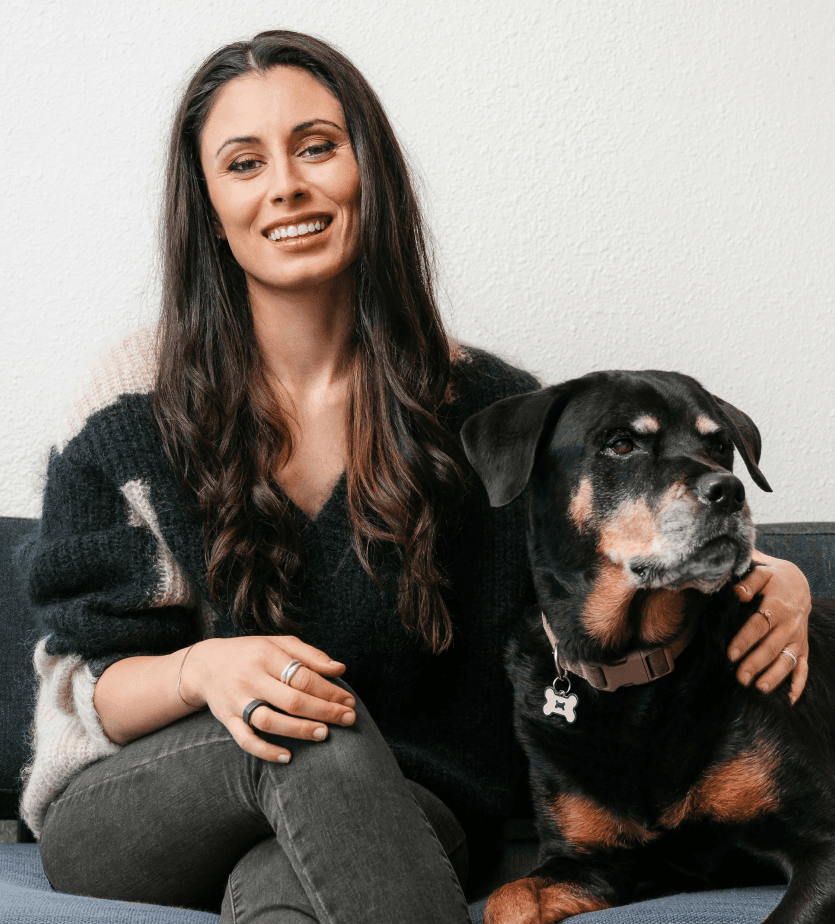
I non-ironically LOVE that being a solo founder makes me Loyal's 'single source of failure'. All mistakes or issues ultimately trace back to a decision I made - hiring the wrong person, choosing the wrong strategy, etc. It's empowering, because it means everything is within my power to fix and get right.
Celine Halioua, Solo Founder of Loyal
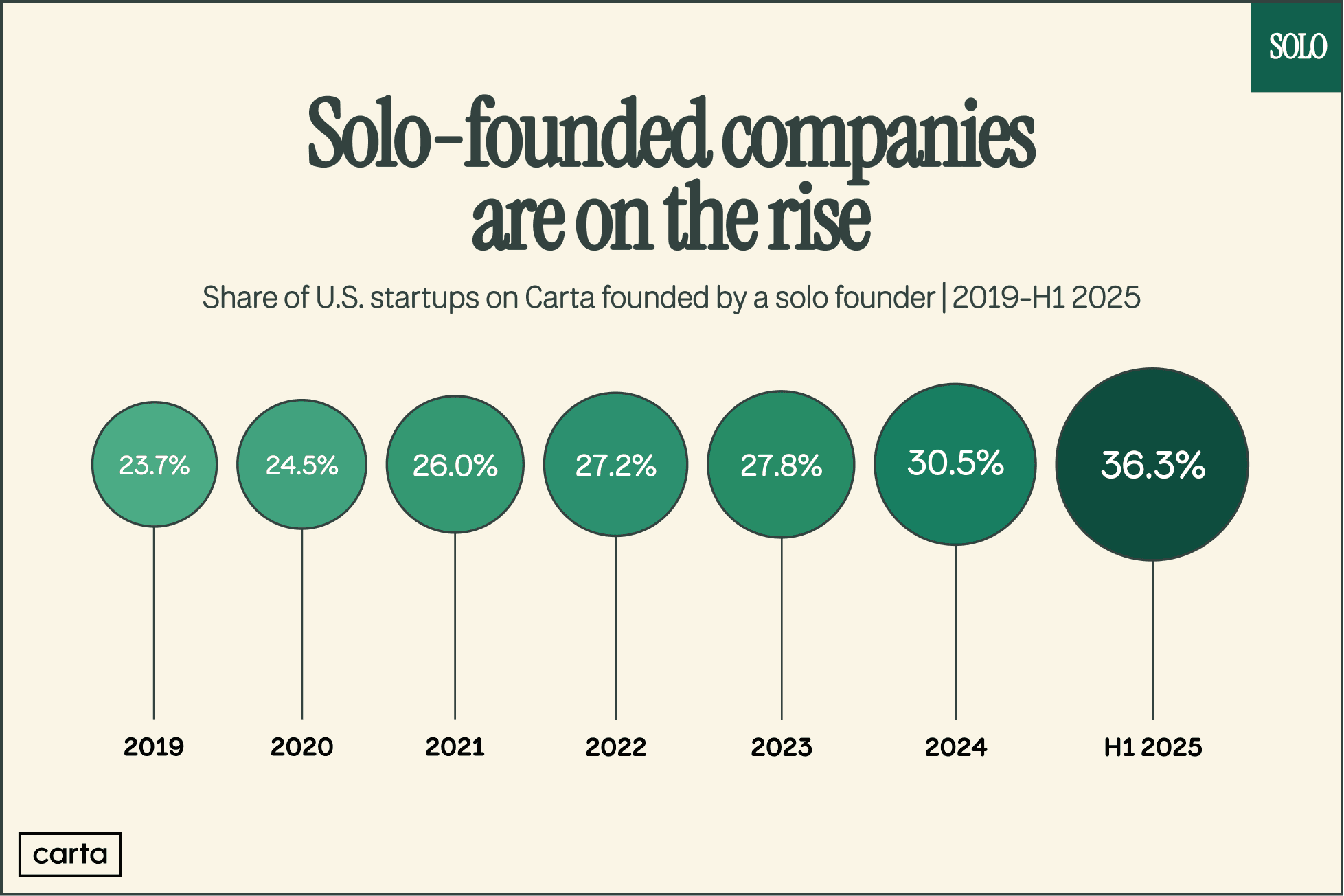
The share of new companies that were started by solo founders steadily increased over the last few years. This trend accelerated in the first half of 2025, when over one-third of new companies were solo-founded. Several factors may be contributing to the rise of solo founders. First, AI has expanded what individuals can accomplish in a finite amount of time, making it more feasible for a single founder to both build and sell. Second, the success of solo-led companies, such as Polymarket, Vercel, and Wander, has helped validate the model among investors and may also be inspiring more entrepreneurs to follow a similar path. And for some founders, building solo may reflect a preference for maintaining creative control from the start. As Peter Walker, Head of Insights at Carta, comments: ’A 13-point rise in about five years is a big shift. Some of this reflects the changing environment. It has become consistently easier to start a company. This trend reflects technology lowering the cost of company creation.’

I think being a solo founder has been normalized and feels more de-risked. People are investing in solo founders more often. In the past, a key reason not to be a solo founder was the belief that investors wouldn't back you.
PAUL KLEIN IV, BROWSERBASE

I think of solo founding as an art form — it's a new thing. The people who are doing it are going to inspire a lot of others.
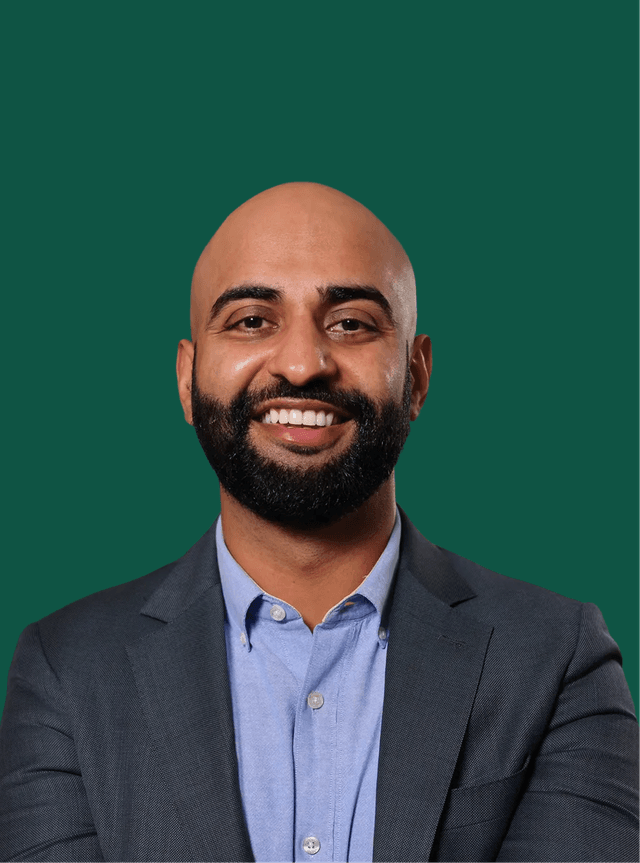
I come from the world of education, where most schools are founded by one person. Teams are incredibly important, but speed is also a critical advantage early on — and having a single decision-maker with a clear vision can be really powerful. [Solo founding] is the only way I know how to found an organization, and I think this trend will only keep growing.

That is a very short time period to see a 13-point rise in solo-founded companies. The jump in 2024 is especially interesting. It’s definitely a testament to AI making things much easier. The ability to generate copy, graphics, and code makes starting a company much easier for one person.
Daniel Francis, Abel Police
Today, with AI, you can do a lot more. Many of the skills you once needed a co-founder for can now be supplemented by AI, allowing one person to build the initial prototype. I think we’re going to see many more solo-founded companies, given how hard it is to find good co-founders.
To me, having a co-founder has even higher stakes than getting married. Co-founder conflict is one of the top killers of a startup, if not the number one killer. Since it wasn't inherently obvious who I should start this business with, my default was to go solo.

I never considered having a co-founder because, at the start, I didn't think I was founding anything. I was just blogging, so I didn't have that techie, SV-style mindset.
Kevin Espiritu, Epic Gardening
I think being a solo founder is a strong option for many people. There’s no single ‘right’ way to build a company — history has plenty of examples of both solo founders, like Bezos, and co-founding teams with complementary skill sets achieving amazing outcomes. It really depends on the company and the situation. As it becomes easier to start a company and AI can take on more work, I believe the percentage of solo founders will continue to rise.
Christina Melas-Kyriazi, Bain Capital Ventures
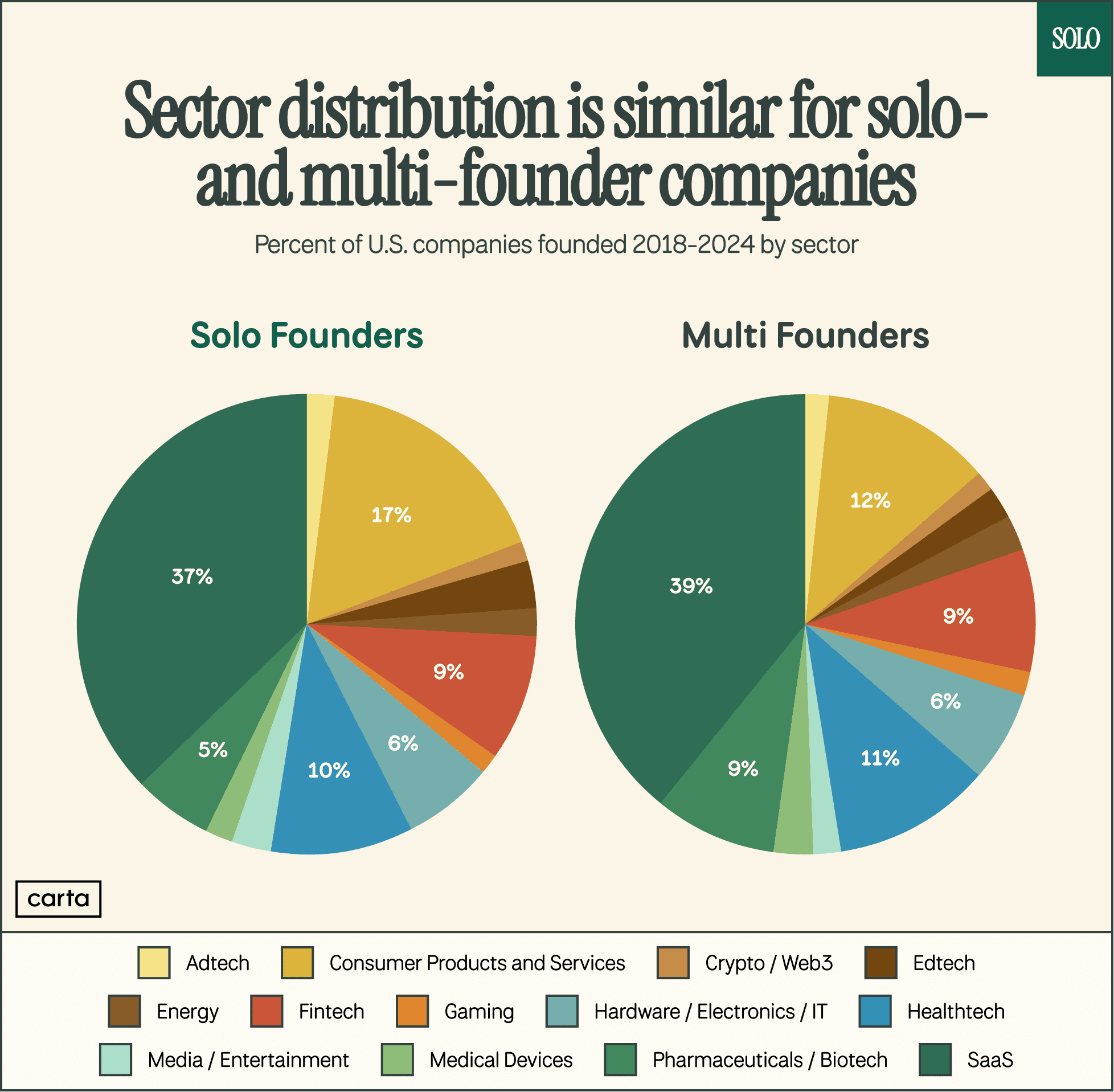
Solo- and multi-founder companies have broadly similar sector distribution. For both groups, the top three sectors — SaaS, Consumer Products and Services, and Healthtech — make up roughly two-thirds of total startups on Carta. Solo-founded companies are slightly more represented in Consumer Products and Services (17.0% vs. 12.0%). This may reflect a different orientation toward risk and motivation. Some solo founders seem more willing to pursue passion-driven or non-consensus ideas, whereas co-founder teams may be more likely to gravitate toward sectors that align with investor consensus and perceived fundability. This dynamic is underscored by Carta data showing consumer startups raised their lowest quarterly totals since 2019 in Q1 2025. Meanwhile, solo-founded companies are less represented in Pharmaceuticals and Biotech (5.3% vs. 8.6%), where deep technical expertise, often at the PhD level, typically needs to be paired with operational or commercial experience. Overall, the clustering of solo- and multi-founder companies suggests that solo founding is a viable path in a wide range of sectors.

I’d generally expect to see fewer solo founders in medical devices and pharmaceuticals — and maybe in hardware or other deep-tech categories. At the same time, you often see iconoclastic founders in these categories, like Valar Atomics.
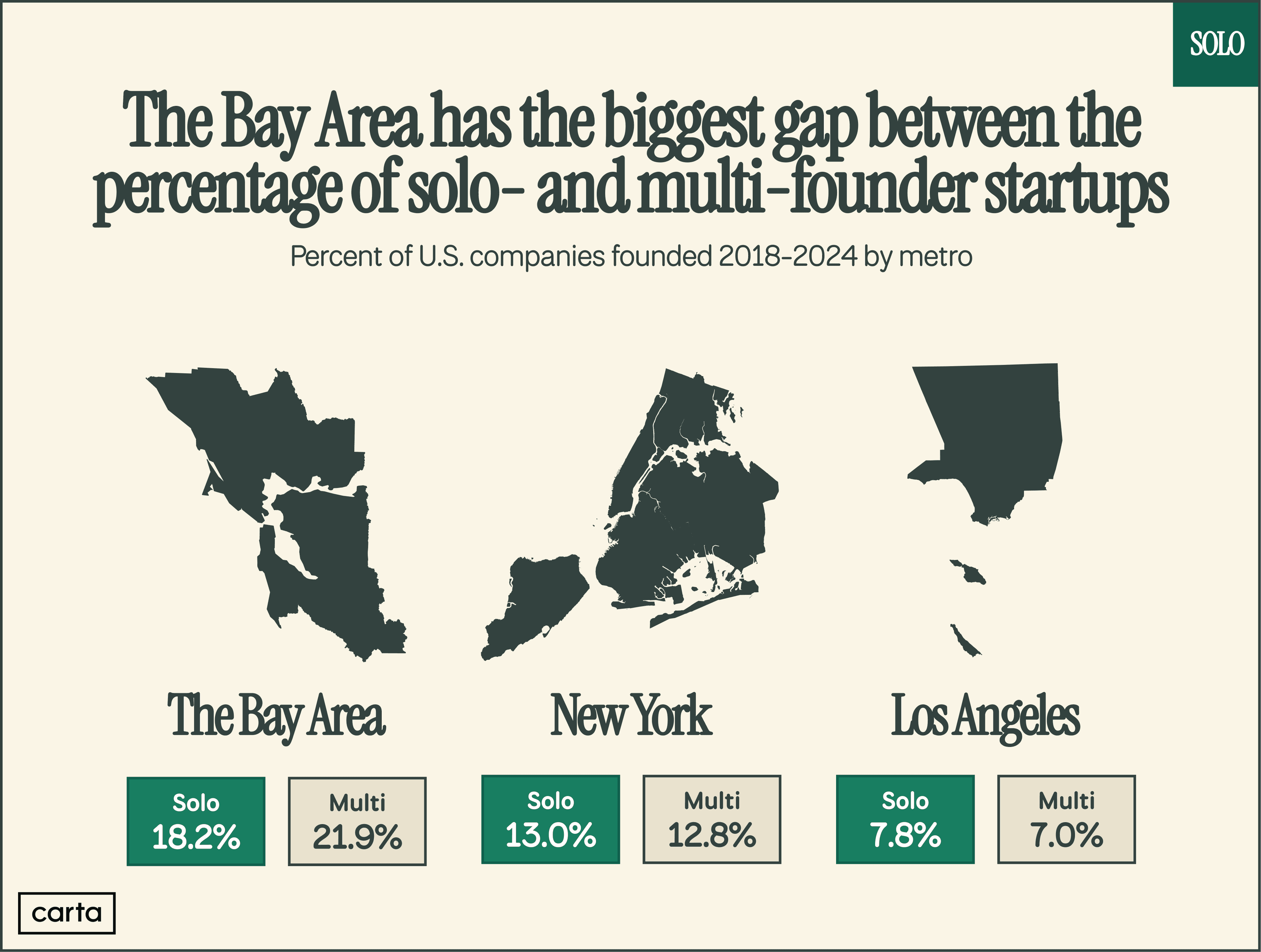
Solo- and multi-founder companies tend to cluster in the same major startup hubs, but the Bay Area shows the widest gap between them. This gap likely reflects a mix of factors: the Bay Area has the deepest pool of potential co-founders and a stronger cultural belief that you're "supposed" to have co-founders, which naturally leads to more multi-founder teams forming there. Julian Weisser (Solo Founders) comments: 'My hypothesis is that the Bay Area is much more conformist about how companies should be built. If you're building in Los Angeles, New York, or Seattle, you're not in the mindset of, "I have to do everything the way that some accelerator says." Many more factors are also likely at play. As Niels Hoven (Mentava) notes: ’Good people leave the Bay Area for reasons that correlate with being ready to found a company. For example, they might be starting a family, or they're senior enough and have the experience to be ready to found something on their own.’ Zach Pogrob (Share Aura) adds: ’San Francisco truly feels like a startup city. When I was there, it felt like everyone was in the game. New York isn’t like that yet — it’s mostly small pockets and individuals working on startups. I think that solo, grinding, main-character energy is just what you need to survive in NYC.’
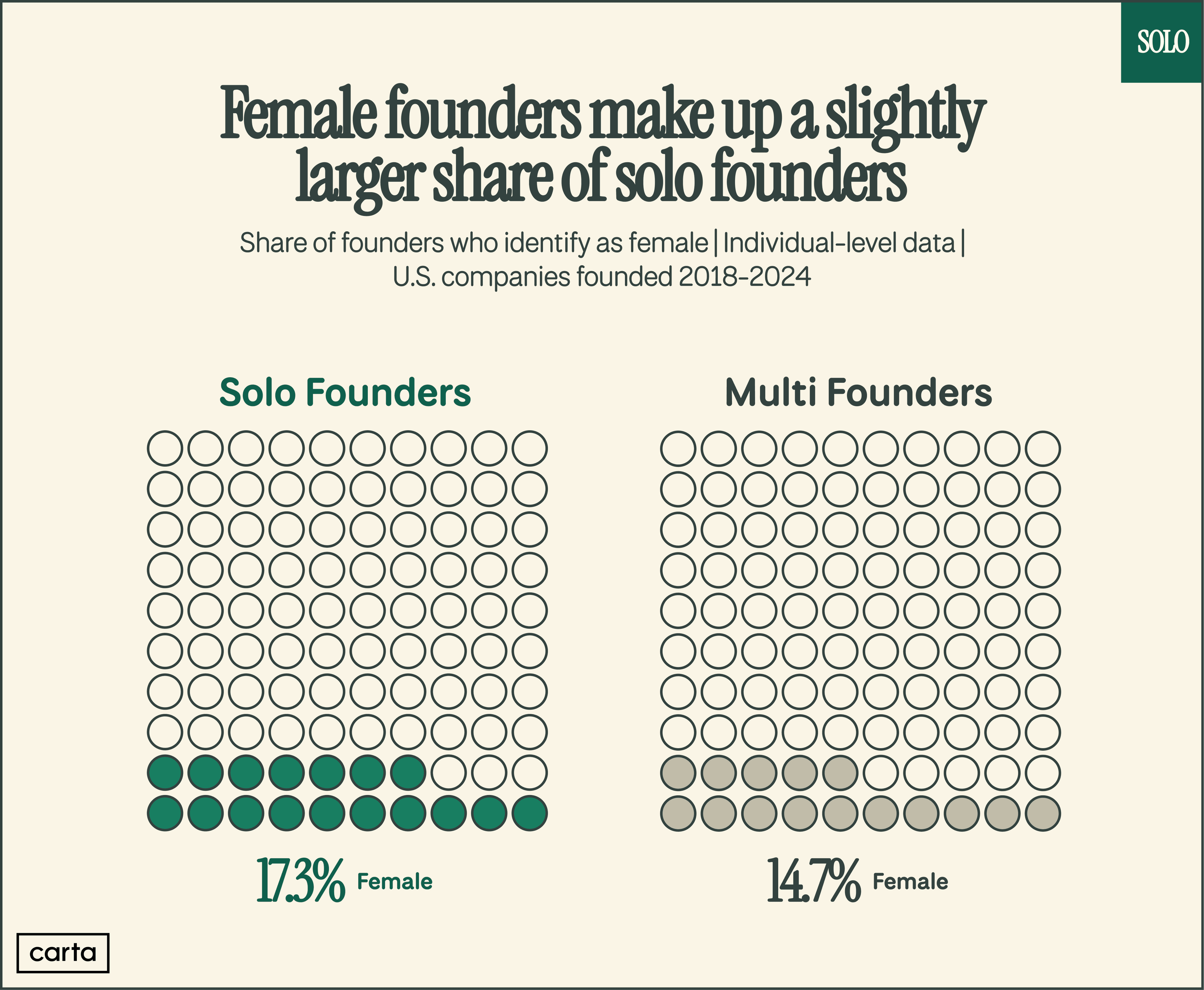
When looking across all individual founders — not companies — women represent a slightly larger share of solo founders than of multi-founder teams. There are many hypotheses about why women are less represented in the startup ecosystem overall, and we won’t venture an answer here. What we do see in our community is that the women who do take the leap to found are outliers. Many come from non-traditional tech backgrounds — scientists, healthcare operators, real-estate professionals — where “starting a startup” is not the default career path. When they decide to build, it usually feels less like a career move and more like a calling to solve a specific problem. They get going before they have perfect funding or the ideal co-founder, and they are prepared to do the unglamorous work themselves until others catch up to their conviction. The slightly higher share of solo female founders in the data may reflect this selection effect: these are exceptional, mission-driven founders who would build their companies with or without anyone’s permission. Ann Miura-Ko (Floodgate) notes: ’These days I’m seeing female founders just get started on their own, especially using AI tools to prototype and get their ideas across. That way, someone can look at a product instead of just an idea and decide to join.’ Noémie Federico (Solo Founders) adds: ’Fewer women start companies, but the ones that take the leap are extremely driven. Exceptional founders will stop at nothing to will their companies into existence, even if it means doing it without a co-founder.’
FIELD NOTES
from Julian Weisser
CEO of Solo Founders
Don’t fall for the denominator delusion. Many believe co-founding is better because many successful companies are co-founded, but they ignore the graveyard of failed companies that died due to co-founder conflict.
Avoid “co-founders of convenience”. Ask yourself if you are looking for a co-founder because your business truly needs one, or because you are afraid to start on your own.
The idea that co-founders are essential is largely cultural. Many outside the tech industry have built successful startups as solo founders without realizing they were challenging the norm.
If the biggest risk of co-founders is conflict, the biggest risk for solo founders is loneliness. One solo founder shared: 'The most interesting experience that solo founders have — one that isn't as common with multi-founders — is how emotionally intense and insanely lonely it is. The main difference is that emotional one.'
Find ways to be solo but not alone. Dhravya Shah (Supermemory) says: I love the concept of ‘solo together.’ At Solo Founders Program, you get the benefits of having a co-founder by living with other solo founders. What’s special about this is that everyone else is also a solo founder, so we have the same kinds of problems.
Chaitanya Choudhary (Workers IO) agrees, describing it as follows: '[Being in Solo Founders Program] is like having five co-founders to reach out to for help in those shaky moments, and that’s super powerful.'
Authorship is more important than ownership. Many solo founders consider this a primary motivator for not having co-founders.
Daniel Francis (Abel Police) believes maintaining solo authorship is beneficial because: 'Your mental models are felt throughout the entire product and brand, making it all feel cohesive.'
However, it’s more than that. Startups are a form of self-expression. As John Andrew Entwistle (Wander) puts it: 'Candidly speaking, my startup is my soul, but as a company.'
Solo founders are raising substantial amounts of capital and doing so on similar terms to companies with co-founders.
Their total fundraising volume, which tracks closely with broader funding cycles, is smaller only because there are fewer of them, not because they raise less per company. At the early stage, their approach looks slightly different. Solo-founded companies tend to reach their first priced round faster than companies with co-founders. In many ways, however, solo- and multi-founder companies look remarkably similar. Valuations, dilution, and round sizes are comparable from Priced Seed to Series B, suggesting that fundraising is shaped more by market dynamics than by founding-team structure.
In this study (using Carta’s fundraising taxonomy), we report on two financing types: pre-seed and priced equity. Pre-seed refers to any fundraising on convertible instruments (SAFEs or convertible notes) before a company’s first priced equity round. Priced equity refers to venture rounds where a valuation is set (e.g., Series A), based on the share class name in a company’s charter. Rounds without standard series naming are excluded from series-specific charts but included in non-series aggregates. “Primary” rounds are the first equity round within a given series.
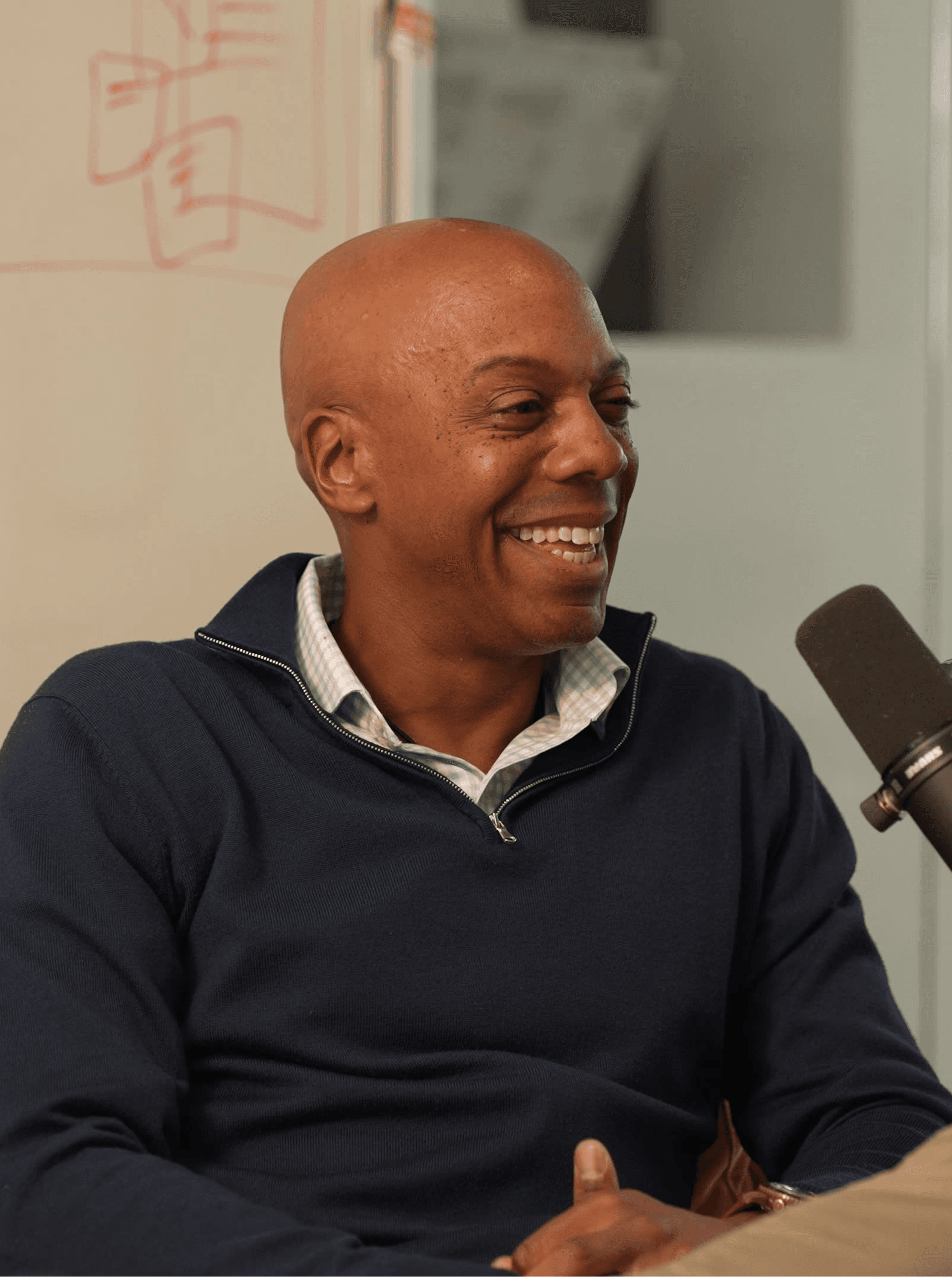
My preference is two deeply connected, tightly coupled co-founders who have a lot of trust and previous experience. Of course, even those teams can break up and blow up, but that's the platonic ideal. The second best thing — and the third isn't even close — is a really talented solo founder.
Charles Hudson, Precursor Ventures
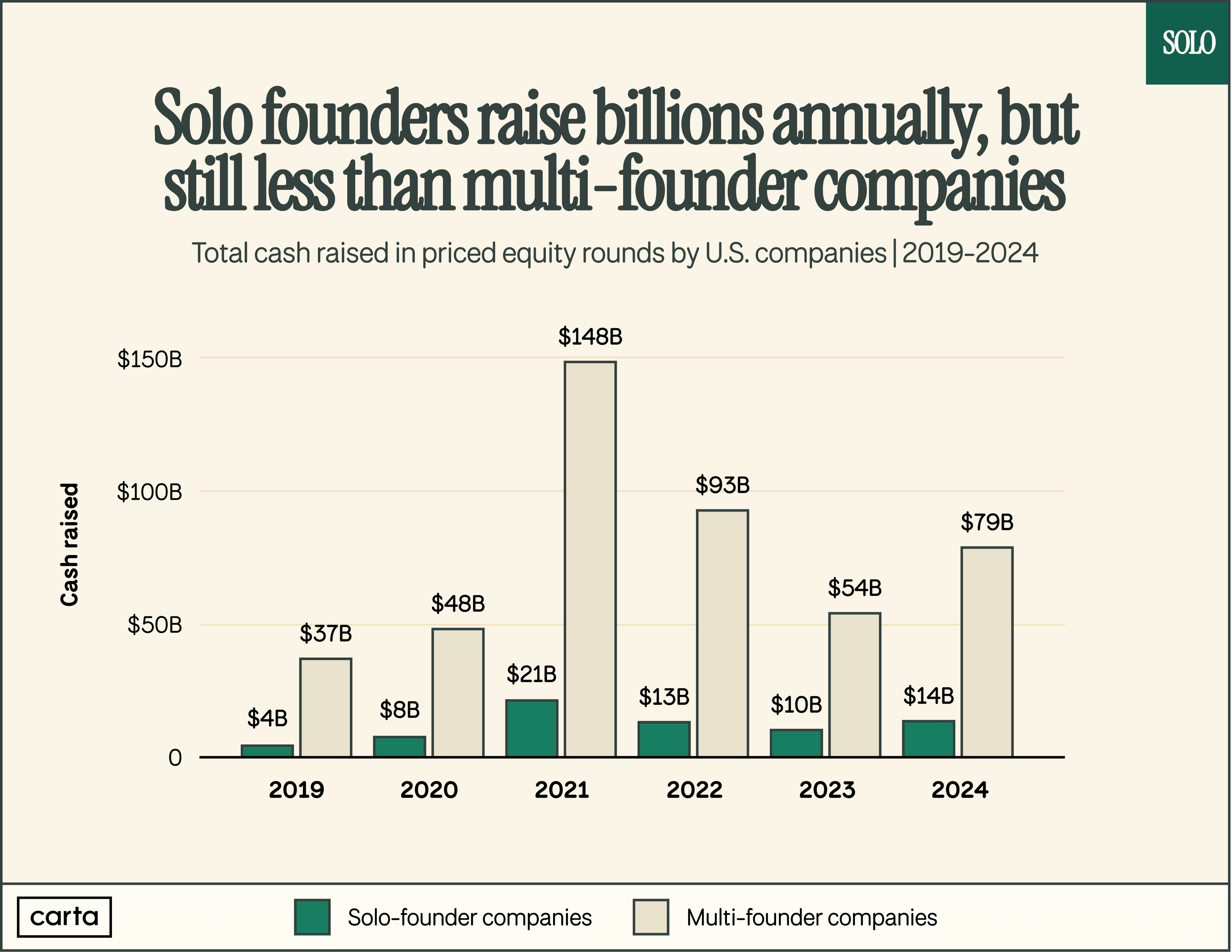
Solo-founded companies raise billions every year, though their totals remain below those of companies with co-founders. Cash raised is a lagging indicator. While the share of solo-founded companies is rising, it takes time for newer cohorts to reach later funding stages that meaningfully move these aggregates. The timing and direction of swings track market cycles almost identically for both groups: peaking in 2021, moderating in 2022–2023, and partially rebounding in 2024. Companies with co-founders tend to show slightly greater volatility, with bigger surges in boom years and sharper pullbacks in downturns. That is likely because large, growth-stage rounds either happen or don’t in a given year, significantly impacting annual totals.
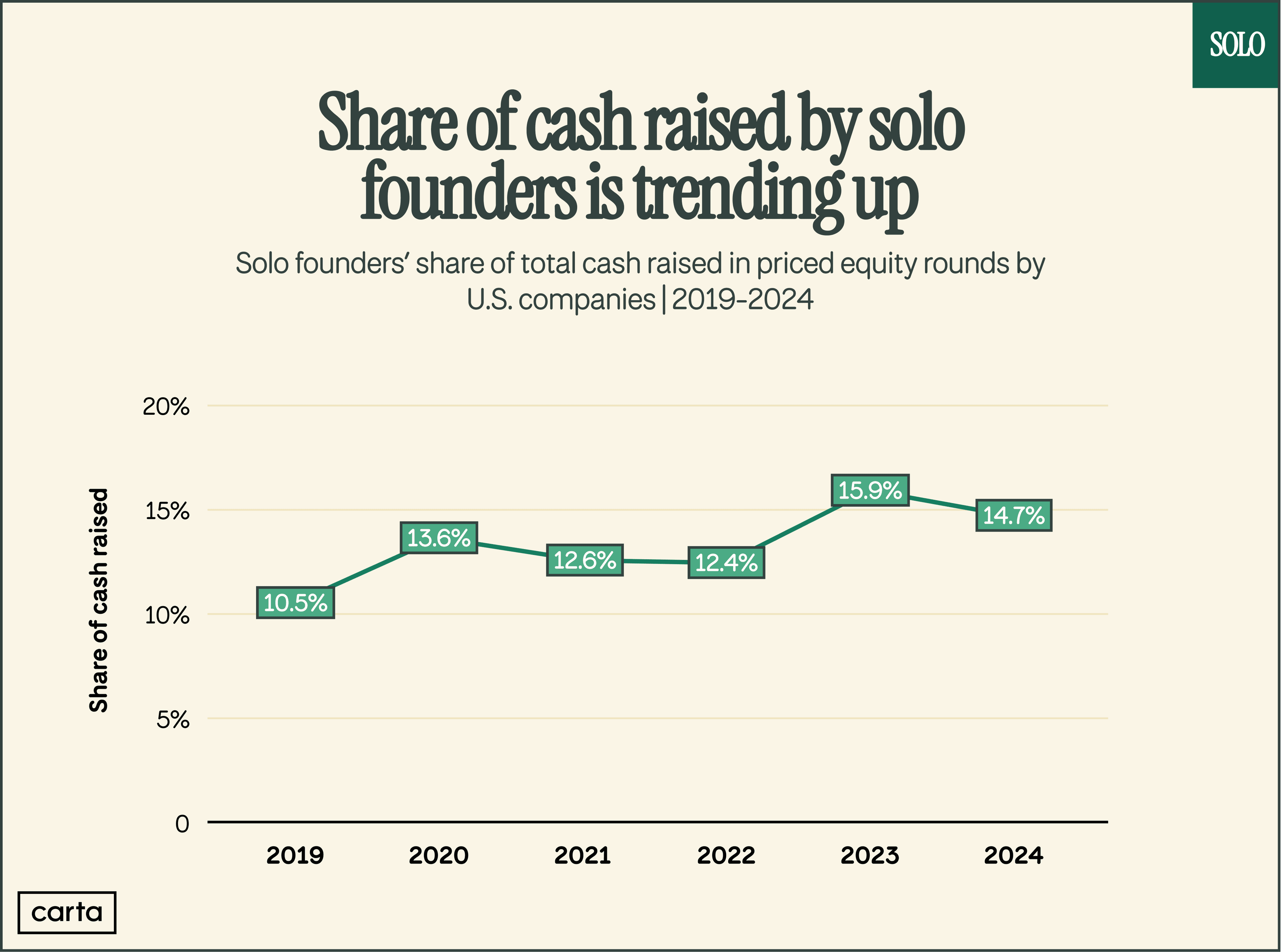
The share of cash raised by solo-founder companies has trended up over the past several years. This increase aligns with solo-founder companies making up a slightly larger share of total companies — 23.7% in 2019 versus 30.5% in 2024. This trend may also reflect more solo-founded companies progressing into later funding stages, where round sizes are larger and therefore have a greater influence on total cash raised amounts. As Peter Walker (Carta) comments: ’This is to be expected. If the share of solo founders is rising, you would expect them to raise a slightly higher percentage of cash year-over-year, which is what we see in this chart. This is impacted less by the number of people starting companies as solo founders and more by the number of founders getting through VC filters to raise capital. As VC attitudes toward solo founders change, this percentage might increase faster in the coming years.’ Ann Miura-Ko (Floodgate) adds: ‘I’d attribute the increase — going from around 10% in 2019 to the mid-teens more recently — mostly to investors getting more comfortable after seeing more solo founders succeed. Although, I don’t know that it’s hugely significant. In my own deal flow, it still feels like maybe one in eight or one in ten companies is led by a solo founder.’
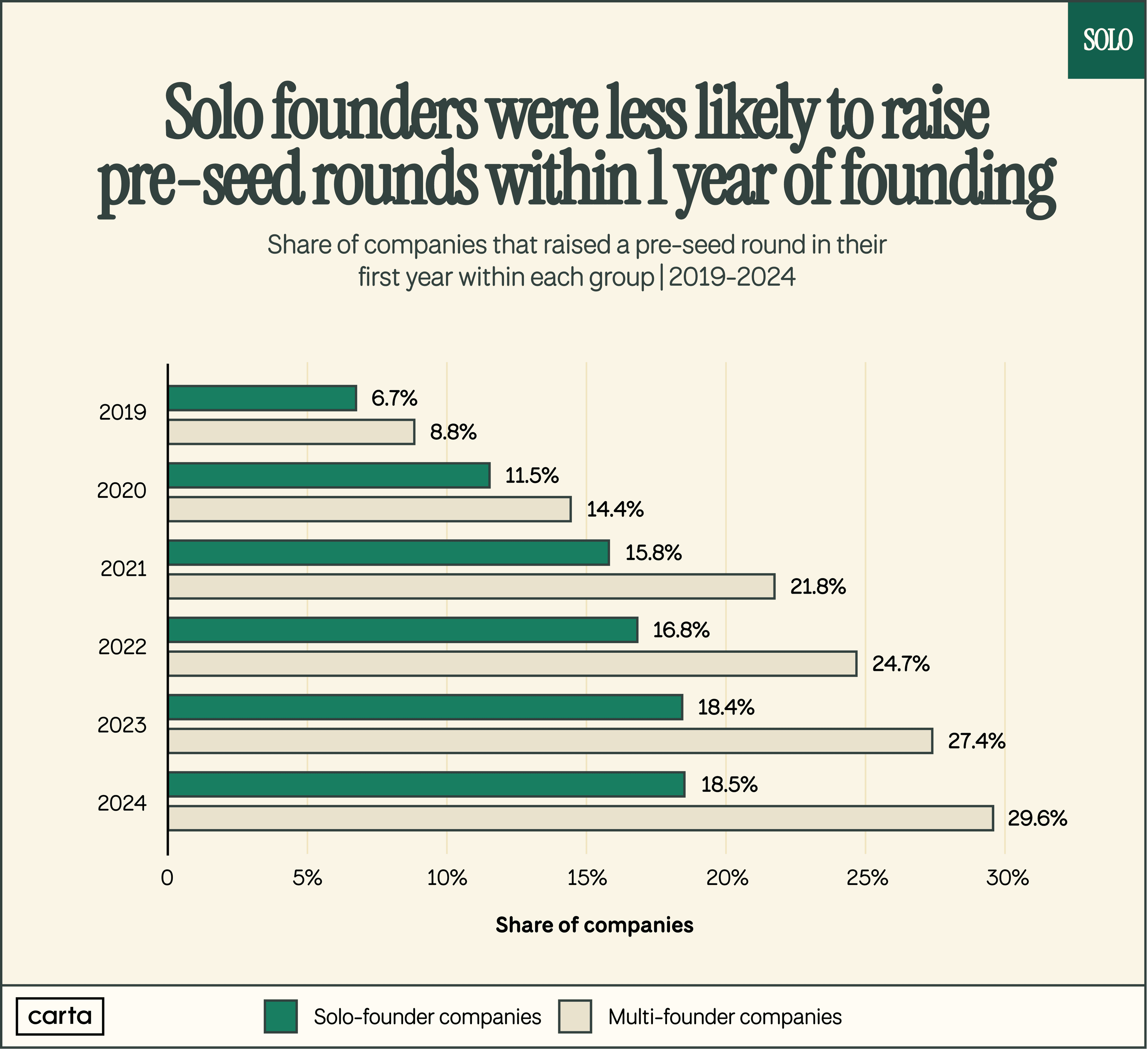
Solo-founded companies were less likely to raise a pre-seed round (SAFE or convertible note) within their first year compared with companies with co-founders. Several factors could explain this gap. Some solo founders may wait longer to raise, using that extra time to build usage, revenue, or product traction before fundraising. It’s also possible that timing differences play a role: as the next chart shows, solo founders often raise their first priced round sooner, which means some may skip the pre-seed stage entirely. The share of companies raising within one year has increased for both solo- and multi-founder companies over time. This could reflect how AI startups are raising sooner than traditional SaaS companies, reaching revenue milestones and investor readiness earlier. As Peter Walker (Carta) comments: ’There are likely many cross-currents and underlying dynamics at play here. You could argue that a solo founder has lower burn after incorporating than a company with co-founders or early employees, which allows them to tinker, pivot, and experiment for longer before needing to raise external capital. It’s also possible that solo founders are less fixated on raising venture funding at all. For many, a pre-seed round isn’t the top priority; they’re more focused on nailing the product, market, and customer first.’
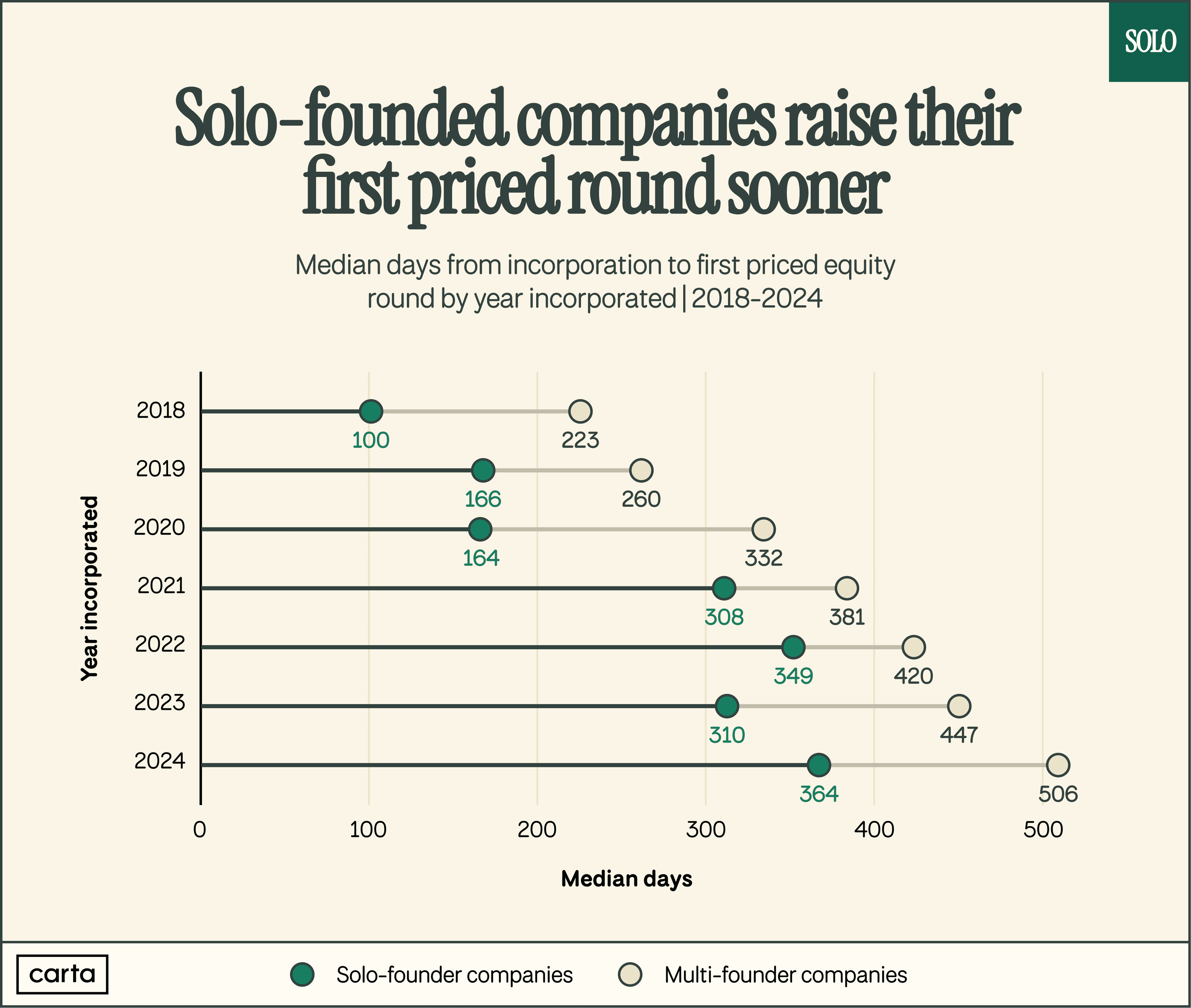
Solo-founded companies raised their first priced equity round sooner than companies with co-founders in every cohort year from 2018–2024. This pattern likely aligns with the previous finding that solo founders are less likely to raise a pre-seed round in their first year. Without that early injection of capital, solo founders may move more quickly to a priced round. In contrast, multi-founder teams that raised a pre-seed round would have more runway before needing to raise again. The overall time to first priced round is increasing for both solo- and multi-founder companies. This likely reflects a combination of startups progressing further on SAFE rounds before pricing equity and founders being able to bootstrap longer — aided by AI-driven productivity gains and lower upfront costs. As Peter Walker (Carta) comments: ’This connects to the previous chart, which shows solo-founded companies are less likely to raise a pre-seed round. One interpretation is that they spend less time raising SAFEs or pre-seed capital during the tinkering phase. It may take them a little longer to find their footing, but once they do, they move directly into a priced round.’
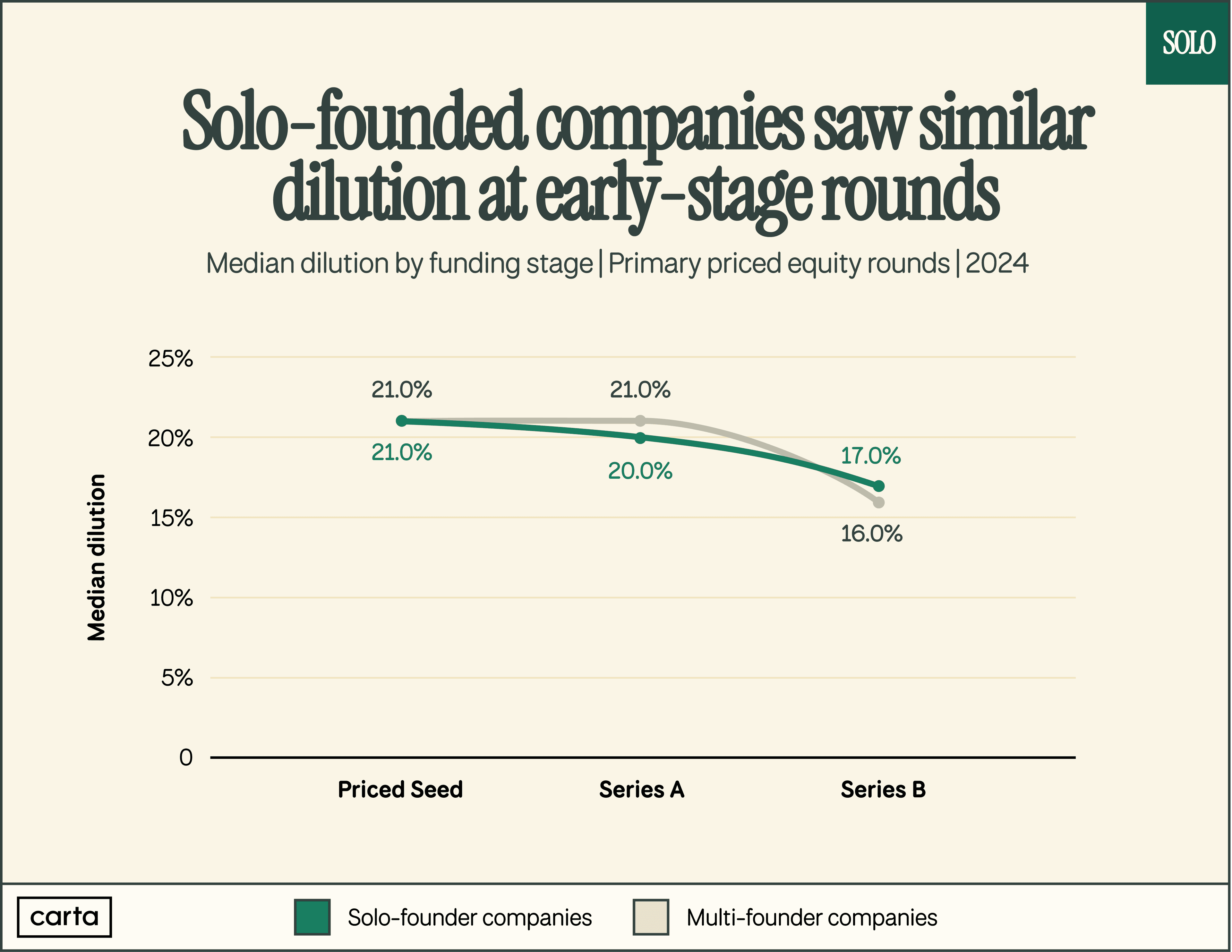
In 2024, solo- and multi-founder companies experienced nearly identical dilution across early funding stages. Institutional investors often target similar ownership ranges by stage, and competition among funds helps keep those norms in check. Increasing founder-to-founder communication further reinforces these expectations, leaving limited room for meaningful deviation. As a result, both solo- and multi-founder companies tend to give up similar percentages at each stage, regardless of founding team structure. As Peter Walker (Carta) comments: ’This tells me that when a solo founder can convince a VC they are a great investment, they don't pay a tax. The VC doesn't demand more equity to counter the perceived risk of a solo founder. The dilution is about the same as it is for other companies they're investing in.’
As a solo founder fundraising, I think you get more bullets. I raised a pre-seed that I probably didn't need and then raised a seed round four months later. Because I'm a solo founder, I have more equity. That gives me a great opportunity to bring more people onto my cap table and give them an early markup.
Paul Klein IV, Browserbase
Most of the penalties happen at pre-seed and seed. By Series A, the business is operating and effective, so the question of being a solo founder is less material because you have business performance to evaluate.
Charles Hudson, Precursor Ventures
Solo founders feel risky. The price differential at seed could entirely be ‘hit-by-a-bus’ risk, where the entire venture is wiped out if something happens to that one person.
Daniel Francis, Abel Police

Solo founders are often more selective about which investors they work with because they don’t have a built-in partner serving as a constant mirror. Speaking for myself, I’d be very intentional about who I wanted on my board and who I’d work with long-term. It’s not just about the capital.
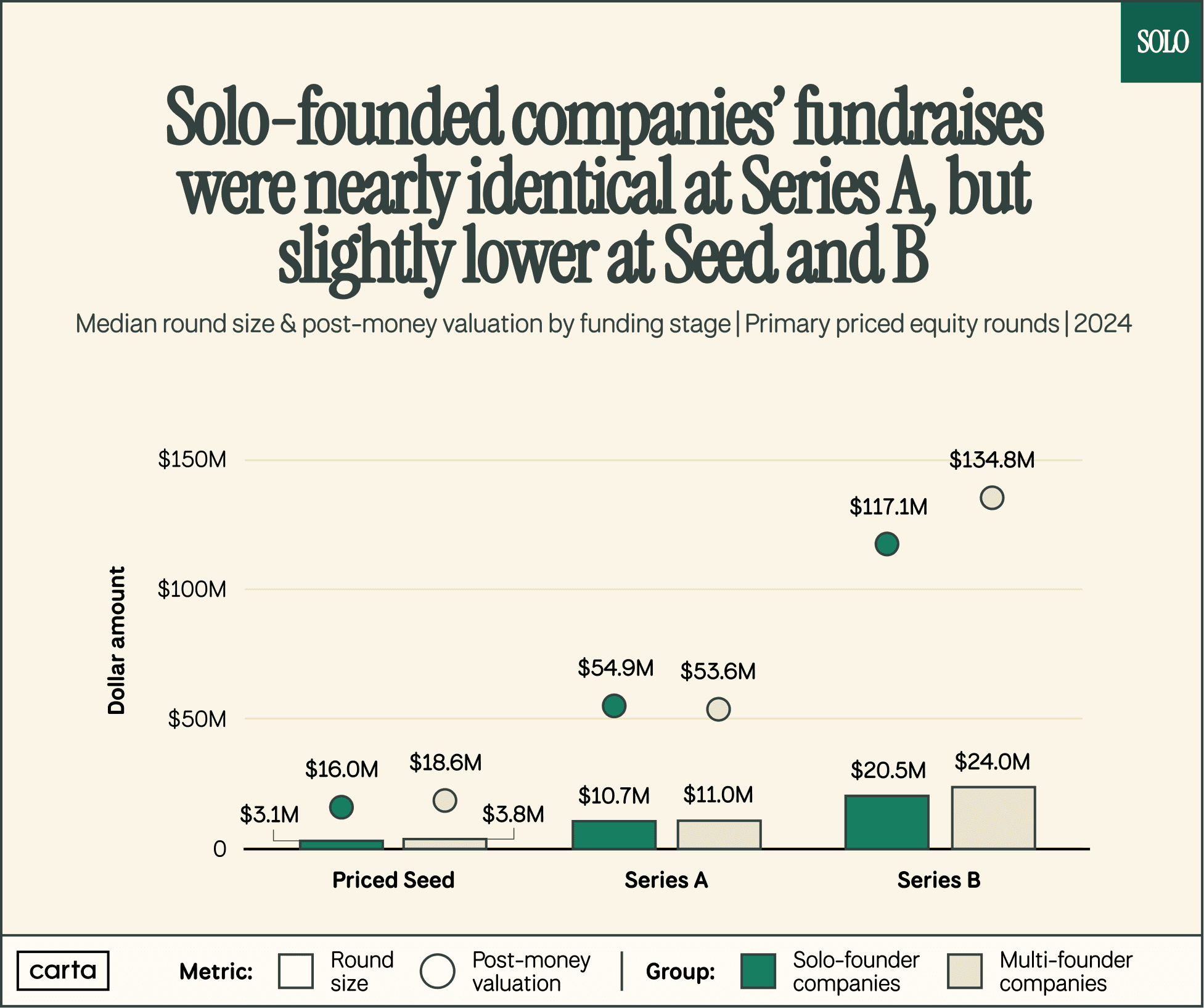
In 2024, solo-founded companies' fundraises were nearly identical to multi-founder companies at Series A, but slightly lower at the Priced Seed and Series B. At Priced Seed, investors are mostly evaluating the founding team. A mild bias against solo founders likely pulls their median valuation down, and there's often less competitive bidding to push it up. By Series A, the focus shifts to the business and broader team, so whether there's one founder or several has far less influence on valuation. As Peter Walker (Carta) comments: 'There might be some distinctions by industry. For example, if more solo founders are concentrated in sectors with lower valuations overall, that could help explain the difference. If this is causal and not just correlative, my instinct is that solo founders are a little more conservative about how much money they think they need. Usually, dilution is just the result of a math equation: how much you want to raise determines the valuation, and 20% just pops out. It may be that solo founders are more conservative on the amount they raise than their co-founder counterparts.
FIELD NOTES
from Julian Weisser
CEO of Solo Founders
Don’t over-index on investors’ reasons for passing. Often they choose an inoffensive reason instead of the truth. It’s easier to say you’re solo or the TAM is too small than to say, “I don’t believe you have what it takes to win.”
It's better to start with angels. Angels look for reasons to say "yes" and VCs look for reasons to say "no." Niels Hoven (Mentava) had this experience:
'VCs would say, 'You're not technical enough. You don't have a co-founder. You don't have a product. You're too early.' They were looking for all the reasons to say no.
In contrast, the angels were like, 'We love you. We love your mission. You don't need a co-founder. Go for it.' The difference between the VCs and angels was stark.'
When raising, you can be less valuation-sensitive. All founders say they prioritize the investor’s quality over the valuation, but it’s easier to be lured towards an offer with less dilution from a lower quality fund when splitting your company equally with co-founders.
Don’t apologize or mention being a solo founder. Charles Hudson (Precursor Ventures) warned:
'If being a solo founder was an intentional decision, you shouldn't have to qualify or explain it — and definitely don't do so until asked. If you know you're never going to add a co-founder, don't give a wishy-washy answer like, 'Maybe someday.' Just say: 'No, it's going to be me. We're building a team, and I'm not looking for a co-founder.’
Have a clear plan for hiring. We’re not in the AI-only teammate era. If asked, take Charles’ advice:
'Be ready to share how you will use the extra equity you have [as a solo founder] to build a world-class team.'
Be aware of predatory terms. We’ve noticed a disturbing trend of some notable VCs and accelerators emphasizing valuations while hiding founder-unfriendly terms in side letters that they try to slip past less experienced founders. No founder should consider accepting these terms unless their company is under extreme financial duress.
Solo founders tend to build their teams earlier because it’s just them to start.
Across both solo- and multi-founder startups, engineering remains by far the most common first hire, reflecting the essential need for technical capacity. On equity, the data suggests that solo founders are still following market norms. Median equity for early employees is broadly equivalent across solo- and multi-founder companies.
These patterns point to a moment of transition: solo founders are hiring earlier, but they’re still operating within familiar frameworks for building early teams and allocating ownership. As solo founding becomes its own category, we anticipate that solo founders will use their extra equity to win the most sought-after talent.

As a solo founder, you better be a really good recruiter. Not everybody is. I met 55 different people before offering the founding engineer/CTO role to Saul.
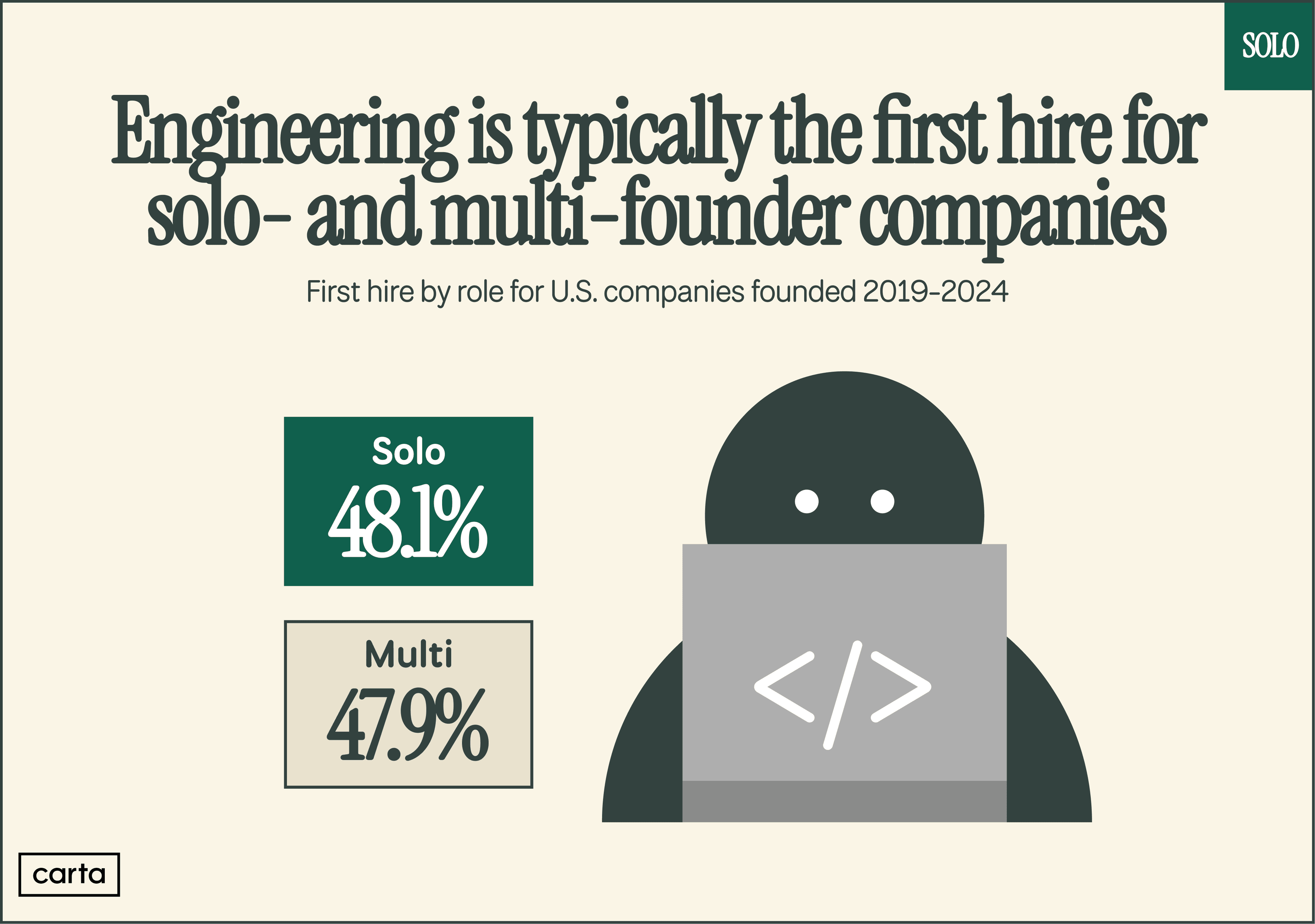
Across both solo- and multi-founder companies, engineering is by far the most common first hire, allowing founders to keep leading early sales while technical work moves forward. When engineering isn't the first hire, solo-founded companies lean slightly more toward operations roles — 14.5% versus 10.7% for multi-founder companies. Anecdotally, some founders prioritize hiring a specific type of person rather than a particular role. As Rahul Sonwalkar (Julius AI) notes: ''You need people who will multiply your efforts — not just execute a delegated task and wait for the next instruction, but take a direction and run with it.' Others think of hiring as a way to complement their own skillset and add to the culture of the organization. Adeel Khan (MagicSchool) shares: 'As a non-technical solo founder, my first hire needed to be technical so they could help me build the MVP. I also optimized for people who were deeply committed to the mission, who had skills and talents distinctly different from mine, and were willing to take a risk with me on an early-stage startup.'
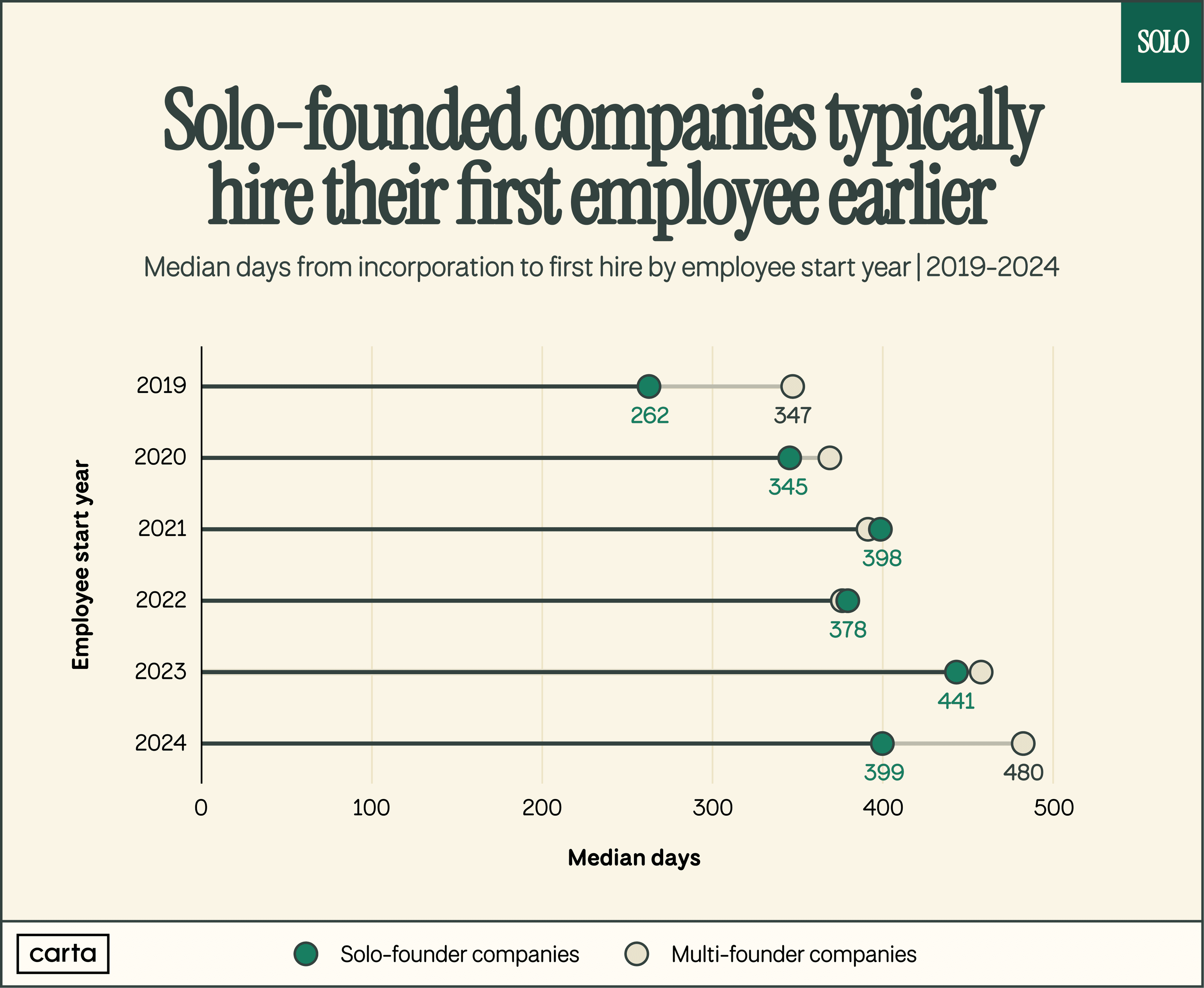
Solo-founded companies typically hire their first employee earlier than multi-founder companies. This makes sense, as co-founder teams start with greater built-in capacity — simply having at least one more person to share the work. Both groups, however, are waiting longer to make their first hire than they did just a few years ago. As Charles Hudson (Precursor Ventures) observes: ’Having someone who can work on a different function while you're doing something else is really important. Once you've raised money as a solo founder, you usually have the capital to do it. So it's pretty common that you have to hire really quickly.’
By default, a solo founder is single-threaded. You must become multi-threaded. You have to have someone building and selling the product while you're hiring.
Paul Klein IV, Browserbase
You can tell how good a founder is by talking to their founding engineer. Solo founders always have excellent ones. More authorship and more equity to grant gets you the best people.
NoÉmIE FEDERICO, SOLO FOUNDERS
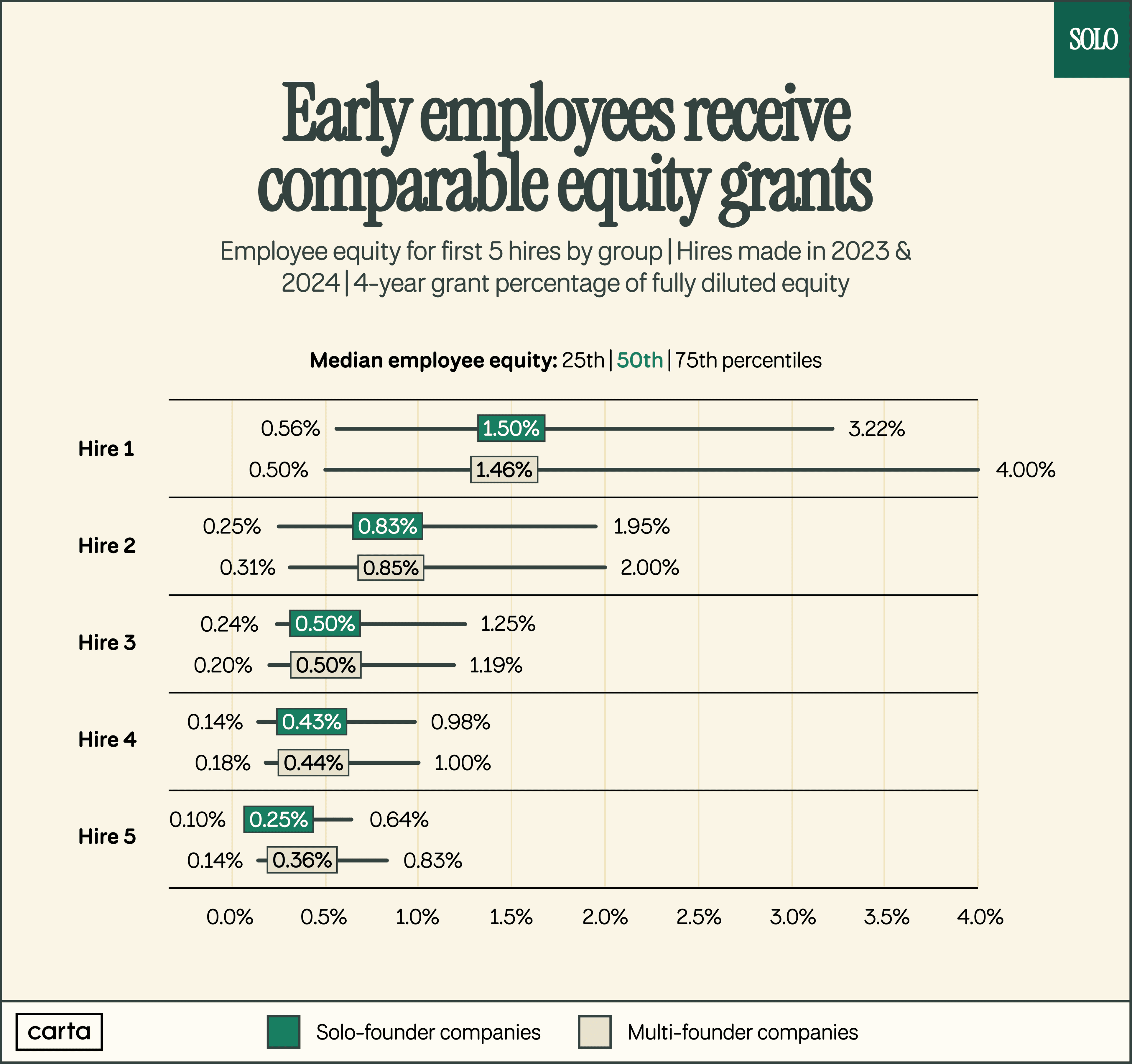
For hires made in 2023 and 2024, median equity grants for the first five employees are tightly clustered and almost identical across solo- and multi-founder companies. This level of convergence is somewhat surprising. In theory, solo founders have more equity to work with because they’re not splitting ownership with co-founders, yet the median grant sizes to their early employees are broadly similar to multi-founder teams. One plausible explanation is that when solo founders look for guidance on equity, they often encounter frameworks built for co-founder teams that have already split the company two or three ways. Those grant sizes make sense when the founding team is heavily diluted from the start, but they don’t reflect the additional leverage solo founders have to strategically attract and incentivize early employees with larger equity grants. Most solo founders we’ve spoken with are more generous with employee equity than the median in this dataset. In those cases, the additional equity can be a decisive factor for candidates choosing between otherwise comparable opportunities. The data here shows where the median is, but it also highlights how much room solo founders have to use equity as a strategic advantage in early hiring.

Being able to offer larger grants to our early team helped us get the best people in those roles. Grants of that size may not have been available to me with co-founders.
As a solo founder, it's important to give significant grants to the early team. When you treat people right, it pays forward to everything you do in the future.
A solo founder has an unfair advantage because they have far more equity to work with. Building an early team with meaningful ownership is powerful — it changes the game. Instead of having two or three co-founders deeply invested in the outcome, you can have 10 or 15 early team members who all feel like owners.
What this data exposes is that many solo founders are probably leaving excellent talent on the table because they aren’t willing to offer, say, 4%. They have that equity. You could easily give it and get someone who will move their family and be completely live-or-die for the company.
I don't think we're as sophisticated about solo founder equity, cap tables, and grants as we are with co-founded companies. They might ask, 'Why shouldn't we give our first or second founding engineer 3%?' and then immediately think, '3% is way too much.' But 3% is only too much in the context of two founders.
Charles Hudson, Precursor Ventures
There’s very little difference in equity grants, which runs counter to the theory that solo founders would be more generous with ownership. We expected equity to be a lever they’d pull to outcompete multi-founder companies for the best talent. Perhaps this is an underused strategy that solo founders could lean on, but largely aren’t yet.
FIELD NOTES
from Julian Weisser
CEO of Solo Founders
More equity for early hires is a massive hiring advantage — use it. One of the most surprising things in the Carta data was how closely the median solo founder’s employee equity grants mirrored those of multi-founder companies. That’s likely due to them following median advice — likely geared towards multi-founder companies.
The Carta data does not align with my experience with solo founders over the last 6 years or the Solo Founders Program in 2025. In both cases, the solo founders I've worked with often gave 2-5x the equity for early employees than the median numbers in the previous chart.
Daniel Francis (Abel Police) says it well:
'The solo founders in this data are being too greedy... They're being penny-wise and pound-foolish, because the quality of the person you can bring in [with higher equity] is so much higher.'
If you don’t have co-founders, you have double the equity to recruit the best people. In competition for top talent, you’ll have a significant advantage with higher equity compensation than multi-founder companies. Importantly, higher equity will attract those who care about long-term upside.
Consider longer vesting periods. It’s becoming common for co-founders to have longer vesting than 4 years. If you’re giving large equity grants to attract top talent, consider making it over a longer time horizon like 6 years. A one year cliff is still the standard.
Part-time hires are underrated. Many founders believe they should focus on hiring full-time team members, but many successful solo founders have discovered it's better to keep the core team as small and high-quality as possible. Eugenia Kuyda (Wabi) emphasizes this idea, saying:
'We're trying not to hire everyone for the core team. If we need someone for a specific task, we'll hire them as a contractor instead.'
Contract-to-hire helps you lure the best talent full-time. Some top candidates aren’t available full-time. The strategy is to use contracting as a hiring tool to convert hard-to-get people.
Daniel Francis (Abel Police) describes the benefits:
'They start falling in love with the problems they’re working on, seeing the progress and then you can hire them.'
Paul Klein IV (Browserbase) shares how reducing the friction to start working with someone part-time ultimately helps you get them full-time. He says:
'You can DM someone you like on Twitter and offer to pay them to work with you for a couple of weeks. If they agree, you have a good chance of convincing them to join for the long haul. Using a contract to convince someone to work for you is a great way to get your foot in the door.'
Solo founders retain significantly more ownership than co-founders.
Their stakes start higher and remain higher at every stage of the journey. They tend to hold meaningfully more ownership than lead founders in multi-founder companies when exiting, and are now exiting slightly faster. This pattern suggests that greater ownership gives solo founders more flexibility in defining success — and, in some cases, the ability to realize meaningful outcomes earlier, before taking on the heavier dilution of later rounds.
More ownership doesn’t necessarily mean a better outcome since exit values drive most of this, but it highlights how the structure of the founding team influences one of the most consequential variables in the founder experience. Overall, the data points to a core advantage of the solo founder model: greater individual ownership translates into greater agency from fundraising through to exit.
To this day, when I think of how much equity I have left, I'm grateful for my investors because I got something in exchange for it. But I can't imagine what it would be like if I had a co-founder and half as much equity. I certainly would have been a lot more stingy and would have fought harder to give up less ownership in every round.
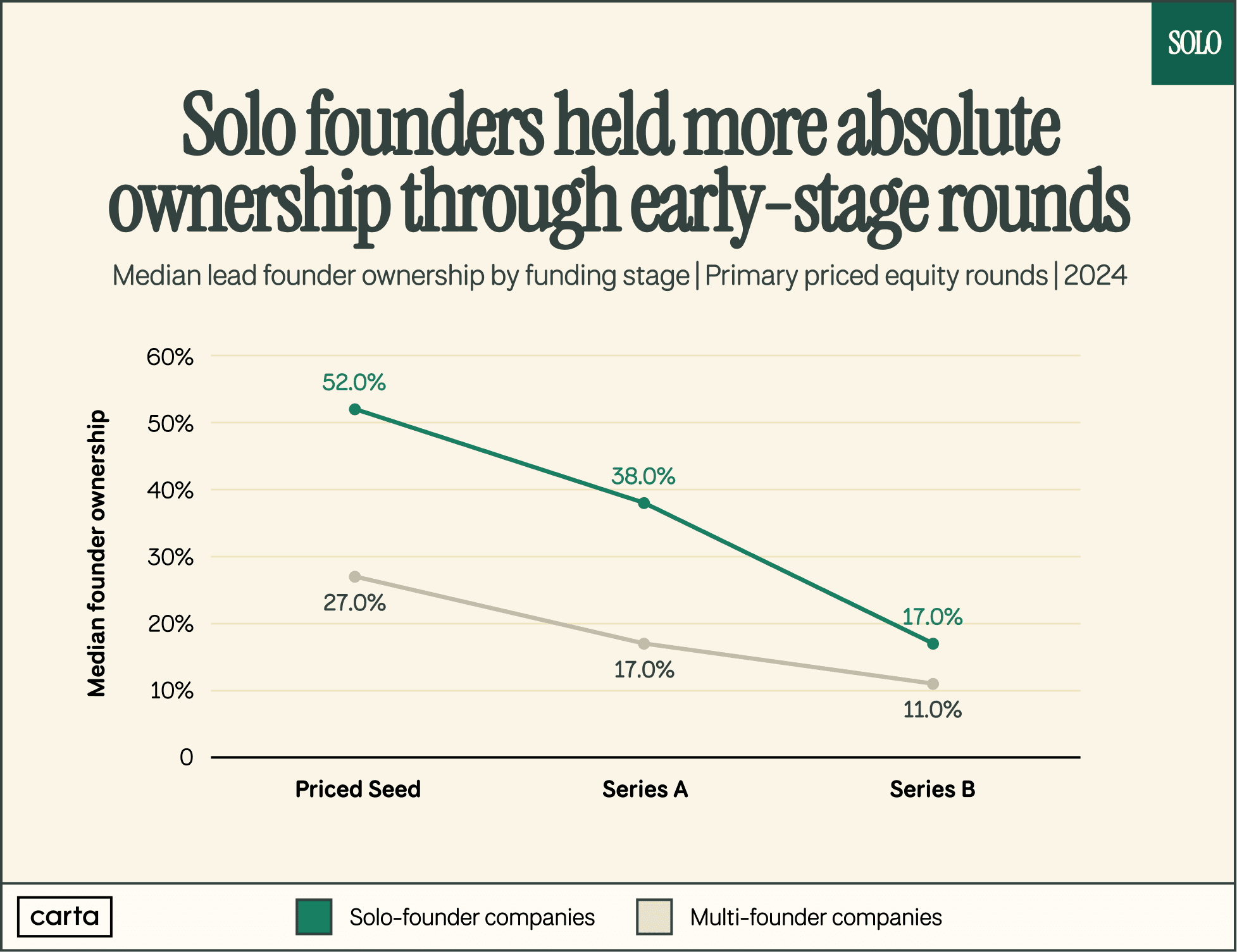
Solo founders held substantially more absolute ownership than lead founders (the co-founder with the largest equity stake, typically the CEO) in multi-founder companies through early-stage rounds. The effect compounds meaningfully over time. By Series B, solo founders hold a roughly 50% larger personal stake, assuming comparable valuation and dilution levels. As Peter Walker (Carta) comments: ’Solo founders split equity with no one on a co-founding team, so they naturally own more of the company at every round. They’re diluted at roughly the same rate as their peers, which means they personally retain a larger share of the pie.’
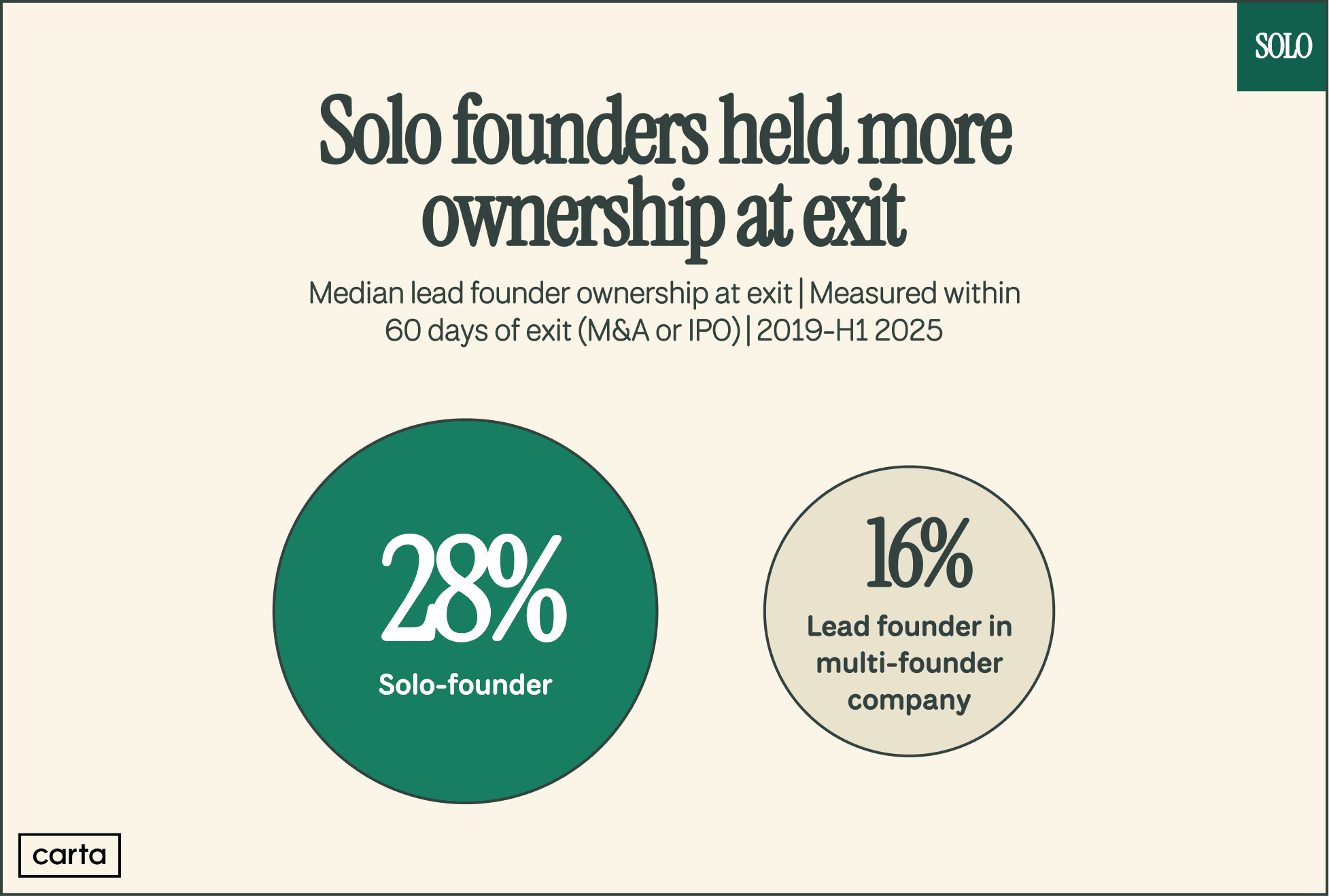
Between 2019 and H1 2025, median ownership at exit was 75% greater for solo founders than lead founders (the co-founder with the largest equity stake, typically the CEO) in multi-founder companies. A few factors may help explain this gap. Solo founders hold more ownership because they don't have to split equity early among co-founders. As a result, if their dilution patterns through fundraising mirror those of multi-founder teams, they tend to retain more ownership when exiting at comparable stages. Another possibility is that a larger share of solo-founded companies exit earlier in the startup lifecycle, before taking on the additional dilution associated with later-stage funding. For example, if solo-founded companies were to exit around a Series C stage while teams with co-founders exit closer to Series D, that timing difference would naturally contribute to the gap. It's worth noting that more ownership at exit only implies a better outcome when exit values are comparable, which this data does not capture. Still, the ownership gap highlights how structural differences in founding team size can come into play at exit.
It makes sense to me that solo founders often hold more at exit because they don’t split the pie at the beginning. The right co-founder can grow the pie, but I also recommend long founder vesting schedules if you do go the co-founder route. The wrong co-founder can be value destructive.
Christina Melas-Kyriazi, Bain Capital Ventures
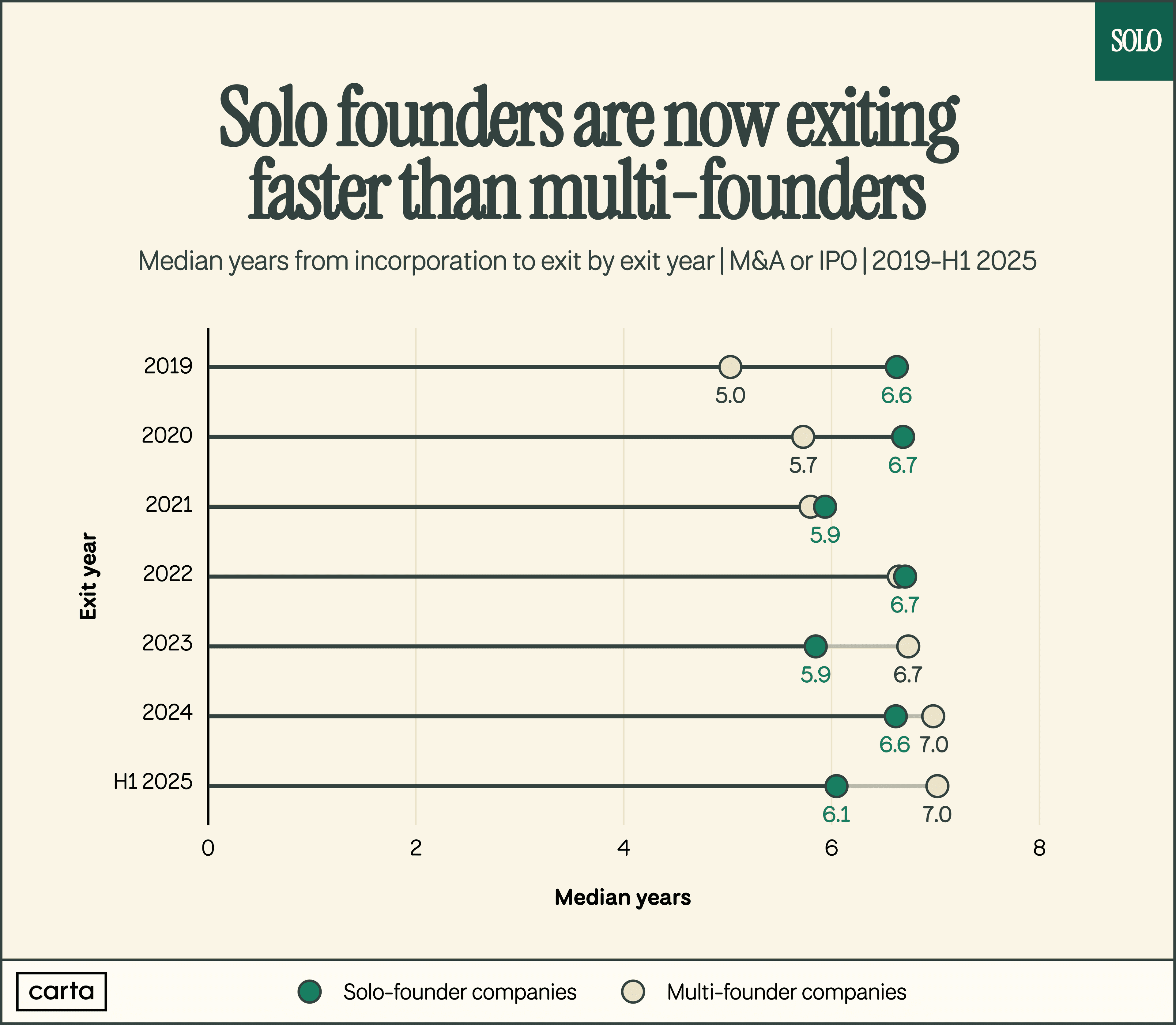
Solo-founded companies took longer to exit in earlier cohorts, but have exited slightly faster than multi-founder companies more recently. Read alongside the previous chart, solo founders have been reaching exits sooner while holding a larger percentage of their company at exit. Several factors may help explain the difference. For one, decision-making is often more streamlined for solo founders when it comes to selling the company. There’s no need to align with co-founders who may have different views on timing, exit price, or post-acquisition roles. In addition, solo founders may have greater flexibility in determining what constitutes a satisfactory personal outcome, allowing them to accept acquisition offers that meet their goals sooner. Together, these dynamics may help explain why, in recent years, solo-founded companies have accepted exit opportunities slightly sooner than their multi-founder peers. Peter Walker (Carta) comments: ’The fact that [solo founders] are exiting faster is the more interesting part. Perhaps there’s a greater willingness to take a deal when they don’t have to argue it out within a partnership. Many startup founders are offered M&A opportunities along the way, and solo founders may be more open to them because a single exit can represent a generational wealth event.’
The idea that solo founders exit faster is interesting. I imagine co-founders introduce more personalities, potential conflict, and coordination problems, which slows things down. We've raised tens of millions of dollars. We've used that growth capital to buy some businesses. I don't know when we'll exit, but it makes sense that solo founders might exit faster simply because they can move faster.
Solo founders might get more money from an exit, which can make them more inclined to take a deal. If I were only getting a third of the payout, it might not feel as meaningful — I’d question the point of selling.
FIELD NOTES
from Julian Weisser
CEO of Solo Founders
When you own significantly more of the company, early exit offers will be more tempting. An offer that feels modest to co-founders can feel life-changing to a solo founder. Don’t wait to decide in the moment.
Before starting the company, write down your thresholds, values, and conditions for saying yes or no, so emotions do not hurt your decision-making.
An exit isn't the only way to get liquidity. Consider secondaries for you and the team. It's become more common for startups to sell secondaries at the Series B stage. Charles (Precursor Ventures) advises founders to take liquidity to de-risk their lives so they can go "long" on the company without financial stress.
Consider this for your team, too. Many haven't seen their equity become valuable. This shows them that the hypothetical is now real and will benefit them financially. It will reward them for their past work and encourage them to keep going.
Utilize your extra equity with investors. Because you start with 100% ownership, you can be less sensitive to dilution than a multi-founder team. Use this leverage to secure the best partners.
Jimmy Douglas (Plug) explained this strategy:
'Maybe being a solo founder makes me less concerned about dilution, honestly, because I'm starting with at least 100% more equity than in a co-founder situation.
We're going to dilute 25% instead of 20% because we really like the partners we have at the table.'
MAKE SOMETHING
(OF YOURSELF)
Life becomes more enjoyable and meaningful when you make something. Some will tell you to make something people want. The far more important work is making something (of yourself). When you make something of yourself, it’s more than producing an object or a business. It’s embedding a part of you in the thing you’ve made — it’s creating an externalization of your soul. That happens best when you’re not chasing others’ approval or shaping your work around their opinions, but simply doing what feels right. When it comes to startups, I’ve seen far too many people held back from making something because they could not find an excellent co-founder. Worse, I’ve seen people start things with “co-founders of convenience” only to have the entire thing they were making go up in smoke. Don’t let the false belief that co-founders are required stop you from building something important. Solo founding is the future. If you’re reading this, you might have already gotten started. If so, keep going. If you haven’t started yet, maybe now is the time. The world needs more authors.
Julian Weisser
julian@solofounders.com
December, 2025

Thank you to the following people for supporting Solo Founders and this project:
Flo Crivello
at
at
Plug,
at
at
at
at
at
at
at
at
at
Wabi,
at
at
at
at
at NFDG,
at
at
at
at
Lex,
at
at
at
Andrea Torres, and
Thanks to key contributors from the Solo Founding Team:
Thank you to the
Team,
and
Special thanks to Solo Founders Program founders:
at
Nura,
at
at
at
Giga,
at
at
at
Docura Health, and
at
A REPORT FROM THE FRONT
Get the full PDF of the State of Solo Founding
100 pages of solo founder data, commentary, quotes, insights, and interview content, straight to your inbox.
By submitting your information, you agree to the processing of your personal data by Carta as described in Carta's Privacy Policy and Terms of Service.