When a woman is murdered because of gender-related violence, we have a word for it: femicide. According to UN Women, a killing may be classified as femicide when it is motivated by gender-related factors such as discrimination, unequal power relations, gender stereotypes, or harmful social norms. In practice, UN femicide numbers include any killing of a woman by intimate partners or other family members. Misogyny—the hatred of, contempt for, or prejudice against women or girls—is listed as one of the contributing factors.
In the United Kingdom, the organisation Femicide Census recorded 121 killings of women by men in a single year. But its approach is perhaps too broad, classifying killing as femicide whenever a woman is killed by a man, regardless of motive or context. This means the census includes not only killings that clearly involve gendered violence—one case of so-called “honour” killing or three cases of murders following rejected advances—but also cases arising in the course of other crimes, including robberies, substance abuse, and, in a small number of instances, illegal assisted suicides.
Government statistics can offer a more nuanced picture.
The UK Home Office publishes Domestic Homicide Reviews (DHRs), a multi-agency investigation into deaths that may have resulted from violence, abuse or neglect by a family member or current or former intimate partner. Reviews are also conducted when a victim dies by suicide following a documented history of domestic abuse.
Between October 2022 and September 2023, the reviews recorded 80 victims killed by a current or former intimate partner: 66 women and 14 men.
Whether misogyny or misandry was a contributing factor in any individual case is not routinely established by these reviews. Instead, the framework looks past explicit hatred to define gender-related violence through the lens of gender stereotypes, prejudice, unequal power dynamics, and harmful social norms.
If those factors are sufficient to make a woman’s death a gendered issue, they should be sufficient to make a man’s death a gendered issue as well.
In the United Kingdom, the Health and Safety Executive recorded 124 fatal workplace injuries during 2024. Of those, 118—more than 95%—were men.
For technical reasons, the HSE excludes road traffic collisions involving professional drivers from its workplace fatality statistics. The Department for Transport estimates that a further 59 working drivers and passengers died in road traffic incidents during the same year. Although no official breakdown by sex is published, the UK’s professional driving workforce is 98% male.
Most victims, however, are far less visible.
Occupational disease unfolds over decades. The Health and Safety Executive estimates that 13,000 people die in Britain every year from illnesses linked to past workplace exposure, principally asbestos, silica dust, diesel exhaust, industrial chemicals and other hazardous substances. Again, these statistics do not distinguish between men and women. But they do not need to. The occupations historically associated with these exposures—mining, construction, heavy manufacturing—have always been overwhelmingly male.
Few areas of public life remain as heavily segregated by sex as dangerous work, and the silence around this disparity is striking. No annual reports rank countries by occupational mortality inequality. No international targets to reduce the gender gap in workplace deaths.
For decades, governments, international organisations and campaign groups have rightly devoted enormous attention to gender disparities in pay, political representation, unpaid care work and participation in science, technology, engineering and mathematics.
The European Union has adopted strategies to reduce occupational segregation in STEM professions. The United Nations’ Sustainable Development Goals call for the reduction and redistribution of women’s burden in unpaid work. The European Parliament demands an action plan to eradicate the gender pay gap.
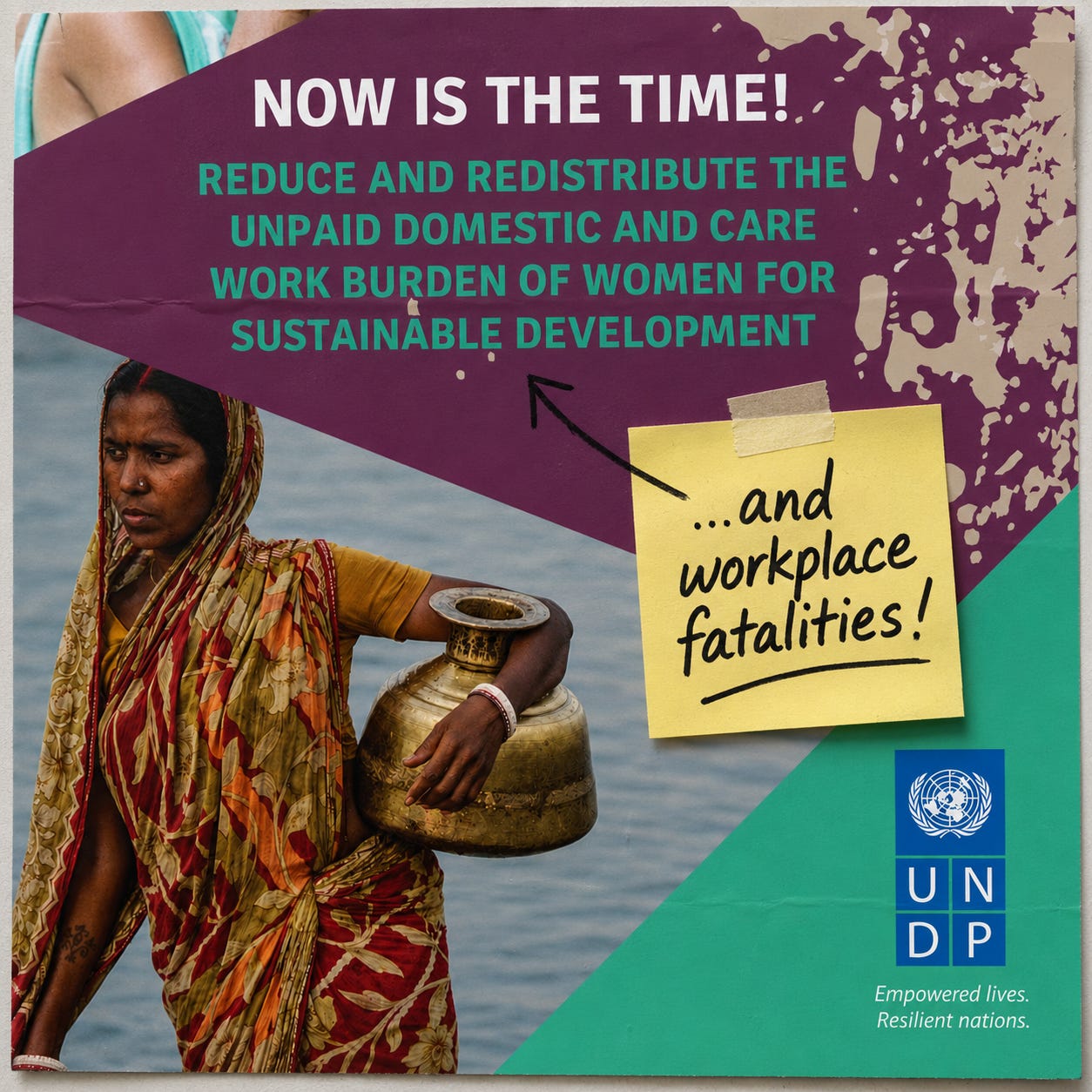
All of these institutions address occupational disparities rooted in millennia of traditional gender roles.
But none has an equivalent objective for the largest occupational disparity of all: the fact that men die at twenty times the rate of women simply by fulfilling their gender roles — providing for their families and building their nations.
Nobody ever demanded that working men not die at twenty times the rate of working women.
This omission matters because how societies classify problems influences how they attempt to solve them.
When a disparity is recognised as a gender issue, it attracts research funding, dedicated policy initiatives, public awareness campaigns and institutional accountability. When the same disparity is framed simply as an unfortunate consequence of individual choices or market forces, it rarely receives comparable attention.
Not every gendered death is violent. Some unfold in private, behind closed doors, leaving no obvious perpetrator and no dramatic images for the evening news.
In the United Kingdom, men account for around three out of every four suicides. Similar patterns exist across Europe, North America and much of the developed world. In many countries, suicide is the leading cause of death among men under 50. Yet despite its extraordinary gender imbalance, it is rarely discussed as a men’s issue.
If three out of every four victims of a particular disease were women, few would hesitate to describe it as a women’s health issue. Researchers would ask why women were so disproportionately affected, governments would commission dedicated strategies, and campaigners would argue that gender-specific interventions were essential.
When the victims are predominantly men, the language changes.
Consider how international organisations measure gender equality in health.
The United Nations Development Programme’s Gender Inequality Index (GII) includes three dimensions: reproductive health, empowerment and labour market participation. Health is represented through just two indicators: maternal mortality and adolescent birth rates—and because very few men get pregnant or die during childbirth, men’s health score is not measured, but fixed at 100%.
Such a choice of indicators is hard to justify.
In the United Kingdom, roughly 80 women die each year during pregnancy or shortly afterwards. During the same period, approximately 162 more men than women die from workplace fatalities and 3,500 more men than women die by suicide. Ten thousand more die from occupational diseases linked to decades of hazardous work.
Yet within one of the world’s most widely used measures of gender inequality, only maternal mortality contributes to the assessment of equality in health. Suicide, occupational mortality and the overall life expectancy gap do not.
Measurement shapes perception. Perception shapes policy. The questions institutions choose to ask determine, in large part, the problems society comes to recognise as requiring solutions.
Is it possible we have developed an institutional blind spot for negative social norms affecting men?
There is an instrument that should answer exactly such a question. The OECD’s Social Institutions and Gender Index (SIGI) seeks to measure discrimination embedded in informal laws and social norms:
Formal and informal laws, social norms and practices fundamentally dictate what women and men are allowed to do, what they are expected to do, and in the end what they do.
The SIGI examines twenty-five indicators across four broad dimensions, ranging from family law to physical integrity and economic resources.
Twenty-five indicators measure discrimination affecting women and girls.
Zero indicators measure discrimination affecting men and boys.
As the authors explain, indicators are capped at 50%, meaning that male disadvantage is not recorded if women perform better than men.
The United Nations’ Gender Social Norms Index (GSNI) takes a similar approach. Published every year, the index claims to break down gender biases and shift social norms towards gender equality. Drawing on data from the World Values Survey, it compiles seven indicators of gender bias against women and girls and none against men and boys.
The SIGI and GSNI do not deny that harmful social norms affect men;
They refuse to look at them.
This leads to a sad paradox. Institutions established to identify harmful gender norms become the pinnacle of the very phenomenon they seek to measure.
This pattern can be seen everywhere, and it suggests a broader principle—the Gendered Vulnerability Razor:
Issues that disproportionately affect one gender are sorted into two categories: those addressed as gendered and those affecting men.
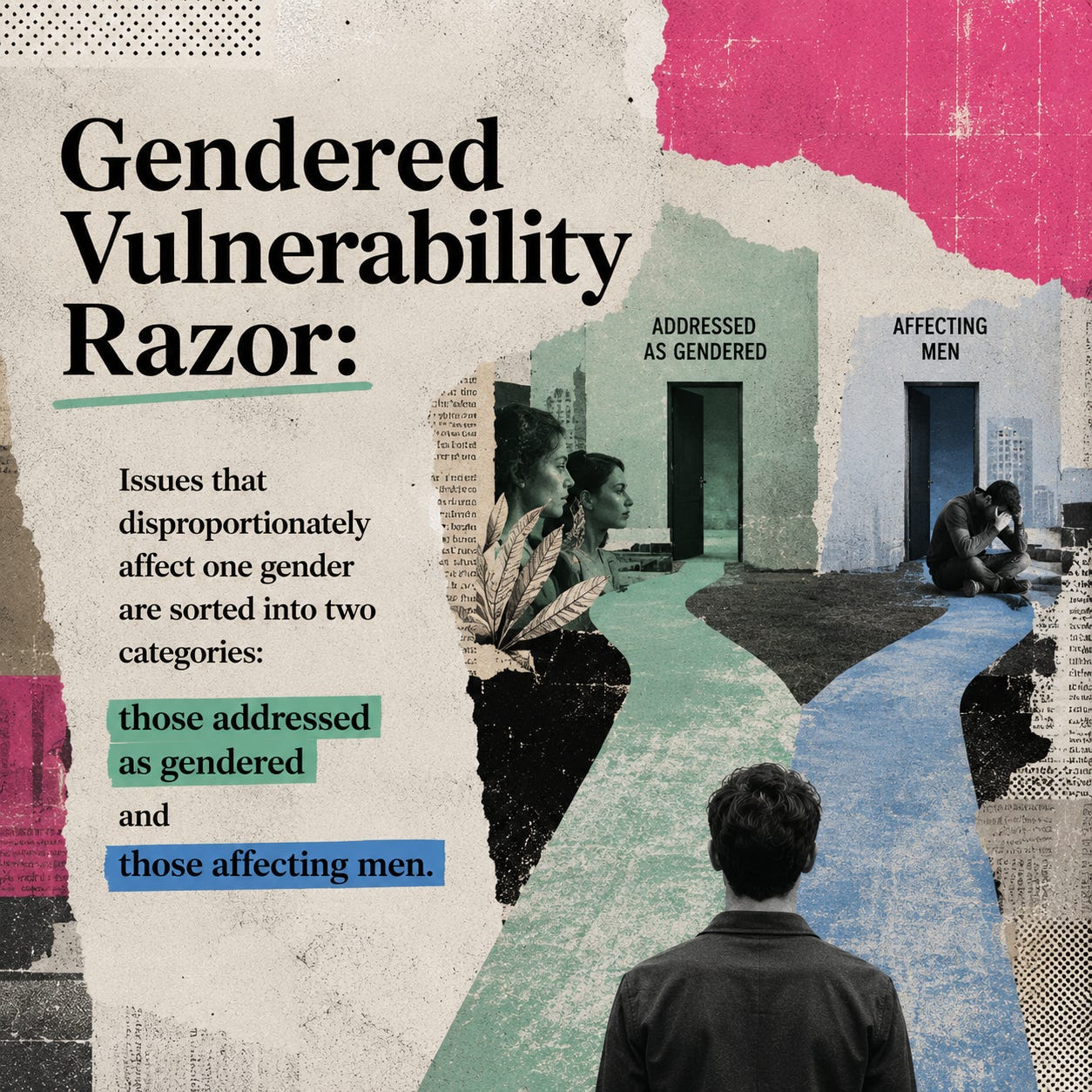
Corollary: Issues that disproportionately affect men are rarely addressed as gendered.
Suicides, accidents, and exposure to hazardous chemicals. Violence, higher rates of smoking, alcohol consumption, and harmful substance use. Together they form the single largest and most consistent health gap between the sexes.
Men die younger in virtually every country—by 6 years in Japan, 5.8 years in China, 5 years across Europe, 4.9 years in the United States, and 3.2 years in India. The world average is 5.3 years.
This is known as the Gender Gap in Life Expectancy (GGLE)—yet it is rarely discussed as a gender inequality.
Instead, it is explained away by one of the most persistent myths of modern public health: that men die younger because of their biology, and there is little we can do about it.
It is an appealing story. It absolves governments of responsibility, discourages scientific curiosity, and transforms one of the world’s largest preventable health inequalities into an unavoidable fact of nature.
The evidence tells a different story.
If biology were the primary cause, we would expect the gap between male and female life expectancy to be broadly similar across countries with comparable populations.
It is not.
Norway and France illustrate the point. Overall life expectancy is nearly identical—82.32 years in France and 83.16 years in Norway. Yet the gender gap differs dramatically. In France, women outlive men by 6.2 years. In Norway, the gap halves to a mere 3 years.
Genes do not change at the border. Public health policies and social norms do.
Cause-of-death statistics tell the same story. Around 30% of Norway’s life expectancy gap is explained by entirely external causes, including suicide, transport accidents and homicide. Remove those deaths, and the gap falls from 3 years to just 2 years.
This raises a compelling question. How much of the gap is truly biological?
Despite the enormity of the consequences, remarkably little research has attempted to answer that question directly. But the studies that do exist point in a consistent direction. Frans Janssen (2020) estimated that gender differences in smoking alone explained around 45% of Europe’s life expectancy gap in 2014. Lars Sundberg (2018) concluded that approximately 75% of the gap could be attributed to non-biological factors such as behaviour, lifestyle and social roles. Jan Schünemann (2017) modelled that differences in unhealthy consumption accounted for nearly 90% of the disparity. Marc Luy’s (2004) study of monks and nuns—living under unusually similar environmental conditions—suggested that biology alone may confer women with a survival advantage of no more than one year.
The precise estimates differ, but their conclusion is remarkably consistent: the Gender Gap in Life Expectancy is not primarily a biological inevitability. It is, to a large extent, the cumulative result of deaths that societies can and do influence: suicides, workplace hazards, smoking, alcohol, accidents, violence and other preventable causes.
The myth of male biological destiny is not merely wrong.
It is deadly.
The world’s most influential gender indices do not merely measure inequality. They define it. Governments use them to shape policy, researchers use them to compare countries, and international organisations use them to determine where progress has been achieved.
The way inequality is measured determines the way inequality is addressed.
Consider the Global Gender Gap Index (GGGI), published annually by the World Economic Forum.
One of its four dimensions is Health and Survival. Yet gender parity is not achieved when men and women have the same life expectancy. Instead, the index proposes that women should outlive men by approximately five years. Only then can a country achieve a perfect score.
The justification is that women “tend to naturally live longer than men.”
But the evidence does not support a five-year biological gap. The variation between countries alone makes this impossible. Cause-of-death statistics show that a majority of the difference comes from preventable factors: suicide, accidents, violence, smoking, alcohol, and occupational hazards.
The United Nations makes a similar adjustment in its Gender Development Index (GDI). The index measures inequality in three dimensions of human development, including health. Yet before comparing male and female life expectancy, five years are added to men’s numbers to account for an assumed “five-year biological advantage that women have over men.”
It is difficult to regard this as an accidental oversight. The five-year adjustment is an explicit methodological choice, made by researchers with access to the most detailed cause-of-death statistics.
The myth that men die younger because of biology does not merely survive. It is built into the blueprints of modern gender discourse.
The consequences are difficult to overstate.
These indices are widely used in academic research, international policy and public debate. They provide the numbers from which researchers construct theories of gender inequality and governments identify areas requiring intervention.
In celebration of International Women’s Day, the United Nations took to social media to issue a cautionary reminder: It’s 2026, and no country has yet achieved gender equality.
And their numbers prove it.
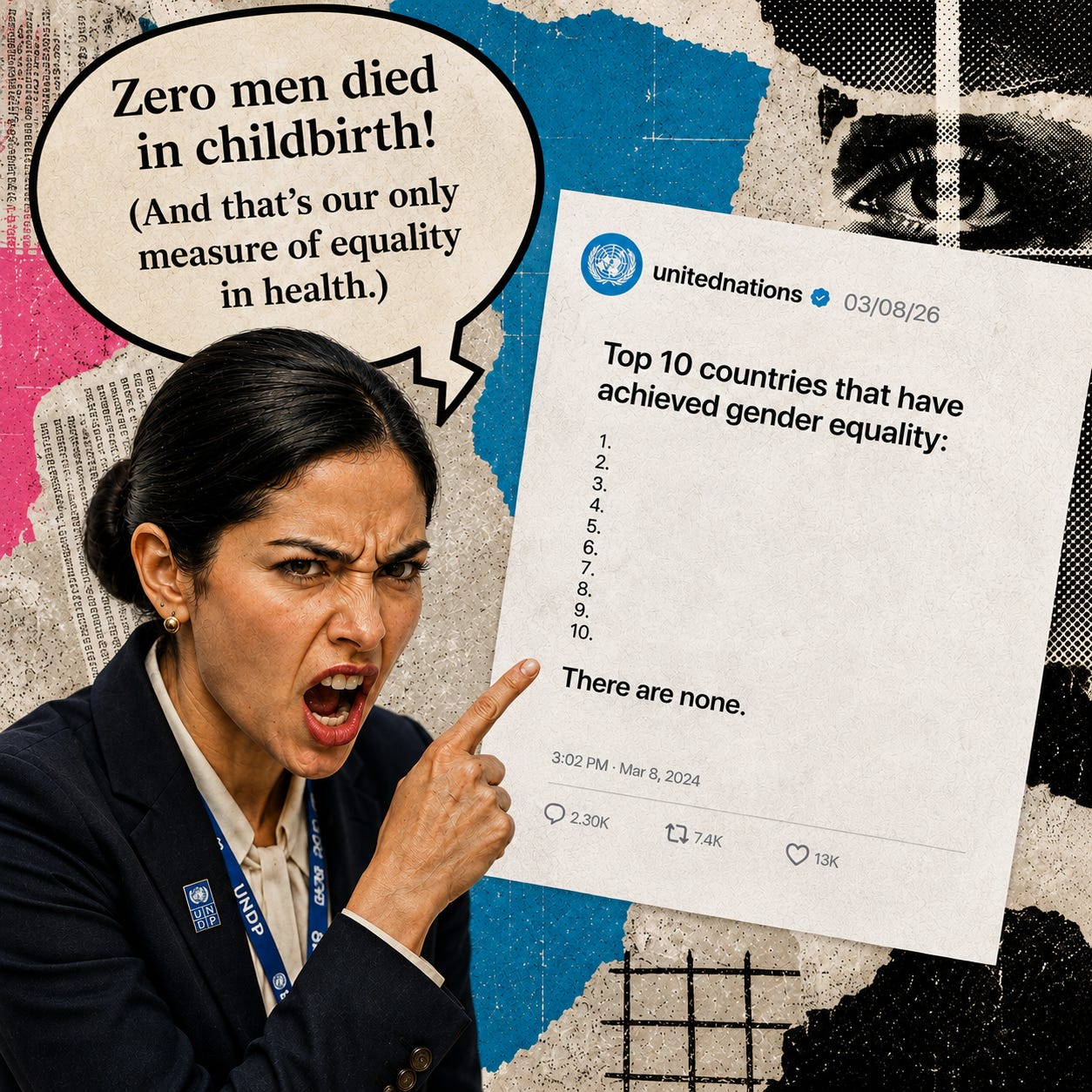
As the GII would have it, even the world’s most gender-egalitarian countries still fall short on health—if only because no men die from maternal mortality. And as the GDI makes clear, in many countries women would emerge as the more developed gender, were it not for the fact that men live beyond the prescribed five-year gap.
Much of contemporary gender scholarship begins with the question of who is systematically advantaged and who is systematically disadvantaged. The answer is then used to construct broader accounts of patriarchy, privilege and gendered power relations.
But what happens when one of the largest gender disparities in human life is defined away before the analysis even begins?
This is not an argument that women face no discrimination or disadvantage. They clearly do. But they don’t need anyone’s thumb on the scale to make the case.
Misandry is defined as hatred of, contempt for, or prejudice against men or boys.
We have seen how gender roles and stereotypes normalize men’s deaths, and how the very tools used to measure social norms and gender inequality are often constructed in ways that systematically overlook disadvantages affecting men and boys. We have also seen how gender prejudice can redefine our understanding of equality itself—turning a five-year male mortality gap into a supposed biological baseline, leaving the resulting deaths largely outside the study of gender inequality.
The question is how many lives does this blind spot cost?
Public health science has a way of answering that.
Rather than simply counting deaths, epidemiologists measure Years of Potential Life Lost (YPLL)—the number of years a person would have been expected to live had they not died prematurely. It is one of the standard ways of comparing the true burden of different causes of death.
For example, slightly fewer women in the UK die from breast cancer than men die from prostate cancer. Yet breast cancer claims many younger lives, resulting in around 198,000 years of potential life lost each year, compared with 117,000 for prostate cancer. Although the number of deaths is slightly lower, breast cancer imposes a much greater burden on society.
The same measure can be applied to our question.
At the beginning of this essay, we identified 66 women as victims of gender-related intimate-partner homicide or suicide. The average age of victims in the review was 48. On that basis, we can estimate a loss of approximately 2,310 years of potential life.
By comparison, approximately 322,500 men in the UK die 3.9 years prematurely because of the life-expectancy gap, much of it driven by preventable factors with clear social and behavioural components. Together, these deaths represent approximately 1.26 million years of potential life lost every year.
For perspective, the United Kingdom lost approximately 2.84 million years of potential life for every year of the Second World War.
The annual burden of excess male mortality is approaching half that scale. Year after year, every year. A war on men that never ends.
One is recognised as one of the greatest national tragedies in British history.
The other is largely swept aside as men's supposed biological destiny.
Earlier this year, a tragedy briefly dominated the UK media: a 16-year-old boy, described as “kind, sensitive and calm”, took his own life. His school was described as having a “bully or be bullied” culture. But that wasn’t what drew national attention—the novelty was that, just before his death, he had asked ChatGPT for the “most successful” way to kill himself.
The UK suicide prevention charity Papyrus warns that suicide is the leading cause of death among young people. Strictly speaking, that is true, but it obscures the defining feature of the problem: boys and young men account for three-quarters of all victims.
Imagine, for a moment, that institutions treated this as a gendered health crisis in the same way they treat any other issue affecting mostly women. Research would be directed towards understanding why young men are so disproportionately vulnerable. Prevention strategies would be designed around their specific risks. Saving their lives would become an explicit measure of progress.
But there is a catch.
The incentives have been perverted.
According to both the World Economic Forum and the United Nations, the United Kingdom is already unequal for women because their 3.9-year advantage in life expectancy is too small. To make the UK a truly equal place, more premature male deaths are needed, not fewer.
Every intervention that successfully saves a man’s life—every suicide prevented, every dangerous workplace made safer—increases the perceived discrimination against women and girls.
A moral society should have no difficulty making the rational decision to direct its attention and resources toward helping women instead. And so we do.