The Gender Inequality Index (GII), along with its more famous sibling, the Human Development Index (HDI), is an index published annually by the United Nations Development Programme (UNDP).
The GII is designed to measure gender inequality within a country and compare the results between countries. The UNDP puts it this way:
GII reflects gender-based disadvantage in three dimensions— reproductive health, empowerment and the labour market— for as many countries as data of reasonable quality allow.
It shows the loss in potential human development due to inequality between female and male achievements in these dimensions.
The index ranges from 0, where women and men fare equally, to 1, where one gender fares as poorly as possible in all measured dimensions.
In theory, a number greater than zero could mean inequality in any direction, even men being worse off than women. In practice, that can never be the case, but for a different reason than you may think.
Sidenote: While the authors talk about “gender-based disadvantage“, the index is often interpreted by the mainstream media as a measure of sexism against women.
The index construction looks complex, but it ultimately boils down to five indicators organized into three dimensions:
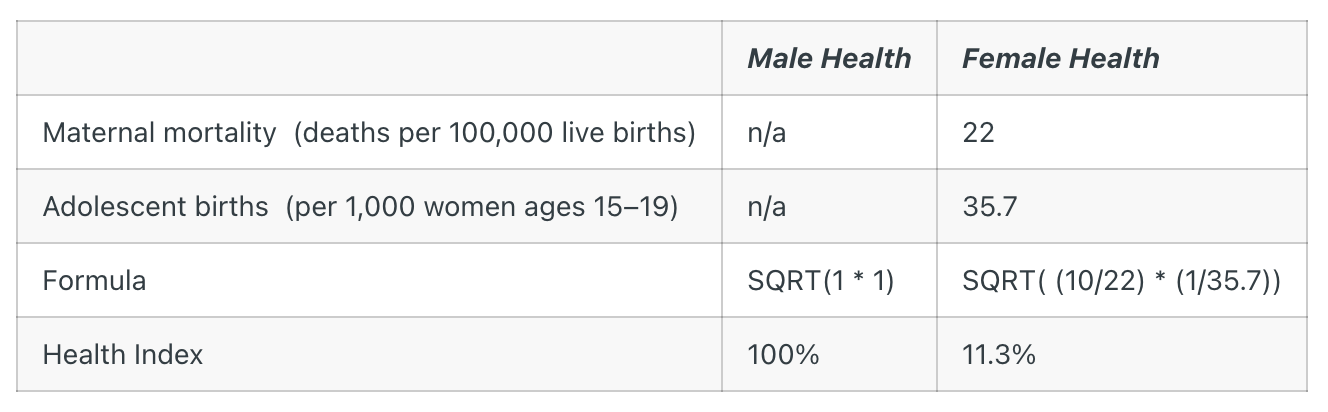
The Maternal mortality ratio (MRR), measured in deaths per 100,000 live births, contributes to the Health dimension.
The Adolescent birth rate (ABR), measured in births per 1,000 women ages 15–19, also contributes to the Health dimension.
The Female and male population with at least secondary education contributes to the Empowerment dimension.
The Female and male shares of parliamentary seats also contribute to the Empowerment dimension.
The Female and male labour force participation rates represent the Labour market dimension.
UNDP provides this simple example about Costa Rica:
You may be wondering: how does Maternal mortality ratio and Adolescent birth rate represent male health in the Health dimension? The answer is simple: male health is always considered to be 100%. For instance, this is how the Health dimension for Costa Rica looks:
There are three problems with using these female-only indicators to calculate gender inequality:
1/
Adolescent birth rate (ABR) is strongly correlated with a country’s overall birth rate. This is a no-brainer. South Korea is rated more equal, largely because it has the world’s lowest ABR (0.5 per 1,000 women)—a direct consequence of having the lowest fertility rate among developed countries (0.7 children per woman). GII penalizes countries simply for having a replacement-level birth rate.
One simple way to fix this would be to replace ABR with the share of adolescent births relative to all births.
2/
Maternal mortality ratio (MMR) is strongly correlated with the financial resources available for public healthcare. Poor countries are penalized simply for being poor. Said Costa Rica, with Gross National Income $23,417 per capita, punches way above its weight with MMR of 22, but according to GII, its Health dimension is more “gender unequal” than twice as wealthy Saudi Arabia with Gross National Income $50,299 per capita and MMR of 16.
One simple way to fix this would be to replace the absolute MMR with MMR per unit of Gross National Income.
3/
Men’s health is completely ignored. Poor countries have not only higher MMR, but higher male mortality too. The MMR of 22 deaths per 100,000 live births translates to 8 dead Costa Rican women in 2022 (source). At the same time, 11 women and 115 men died of workplace accidents (source). Why are 8 maternal deaths considered “gender-based disadvantage“, but 103 more men than women suffering workplace fatalities do not move the needle at all?
One simple way to fix this would be to throw away all female-only indicators, acknowledge that men face hardships too, and measure gender disadvantage symmetrically.
GII interprets lower female labour force participation as evidence of discrimination. Women’s “gender-based disadvantage” could disappear only if women’s labour force participation equaled that of men. That is what women want, right? Wrong.
A 2019 Gallup poll shows that 39% of women and 23% of men in the US would prefer to “stay at home and take care of the house and family” if they were free to choose. This number rises to 50% among women with children under 18—only 45% of women with children under 18 prefer to “work outside the home.“
In a 2010 Gallup poll, 41% of women in the US answered that it is “very important for a good husband or partner to provide a good income.” Only 19% of men consider the same to be very important for a good wife.
Globally, only 29% of women prefer to have a full-time paid job all the time. 27% prefer to “stay at home and take care of your family and the housework,” and 41% prefer to “do both”. (International Labour Organization & Gallup, page 16).
The importance of the GII cannot be overstated. Researchers use it to correlate “sexism” with medical, educational, and social outcomes worldwide, and governments and policymakers rely on it to inform laws and spending decisions.
But index, which is mathematically incapable of showing anything other than women being disadvantaged, is not a good index.
Index, that focuses on the health of one half of the population and ignores the health of the other half is not a good index.
Index, that prescribes not the equality of opportunity, but the equality of outcome, regardless of the wishes of mothers and fathers, is not a good index.