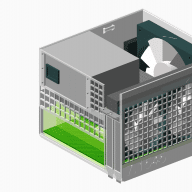
To illustrate it better that is the actual cooling system without the side cover:
And some more pictures with the side cover assembled, the PSU in place but obviously without the board:
Thanks!
What I do know is how my fanless Mini PC is working like: That system has a 28W APU (7640U). With two flat heat pipes and those heat pipes have not too efficient contact with the heat sink via 1 mm thermal pads. That is good enough. There is thermothrottling during full single core load and its hitting thermal limit during lasting full multicore load. Interestingly with full iGPU load during games temperatures stay pretty decent at less than 70°C (even though RAM is hitting thermal limit). From that system I also know that the heatsink can manage to reach 55-60°C or so (just a bit too hot to touch for longer than a few seconds).
The Mini-PC heat sink is actually a LED heatsink (PADLED-13080) and has a technical data sheet: https://wakefieldthermal.com/content/data_sheets/PADLED_WT_v2.pdf
At a deltaT to the room temperature of app. 30°C, the data sheet would specify a power dissipation of 33W. Close enough I think to what I see in reality. The data sheet is listing a thermal resistance of 1.5 °C/W. But based on the actual numbers it would look more like 1.0 °C/W. Anyhow, it is a starting point.
I found extruded heatsinks with technical data sheets and took the profile of one as inspiration for my heat sink. The commercial one would have a width of 200 mm and be 5 mm less deep with a thermal resistance of 0.3 °C/W. My heat sink is on one side 250 mm long and on the other 70 mm long. That should estimated get me somewhere around 120-140 with 30°C dT. If I can keep thermal losses low enough from the die to the heatsink it should theoretically work out.
What should work in my favour is that my heat pipes are distributing the heat along the height of the heat sink and there also 3 dedicated heat pipes to the front where there is more heatsink surface. What works against me is that some heat pipes are rather long at 250 mm. However there is additionally also a pretty large direct aluminum link to the heat sink which should also transfer some of the heat.
That's my reasoning. How well I estimated it all i will only see once I have it completed and I can test it.
Manufacturing
Ok, I possibly did not go the most effective route and most definitely not a cheap one. But I have to say I did enjoy to design CNC parts and see them turning out just as I wanted them. I was already aware that my design with slanted fairly narrow fins (for CNC) would probably need more advanced tools. I was ordering it form JLCCNC and they used wire cutting to cut the heat sink fins and then milled the rest. That came at a rather steep price admittedly. But at least I got app. 5 kg heat sink in return for it.
Those 3d printed shapes were screwed into the base and I had a metal tube as lever.
A first test assembly:
I replaced some of those pipes in the end. Lessons learned: Go for heat pipes with mesh if you want nice curves. Sintered pipes do still work out but grooved pipes are an absolute nightmare. Those groves stabilise the pipe and make it very challening to bend without knicking them, at least at minimal radii.
I have to make a small correction. The commercial reference heat sink with 0.3 K/W thermal resistance was 250 mm wide, not 200 mm. So my 250+70=320mm width would have roughly 0.234 K/W if I assume that it all simply adds up. So, to cool 140W the dT of the heatsink to room temperature would have to be 33 K. In other words, at 25°C room temperature, a heat sink with 58°C.
It is a bit on the tight side but I the reference was under the assumption of black anodized surface and vertical orientation but no heat pipes and with 5 mm less fin depth.
The real question mark is how high the temperature loss will be at the interface of die to copper spreader, from there to the heat pipe, in the heat pipe and then from the heat pipe to the heat sink.
I didn't know about a Minisforum Strix Halo MoDT. It would certainly make some sense. I wouldn't hold my breath though for it to be dramatically cheaper than the Framework one. It is really hard to say how much reworking of my design it would need. If the layout and especially the clearances are very similar to the Framework board, maybe just the cold plate but it also could be that all the heat pipes and everything but the black heatsinks would have to change.
The main challenge is that one would probably have to buy the board first as they will hardly upload technical drawings and a step file like Framework did.
It inspires me to finish mine, even when using a discrete GPU. I hope I can cook down up to 150w for the GPU. Those are my heatsinks that I got from a bigger device and peltier elements.
Those are some beefy heatsinks you have there but 150W needs beefy.
I assume the challenge there will be to get the heat efficiently to the larger surface of the heatsink backside.
I got the 2TB drive for a start.
I do have a plan B though. My PSU compartment is already designed that way, that I could also install the 500W DC/DC converter from HDplex. The downside there is that I would have to use an external power brick. There is a DELL Alienware power brick that is rated for 360W and is actually rated for high enough current to supply 500W at least during transient bursts (which should be fine even according to official Framework recommendations). It's just means burning another 300 EUR
PS: If it is possible with the Framework system, I also consider setting the power limit lower than 120/140W. I do like the idea of having power optimised systems and the golden balance seems to be around 80W. But let's see.
I also did consider a MeanWell passive PSU but that would have also needed an ATX DC/DC converter, would not have fitted either.
I hope you get a board soon, it was good to see that Nirav from Framework posted on your thread ![]()
I am hopeful it won't take too long for the board. Might have sped up a bit in the meanwhile.