[This is an entry to the 2019 Adversarial Collaboration Contest by Doug Summers-Stay and Erusian]
Adversarial collaboration on the question: “Automation/AI will not lead to a general, sustained economic crisis within our lifetimes or for the foreseeable future. Automation/AI’s effects into the future will have effects similar to technology’s effects in the past and, on the whole, follow the general trend.”
Defending the proposition: Erusian
Challenging the proposition: Doug Summers-Stay
tldr: Until the pace of automation increases faster than new jobs can be created, AI shouldn’t be expected to cause mass unemployment or anything like that. When AI can pick up a new job as quickly and cheaply as a person can, then the economy will break (but everything else will break too, because that would be the Singularity).
Introduction
As software and hardware grow more capable each year, many are concerned that automation of jobs will lead to some sort of economic crisis. This could take the form of permanent high levels of unemployment, wages that drop below subsistence levels for many workers, or an abrupt change to a different economic system in response to these conditions.
This has become a talking point outside of economic circles in the U.S. Democratic presidential candidate Andrew Yang’s most well-known policy proposal is a universal basic income to offset this (an idea Elon Musk has supported for years). Bill Gates suggested that when robots replace workers, the companies should be taxed at a similar rate to the taxes being paid by those workers. These entrepreneurs have spent a lot of time thinking about and planning for the future, and have a lot of experience with introducing new technology. Are their concerns valid?
Throughout this discussion, we use the words AI, automation, and robots more-or-less interchangeably. Imagining Asimov-style androids with positronic brains makes it easier to picture a world where all jobs are automated. In reality, though, it would be a silly waste of resources to literally have robots come in and do jobs as drop-in replacements for workers, and there are few jobs where this would make sense. A lot of software in the future will be more human-like in the sense that many machines could have natural language and image-understanding capabilities and have the ability to reason about the wider context in which their work exists to avoid dangerous or costly mistakes due to a lack of common sense. In many other ways, though, software for nearly all working robots will not be similar to human minds at all.
Some jobs, like picking most fruits and vegetables or most assembly line jobs, currently can’t be done by machines because they require manual dexterity. In such cases, you would need more precise manipulators with touch sensors that can adapt to a wide range of situations. There is no reason to expect they will look like human hands, though. Machines will also be networked, of course, so imagining them as a bunch of individuals is also unrealistic. Finally, the way tasks are currently divided into jobs makes sense for human workers, but wouldn’t make sense for automation. Instead, certain tasks will be automated first, and the remaining tasks that form part of a job will still be done by humans.
What is happening in technological unemployment today?
Worldwide, employment rates are not worse than historic levels. This seems to show that jobs are being created more-or-less as fast as they are being automated. Scott has covered this issue thoroughly in a survey article. The Bureau of Labor Statistics puts out a report of their projections for what jobs will be lost and what will be added for the next ten years. Some jobs that are expected to grow are in health care, renewable energy, and several computing professions. The ones that are declining include secretaries, clerks, assemblers, and care of outdated tech like locomotives and wristwatches. Automation has tended recently to take middle skill jobs. This has caused many people to take less desirable jobs.
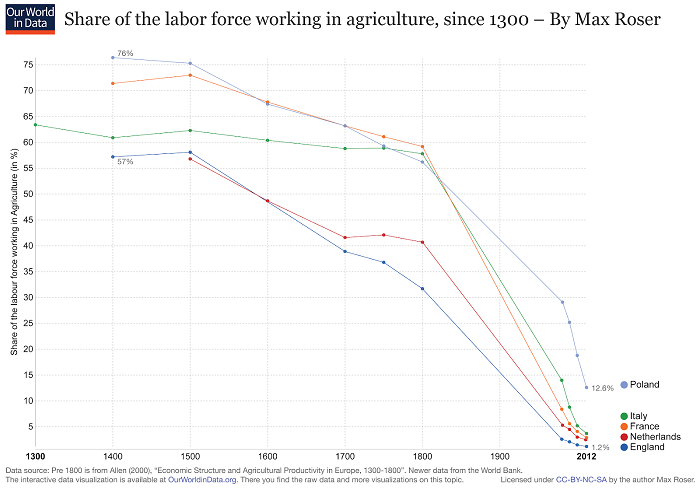
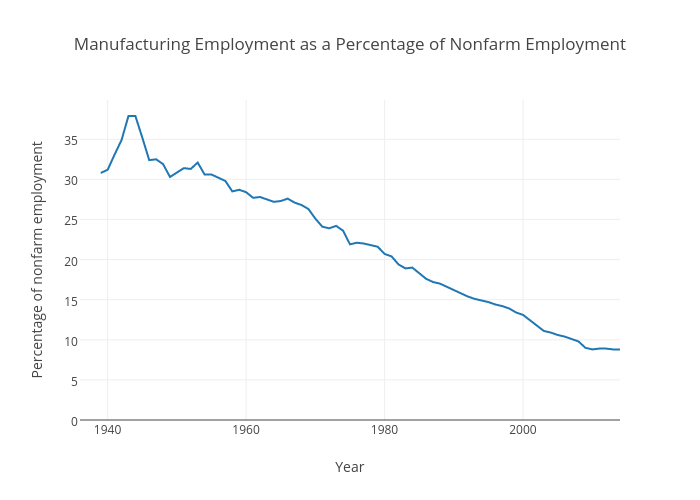
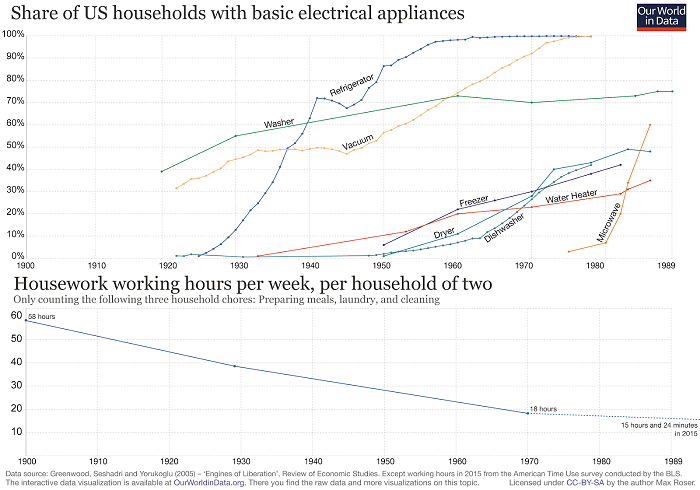
We have seen at least three instances in the past where automation has taken a significant fraction of all existing jobs. Before the neolithic agricultural revolution, nearly everyone was a hunter or gatherer or both. During the period from about 8000-4000 B.C., this gradually shifted so that most people were employed in agriculture. Before 1400, around 70% of all employment was in agriculture. Today, it is only a few percent in advanced economies. At its peak during World War II, nearly 40% of U.S. employment was in manufacturing. Today, that number is below 10%. Housework also declined from 60 hours a week in 1900 to only 15 hours a week today (although this doesn’t show up in employment figures, of course, and can also be partly attributed to declining fertility rates.)
Another line of evidence to consider is GDP. Before 1000 AD, the per capita GDP everywhere was below $1000, adjusted for inflation. In Western countries today it is around $50000. Since human innate capability hasn’t changed, this must be the result of innovations (in education, processes, tools, machinery, or what-have-you) that allow people to produce more value for each hour of work. By one way of looking at it, this means that there are already 49 “robots” worth of automation for every person in these countries. Yet employment is still at roughly the same level it has always been.
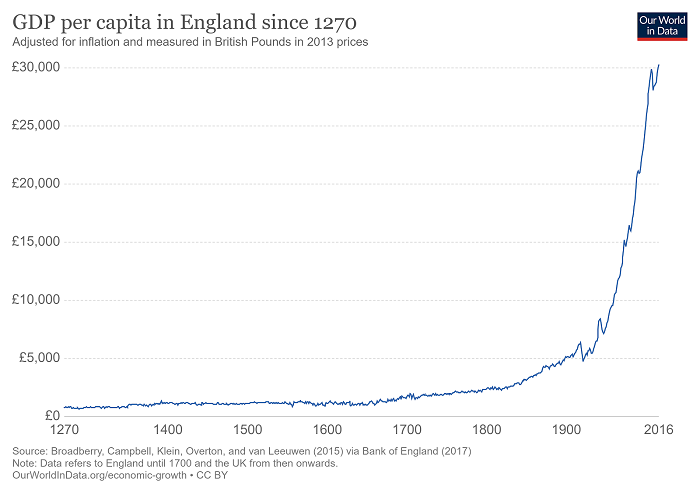
So we know from experience that employment is able to adapt to extensive automation. However, these changes took place over millennia, centuries and decades respectively. If the pace of job automation were to increase so that replacement of a significant fraction of the workplace happened over years instead of decades there might not be time for people to retrain fast enough to avoid some higher rates of unemployment. Again, though, that doesn’t seem to be the case at the moment.
Are there things computers will never be good at?
A common response to the question of whether we will eventually reach the point that all jobs can be automated is to name a skill that computers will never be able to perform, attempting a disproof by counterexample. The following terms link to places a skill was claimed to be impossible for computers: write jokes, write novels, express compassion, robotically navigate a human environment (like an arbitrary kitchen), manufacture new categories at arbitrary levels of abstraction, act creatively, represent and invent concepts, learn from small data, express emotion, have motivational direction, think socially and cooperate.
Researchers are, however, aware of these limitations of current machines and actively trying to find ways to automate them. Here are the same terms along with a link to a paper where research is presented on how to automate the task: write jokes, write novels, express compassion, robotically navigate a human environment, manufacture new categories at arbitrary levels of abstraction, act creatively, represent and invent concepts, learn from small data, express emotion, have motivational direction, think socially and cooperate.
In every case, although researchers haven’t yet solved the problem and in some are far from a solution, it is possible to see a clear research direction and a path to gradual progress. Many claims of this sort are (in the local argot) making a motte-and-bailey argument. When someone argues that a machine can’t really feel emotion, they can always retreat to the motte that the machines are incapable of phenomenal conscious awareness of what it is like to feel (for example) emotional pain. This is true: we have no idea how to make a machine that is conscious in this sense or to test whether phenomenal consciousness is present in a person, animal, or machine. They then, however, make claims that the robots will not be able to respond to anger in a voice, or anticipate that taking an action might cause someone to feel sadness. This is false: a neural network trained on examples of anger in a voice could learn to discriminate it without the ability to feel blood rush to its ears. For the purpose of taking jobs, an accurate discriminator or ability to accurately simulate emotions is all that is necessary.
The new techniques researchers have come up with are not only able to perform better than previous methods on a particular benchmark; they are also becoming more general. Artificial General Intelligence is what human-like AI is usually called these days because the ability to handle unanticipated situations is such a central part of what makes human intelligence special.
The new Transformer neural net architectures are an example of how AI is becoming more general. Although simply trained on predicting the next word in a sequence, such models have demonstrated superior performance on question-answering, common-sense, categorization, and other benchmarks. A similar architecture, with few changes, can be used to compose music, create artwork, simulate voices, and so on. These models work well because they are able to learn to direct attention to the parts of the context most applicable to deciding what the next output should be. In the future, we should expect systems that are more adaptable still. An adaptable AI will be quicker and cheaper to deploy on new jobs, so we should expect the rate at which jobs are automated to increase.
In terms of hardware, we can expect computational capacity on the order of the human brain in supercomputers in the next five years and in home computers about twenty-five years after that. (Assuming 100 billion neurons, 1000 synaptic connections per neuron, 10 floating-point operations per interaction, and a temporal resolution of 1000 interactions per second.) So hardware shouldn’t be a limiting factor after 2050 or so, as long as current trends hold.
This is not to minimize how far we are at the moment from a machine that can learn an arbitrary new job as easily as a human can. People can model another human by “putting themselves in their shoes.” All of that ability to anticipate how other humans would react to an action has to be built into machines to achieve the kind of autonomy we are imagining. While machines can now act in creative ways as well as rational ways, tying the two together is still a very open problem. Systems that have lifelong learning, that continue to grow with experience, are still very rare. The ability to understand spoken or written language is still at a very primitive level. These problems don’t seem insurmountable– merely very hard.
What jobs will be automated?
Frey 2013 characterizes which jobs are likely to be automated soonest based on the following capabilities required to perform the job:
– Finger Dexterity, Manual Dexterity, Cramped Work Space, Awkward Positions
– Originality, Fine Arts
– Social Perceptiveness, Negotiation, Persuasion, Assisting and Caring for Others
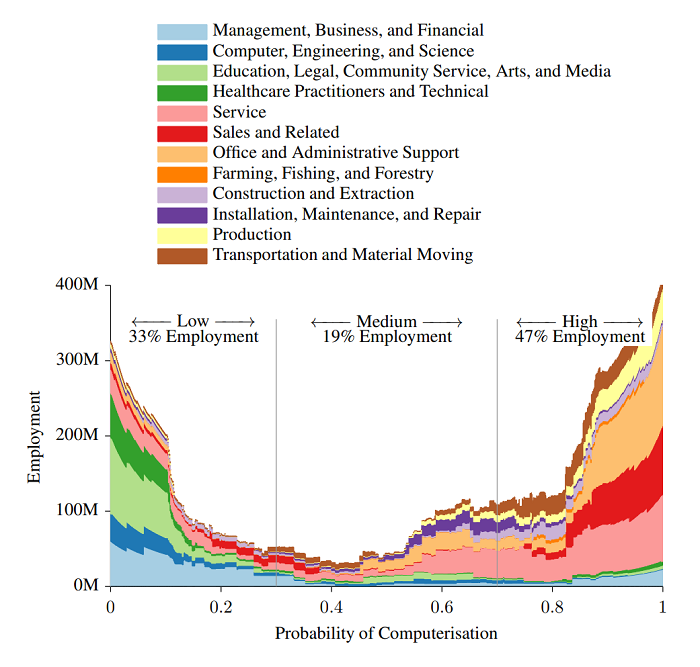
He concludes that 49% of U.S. jobs are repetitive, don’t require fine dexterity, originality or people skills, and are therefore likely to be automated in the next few decades. This includes most office and administrative support jobs, sales jobs, some service jobs, and most production and transportation jobs.
However, Arntz et al argue that this number is much too high. Holding everything else the same, they show that this is neglecting the variation within a profession and the ability for a job to adapt when new technology becomes available. With these taken into account, only 9% of jobs are found to be at risk.
Both of these papers are discussing the right side of the graph above, everything above the “75% probability of computerisation” line. Eventually, though, essentially all the skills described on this chart will be automatable. While it may not fall within our lifetimes, it does seem to be part of the “foreseeable future.” It doesn’t seem like there are any fundamental physical limitations preventing it (in the sense that we may never build a spaceship that goes faster than light.) The existence of human brains shows that the right arrangement of atoms can compute at human levels with reasonable size, weight, and power restrictions. It seems reasonable to suppose that computers will continue to increase in capability until they will be able to perform any intellectual task required in a job as well as a human. This includes creative, decision-making, and emotional reasoning tasks.
To replace people in jobs also requires a body that can perform tasks with the dexterity and ability to adapt to different conditions that are required for a job. This also seems to be at least decades away for many jobs.
Beyond the invention of hardware and software capable of performing these tasks, the cost of developing and deploying the technology must fall below the cost of hiring workers in order for the workers to be replaced. The price of computing has been dropping steadily for several decades now, and there are no fundamental physical limitations to this improvement that would prevent the trend from continuing to the size and power-usage levels of a human brain. Robotic bodies and manipulators, while continuing to improve in dexterity, sensing ability, and cost over time, do not seem likely to have the same exponential improvement that we have seen in computing hardware. Again, though, we know that a machine with human dexterity is possible (because hands exist) so it seems inevitable that machines will eventually surpass us in these abilities as well.
There are, however, certain jobs that some people may be willing to continue to pay for a human to do, even if a robot can do it better in some sense. For example:
– producing handmade goods
– creating artwork whose value depends on whether it is an original
– some kinds of food preparation
– performance arts (acting, dancing, stand-up comedy, etc…)
– domestic service (personal servants like butlers, gardeners, etc)
– sports
– therapy
– hairdressing and the like
– massage
– certain aspects of medical care (a sense that someone cares)
– certain aspects of teaching (motivation, mentorship)
– certain aspects of war (decisions about when to use violent force)
– clergy work
– mortuary services
– some kinds of sales
– politics
For these kinds of tasks, having it done by a human is part of what is valued by some customers. If most other jobs can be automated, more jobs that fall in this category would be expected to be created, as a larger pool of workers is available to do them.
As more jobs are automated, what economic effects should we expect to see?
Around 1800, economist Jean-Baptiste Say argued that workers displaced by new technology would find work elsewhere once the market had had time to adjust. By the mid-1800s, a theory was in place that explored the economic effects of automation. In Das Kapital Marx would later dub it “the theory of compensation.” This includes additional employment in the capital goods sector, decrease in prices, new investments, and new products (the effect on wages is complicated). In general this is still the prevailing opinion of economists.
According to this theory, when workers are fired because their jobs are automated, this frees up capital which the owner will then use to hire other workers to do other jobs. Because of this, the number of workers hired doesn’t decrease because of automation. (Marx disagreed with this, saying that part of the capital would now be tied up in the machines). The theory also discussed other effects. Automation reduces the prices of goods, making them more affordable. It also reduces the prices of components, making new products viable. The companies making these goods make more profits, allowing them to expand and hire more workers.
Because of these effects, as long as the market has time to adjust, we shouldn’t expect to see increasing levels of unemployment up to the point where robots have taken all the jobs. Instead, new jobs for workers should be created until the entire employment pool is being utilized. This process can be expected to continue up until the point that all jobs can be done more cheaply by machine. As long as there exist skills humans can do more cheaply than machines, the number of jobs using those skills should increase until they absorb the entire available human labor pool.
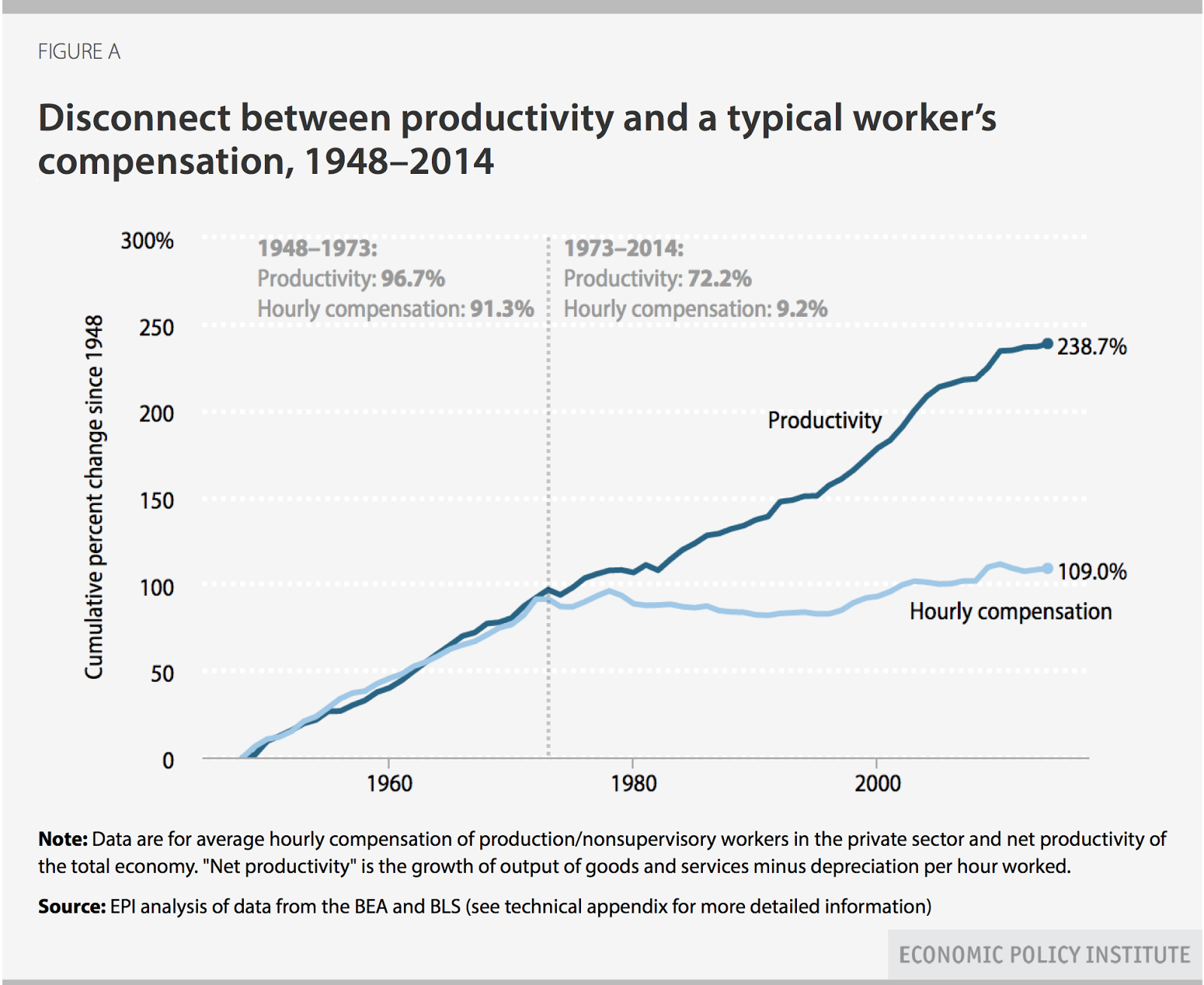
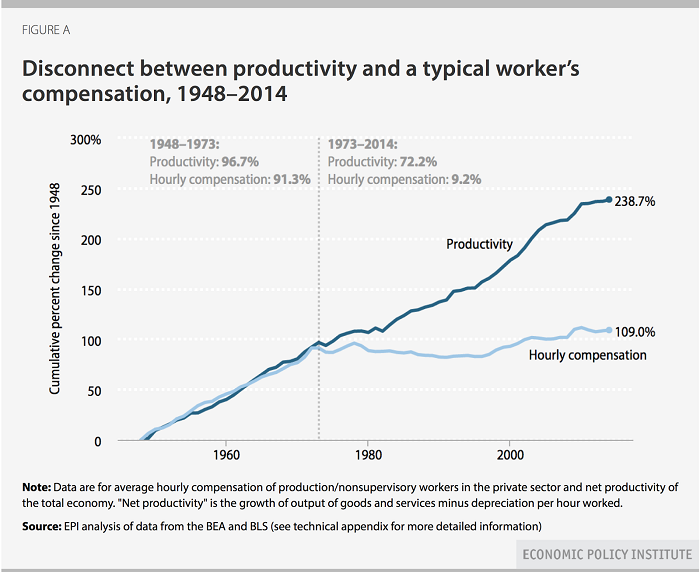
Susskind 2018 concludes that in the future, automation will put downward pressure on wages, while increasing the amount earned by capital owners. We may already be seeing this effect in the United States: although GDP per capita and net productivity have increased consistently since the Great Depression, median wages have stagnated since 1975. This would be consistent with automation sending increases in productivity to the owners of capital rather than workers.
As more jobs are automated, the mean standard of living will improve, as the amount of value produced per-capita goes higher and higher. Even without raising tax rates or rates of giving to charity, the overall amount received will increase as more is produced at lower cost. Whether this leads to more people living on the dole or not is more a matter for political argument than for technological extrapolation.
Another effect might be shorter working hours– as more jobs become automated, the same number of people could be employed, but at fewer hours per week or more days of leave per year. Given the option, though, the preference of most workers at the moment is to work full-time (and for many workers, overtime) trading leisure time for additional income. For this to change would require both regulatory changes (part-time workers have different rules about benefits, for example) and cultural changes. It is not absurd, though: in Germany, for example, the average adult only works 1400 hours a year (26 hours a week) compared with 1900 hours a year (35 hours per week) in the U.S.

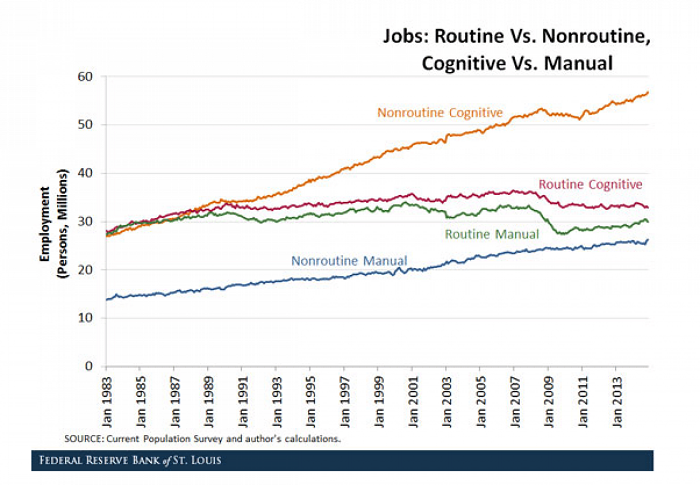
One might expect that as machines become more capable, more and more people will find themselves below the waterline, unable to find any job that AI can’t do better– perhaps those with the lowest IQ first, or something along those lines. To date, though, the capabilities of AI have not developed this way. Grandmaster chess and rapid calculation can’t be done by those with low IQ, but are simple for modern machines, and the inverse is also true– even very young children and those with a low IQ can perform recognition tasks in varying conditions that defeat even the best computer vision programs, for example. On the other hand, the number of routine jobs in the U.S. is an ever declining fraction of all jobs. If some constant fraction of people can only perform routine jobs, eventually some of them will be unable to find any job they can do, if current trends continue.
Suppose we reach the point where robots can do literally any job a human can do. What will happen to the economy?
A robot will likely never be cheap compared to other manufactured goods. Although future process innovations (such as advanced 3D printers or nanotech assemblers) may reduce the cost of building robots, they will also reduce the cost of manufacturing everything else, and robots must have large numbers of moving parts. This could mean that the number of robots will be limited, and this limited supply will drive up wages in jobs that the robots could otherwise do, if there were enough of them or they were cheap enough to produce.
Robots with human levels of ability, however, would be able to self-repair, extract natural resources, manufacture parts and create more robots without any human intervention. They would also be able to invent new ways to make money and employ other machines to achieve goals.
For any job, the machines in this scenario could do it better. People will still likely strive to purchase and direct factories, resource extraction, and robots for all purposes. Those doing this would still have a job of deciding how to direct the robots, acting as business owners. (Although one imagines running an AI as a manager to handle this kind of work as well.) There will also be people with earned or inherited wealth who don’t work, and welfare recipients who don’t work, but to what extent the economy will redistribute the wealth generated by this vastly expanded economy is a political question.
If we ever reach this point though, it is hard to make serious predictions because we don’t know what such machines would be like, and whether we would be able to maintain control of our economy and civilization at all (this breakdown of all models is the reason von Neumann called such an eventuality a singularity). If it becomes possible to create machines with human level intelligence and skills it will be possible for a little more money to create superhuman intelligence and skills, which will necessarily be hard for us mere humans to predict or control.
Conclusion
Even if nearly all currently existing jobs will eventually be automated, as we progress toward that point new jobs will continue to be created for humans, preventing the kind of mass unemployment or low wages that might be expected, as long as the market has time to adjust (which isn’t necessarily the case– if the pace of automating jobs were to speed up enough, we could still see a crisis.) However, once machines surpass human capabilities for a low enough price in all jobs, the entire economy will change and something else will take its place. What that is we can’t really say– our economic models break down, and the future becomes even more difficult to predict. Beyond this point, we don’t even know to what extent humans are still guiding the course of civilization, let alone how employment will work.
The economic gains that come from all this automation will flow primarily to those who own the machines. As they invest more, create new products, spend more, pay more taxes, and give more to charity, the general civilization will benefit, though some people will doubtless be unable to adapt and find new work and be worse off. How we choose to provide for those that can’t find work is something each democracy will need to continue to decide.
Further Reading
I found this article on Wired had some good points. One of them was that ‘job churn’ is at historic lows. That’s the rate of creation and destruction of jobs. You would expect that to go up if the rate of job automation was increasing.
The paper Automation and New Tasks: How Technology Displaces and Reinstates Labor provides a reasonable framework for estimating current and future effects of automation on labor. They conclude “if the origin of productivity growth in the future continues to be automation, the relative standing of labor, together with the task content of production, will decline. The creation of new tasks and other technologies raising the labor intensity of production and the labor share are vital for continued wage growth commensurate with productivity growth.”
If you are interested in specific predictions about dates for developments in AI, ML and robotics, MIT roboticist Rodney Brooks has a blogpost.
AI researcher Stuart Russell’s new book Human Compatible provides a nice introduction to current thinking about the future development of AI. It also contains some interesting ideas about creating artificial intelligence with open objective functions, so that the AI wants to please people but isn’t sure how best to do so.