Inside the Secret Group Chats Fueling MAGA’s Messaging Machine
Ashley St. Clair revealed the coordinated system shaping pro-Trump narratives online.
By
Sign up for the Slatest to get the most insightful analysis, criticism, and advice out there, delivered to your inbox daily.
It didn’t take long for President Donald Trump, who faced down yet another assassination attempt on Saturday, to immediately weaponize that event on behalf of his personal grievances. Following the gunman’s interruption of the White House Correspondents’ Association dinner, Trump was whisked away from the Washington Hilton’s ballroom and taken back to the presidential manor, where he delivered a press conference on the event that, bizarrely enough, made another case for his controversial White House ballroom, whose construction was halted by a federal judge. “It’s drone-proof. It’s bulletproof glass. We need the ballroom. That’s why Secret Service, that’s why the military are demanding it. … We need levels of security that nobody has ever seen before.”
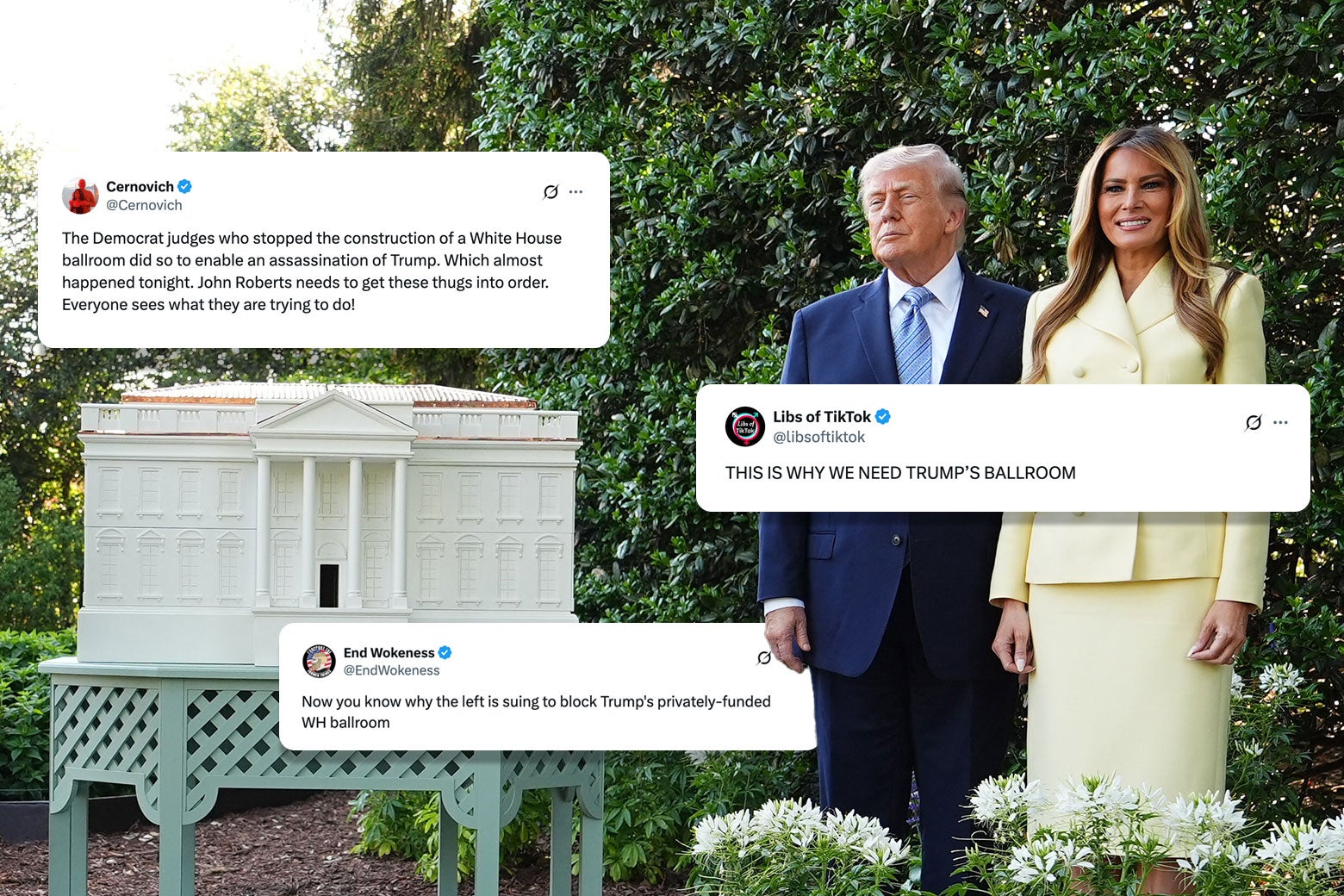
It’s unclear whether the Secret Service and Pentagon are actually “demanding” the ballroom, but even if they aren’t, Trump’s acolytes certainly are. Following the presser, right-wing supplicants took to X en masse to further parrot this particular talking point, hastily setting aside their initial rage over the WHCD scare. A whole lineup of the usual suspects—Jack Posobiec, Chaya “Libs of TikTok” Raichik, Nick Adams, Mike Cernovich—tweeting about the same ballroom, at the same time, with the same tone, mere hours after a wholesale assassination attempt.
Even if you didn’t buy the false-flag conspiracy theories around what happened at the WHCD, you might have found this unified messaging pretty suspicious. And in this case, there was some support for that intuition from a prominent former MAGA insider: Ashley St. Clair, a young influencer who drifted away from the movement after having a child with Elon Musk, getting spurned by the child’s father, and defending herself online against vicious Musk stans. Over the past few weeks, St. Clair has leveraged her position as Republican apostate to share TikToks about the MAGA movement’s reportedly paid and coordinated influence operations—and her alleged revelations, backed up by screenshots and detailed behind-the-scenes stories, are damning and compelling enough to help you notice how frequently, and predictably, this apparatus works to mainstream particular agenda items.
For St. Clair’s ongoing video explainers, this weekend’s events provided a perfect hook. “I told you guys that all of MAGA is paid and they coordinate their messaging in lockstep via group chats,” St. Clair narrated in a Sunday TikTok, speaking in front of a screenshot of the pro-ballroom tweets. While she did not confirm outright that said tweets were the result of a group-chat prompt, she noted that “the statistical likelihood” of those X figureheads independently and simultaneously promoting this Trump project was “not probable.” Then, she showed off a screenshot of “one of the main group chats,” an X group DM titled “Fight, Fight, Fight!”—named for Trump’s fist-pumping exclamation to his rallygoers after he was shot in the ear in Butler, Pennsylvania.
St. Clair no longer has direct access to such chats, having been logged out of X while she and the social network’s parent company fight each other in court over the sexualized deepfakes that Grok users generated of countless girls and women (including St. Clair herself). But the screenshot is telling: Old X avatars for paid subscribers like Posobiec and ALX can be seen up top, while the chat history displays Florida Rep. Anna Paulina Luna sharing Maxim magazine’s tweeted Trump endorsement ahead of the 2024 election. Members of the chat included “the official Trump War Room, members of the administration like [deputy chief of staff] James Blair, and all your favorite MAGA influencers,” St. Clair explained.
In a 10-minute video posted April 10, St. Clair had dug further into the nitty-gritty of these operations, drawing upon her firsthand experiences from the moment when, as a 19-year-old, she was recruited by Turning Point USA to drop out of college and pursue lib-trolling full time. “Their main avenues for this influence are group chats, paid influence campaigns, and parties,” she said, emphasizing the importance of Twitter channels in connecting aspiring young conservatives with higher-up Trump advisers. “Republican operatives … built out these platforms that these right-wing influencers can log on to and see active campaigns and sign up for and get paid for promoting certain messaging, certain initiatives, certain petitions. And this pay is typically per click, sometimes it’s a flat rate.” A lot of it comes top down: telling their followers to call their members of Congress in support of a particular bill, instructing them on how to respond to queries about the Epstein files, railing against a particular anti-Trump Democrat. Or, in St. Clair’s case, raising public support for Richard Grenell’s (unsuccessful) bid for secretary of state.
The setup, St. Clair noted, is “indistinguishable” from the digital strategies employed by big corporations—except that MAGA folks can get away with obscuring the fact that their posts are sponsored, thanks to a Federal Trade Commission loophole that only mandates such disclosures for tangible goods. (The consulting firms that run these platforms will show up on Federal Election Commission disclosures as recipients of political-campaign payments—but they don’t have to provide specifics on how they spent that money.) Taking a sum and a script from a Trump adviser and blaring it out to the madding crowd may technically fit the definition of an #ad, but unlike the users who promote beauty companies on Instagram, these influencers don’t need to use that hashtag.
St. Clair’s expositions are useful, not least since you can take a scan of X and see even more apparent examples of such coordination out in the wild, even following the WHCD affair. The Department of Justice’s federal indictment on Tuesday of a former adviser to Dr. Anthony Fauci—David Morens, a man you’ve likely never heard of—was shot out to commons with big “BREAKING” posts by notorious commentators like Benny Johnson, Michael Flynn, and Sean Davis. See also: the calls to fire Jimmy Kimmel in the wake of Melania Trump’s vendetta, furthered by Michael Knowles and the “End Wokeness” account. As ever, the loyalists will go where the money talks.
Such well-compensated coordination is not exclusive to the right, but Democrats have nowhere near the same level of base unity and loyalty that Trump’s acolytes have for the president. If there’s one lesson to be learned from the exposure of these inauthentic campaigns, it’s that liberals should perhaps be a little more hesitant before hopping onto whatever is being touted in unison among the right. Conservatives so often define online debates because they know how to spam the feeds, have enough cash incentives to do so, and realize that the left will frequently take the bait. But with the knowledge of how “fake” it all is (to use St. Clair’s own descriptor), there’s no reason to give these grievances any more oxygen. Everyone looks like they’re talking about the ballroom, but no one really is—besides Trump himself.
Get the best of news and politics
Sign up for Slate's evening newsletter.