84%of the parts in games since 2010 were already in a game by 2000§5.2
-0.42mechanics that generate more unscripted variety are rated harder to read (ρ across the rubric scores)§5.6
49%of mechanic uses fall on mechanics that no technique in this dataset is linked to§8.2
23 of 35AI techniques that run during play cannot run in lockstep multiplayer unless one machine streams their outputs§6.4
four findings from the paper; each links to the section that makes the case
every mechanic · 199 in 21 families, most used firstall 199 mechanics
economy & finance 19



















agents & behavior 16
















logistics & networks 14














resources & production 14














physics & materials 12










space & construction 12











control & automation 11











environment & ecology 10








information & legibility 10








governance & policy 9







population & lineage 9









risk & failure 9









progression & goals 8








social relations 8







multiplayer & persistence 7







biology & health 6






narrative & generation 6






time & pacing 6






conflict & defense 5





operation & procedure 4




world generation 4



Each icon is one mechanic, a rule-system a designer would recognize across games. Point at one to see what it is, or open it.
plain-text twin · 21 families
economy & finance
Treasury and budget, Contracts and orders, Staff hiring and rosters, Trade routes, Loans and debt, Taxation, Supply-demand pricing, Customer value choice, Rival firms, Advertising and awareness, Labor market, Land value, Player-driven markets, Auctions, Equity and buyouts, Negotiation, Product development, RCI demand, Delivery-time payment
agents & behavior
Agent skills, Needs decay, Personality traits, Utility action selection, Memories and thoughts, Agent pathfinding, Daily schedules, Mood and breakdowns, Crowd preferences, Work priorities, Creature learning, Smart objects, Aspirations and wants, Attribute-driven match engine, Autonomy levels, Stress accumulation
logistics & networks
resources & production
physics & materials
space & construction
control & automation
environment & ecology
information & legibility
governance & policy
population & lineage
risk & failure
progression & goals
social relations
multiplayer & persistence
biology & health
narrative & generation
time & pacing
conflict & defense
operation & procedure
world generation
Each game drawn as the parts it is built from, core parts first. Open one to see how it does each part, and which other games share them.
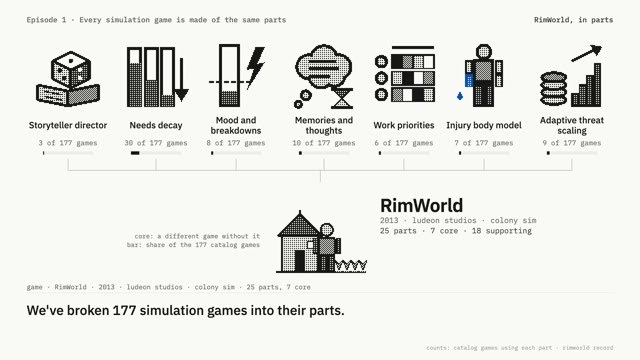
episode 1 5:27
Every simulation game is made of the same parts
RimWorld taken apart into its mechanics, then every game in the catalog the same way. Most of the commonest parts simulate nothing, the parts a game can't do without are much rarer, and each genre spends its parts differently.
episode 2 7:47
Where the parts came from
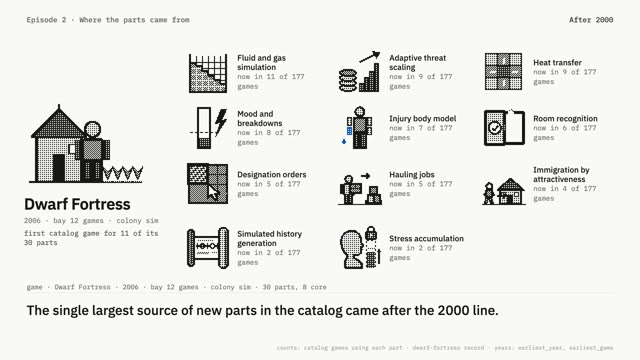
Hamurabi, from 1968, already used parts that games still use. Most of the vocabulary was in a catalog game by 2000, a test against chance shows how much of that comes from parts being widely shared, and recent games are built mostly from old parts.
The techniques furthest along in shipped games, and the mechanics each one changes.

neural rendering & 3d generation · 2025 · shipped (mainstream)
Neural rendering in the graphics pipeline
Small neural networks inside the renderer upscale frames, generate extra frames, denoise ray tracing, decode compressed textures and layered materials, and since DLSS 5 re-light the final frame, all without touching simulation state.

llm agents · 2023 · shipped (niche)
Generative agents (memory stream, reflection, planning)
LLM-driven characters that store observations in a natural-language memory stream, retrieve them by recency, importance, and relevance, synthesize reflections, and plan their day top-down.
automated game design & playtesting · 2018 · shipped (niche)
Agent-based automated playtesting and balancing
Studios train imitation, reinforcement learning, and search agents to play builds, estimating level difficulty, pass and churn rates, progression pacing, map coverage, and exploits before players reach them.

llm narrative & dialogue · 2019 · shipped (niche)
LLM game master and narrative director
A language model that adjudicates player and NPC intentions, decides outcomes, generates events and quests, and narrates them, either free-form or checked against a typed world state and canon.

generative world model · 2024 · shipped (niche)
LLM-adjudicated state transitions (LLM as game mechanic)
A language model computes the outcome of an interaction (two elements combined, an action on an object) from a text description of the inputs, with results cached so every player sees the same rule.

game-theoretic solvers · 2006 · shipped (niche)
Monte Carlo tree search for game AI
A best-first search that grows a game tree from repeated simulated playouts and picks branches with a bandit rule such as UCT, letting AI players plan from a forward model without a hand-tuned evaluation function.
Design bets ranked by impact, feasibility, and novelty. Each one names a test a small team could run and a dated prediction anyone can check.

1-2 years · resolves by 2027-12-31
Why-query over the simulation log
Let players ask why something happened and answer from the simulation's own event log, making deep systemic games legible without simplifying them.
1-2 years · resolves by 2028-06-30
Branch preview of policy futures
Fork the simulation in the background and show the player likely futures of a decision before committing, using parallel or surrogate simulation.
1-2 years · resolves by 2028-12-31
Event-sourced simulation runtime
An engine layer that records simulation and model calls as an append-only event log, giving replay, forking, explanation, and determinism for games with AI components.
1-2 years · resolves by 2028-06-30
Mechanic modding by description
Players describe a rule change in plain language; a model writes the mod against the modding API and automated agents test it before it is shared.
The findings at book length, for reading straight through: what the parts are, how they trade off, where AI lands, and what to build.
the paper and the data
paper
The Grammar of Simulation
Every finding with its method and statistics, figures you can explore, and the full catalog of games and techniques. The place to check a claim.
about
How the atlas is made
Every game, mechanic, and technique is an open record with its sources, so any number here can be traced to where it came from, checked, and corrected by anyone.