
Some years ago, when reading Doug Henwood’s Wall Street, I had an ‘aha’ moment that has always stuck with me. In setting out the basics of what the stock market does, he highlighted that - for many years - the stock market had operated in exactly the opposite way that people tend to assume. The layman vision of the stock market is that it’s a market to raise money for companies who then go and invest in their businesses. Except, Henwood noted, what actually happened in the stock market was that stocks were routinely taken out of the market - through buybacks, for instance - in exchange for cash. The flow of money was therefore not from eager investors to investment-hungry firms, but rather from cash-laden firms to stockholders. Cash was flowing out of the stock market, not in.
This was a relationship which held in aggregate - as JW Mason points out, net equity issuance has long been negative. And it held especially for the big tech companies who, since their IPOs, have long ago stopped having any real need to go to investors for money. Instead they have generated huge amounts of cash through their businesses. So much so that, as I noted in Platform Capitalism, these companies were sitting on huge cash piles throughout the 2010s with few profitable investments to spend it on.
That’s changed with AI. In 2026, in particular, the capital markets are being tapped for everything they’re worth, and that includes the stock market too. You can see this in the aggregate figures from the Federal Reserve:
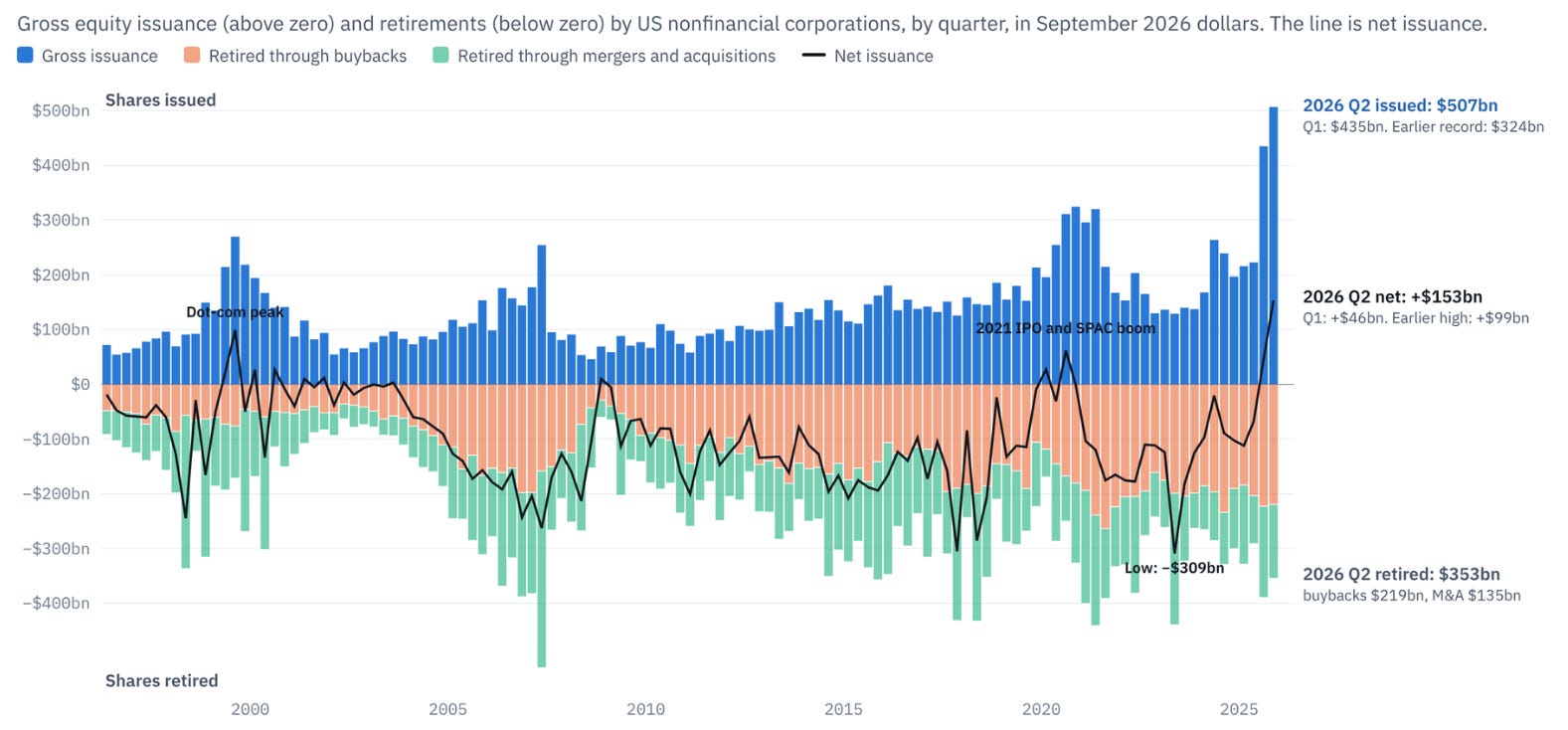
(AI disclosure: Claude helped with the design of this chart)
But you can especially see the shift when we focus on the big tech companies. Just today, Meta announced they would be looking to raise up to $95 billion through new stock issuance, alongside Google’s earlier $50 billion raise in June. From basically no equity issuance over the course of their existence, they are now looking to raise immense amounts of money through the stock market.
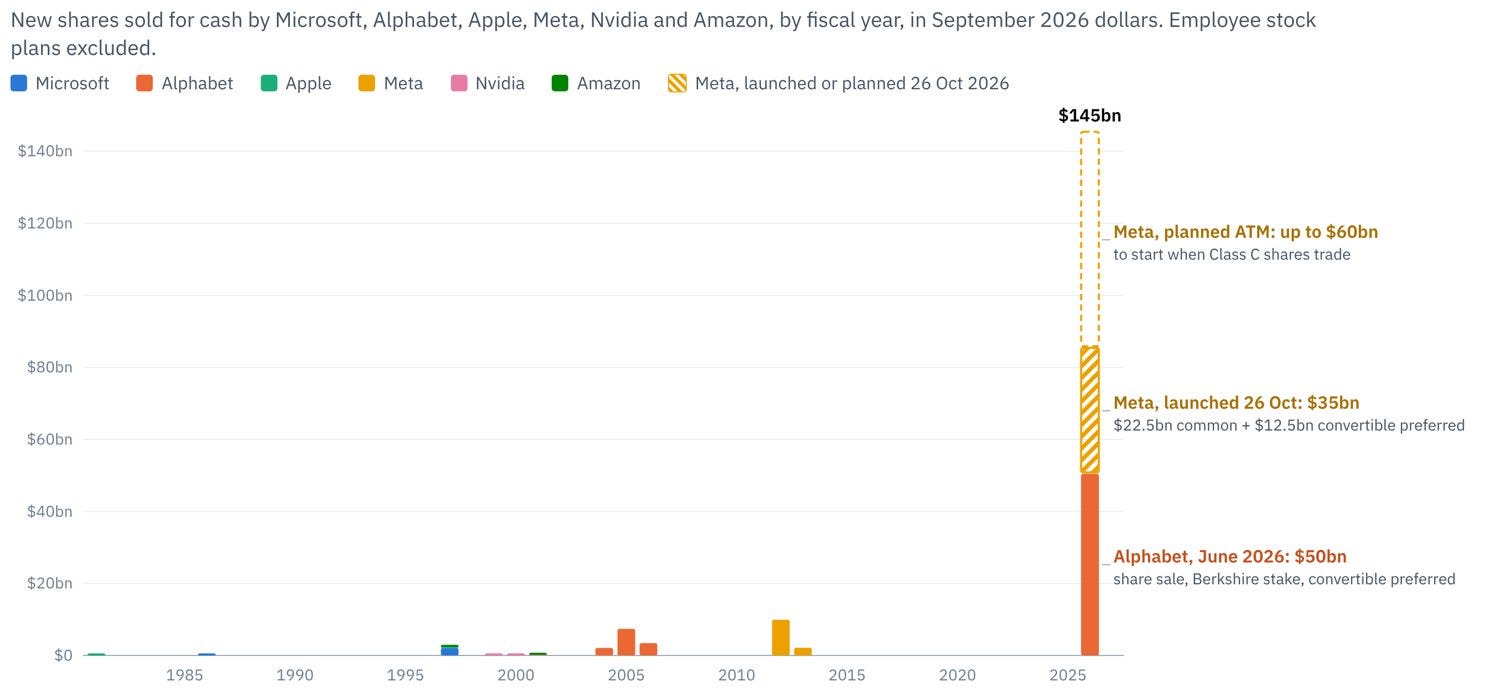
(AI disclosure: Claude helped with the design of this chart)
This is a remarkable shift. It’s a move from a capital-light leading advanced capitalist sector (the 2010s platform model) to a capital-intensive leading advanced capitalist sector (the 2020s AI model). This change (alongside a lot of others that I might try to lay out in a later post), all mean that we’re firmly moving out of the platform era in many ways. The concepts, tools, theories, and critical reflexes that were learned over that period will need to be revised in light of the changes that the AI boom is bringing.