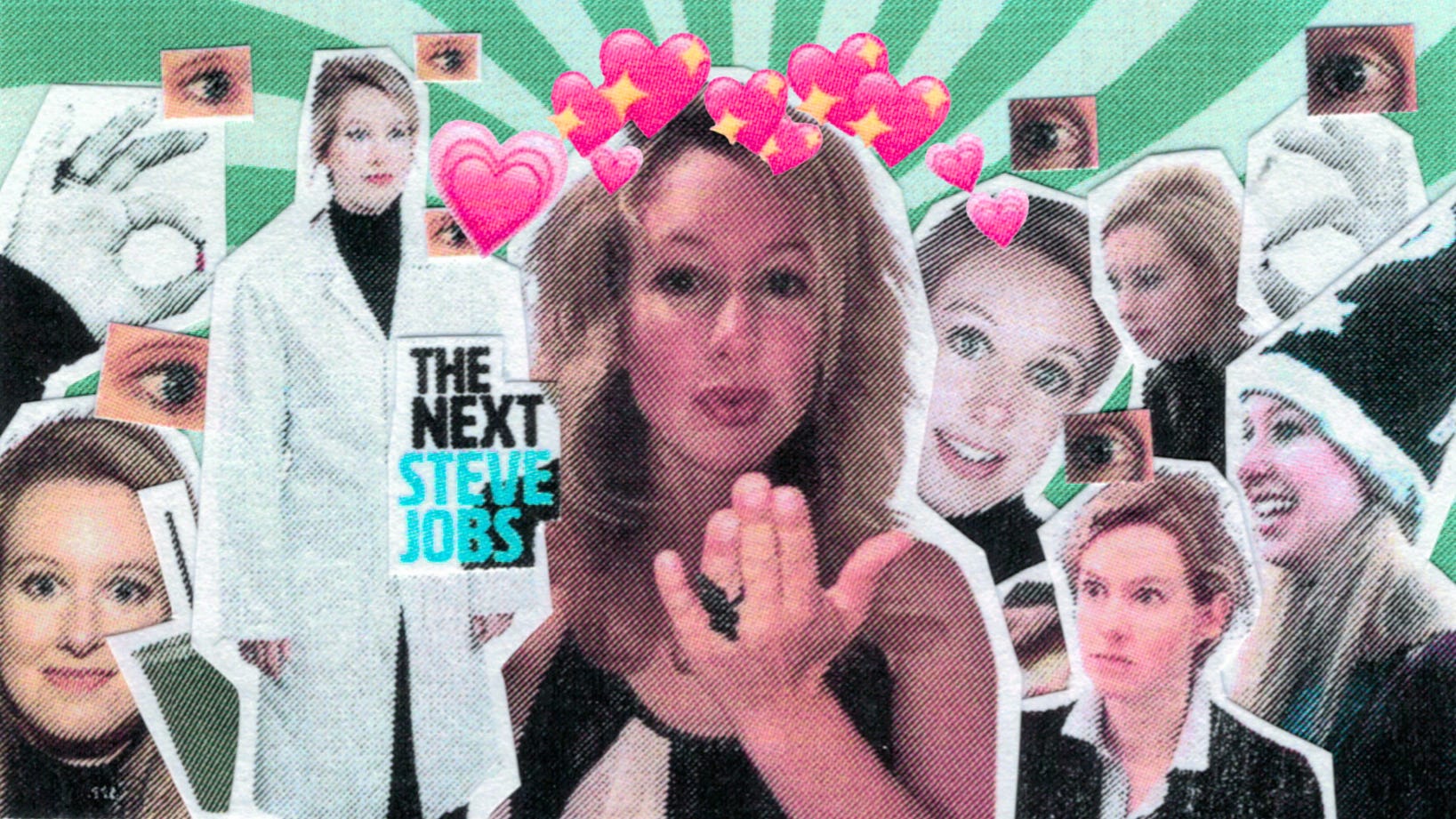
“Why am I so drawn to Elizabeth Holmes?” I ask myself, as she begins to consume me. Her blue eyes pierce my Instagram profile photo, multiple chat backgrounds, my phone wallpaper… I even involuntarily drop my voice an octave every now and then, pressing my lips tight after speaking.
At first glance, she looks like a regular, unassuming woman. But then you hear her speak. That uncanny baritone voice that’s just a bit too deep for someone who looks like her. As she continues, her eyes remain fixed with an unsettling stare, unblinking, and they somehow appear to grow larger the longer you look at them.
You watch her speak with a regular, considered pace. She pauses mid-sentence after every few words, as if every sentence she says is so important that it needs to land with sufficient gravitas. Her visions are always grand and her statements always sweeping. “I found what I felt like I was born to do,” she said about her company, Theranos. She regularly drops buzzwords like “disruption” and “revolutionary”. For good measure, she throws in a Gandhi quote: “First they think you’re crazy, then they fight you, and then all of a sudden, you change the world.”
You scroll through other footage and see the same thing. Every time. That same black turtleneck, paired with black pants and, occasionally, a black blazer. Unchanging. Unflinching. Uncompromising. You can’t stop watching.
This is a character.
“Elizabeth Holmes” has the wardrobe of Steve Jobs and speaks the language of the visionary genius who invented “revolutionary” technology, locked into power poses and gestures, as if all the world’s a TED Talk stage.
Listening closer, you can hear some of her words are occasionally spoken at a higher pitch. As she goes on speaking for minutes on end, these words become more and more frequent until it starts to sound like a natural voice again. Then she resets, deepening her voice like a nine-year-old pretending to be their parents, trying to get out of school.
That “first they think you’re crazy” quote by Gandhi? A fake. She works 16-hour days, seven days a week, so she sleeps at the office, and her diet is so time-optimised that it’s almost exclusively “green juice” and bland salads? She dropped out of Stanford University to found her start-up when she was 19? Come on!
She is a walking caricature of the Silicon Valley entrepreneur. And yet she became the “world’s youngest self-made female billionaire” thanks to investors pouring nearly $700 million into her company, based on a technology that regulators never approved and that experts considered scientifically impossible. They put her on the cover of Fortune and Forbes magazines, with Inc. Magazine even canonising her “the next Steve Jobs”.
Had this been performance art, this would’ve been its crowning achievement.
“Elizabeth Holmes” targeted Silicon Valley, a place with its own founding myth: the college dropout who created world-changing technology in his parents’ garage. It was the birthplace of some genuine technological advancements, so it started writing its mythology as quickly as it hoarded wealth, brandishing itself the epitome of meritocracy and innovation.
It runs on venture capital, a business model relying on making plenty of expensive bets on nascent companies and their bold ideas. It concedes that many of the investments will fail, but hopes they will be by one of them hitting the “unicorn” jackpot: being valued at over a billion dollars. With the common adage that “start-ups fail all the time”, every great venture capitalist’s credibility hinges on what they invested in. Unicorns like Uber or Airbnb are worn as badges of honour, as if they came up with the ideas themselves. And there’s greater prestige to being an “early” investor, a status symbol for making the riskiest of bets, before the ideas they invest in are even proven. There’s an unwavering belief that previous successful bets predict future successful bets. They believe that this is a sane way to create successful businesses.
This is a machine that, in its relentless quest to one-up each other, has so bastardised the term “technology” that they had to invent the term “deep tech” to refer to actual technological advancement. And even that classification has become dubious: they have started using that term to refer to “AI” start-ups that are just thin wrappers around someone else’s LLMs. I wouldn’t be surprised if someone coins the term “superdeep tech” to solve this conundrum.
In the early 2000s, following the dot-com bubble and the collapse of Enron (of which her father was an executive), Holmes targeted established tycoons like Larry Ellison, who co-founded the software company Oracle, and Tim Draper, her childhood friend’s father. They were later joined by other investors with no medical training, like Rupert Murdoch of News Corp.
She taunted them, seeing how far they would go with someone who had just dropped out of university, with no actual experience in medicine. (She was studying chemical engineering.) One investor pledged $1.2 million after just a five-minute phone call. She claimed to have solved the numerous problems associated with miniaturising blood testing, while refusing to explain how. They could have easily asked for any medical professional’s opinion to see how many red flags there were. Millions of dollars later, it didn’t matter.
In 2007, she upped the ante, now donning Steve Jobs’ black turtleneck, as suggested by the former Apple employee she hired. Murdoch invested over $100 million more to become Theranos’ largest single investor in 2014.
Hiding behind the defence of “trade secrets” and the paranoia of its competitors stealing their technology, Holmes dodged questions about Theranos’ technology and relied on the prestige of the board. It comprised two Secretaries of State: Henry Kissinger (of war crimes fame) and George Shultz, four-star General James Mattis, and other politicians. The only members with medical expertise were Bill Frist, a senator that hadn’t practised medicine in decades, and William Foege, a retired epidemiologist. The average age of board members was 80, they were all men (bar Holmes herself), and all white (bar her co-conspirator, Sunny Balwani).
James Mattis, when asked what the first words that come to mind about Holmes are, said, “First is integrity, competence, and confidence in both technical, scientific, but also a focus on human rights […] she is really a revolutionary in the truest sense.” Mattis was later appointed Defence Secretary in Trump’s first presidency.
“Elizabeth Holmes” looked the part, sounded the part, and was backed by some of the most powerful men in the country. With just this, she was able to dangle a carrot to investors—the chance to further engorge their coffers by disrupting a $70 billion industry. If everyone else, including the media, including the Harvard Medical School that appointed her to their Board of Fellows, believed in her, why couldn’t you? Theranos’ valuation swelled to $9 billion at its peak.
The Theranos veil was finally pierced in 2015, three years after it started blood tests on real people. After two professors criticised Theranos’ lack of peer-reviewed research, then-Vice President Joe Biden toured a fake Theranos lab to shore up defences. President Obama appointed Holmes a “Presidential Ambassador for Global Entrepreneurship”. It took a bombshell, wildly understated exposé, titled Hot Startup Theranos Has Struggled With Its Blood-Test Technology, by John Carreyrou in the Wall Street Journal, with evidence from whistleblowers and victims of fake results.
In response, Theranos formed a medical board to advise it. Twelve years after its founding.
Theranos collapsed in 2018, following regulators finding it had committed multiple violations and shutting down its lab for causing “immediate jeopardy to patient health and safety”. Investors and its partner, Walgreens, filed multiple lawsuits against the company.
The Theranos affair ended with Holmes convicted, but only for defrauding investors. She was found not guilty on all four counts of defrauding patients, as she successfully convinced the jury she was a step removed from the patients via her co-conspirator, Balwani. She was sentenced to 11 years and 3 months in prison and was ordered, alongside Balwani, to pay $452 million in restitution to investors, of which $125 million goes to Rupert Murdoch. In a separate civil case, Theranos was ordered to pay $4.65 million to refund patients in Arizona. In a class action launched by patients, Walgreens paid $44 million.
Neither were charged for the death of Dr Ian Gibbons, who was one of Theranos’ first employees, and served as chief scientist. Gibbons raised concerns about Theranos’ technology to a board member, Channing Robertson, who was Holmes’ professor at Stanford. He alerted Holmes, who fired Gibbons. He was rehired following threats from staff, but was demoted out of the Theranos lab. Facing a patent lawsuit, Gibbons was subpoenaed to testify and became distressed with the dilemma of lying under oath, under pressure from Theranos, or losing his job, which provided the health insurance he was dependent on due to cancer. He was found unconscious by his wife and died in hospital from overdosing on alcohol and painkillers. Theranos threatened her with a lawsuit if she spoke to journalists.
At the time of writing, Holmes is confined in Camp Bryan, a minimum-security federal prison camp. She is held there alongside Ghislaine Maxwell, whose transfer there sparked accusations of special treatment, and gushed about the conditions in leaked emails. Holmes had her sentence reduced by a year and is scheduled to move to an even less restrictive halfway house in August 2027.
“Elizabeth Holmes” is the natural progression of the snake-oil salesman, but so significantly accelerated to meet the moment of how much money and resources are wasted by people who refuse to pull the curtain.
The Holmes phenomenon questions why theseare the people—the ones who got lucky with chasing “unicorns”—who hold the keys. Tim Draper, one of her first investors, continues to defend her: in 2018, he claimed her company became “worthless because this writer [Carreyrou] was like a badger going after her”. He later appeared in the HBO documentary into Theranos, The Inventor, wearing a tie with a bitcoin pattern, bragging: “We invest in a girl and a dog or two guys and a cat. We just say, ‘Is this person going to dedicate their life and make something extraordinary happen?’ ”
Why do we rely on them to do their due diligence before splurging millions, without any oversight? In a retrospective on Theranos’ board, Fortune notes that the lack of “sitting chief executives at other companies” violated “a basic tenet of board best practices”. But a best practice isn’t enforced by anyone, and having the right people doesn’t guarantee sufficient due diligence. In 2021, venture capitalists even admitted to doing less due diligence to ride the wave of the zero-interest Covid investment boom—so much so that it became a meme. Proponents of free markets would defend this, saying the market would correct for this by withholding investment from any future Theranos. But nothing stopped these investors from burning cash on Theranos. Sure, they paid the price by losing their money, but that was still $700 million wasted due to the inefficiency of this market—$700 million that could have gone to actually help people. And what would they say to the patients whose lives were endangered by Theranos’ fraudulent test results?
Why is this so-called innovation gatekept by an industry relying on luck as its business model? “The vehicle of a business provides the greatest tool for being able to affect change,” Holmes said. Investors concur: one of the most prominent Silicon Valley investors, Marc Andreessen, wrote the psychotic Techno-Optimist Manifesto, where he hailed the “techno-capital machine” as the best means for technological advancement. He described technology as “the glory of human ambition and achievement, the spearhead of progress, and the realisation of our potential.”
And yet to achieve this technological advancement Silicon Valley so highly touts, it requires having a business model to profit off the technology and convincing investors like him that their start-up has the potential to “10x” their investments. This is a man who has proudly admitted to doing “zero” introspection because “great men of history didn’t sit around doing this stuff”. He even praised Elizabeth Holmes just days before Carreyrou’s exposé, tweeting, “The ongoing veneration of scientific peer review is really questionable” and blocked other Twitter users for disagreeing with him.
If pursuing technological advancement were so important that it should be pursued at all costs, without any restriction, a scheme they branded “effective accelerationism”, then why do innovators need to be funded first? Why must they be impeded by questions about financing? If anything, their philosophy sounds like a great case for a universal basic income. But these are the same people who switched political allegiances following Joe Biden proposing a minimum tax on billionaires and increasing regulation on cryptocurrencies (which his firm continues to invest billions into) following the Sam Bankman-Fried fraud.
Suppose we were to take Holmes’ sincerity about improving healthcare seriously. In her TEDMED talk, she lamented the failure to guarantee health as a basic human right: “In the United States today, healthcare is the leading cause of bankruptcy. And the lack of it—the leading cause of the suffering—associated with finding out too late in the disease progression process someone you love is really, really sick.” Theranos, of course, was her solution, as it promised to make blood testing “affordable […] that means that it’s available to people as a basic right, early, before they’re sick.” Never mind that the “Nanotainer” carrying the pinprick blood sample actually cost $200 each, but if blood testing were to be a basic right, why would patients have to pay a for-profit company that holds the patents and exclusive rights? Universal healthcare, anyone?
“Elizabeth Holmes” calls bullshit on this whole system. Despite all their proclamations about enabling the advancement of humanity, or even working towards the greater good by improving healthcare, they ultimately only care about becoming filthy rich. In many ways, she’s the harbinger of the mess we find ourselves in now, with global economies threatened with collapse due to the AI bubble. Hell, she even sounds like AI—with its perpetually grandiose, staccato sentences. It’s not just fraud, it’s a warning. And she did it from the depths of the uncanny valley.
Silicon Valley would have you believe that this all would have been avoided with just one drop of due diligence and more responsible investors. But who’s holding them to that?
Recommended:
Selling The Miracle Machine from Current Affairs further examines the failures of the investors through John Carreyrou’s book about Theranos, Bad Blood.
You Can Believe Everything from The Atlantic exposes how Silicon Valley continued to be scammed by Holmes-style “fake it till you make it” schemes, and finds parallels in their current AI fixation. It contains spoilers for You Can See Everything.
Elizabeth Holmes’ Downfall Has Been Explained Deeply—By Men from Wired explores Holmes’ deception from the lens of women not being believed.
Elizabeth Holmes will take your $1.2 million but not your phone calls from The Verge details one of the charges against Holmes: defrauding an investor, who—after failing to receive financial updates and was even offered to be bought out by Holmes to stop him asking questions—continued to invest in Theranos.