This post has been sat on my shoulder nagging to be written for a while, so here we go. You need to watch this 5-minute clip of me first 🙈 (it starts off with loud music so turn your volume down a bit):
… Finished? Alright! I hope that evoked something, whether it was laughter, thought or cringe.
I’ve previously shared that clip within the walled garden of Facebook to many encouraging comments. On the night itself, I co-won the “clap-off” for a tiny plastic trophy and a half-pint. Despite evidence that it’s not horrendous, it’s taken me this long to feel OK to share it on the wider Internet, which for some reason I feel the need to do.
I think one reason is that the Amir who did that set is far enough in my past, yet still so familiar, that I can indulge in some curiosity and learn from his experience.
So we're gonna do some terrorist jokes at the end [laughter starts] … if you're really good [big laughter] ... but before that, let's ease you into it ...
This line was in my opener in all the 40-odd spots of stand-up1 I did. It worked each time. An opener bit is meant to put the audience at ease and let them know that “I’m definitely funny, you’re in good hands”. But this opener joke is missing something: a set-up. My presence on stage is the set-up. An audience seeing a brown male comic getting on stage expects to hear a standard assortment of race- and terrorism-related jokes.
In the 6-week course I did before hitting real stages, our group did an exercise of listing our first impressions of each other. I got some expected ones like “smart”, “shy” and then the resident Karen of the group went for it: “terrorist”. Gasps from the rest of the group, mild outrage and her response of “What? I’m just being honest!” ensued.
So here is where I reluctantly express gratitude to a Karen for Saying It Like She Sees It™️ because without that comment I wouldn’t have hit the best joke-writing deal you can get: Deliver a Punchline, Get a Set-up for Free!
Except it’s not free, right? Why do weirdos, people in the fringes and depressive types get drawn to comedy? Because one way or another, we ARE the tension in the room, and therefore well-versed in the art of tension diffusion well before there is a stage involved2. The price of my free set-up is a heavy existence that I carry all the time, and the comedy stage allows a moment of relief from it, not just for the audience, but also for myself.
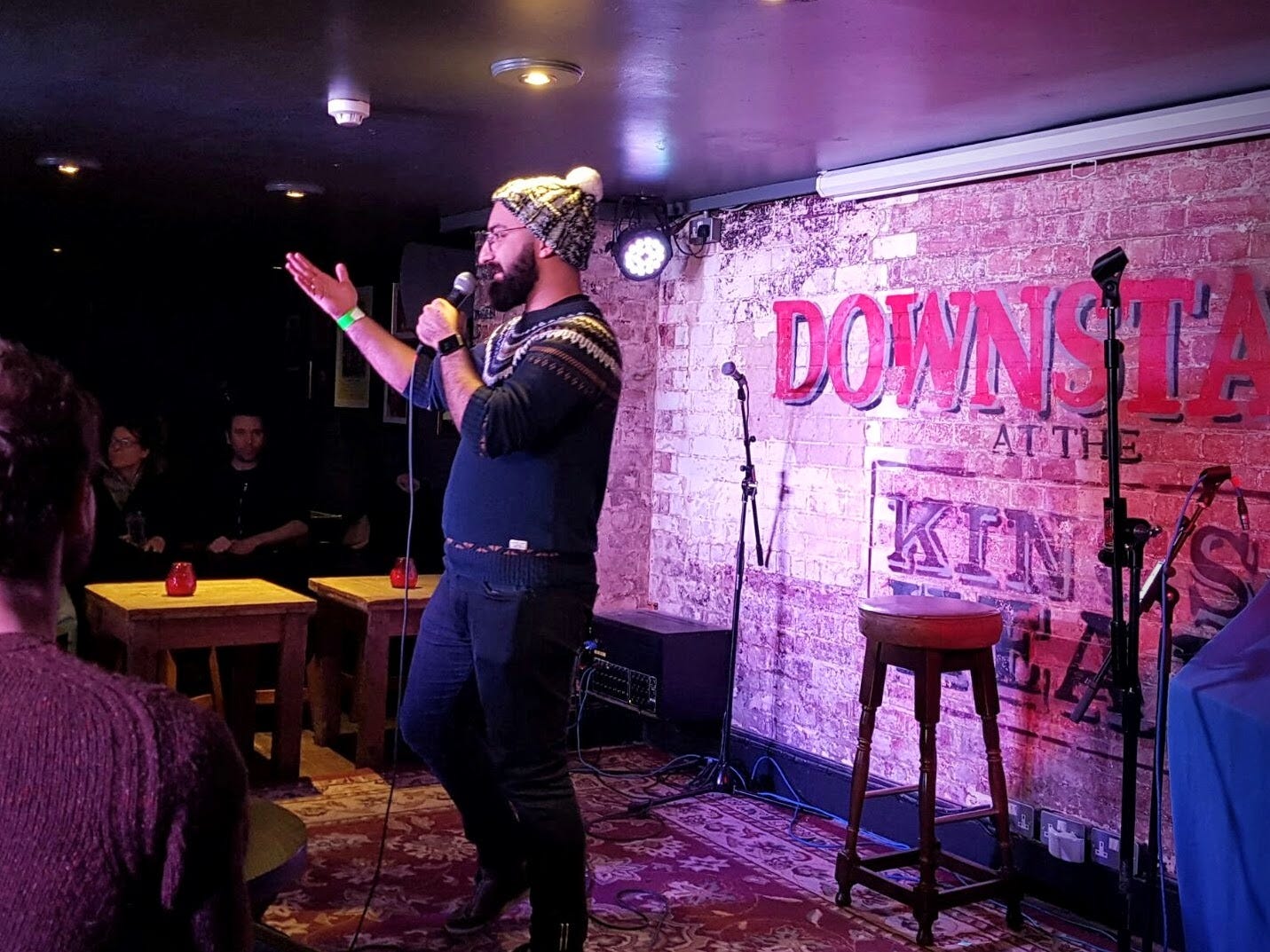
… I'm gonna lay out the agenda so we all know what we're getting into …
I’m proud of my agenda bit. Thanks to my beginner’s mind, I broke at least two rules of comedy by ostensibly telling the audience what the set was going to be about: a) comedy sets aren’t run like work meetings3, and b) in a list of three things, the last one is supposed to be the funny one.
The idea for doing an agenda came from watching a semi-pro comic waste 1 minute of a 10-minute set doing so, in what seemed to be an attempt to be considerate and give trigger warnings. Except it was not funny.
I’d performed my bit about circumcision a couple of times at this point and also felt the compulsion to warn people about it, but I refused to do it in a way that wasn’t funny. I also knew that my well-practised final bit on geopolitics was my best bit and had to remain the closer. So the constraints of wanting to give a heads-up about a sensitive topic but also wanting my funniest bit to be last, resulted in a meta-bit that itself was unconventionally funny, if I may say so myself (I also got a lot of satisfaction from doing it!). That each item on the 3 point list got a laugh was a bonus, thanks to some off-the-cuff riffing, which incidentally is how most of my best bits got “written”:
We're gonna examine what it's like living under late consumerist capitalism [laughter]
It's quite a heavy topic so we're gonna palate cleanse with a little bit of chat about my penis [laughter]
And then we're gonna deconstruct the ideas of race and nationhood [laughter]
To this day, if I’m ever facilitating an honest-to-goodness serious meeting and people enjoy it, I think back to how this experience shaped my instincts.
Hi, Kosta! You're like the friend of the comedians, I love it!
Me: What was next, Kosta?
Kosta: erm, I'm stuck at the penis …
Me; You're stuck at the penis?! [laughter] hahah ... I wish! [laughter]
Audience interaction in comedy is a double-edged sword. My personality, minor exposure to improv practices (yes-and-ing, repeating the last phrase, doubling down on absurdity etc.), and fast response times meant I usually survived after engaging in it.
The handful of times that I got spontaneous claps from audiences during (vs the end of) my sets were when I ‘handled’ hecklers. This told me time and again that people come to live comedy for what could only happen at live comedy: unique playful interactions. In a sense, hecklers are starting conversations. So I started seeing the performances more like conversations. The resulting connection between stage and audience feels electric, even if channelled through just one person, and worth cultivating intentionally. Good MC’s know this and I learned from watching them.
The container of a specific night of comedy is another contributor to a unique experience. I was lucky to be performing on a night when the MC was great, the audience receptive and some existing rapport between stage and audience had been established. It’s why I could get on stage and pick up a conversation with the random audience member Kosta, riding a swelling wave. This is both humbling and empowering: how well I do on stage is not entirely up to my jokes, but also the environment and how I adapt to it.
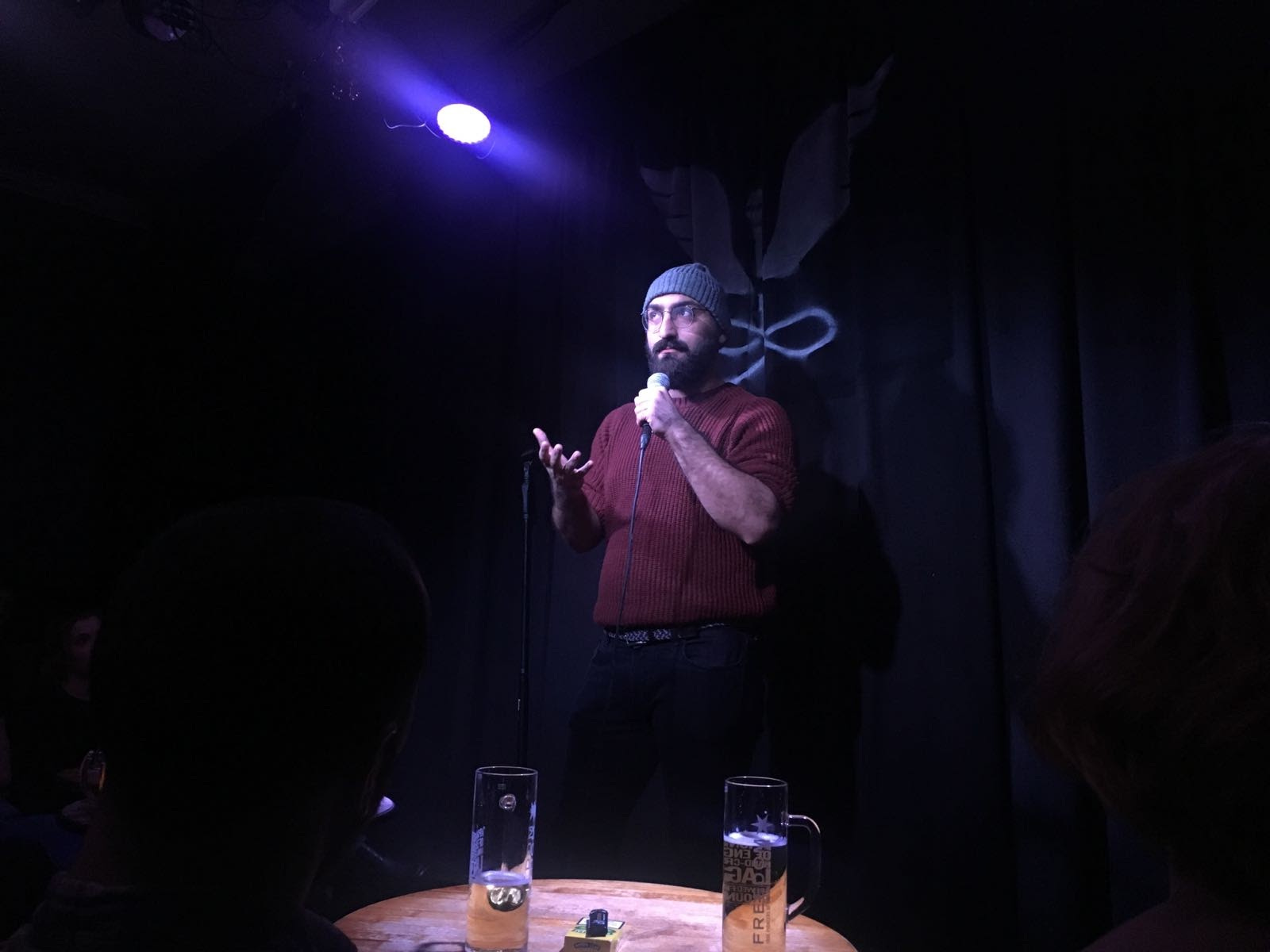
so I guess what I'm saying is fine-tune your bigotry, people [big laughter] there's different kinds of brown people out there [laughter] just like there are different kinds of brown bread! That's how I explained it to my ex's parents [laughter] … they understand bread <sniff> ... [laughter]
I’ve watched back some other recordings of my sets with different material in them, and they follow a predictable structure: opener, some light and reliable material, some stuff I’m still not sure about, and then the heavy material to finish with.
An instinctive need to surface difficult truths to audiences, and to be seen and be heard, is a big part of many comedians’ motivation to do what they do. Perhaps one way that stand-up differs from other performing arts is the accompanying (survival) instinct to provide plenty of honey with the bitterness of those truths.
I suspect a big reason why the audience laughed at my jokes about circumcision or being profiled or geopolitical shenanigans is that I seemed to be smiling along with them. A kind of permission to laugh along, a reassurance that “It’s OK, I’m OK, you can laugh”. A make-belief that I’ve processed this and it’s not hurting me, it’s all light and breezy.
It’s a trope that many comedians do comedy instead of going to therapy, but whether this helps process or perpetuates the pain of many comedians …? One of the most groundbreaking stand-up shows of the last few years is Hannah Gadsby’s ‘Nanette’ and it’s premised on her decision to break from the re-traumatising framework4 of stand-up comedy. When I saw the show at the Soho Theatre in 2018 (cheeky brag), half the audience were other comedians taking notes and getting mindblown by the sheer possibility of this. We all recognised the pattern of freezing ourselves into our traumas for laughs, whether as a coping mechanism or a form of therapy5.
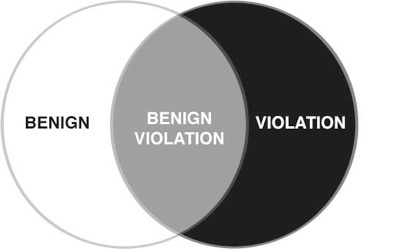
[The Benign Violation Theory proposes that] humor occurs when three conditions are satisfied: 1) something threatens one's sense of how the world "ought to be", 2) the threatening situation seems benign, and 3) a person sees both interpretations at the same time.
I used to say that I stopped doing stand-up because I got bored with my material and didn’t make the time to write more.
Another way I view it is through the lens of Benign Violation Theory. I was experiencing so many “violations to my sense of how the world ought to be” that I looked for ways to make these violations and contradictions seem benign to myself and to others, in a bid for peace and harmony. The main thread of these contradictions were my muted self-perception against the various stereotype threats I faced, most obviously as a brown man, but on several other fronts, too.
So why did I stop doing stand-up? A decrease in the the number of these violations and/or my willingness to force them to seem benign, through a wide range of self-work and healing practices over the years. Although I’m still occasionally conscious and fearful of people’s perception of me, I manage to maintain the belief that I’m a full human being and not a collection of tickboxes. And when I do face those fears and violations, I make more considered judgement calls as to whether to waft them away with a joke, or inquire deeper - which are not mutually exclusive! Often a stray joke leads to fantastic insight.
Maybe one day I’ll do stand-up again. It’ll be very different if I do. I definitely quit on a plateau of mediocre skills, way before any form of mastery.
But the skills I did hone in doing stand-up now permeate many aspects of my approach to work and life: spotting and naming dissonances, timing, finding ways to reconcile contradictions, reading the dynamics of a room, testing and iterating on a craft, effective and accessible articulation of difficult topics, a love of metaphors, painful amounts of self-awareness, enjoying the present moment and the ability to choose when to make light and when to make heavy.
P.S. I initially wanted to write this commentary from a craft and technique perspective which would’ve been … well, different. As a nod to that intention and in the spirit of Showing My Working, here are some stats from the clip at the top:

Amir H. Hajizamani@amirhhz
Just transcribed a video of my not-too-shabby comedy set from 2017. Gag Stats: 🏃♂️ Pace - a laugh every ~7 secs (41 hits over 5 mins) 🎯 Big'uns - 9 🤪 Ad-lib/crowd - 6 👴🏼 Puns - 2 I wanna do a behind-the-scenes/showing-my-working thing with it ... would you read/watch?
11:42 PM · Feb 9, 2021
6 Likes