
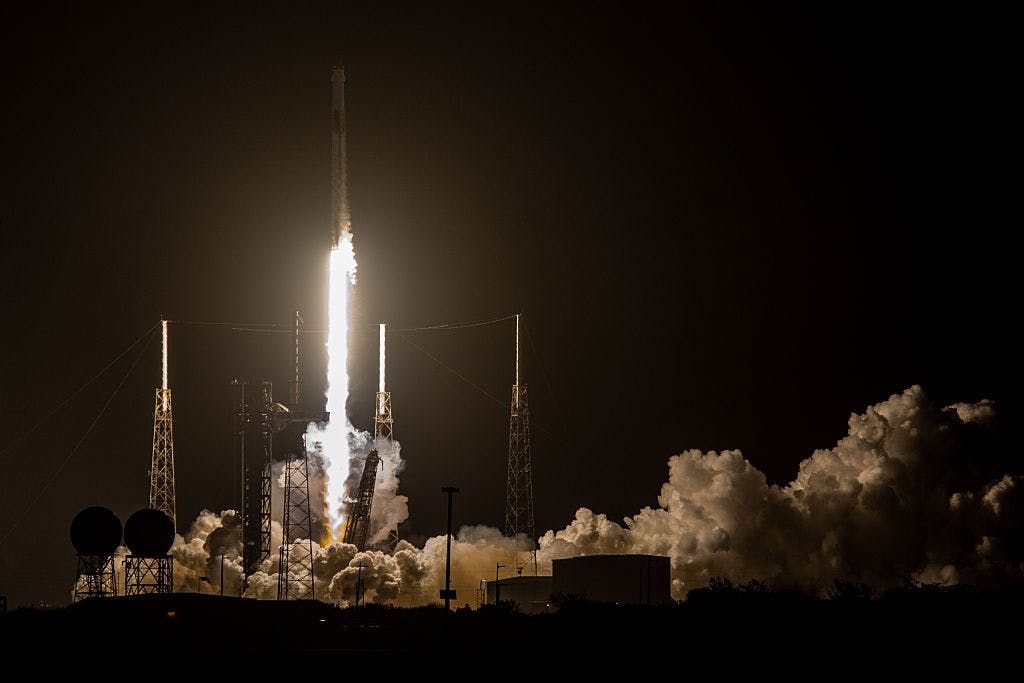
The Falcon 9 rocket launches with Crew 12 from Complex 40 at the Cape Canaveral Space Force Station (Manuel Mazzanti/Getty Images)
Starlink expects to connect 25 million monthly users by the end of the year on a service the company says will allow video calls and streaming.
At the Mobile World Congress keynote Monday morning, SpaceX President Gwynne Shotwell and Starlink VP of Engineering Michael Nicolls said the company plans to offer broadband-level cellular service through its direct-to-cell product, now branded Starlink Mobile.
The company aims to grow from 10 million active monthly users today to 25 million by the end of 2026. The service is designed to give consumers access to high-speed internet, including video calls in remote areas using unmodified smartphones.
“ When your phone’s in your pocket, when you’re in your car and you’re connected to Starlink Mobile, it should look and feel like you’re connected to a high-performing 5G terrestrial network,” Nicolls said. “That kind of experience is what we’re shooting for.”
Still, SpaceX emphasized that satellite service is not meant to replace traditional cellular networks. “It cannot provide the data density that terrestrial networks have,” Nicolls said, while contending that it can augment coverage in areas where land-based networks don’t reach or when additional capacity is needed — a category that includes large portions of the US and much of the world.
For now, SpaceX is positioning Starlink Mobile as a complement to carriers like AT&T and Verizon rather than a direct competitor. The service is meant to fill coverage gaps in remote areas, at sea, and during emergencies when terrestrial networks go down. Shotwell noted that T-Mobile was SpaceX’s first — and remains its only — US carrier partner.
The mobile push comes as SpaceX expands its ambitions beyond launch services. Last month, the company announced it had acquired SpaceX CEO Elon Musk’s AI startup, xAI, creating a combined company that spans rockets, satellite broadband, mobile connectivity, and artificial intelligence. Bloomberg reported Friday that SpaceX is preparing to file IPO paperwork with the Securities and Exchange Commission as soon as March, targeting a valuation as high as $1.75 trillion. At the time of the merger, the combined company was valued at around $1.25 trillion. The higher valuation estimate suggests investors see businesses like Starlink’s internet service, and potentially Starlink Mobile, as key drivers of revenue beyond rocket launches.
According to the report, the numbers reflect the combined finances of SpaceX and xAI, which it acquired in February.
After acquiring xAI, SpaceX’s successful space launch and satellite business may have been dragged down by xAI’s massive data center spending. Earlier this year, Bloomberg reported that xAI had burned through $8 billion in the first nine months of 2025.
According to the report, the numbers reflect the combined finances of SpaceX and xAI, which it acquired in February.
After acquiring xAI, SpaceX’s successful space launch and satellite business may have been dragged down by xAI’s massive data center spending. Earlier this year, Bloomberg reported that xAI had burned through $8 billion in the first nine months of 2025.
Business Insider is reporting that Amazon’s Project Houdini seeks to slash labor costs and installation time by building modular “data halls” — the rows of racks of servers that make up the heart of data centers — in factories, and then shipping them fully assembled on trailers to data center sites.
According to the report, the modular plan would save weeks of construction time and tens of thousands of hours of labor costs.
This week in Amazon’s letter to shareholders, CEO Andy Jassy wrote that the company is planning $200 billion in capital expenditure this year, and that it is embracing its tradition of taking big bets on experiments like Project Houdini:
“You need to invent and experiment like crazy. Many of these experiments will fail, and it might feel like you’re getting nowhere. But, your culture must possess the tenacity to keep at it.”
Business Insider is reporting that Amazon’s Project Houdini seeks to slash labor costs and installation time by building modular “data halls” — the rows of racks of servers that make up the heart of data centers — in factories, and then shipping them fully assembled on trailers to data center sites.
According to the report, the modular plan would save weeks of construction time and tens of thousands of hours of labor costs.
This week in Amazon’s letter to shareholders, CEO Andy Jassy wrote that the company is planning $200 billion in capital expenditure this year, and that it is embracing its tradition of taking big bets on experiments like Project Houdini:
“You need to invent and experiment like crazy. Many of these experiments will fail, and it might feel like you’re getting nowhere. But, your culture must possess the tenacity to keep at it.”
Creator of popular, mysterious “HappyHorse” text-to-video model is Alibaba
AI benchmark leaderboards are often where mysterious new models make their debut, stoking speculation about the unnamed companies behind them.
That was the case with an impressive new text-to-video model named HappyHorse-1.0 that shot to the top of public leaderboards. CNBC reports that Chinese tech giant Alibaba has confirmed that it is the owner of the new model.
HappyHorse beat out the popular Seedance model from rival ByteDance in blind human evaluations to claim the top spot on the Artificial Analysis text-to-video leaderboard.
While OpenAI has announced it is shuttering its text-to-video Sora app, the category continues to see intense competition as a flurry of video models improve with more realistic physics and cinematic effects.
HappyHorse beat out the popular Seedance model from rival ByteDance in blind human evaluations to claim the top spot on the Artificial Analysis text-to-video leaderboard.
While OpenAI has announced it is shuttering its text-to-video Sora app, the category continues to see intense competition as a flurry of video models improve with more realistic physics and cinematic effects.
Axios wrote that OpenAI is allowing a small group of partners to test its new AI tool, which has “advanced cybersecurity capabilities.”
The realization that we have arrived at an era of powerful new AI models that could overwhelm current cybersecurity defenses is spooking investors, with cybersecurity stocks like Cloudflare, Zscaler, CrowdStrike, and Palo Alto Networks all down sharply this morning.
Axios wrote that OpenAI is allowing a small group of partners to test its new AI tool, which has “advanced cybersecurity capabilities.”
The realization that we have arrived at an era of powerful new AI models that could overwhelm current cybersecurity defenses is spooking investors, with cybersecurity stocks like Cloudflare, Zscaler, CrowdStrike, and Palo Alto Networks all down sharply this morning.
OpenAI’s Stargate shrinks further as UK data center “paused”
OpenAI’s ambitious Stargate global data center project just got smaller.
First announced at the White House alongside President Trump at the start of his second term, the OpenAI partnership with Oracle and SoftBank sought to build massive data centers around the world, including sites in the UAE, the UK, and Norway.
Bloomberg reports that the company is “pausing” the Stargate UK project, citing high energy costs and regulatory obstacles.
Last month, the company and its partner Oracle scrapped its planned expansion of the Stargate I data center site in Abilene, Texas.
In a statement to Bloomberg, the company said:
“AI compute is foundational to that goal — we continue to explore Stargate UK and will move forward when the right conditions such as regulation and the cost of energy enable long-term infrastructure investment.”
Stargate UK was announced in September, including a partnership with Nvidia and Nscale that would scale up to 31,000 GPUs.
Bloomberg reports that the company is “pausing” the Stargate UK project, citing high energy costs and regulatory obstacles.
Last month, the company and its partner Oracle scrapped its planned expansion of the Stargate I data center site in Abilene, Texas.
In a statement to Bloomberg, the company said:
“AI compute is foundational to that goal — we continue to explore Stargate UK and will move forward when the right conditions such as regulation and the cost of energy enable long-term infrastructure investment.”
Stargate UK was announced in September, including a partnership with Nvidia and Nscale that would scale up to 31,000 GPUs.
Latest Stories
Sherwood Media, LLC produces fresh and unique perspectives on topical financial news and is a fully owned subsidiary of Robinhood Markets, Inc., and any views expressed here do not necessarily reflect the views of any other Robinhood affiliate, including Robinhood Markets, Inc., Robinhood Financial LLC, Robinhood Securities, LLC, Robinhood Crypto, LLC, Robinhood Derivatives, LLC, or Robinhood Money, LLC. Futures and event contracts are offered through Robinhood Derivatives, LLC.