
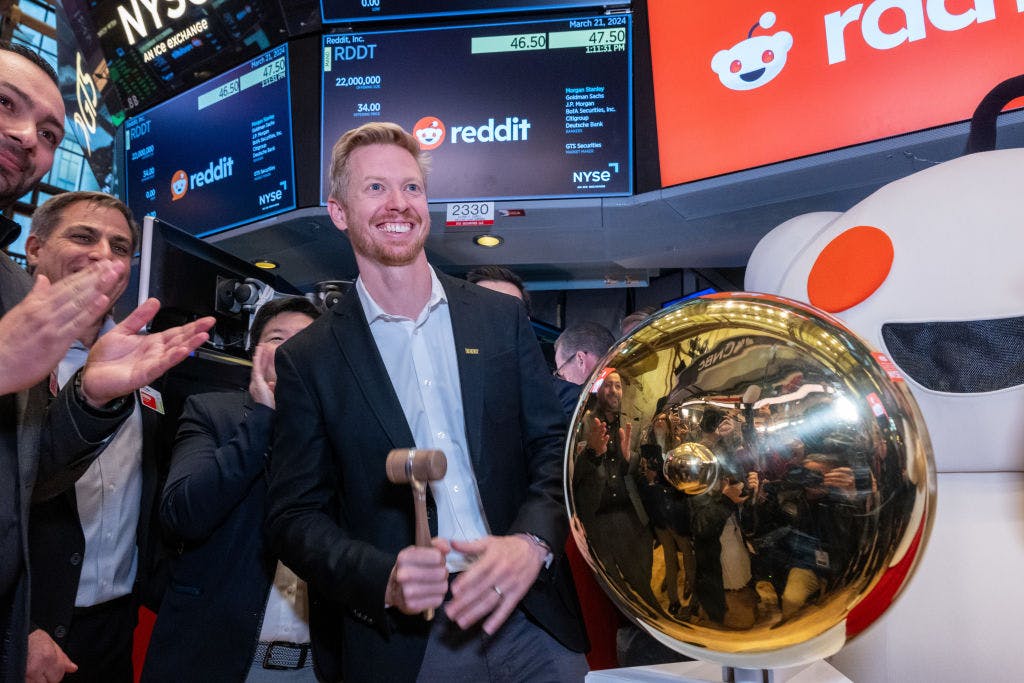
Reddit CEO Steve Huffman stands on the floor of the New York Stock Exchange at Reddit’s IPO a year ago (Spencer Platt/Getty Images)
Its AI licensing business made up less than 10% of the company’s total revenue last quarter.
Reddit’s licensing deals with Google and OpenAI are great, but using that data for itself is even better, Reddit CEO Steve Huffman said at Deutsche Bank’s Media, Internet & Telecom Conference this week.
Here’s Huffman during a fireside chat:
“We did a couple of deals last year — one with Google, one with OpenAI — licensing our corpus for training for their LLMs. And then we also started investing in our own work to kind of reveal the value of that corpus. And that’s where our head is at right now. So this is search. This is Reddit Answers. This is training our own models.”
These deals, where tech companies like Google pay Reddit tens of millions of dollars a year to license its trove of conversations in order to train their large language models, made up less than 9% of the company’s total revenue last year. (The AI business is buried in “other” revenue.) The vast majority of its revenue comes from advertising.
Huffman said Reddit of course is still “open and open for business” when it comes to these licensing deals — it’s basically free money, after all — and will “see where this goes.” But using that data itself is really the main event:
“What I know for sure is that there is an incredible amount of value there. And I think we’re actually in the best position to kind of capture it.”
Huffman also seemed to be playing down the idea that Reddit and Google have become frenemies after Reddit blamed a tweak to Google’s search algorithm for its disappointing growth in daily active users last quarter, and after Reddit has launched its own Google-like services. Huffman says he thinks the company can reach a billion daily active users irrespective of Google’s algorithm.
“Big picture, our relationship with Google is great. We collaborate with them. On the search side, obviously, we have a ton of content in their index that makes their search product better.
It’s an amazing channel for us. Particularly, those logged out users coming from Google, though it’s volatile, it’s a great opportunity for us to teach internet consumers broadly that Reddit has the answer to their questions. It also happens to be our least valuable cohort of users from a monetization point of view, so it doesn’t really affect revenue. That’s why you didn’t see any revenue movement related to anything that Google does.
And then we collaborate with Google on the AI side. They’re a customer for our data. We’re a big cloud customer. We’re mutual advertisers. We collaborate on safety. It’s a really deep and healthy partnership.”
“Google” was mentioned 35 times in the conversation, mostly by the Reddit CEO.
Tesla and SpaceX to jointly run “most epic chip-building exercise in history by far”
In the latest instance that Elon Musk views Tesla and SpaceX as effectively one company, the CEO of both announced Saturday that the two firms will join forces on his Terafab project — what Musk says will be “the most epic chip-building exercise in history by far.”
Many of the details mirror what we reported last week, with one major addition: SpaceX will play a leading role.
Terafab, planned for the north campus of Tesla’s Gigafactory Texas, aims to vertically integrate the entire chipmaking process, from design and fabrication to testing and packaging. The goal is to supply AI chips to Tesla, SpaceX, and its subsidiary, Musk’s AI company, xAI, whose suppliers Musk said will be unable to handle their demand in “three or four years.” While Tesla has designed its own chips, it has never manufactured them.
Musk said the facility is intended to produce up to 1 terawatt of compute annually. The plant will manufacture two types of chips: inference chips for Tesla’s robotaxis and Optimus robots, and custom AI chips intended for space-based applications like solar-powered AI satellites. According to Musk, roughly 80% of the compute will be allocated to space-related uses, with the remaining 20% supporting projects on Earth.
Morgan Stanley has estimated the project could cost Tesla an additional $35 billion to $45 billion in capital expenditures, though now perhaps some of that capex might be shared with SpaceX. Like many of Musk’s ambitions, the project is enormous in scale and will likely to take years to complete — potentially into the end of the decade or beyond.
— Tesla (@Tesla) March 22, 2026TERAFAB: the next step to becoming a galactic civilization
Together with @SpaceX & @xAI, we're building the largest chip manufacturing facility ever (1TW/year) – combining logic, memory & advanced packaging under one roof.
To harness as much power as possible from the Sun, we… https://t.co/QYfGR8XsJx
White House releases AI legislative framework
The White House has released its policy wish list for AI legislation — and what it wants excluded.
Still, the odds of any actual AI regulation getting passed in Congress right now are very slim.
The “National Policy Framework” for AI lays out seven issues that the Trump administration wants to see reflected in any congressional action around AI.
The items listed in the framework include:
Child safety protections, age verification, and parental controls for AI.
Data center projects voluntarily pay their own way when it comes to power, but incentives should still be encouraged.
Copyright laws should allow for training models on copyrighted works, while protecting individuals’ voice and likeness.
Free speech should be defended for AI systems, preventing the government from pressuring companies to ban or alter content based on partisan agendas.
A light touch to regulation to encourage innovation, and no federal agency to regulate AI.
American workers vulnerable to AI job replacement should be retrained and supported.
Federal AI rules should preempt any state AI legislation to prevent a patchwork of laws that companies would hate.
The policy list is the latest in a series of proposals from the AI-friendly Trump administration.
The items listed in the framework include:
Child safety protections, age verification, and parental controls for AI.
Data center projects voluntarily pay their own way when it comes to power, but incentives should still be encouraged.
Copyright laws should allow for training models on copyrighted works, while protecting individuals’ voice and likeness.
Free speech should be defended for AI systems, preventing the government from pressuring companies to ban or alter content based on partisan agendas.
A light touch to regulation to encourage innovation, and no federal agency to regulate AI.
American workers vulnerable to AI job replacement should be retrained and supported.
Federal AI rules should preempt any state AI legislation to prevent a patchwork of laws that companies would hate.
The policy list is the latest in a series of proposals from the AI-friendly Trump administration.
The plan is to merge ChatGPT, Codex, and the Atlas browser together, as it seeks to focus its efforts as it competes with Anthropic and Google for lucrative enterprise customers.
OpenAI Head of Apps Fidji Simo told staffers in an internal memo that “we realized we were spreading our efforts across too many apps and stacks, and that we need to simplify our efforts. That fragmentation has been slowing us down and making it harder to hit the quality bar we want,” per the report.
The plan is to merge ChatGPT, Codex, and the Atlas browser together, as it seeks to focus its efforts as it competes with Anthropic and Google for lucrative enterprise customers.
OpenAI Head of Apps Fidji Simo told staffers in an internal memo that “we realized we were spreading our efforts across too many apps and stacks, and that we need to simplify our efforts. That fragmentation has been slowing us down and making it harder to hit the quality bar we want,” per the report.
Latest Stories
Sherwood Media, LLC produces fresh and unique perspectives on topical financial news and is a fully owned subsidiary of Robinhood Markets, Inc., and any views expressed here do not necessarily reflect the views of any other Robinhood affiliate, including Robinhood Markets, Inc., Robinhood Financial LLC, Robinhood Securities, LLC, Robinhood Crypto, LLC, Robinhood Derivatives, LLC, or Robinhood Money, LLC. Futures and event contracts are offered through Robinhood Derivatives, LLC.