
|
Fixed Gear on the Cheap


Thinking of building a fixed gear bike?
This article is a step-by-step "walk through" of fixed gear conversion issues.
It
is an adjunct to Sheldon's excellent article on Fixed Gear Conversions.
Also, see Sheldon's article on why people like fixed gear bikes.

Many bikes and frames are suitable for fixed gear use, but older road bikes are the ones most commonly available. A typical example is this 10-speed Univega (pictured above). Made in Japan, around 1977-78, the bike came with a steel lugged frame, friction shifting, 27 inch wheels with steel rims, a 5 speed freewheel, and double chainrings.
Choosing a bike
If you are looking for an inexpensive way to get into fixed gear riding, you may want to consider starting with an older road bike.
If you are not sure what to look for, see Sheldon's article Fixed Gear Conversions., the "Frames for Fixed Gear Conversion" section.
Also, if you are not sure how to determine if the bike fits you, please read Sheldon's article on bike fit. And some additional thoughts for conversion useage.
Warning: Fixed-gear riding is habit forming, and once you get hooked, you are likely to want to upgrade to a better fixer!
| 6 Steps to Fixed Gear | |
|---|---|
| What to Do | Why to do it. |
| Remove un-needed components. | No need to carry the stuff around anymore. |
| Select your chainring and determine your chainline. | Straight chainline works best. |
| Replace the freewheel with a track sprocket. | One sprocket= fixed gear. |
| Respace the rear wheel's axle | To put the sprocket in correct alignment with the chainring. |
| Redish the rear wheel | To center the rim in the frame. |
| Put on a new chain. | New sprocket will quickly wear out with an old chain. |
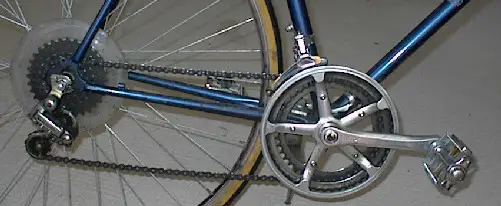
The original drivetrain.
If the bike has the older 27 " wheels, you don't have to replace the 27 " wheels because Tires , and rims , are still available for this size.
| Components to Remove | |
|---|---|
| This is the stuff you won't need any longer. | |
| Components | Why |
| Shifters and Cables | You won't need them |
| Both Derailers | You won't use these either. |
| Chain | If it's old and worn. |
| Chainring | The one you aren't going to use. |
| Tools You Will Need | ||
|---|---|---|
| Because there so much variation in older bike components, this list is meant to cover most possibilities, but not all. So plan on at least one trip to get the correct size tool. | ||
| Tool | Size or Type | Why |
| Screwdrivers | Slotted and Phillips | For removing shifters and cable guides. |
| Allen Wrenches | 4, 5 and 6 mm | For removing handlebars,stems,derailers,... |
| Open/box end wrenches |
At least 8, 10, 12, 13, 14, 15, 16, 17 mm | Have a set handy, for removing derailers, cables, hub locknuts, etc... |
| Freewheel tools | Freewheel remover | You will need the appropriate removal tool for your brand of freewheel... |
| Freewheel tools | Sturdy vise or BIG adjustable wrench | The freewheel is probably very tight, it will take a lot of leverage to break it free... |
| Cone Wrenches | Most rear hubs use 15 mm; most fronts 13 mm | Depending on the hub, you will need 2 of the correct size to move spacers around and to retighten the cones and locknuts. |
| Extras | Chain Tool | Needed if you want to replace the chain. |
| Extras | Cable Cutting tool | A bike cable housing cutter, diagonal cutter or shear cutter should be used. |
| Extras | Small Ruler | To measure chainlines front and rear. |
| Possibles | Crank Puller | On some cranksets, the chainrings can't be removed without removing the crank. |
| Possibles | Allen Wrench or socket wrench | For cotterless cranks. |
| Possibles | Hammer | If it's a cottered crank. |
Old Bike Maintenance
If your old bike has not had any work done on it recently, then you should also check and replace as needed:
- Front and rear brake pads
- Front and rear brake cables
- Tires and tubes.
- Headset bearings
- Bottom bracket bearings
- Wheel hub bearings.
If you are not sure how to approach the above repair items, look here for Sheldon's repair index.
| The bike parts you will need are: | |
|---|---|
| Item | Why |
| Short Stack Bolts | For use with only one chainring.The stock bolts will be too long. |
| Rear Sprocket | Hopefully you know the answer to this one. |
| New Chain | 3/32 "is the derailer standard. We recommend going with it unless you are using 1/8 "sprockets and/or a 1/8"chainring. |
| Brake Cables and housing | You should replace them if they are old. |
| Brake Pads | You REALLY should replace these if they are old. |
| Ball bearings and grease | In case the hubs need them. |
| Thread Locker | To put on the sprocket to ensure it doesn't unscrew. |
| Bottom Bracket Lockring | To put on the hub to hold the sprocket on. |
| Rear Axle spacers | Get a variety of sizes 1,2,3,4 mm, so that you can select the correct combination for spacing the rear axle. |
| New Fixed-Gear Rear Wheel | Optional, but the easiest way to go. Can get a fixed/free flip/flop hub. |
| Conversion Work: | |
|---|---|
| Work | Why |
| New vs. Old Wheel Decision | First you have to decide if you want to use your old wheel or buy a new fixed-specific one. |
| Freehub Rear Wheels | Not for fixed gear, only for singlespeed. |
| Setting chainline | A procedure to ensure it is staight. |
| Respacing to get this chainline | To get the sprocket in the correct position for a straight chainline. |
| Redishing | To move the rim into correct alignment with the frame. |
| Sprocket/Chainring Selection | Thoughts on deciding what gear ratio you want. |
| New Chain Length | A procedure to select the best length of chain. |
| Setting Chainring Roundness | To have the same tension on the chain for the entire revolution of the chainring. |
New wheel vs old wheel:
The lowest cost way to create a fixed gear bike is to keep and reuse it's rear wheel.
However, the simplist and fastest is to buy a fixed-gear specific rear wheel.
A new wheel has significant advantages over reusing an old freewheel-rear wheel. The main advantage ( other than it being new, straight and shiny ) is the ability to run a lockring to hold the rear sprocket on.
Hubs made for fixed-gear use have two threaded sections on one, or both, sides.
- The larger threaded section takes the track sprocket, same as a freewheel-threaded hub.
- The smaller, reverse-threaded section takes the special lockring.
- The lockring screws onto this section backwards. If the track sprocket tries to unscrew, it tightens the lockring, preventing the sprocket from unscrewing.
- The reason this is important is that many fixed gear riders slow down by pushing backwards on the pedals. This 'resisting the rotation' effort can generate a lot of force, possibly unscrewing a sprocket that is on a freewheel-threaded hub.
You can check out the fixed gear wheel options and decide if that's the way you want to go.
Removing the freewheel.
If you decide to use your old wheel, you will need to remove the freewheel and replace it with a track sprocket ( size of your choice ).
If you haven't removed a freewheel before, you'll need to get the specific removal tool for your freewheel.
The harder part is redishing the wheel and aligning the track sprocket with the chainring.
Your local shop can respace the axle and redish the wheel. However, be aware that if problems crop up in the rework of the old wheel, you can easily spend more in shop labor than in the cost of a new fixed gear wheel. Things like spokes breaking, bent axles, spokes rusted to nipples, rims not being straight, hubs worn out, etc., can create havoc in reusing an old wheel.
Freehub rear wheels
If you have a freehub wheel, the ratcheting freewheel mechanism is built into the hub body. So you can't ( practically ) have a fixed gear bike with one of these. However, you can build a singlespeed by replacing the cassette cogset with one sprocket and a set of spacers
Chainline
The Chainline should run straight from the chainring to the sprocket. A couple millimeters either way will make a difference. Please read Sheldon's article on Chainline.
If you hear the drivetrain making noises, it's probable that the chain's side plates are hitting the sprocket or chainring teeth. You will have to get the chainline closer to perfect.
Check the picture of our project bikes' chainline before I respaced the axle and redished the wheel. The sprocket is inboard of the chainring by a few millimeters. While this isn't terrible, it's not good enough for a fixed gear.
Since both the rear sprocket and the front chainring can be positioned in or out ( from the centerline of the bike ) with spacers, you have two variables with which to work.
Since we're talking about older road bikes, the distance from the centerline of the bike to the center of the smaller/inner chainring is about 41-42 mm for most road-double chainrings.
Respacing the rear axle
Respacing the rear wheel requires taking off the cone lock nuts and moving spacers from the right side to the left side until you get the sprocket in direct fore/aft alignment with the chainring.
Like most 10-speeds, our project bike's rear wheel did not need a lot of rim movement. It only needed to be moved about 5 mm to the right.
- You can determine your chainline numbers by measuring the distance between the dropouts.
- With the wheel in the dropous, measure the distance from the inside of the dropout to the center of the sprocket. (The sprocket should be fully spun onto the freewheel threads.)
- Take half of the dropout measurement and subtract the dropout-to-sprocket number and you have the centerline-to-sprocket measurement.
- Up front, it's the centerline of the bike to chainring measurement. Usually, the center of the bottom bracket will be fairly easy to gauge.
- With a small ruler, measure from the center of the bottom bracket tube to the center of the chainring.
- The two numbers will have to be within 1 mm for a good chainline.
- Use chainring bolt spacers to position the chainring in or out on the crank arm spider.
- You will also need some rear axle spacers to get the sprocket where you want it.
- Many old rear hubs have one large right side spacer. You'll need to replace this with a number of smaller ones. The spacers go between the hub's cone nut and the inside lock nut.
- Most any bike shop will have spacers.
Solid Axle
If you have a sold (nutted) axle, you should re-center the axle on the hub. It's nice to have both ends of the (solid) axle stick out of the dropouts the same length.
Loosen both cone locknuts and turn both cone-nuts to the right to move the axle to the left.
This is a good time to backoff the cone locknuts and regrease your hub's bearings.
Once you have the axle recentered and the correct length of spacers on the sprocket side, add enough spacers on the left side of the hub to exactly match the inside width of your dropouts.
Follow Sheldon's article on cone adjustment.
Hollow axle(quick release)
You will Definitely have to center the axle and move spacers.
- You want an equal amount of axle showing on each end.
- The axle must NOT protrude beyond the outside of the frame dropout, otherwise the quick release won't hold.
- Some old bikes used the rear derailer's claw attachment as part of the right side dropout. If your bike used a claw attachment for the rear derailer, you need to make sure that, in removing the rear derailer, the right dropout is not thinner than before.
- If so, the quick release rear axle may be too long for this new configuration.
- You'll need to shorten the rear axle, though sometimes just discarding the conical springs from the skewer will cure this.
Redishing
Redishing the wheel involves moving the rim to the left so that it is, again, in the center of the frame.
You can do this on the bike. You don't need a wheel stand.
You WILL need a spoke wrench that fits your wheel's nipples.
Now, before starting to tighten the left side spokes, it's a good time to get extra spokes in the correct lengths. With old wheels, it's possible that some spokes will break when tightened. And/or nipples will round off or crack.
Take one from each side to your local bike shop and get at least 3-4 of each length. That way, you will have them if any of the old ones break during the dishing/truing process.
Also, with old wheels, it's good to lube the rim eyelets and spoke threads. Some may be corroded or even rusted. They won't tighten easily without some oil or grease on them.
- I like to loosen the left side spokes a couple of turns to ensure oil gets on the threads. It makes it easier to tighten them later. And helps to prevent rounding off the nipple ends.
- Tighten the left side spokes 1/2 turn starting at the tube valve hole and proceeding around the rim.
- Don't try to move the rim all the way over by tightening each spoke the full amount. You will pull the rim out of round and it will be harder to get it back to round.
- If the rim must move more than a few millimeters, you may need to back off on the right side spokes. You'll know if the left side ones get hard to turn before you get the rim in it's final position.
- Continue this process until the rim is centered in the frame. If you are not sure how much tension should be on both sides, check Sheldon's wheel building article.
- True the wheel as needed. If you are not running a rear brake, the rim will not need to be precisely in true. But it's always nice to have it close to true. It makes for a stronger wheel. If you are not sure how to true the wheel, see Sheldon's article on wheel building and truing.
Sprocket/Chainring selection
We are frequently asked, "What should I use for a sprocket if I'm running an X-tooth chainring?".
I wish I could just answer, "Well, you use an 18 tooth sprocket for a 42 tooth chainring.". But it depends on you and the terrain you're riding.
We advise most people to buy two sprocket sizes so they can experiement. You should expect to change either the sprocket or the chainring or both before you have a combination you're happy with.
I, being old and slow, ride a 17 tooth sprocket with a 42 tooth chainring in hilly New England. Therefore: the cliche...
"Your mileage may vary."
I also advise people to ride their currrent road bike (if they have one) in each gear combination and decide which one they would like to be 'stuck' in for a long ride.
Remember, you can't coast. So you will be spinning on every downhill.
You are looking for a midpoint where it is possible to crank up hills, in or out of the saddle, and spin down those hills without having to clamp the front brake hard enought to overheat the rim.
Read Sheldon's section on Gearing.
One more thing. Don't use cheap track sprockets. They are not threaded across their entire width. Because of that, their few steel threads can strip the hub's aluminum threads.
Good ones are wider and fully threaded.
When installing the sprocket, we recommend you use some sort of thread locker, along with a lockring.
These lockrings also fit bottom bracket cups. Same diameter and threads.
The hub you use may not have a lot of threads showing after you install the sprocket, so make sure the sprocket is fully seated and carefully thread on the lockring and tighten.
New Chain Length
- One way to decide how long your chain should be is to set the axle at the middle of the dropout range and put the chain on the sprocket and pull the two ends together around the front of the chainring.
- Then see where you need to break the chain.
- If you are using a modern SRAM chain, you will have a master link that you insert to hook the two chain ends together. This link can be snapped on and off if you need to shorten the chain by another link at a later time.
- On other chains, you will need to use your chain tool to separate the chain at the chosen point, and to push the chain pin back into the selected link.
- You normally want the axle to end up in the middle of the dropout slot when the chain is pulled tight.
You should set your chainring for optimum roundness. So that there is equal tension on the chain for the complete rotation of the chainring. It makes for smoother pedaling.
Finish
If you haven't installed brake cables before, check the article on cutting brake cable housing.
Handlebar Taping:
Handlebar taping can take practice. If you are picky, you may want to take the bike to your local shop. There are lots of articles around on this topic.
Fixed gear conversions make nice weekend projects. If you have questions about this process, call or e-mail us here at Harris Cyclery.
Good luck and happy riding!
Articles by Sheldon Brown and Others
- What's New
- Beginners
- Bicycle Glossary
- Brakes
- Commuting
- Cyclecomputers
- Do-It-Yourself
- Essays and Fiction
- Family Cycling
- Fixed-Gear
- Frames
- Gears and Drivetrains
- Humor
- Old Bikes
- Repair Tips
- Singlespeed
- Tandems
- Touring
- Wheels
- Translations
- Sheldon - the man
Copyright © 1998, 2008 Sheldon Brown
If you would like to make a link or bookmark to this page, the URL is:
https://www.sheldonbrown.com/deakins/how-to-fixed-conversion.html
Last Updated: by Harriet Fell