Yakima, Washington, is an agricultural powerhouse. It grows about three-fourths of the hops in the United States, is a major wine region, and produces many apples and cherries. Washington and California have an odd beef over cherry stems. Washington prides itself on cherries with beautiful, intact stems, while sometimes looking down on California cherries.
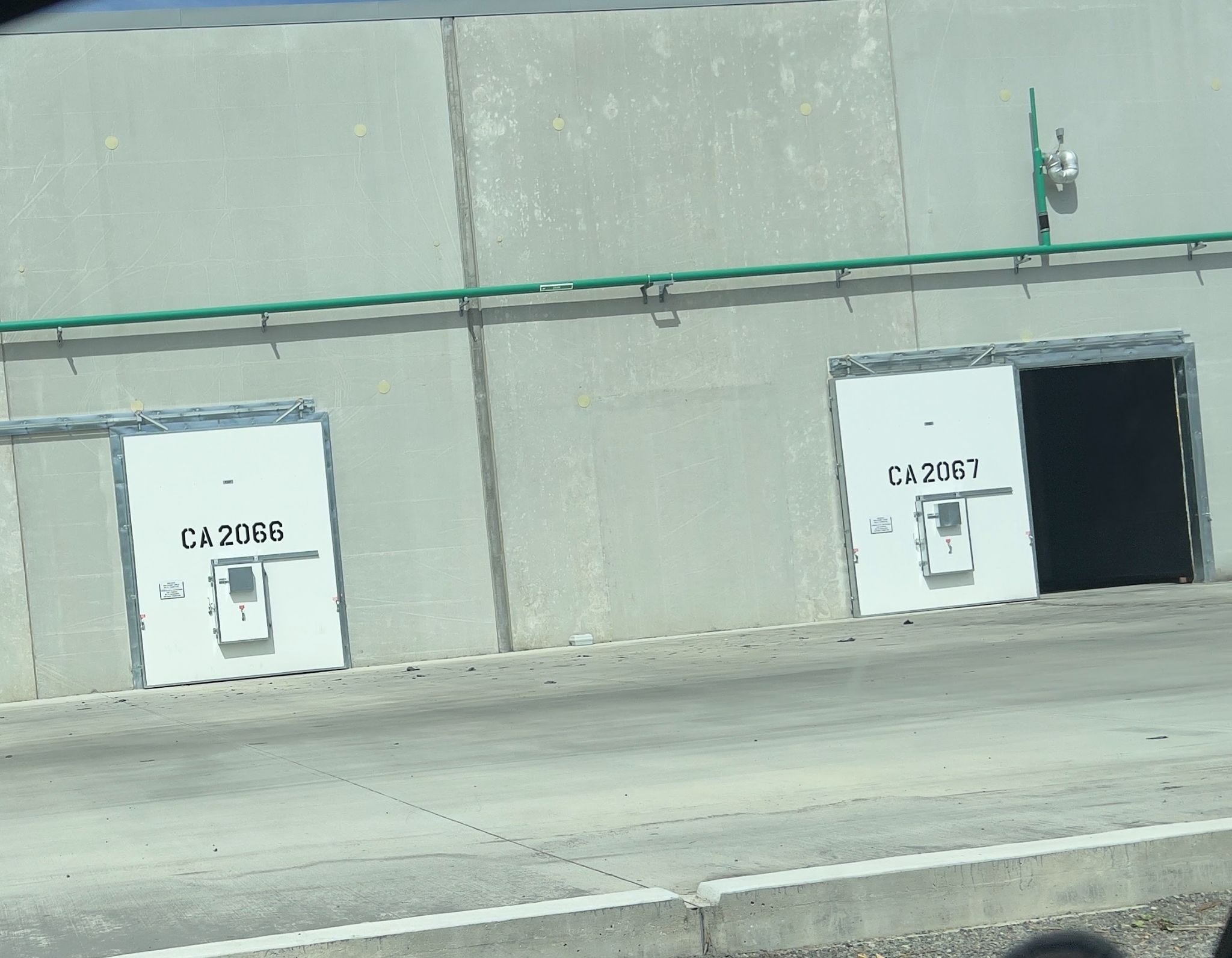
Recently, I had the privilege of visiting one of the largest cherry and apple packing facilities in Yakima, Washington. As you drive in, it feels like you are entering a massive storage facility. Hundreds of controlled-atmosphere rooms store fruit like apples. It is like a massive warehouse with big numbered doors.
Cherries are not climacteric1 and must be cooled quickly to below a certain temperature. Growers bring in hundreds of tons of cherries every day from many different farms, and they immediately cool them with cold water if the temperature is above the required 35 degrees F. At this stage, they wash and clean the cherries, removing most leaves and stems.
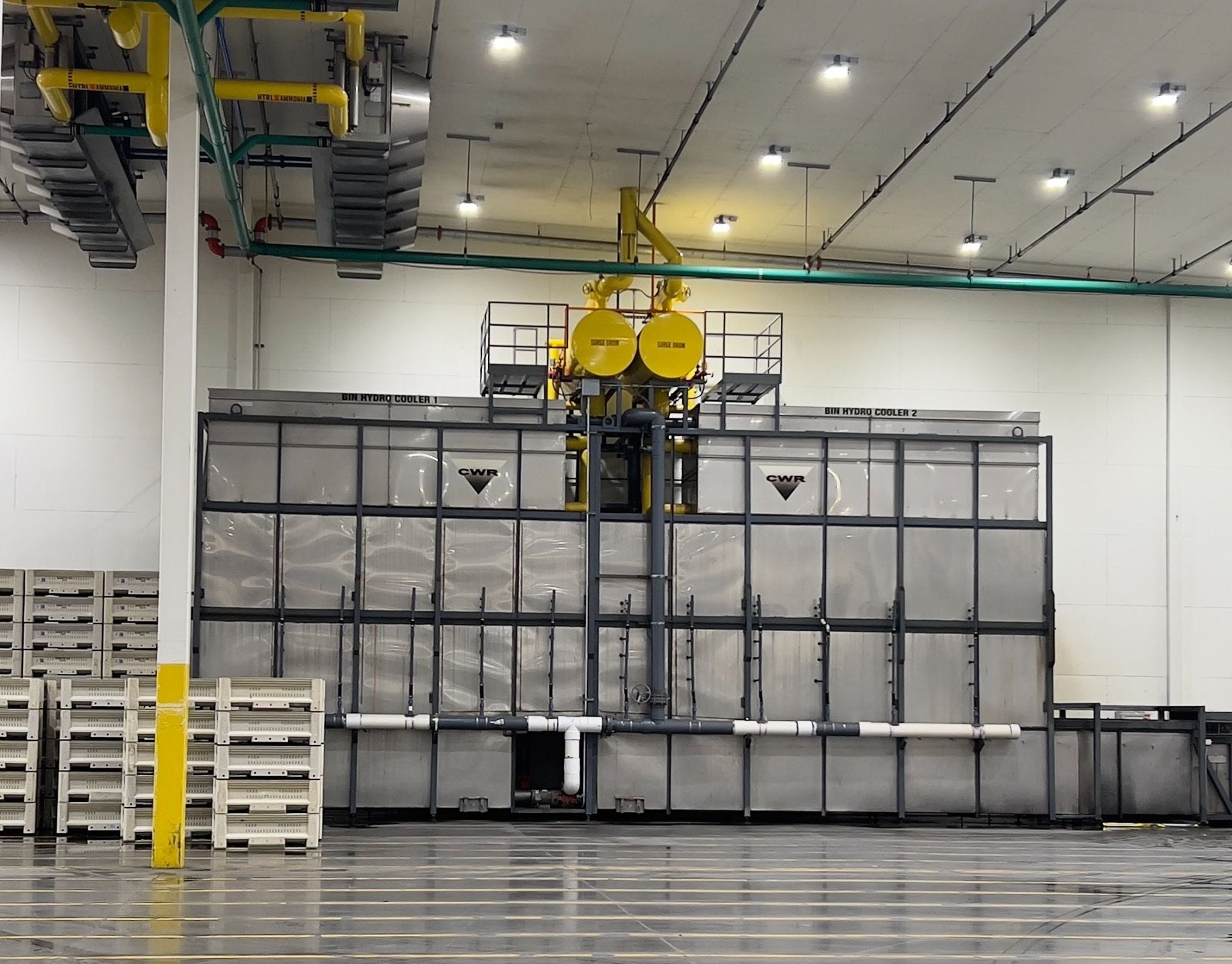
The cherries are in massive trays and bins and move automatically on large conveyor belts. There are hardly any workers there, as most of the process is fairly automated.
Cherries then make it through the conveyor belt system. The cherries are constantly kept floating and moving with cold water. The cold water keeps the cherries cold, firm, and crisp, and it also washes away lighter items like leaves, sand, and sticks. The cherries continue moving along different conveyor belts and are ultimately sent down thin channels that can hold only one or two cherries across their width. The cherries then enter a sophisticated vision-system-based sorting and grading system (the blue box near the top of the image, toward the end of this video shot by Rhishi Pethe).
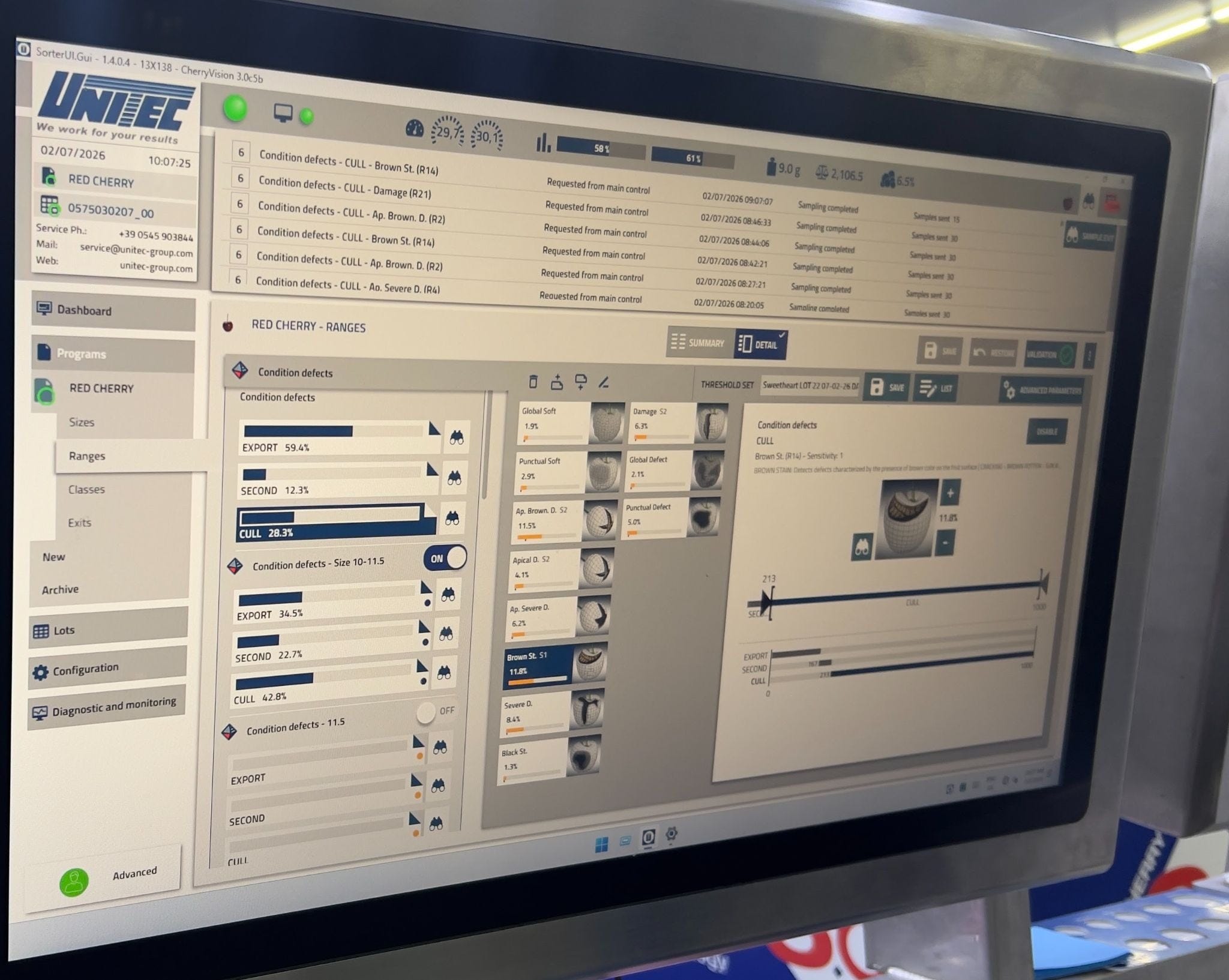
For example, Ellips’ cherry grader captures 30 images2 of every cherry with three synchronized cameras, capturing color, infrared, and a filtered monochrome channel for defect contrast. Each camera fires 10 times as the fruit rotates. The machine analyzes size, color, multiple defect types, cherry firmness, handling defects like bruising, and other factors. The computers that monitor and control the operation provide a real-time view of what it has “seen.”’
Some systems, like the Unitec vision system, read ripeness and sugar content (also known as Brix) non-destructively by analyzing cherry images. It segments cherries by eating quality, not just appearance. These systems can process 20 tons of cherries per hour.
With a few taps on the screens, the machine can tweak what it measures and, most importantly, how it categorizes each cherry based on those measurements. As you can see in the picture, about a third of the cherries were culled when I visited the pack house.
The packing facility works only 6-8 weeks a year, during the cherry harvest season.
For the other 44-46 weeks of the year, the packing facility stays idle, and routine preventive and necessary maintenance is performed to prepare it for the next season. This multi-million-dollar machine is utilized only 2/12, or 16.6%. The machine stays idle for the rest of the time (about 83.4%).
This process is extremely precise, and the system can track each cherry and physically send it to the right bin based on its categorization. A simple software program, run by their operations manager, controls the entire process based on the latest needs from their customers.
While the technology for quality assessment and sorting cherries is amazing, it is even more interesting to understand the implications for the business.
For example, if a cherry is pristine across multiple dimensions and can survive a long journey, it gets marked for the export market for buyers willing to pay a premium. If a cherry has very few visible defects and is crisp with the color the buyer wants, it might go to the Whole Foods category.
Before optical grading, pack-houses used mechanical sizing.
Mechanical sizing was about 40-50% accurate, whereas optical grading is 90+% accurate.
This lets every cherry be graded on its own merits, including defects, appearance, scratches, stem quality, and sweetness. Basically, cherries can be graded and priced like an airline prices every seat within its class and optimizes fare classes.
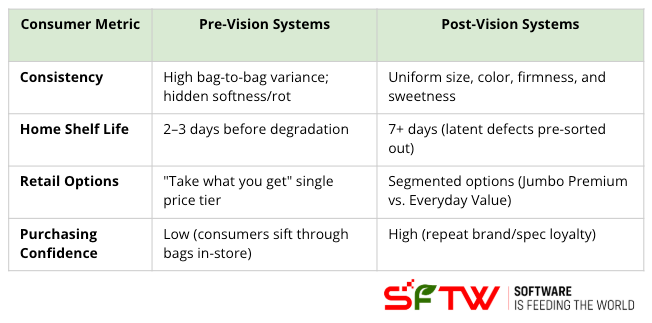
Cherry packhouses can now sort and package jumbo cherries into premium export clamshells, mid-size cherries into domestic retail, and small cherries into value bags; marginal cherries can go to jams, and the rest are rejected. It is similar to a beef carcass cutout: you receive a heterogeneous biological unit with a fixed set of properties, and you can optimize allocation across classes against today’s prices. This differentiation can feed back into upstream breeding and genetics, helping them optimize breeding to produce more of the qualities the market values.
Before optical grading, “quality” was a quasi-informed assertion done by the packer and shipper. Traditional human hand-packers graded fruit mostly on visible size and glaring rot.
Given that cherries are extremely perishable, a picked cherry loses quality by the hour. Vision-based dynamic class segmentation enables shipping first-class cherries with dark color, perfect stems, and high firmness, and airfreighting them to China or Vietnam, where consumers pay $15-$25 per pound for a high-status gift.
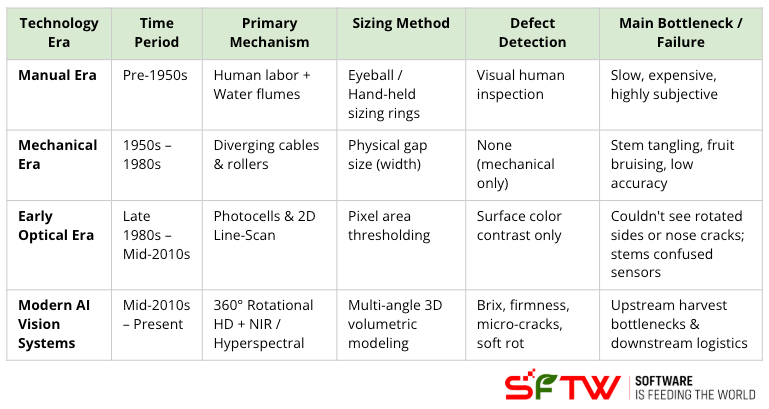
The yield management algorithm matches the cherry’s measured firmness and integrity to its destination. For example, the firmest fruit gets on a 21-day container ship to Asia, whereas the softer fruit stays on a 2-day truck route to regional grocery chains.
Buyers had to inspect batches visually (before optimal sorting) and had to risk inconsistent quality. Now, with optical sorting, a buyer in Shanghai or Chengdu can confidently contract for a container of “Grade A, 28-30 mm diameter, 18+ Brix with less than 2% cosmetic defect” cherries. Containerization and optical systems provide a trusted, repeatable standardization required for global B2B commodity trading.
It has allowed Chile to capitalize on out-of-season demand (out of season for the Northern Hemisphere) and increase exports almost 6-fold over the last decade. Precision sorting unlocked counter-seasonal trade, allowing Northern Hemisphere consumers in North America/Europe to access Chilean cherries from November through February.
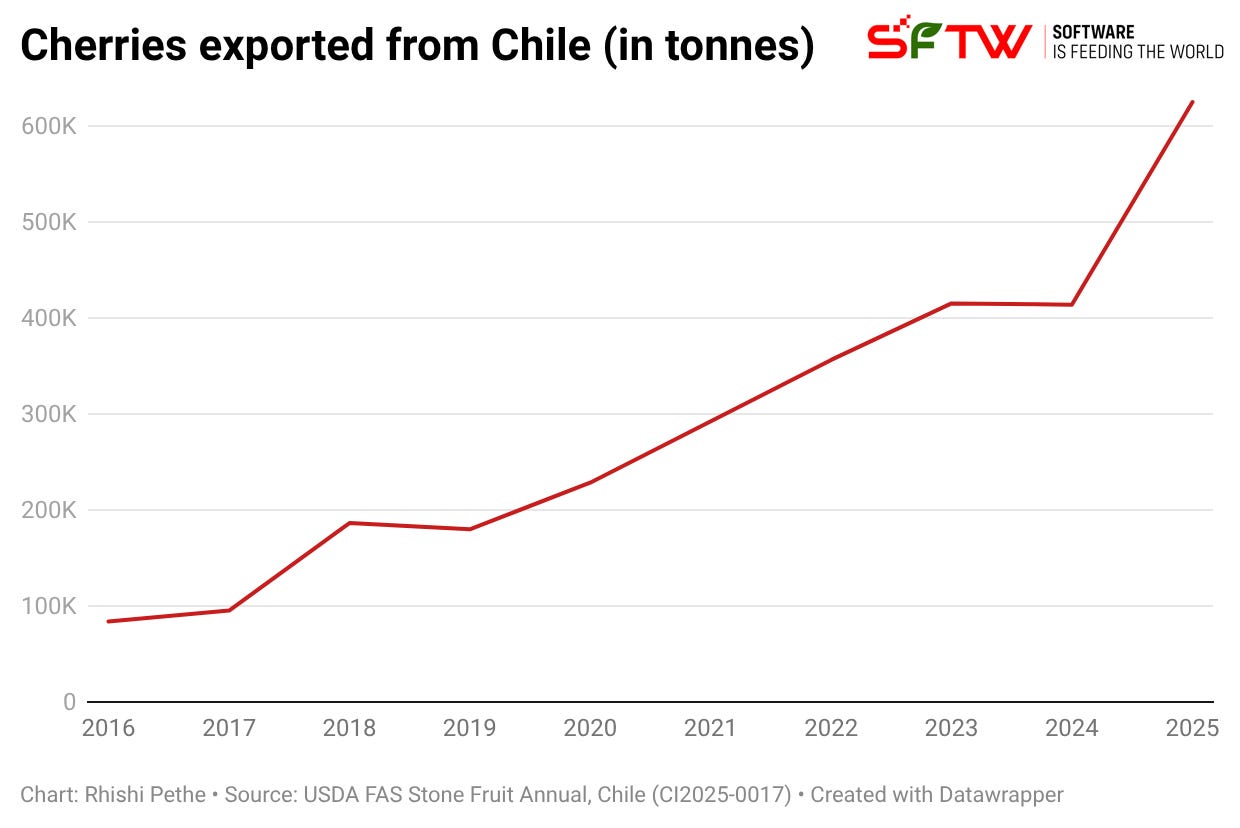
Optical firmness grading enabled Chilean packers to confidently shift from expensive air freight to refrigerated ocean containers, keeping consumer price inflation manageable despite rising global supply chain costs.
Chile’s cherry harvest runs from November to February, whereas China’s runs from May through June. So abundant Chilean cherries land right around the Chinese Lunar New Year (between late January and mid-February) when there is a gap in domestic cherry supply for China.
In Chinese culture, red signals luck, roundness signals completeness, and the price makes it a clear status gift. For almost a decade, the Chile-to-China cherry trade ran on a delicately balanced calendar. Cherries ripen in December in Chile, then are rushed across the Pacific to arrive in the two-week pre-holiday window and sell at a peak.
The huge value proposition of the cherries coming before the Lunar New Year was that they arrive on a fixed date as a premium gift. If the cherry arrives soft, lacerated, or late, it is worthless and fails as a gift. But a reliable vision system makes arrival possible, with consistent quality over long distances. It is possible to ship cherries by sea for 21-23 days because every cherry in the box and the container is structurally sound and at peak taste.
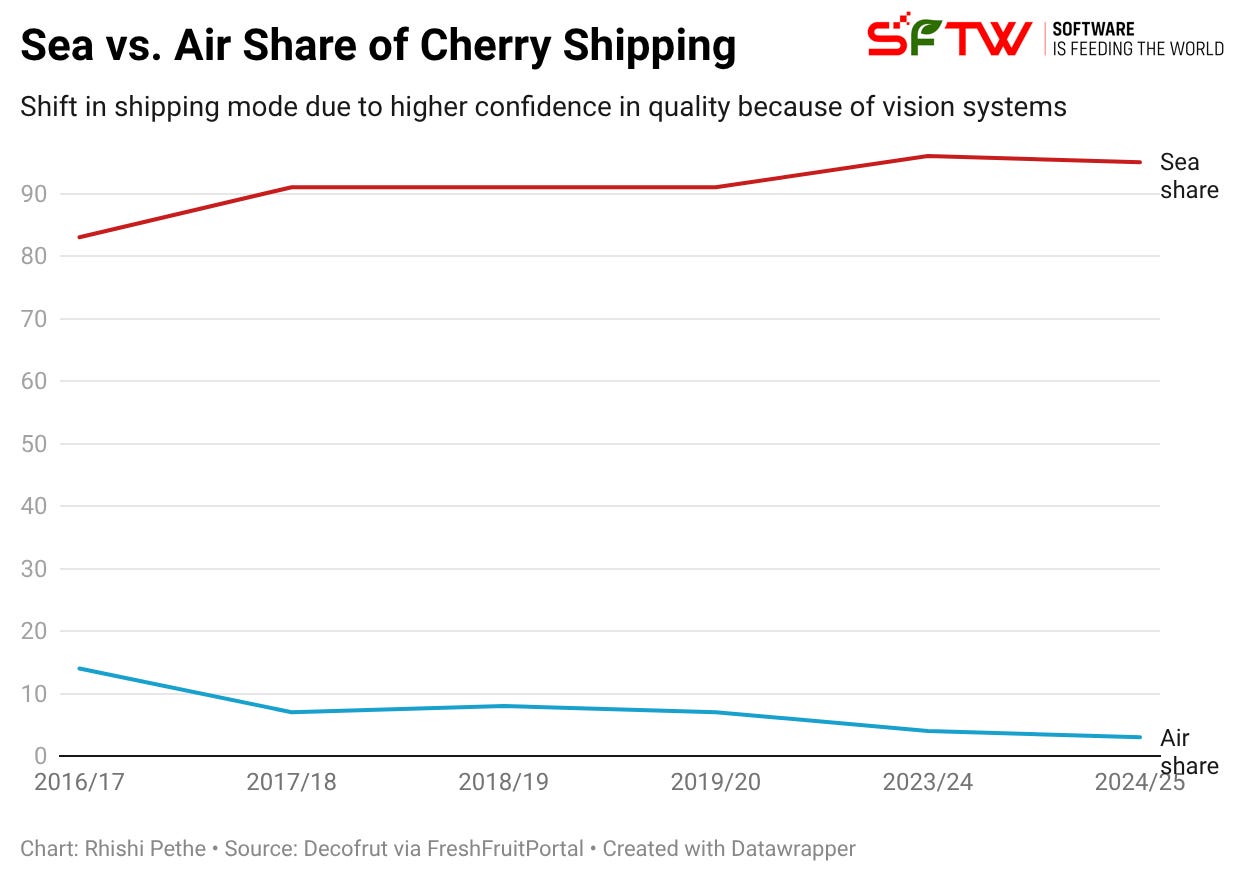
The shift from air freight to shipping dropped the price of the cherries, yet it still delivered a large quantity in time, with the premium quality a Chinese gift-giver expects for the Lunar New Year. But the abundance of high-quality cherries has killed the gift’s specialty; before vision systems, they were scarce and hence more valuable.
Chilean exporters have maintained a direct shipping route to China. The direct route cut shipping time from 30 to 23 days. Cherry shipping capacity doubled in 2025. In 2026, more than four weeks before the Lunar New Year, Chilean cherries were widely available in China, with prices 40% lower for premium red, round, beautiful-looking cherries.
Vision systems began as labor-efficient, consistent, high-throughput systems for sorting, packing, and shipping cherries. The precision of these systems has enabled differential pricing, giving customers the product they need at the price they care about. This has reduced waste by matching each cherry to the right customer and use. However, they may have reduced cherries’ allure a bit, as they are now more widely available.
Vision systems, combined with containerization and fast yet inexpensive supply chains, have made cherries more accessible to many customers when they value them most.