tl;dr - ChatGPT Space could be a huge context centralisation flywheel for OpenAI, accumulating dystopian levels of power. I’m sharing a 2 minute proof-of-concept for a more powerful, open-source alternative.
One week ago, OpenAI announced ‘ChatGPT Space’.
Space helps you create living documents with ChatGPT and the people you work with. Keep work in one shared space, where you can tag in ChatGPT, Codex, or your dot to help—and build on shared context together.
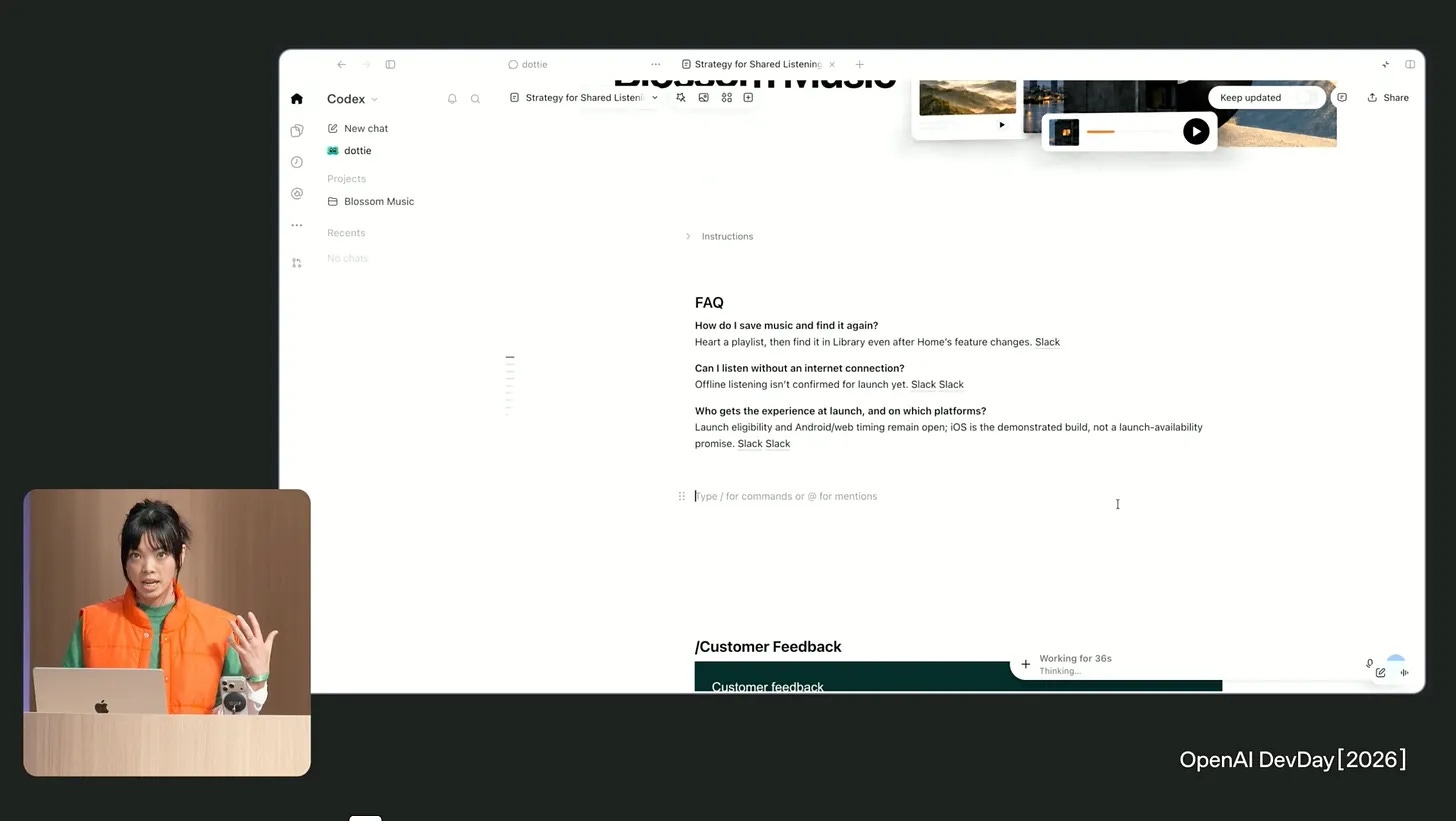
From a product lens, it’s promising: prominent commentators are behind the ‘AI-native workspace’.
From a commercial lens, it’s sizeable: Microsoft 365 makes ~$100bn in annual revenue.
From a societal lens, it could be a centralising dystopia.
I want to focus on this societal lens.
This essay is in two parts:
The centralising dystopia of ChatGPT Space. This is a somewhat gloomy philosophical polemic about why we shouldn’t want a single company to own all of our context. It’s a provocation about what kind of world and future we want.
The unreasonable power of owning your context (here). This is a much more upbeat piece on how owning your context can be radically powerful and joyful. It’s got a short demo video and a high-level of the technical ideas I’m most excited about.
If you want to see the demo / code first, here’s the 2 minute video and the open-source GitHub repo. (You can even ask ChatGPT yourself!)
Here’s a few things you should bear in mind as you read:
This isn’t really about OpenAI specifically. I mention them because they’ve released ChatGPT Space, but: (a) I’m sure Anthropic have similar things in the works; and (b) my point is about structure, not the individual actors in the structure.
The essay is hyperbolic in places. This is because I am a human(!) who wants to convey some abstract ideas. Hyperbole is my natural way of making them vivid (and thus communicable).
I have ideology and an agenda. I believe in the ideas of liberal democracy and ‘freedom as non-domination’, and I want to promote them. I’ve also built, and am open-sourcing, an alternative to ChatGPT Space.
As a nice bonus: this essay is 100% human-written. I write using the en-dash, because I’m British. (The image graphics are Opus 5.5.)
With that said, let’s begin!
To make my first key point tangible, we need to understand incentives.
So, let’s ask a simple question: why are OpenAI doing ChatGPT Space?
I think that, when we deal with big, powerful actors, it’s prudent to ask: why are they doing this? What’s their incentive?
Note: I don’t mean, “What’s the chronological account of the product’s origin?” (I think it’s much more likely that ChatGPT Space began life as an experiment rather than a centrally dictated initiative.)
What I do mean is this: “What’s the vested interest in this product’s success?”
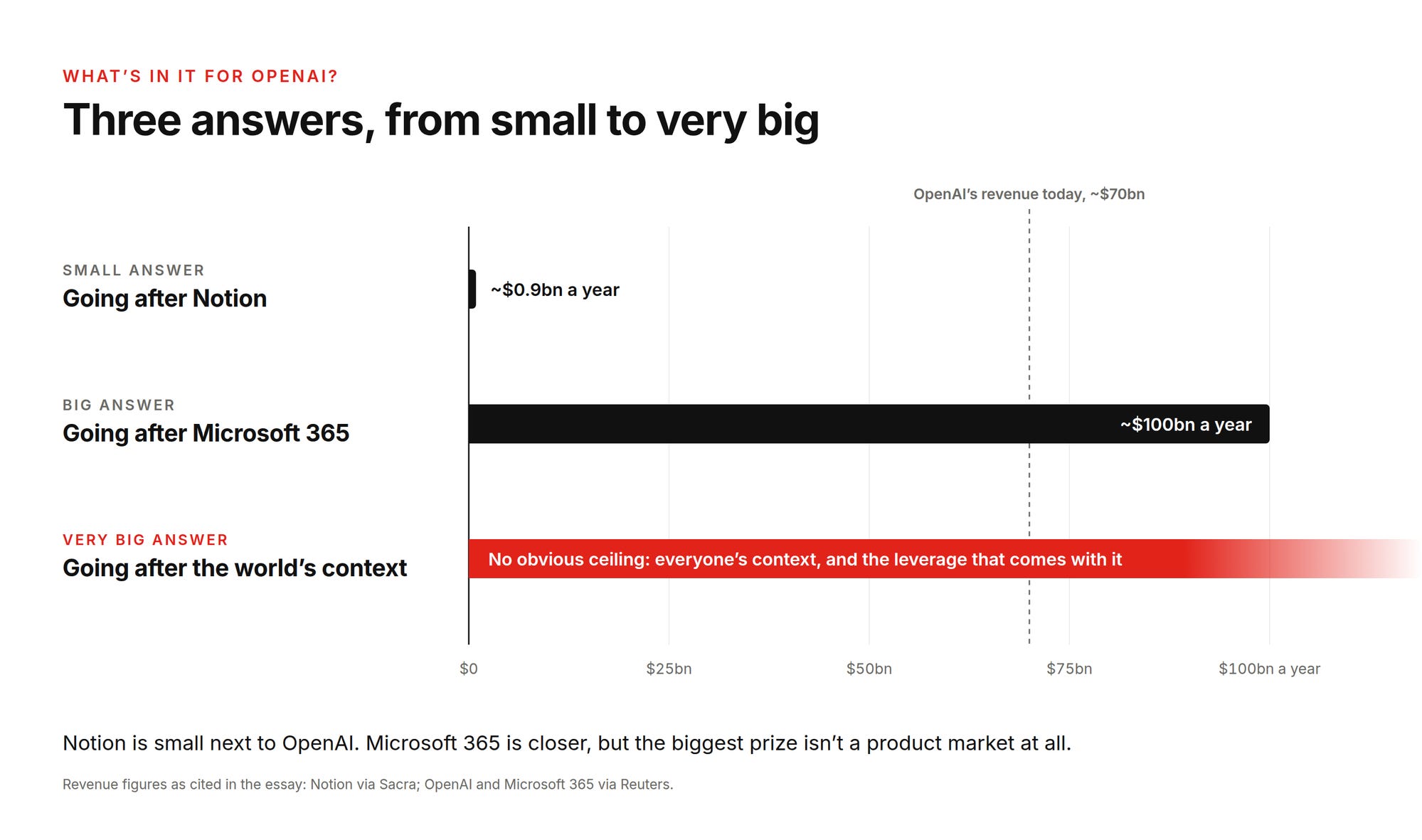
There’s a lot of possible answers. Here’s three possible answers, from ‘small’ to ‘very big’.
A common reflex to ChatGPT Space is, “It looks like Notion”, and so an obvious answer is, “OpenAI are going after Notion!”
Clearly, there’s visual influences from Notion: block-based editing, a nice menu for slash commands and nested sub-pages. (These weren’t necessarily invented by Notion, but Notion made them most popular in startup-land.)
However, I think this answer is far too small. I admire a lot of Notion’s early pioneering work, but the company is simply peanuts compared to OpenAI.
Notion makes an estimated ~$0.9 billion a year in revenue.
OpenAI is at near $70 billion in annual revenue.
They need far, far more than Notion-sized deltas to grow into and beyond a $1.4 trillion valuation.
So, let’s think bigger.
“Collaborative slides and spreadsheets coming soon.”
This is overtly Microsoft-coded. Microsoft 365 makes ~$100bn in annual revenue, over 100x that of Notion.
(Google Workspace is large, but smaller: its revenue is reported as a subset of Google Cloud, which is ~$20bn in annual revenue.)
By the Jevons Paradox, this is a floor of what OpenAI can make here: as knowledge work gets cheap, we do even more of it; and so, conceivably, an OpenAI office suite could make in far excess of $100 billion each year.
I still think this answer is too small.
I think the real answer is much bigger - and it was anticipated a few months ago by Satya Nadella, Microsoft’s CEO, in some tweets and blog posts.
“Space helps you... build on shared context together.”
Here’s the bit this quote isn’t drawing attention to: how ChatGPT Space keeps your data on OpenAI’s servers, integrated only with OpenAI models, and with no costless export.
If you can’t control where your context is stored, or which AI models can access it, do you really own it?
Here’s Satya Nadella’s take on the bigger picture [emphasis added]:
What is at stake is not some digital tool or system and its use, but how organizations continue to learn, build IP, differentiate, and thrive in a world where AI models can continuously absorb the expertise of humans and organizations and commoditize it.
Nadella’s quote is a bit jargon-y, so here’s my crude reduction of it: if economic productivity is context plus AI, then you’re pretty cooked in the long-run if you don’t own your context.
Basically: a model lab that serves you intelligence and owns your context has absurd leverage over you. (The colourful version of that, from Palantir CEO Alex Karp, is: you become a “vassal state“ of the AI labs.)
Here’s why company data and context is so valuable to OpenAI.
It’s strong vendor-lock in. ChatGPT Space is for OpenAI models. If they own your context there, they can lock you down to using their models at a handsome markup.
It’s strong model training data. AI labs are already paying millions for real-world workforce data. Multiple data labelling companies are crossing $1 billion in annual revenue, because of insatiable AI lab data demand.
So, owning data and context can drive an incredibly strong revenue flywheel: stickier customers, better models. (OpenAI reports that it doesn’t train on Business / Enterprise data by default.)
Importantly: I do genuinely think that it’s powerful to have all of your context in one AI-native place, shareable with your team. I just also believe that it’s important for you to own and control that context.
In the age of AI, context has the potential to exhibit incredibly high gravity.
I don’t mean ‘seriousness’ (although, yes, context is serious).
I mean something more like gravitational pull.
Let’s consider humans to start with. When you’re sharing a doc or leaving a comment, where will you locate it? You’ll use whatever platform your team is using for that: e.g. Notion, Slack or Google Docs.
Context gravity is normally a force that inhibits new platforms, like ChatGPT Space - because there’s high friction to overcome, since your context exists in other tools.
However, AI throughput and velocity has the potential to flip that on its head.
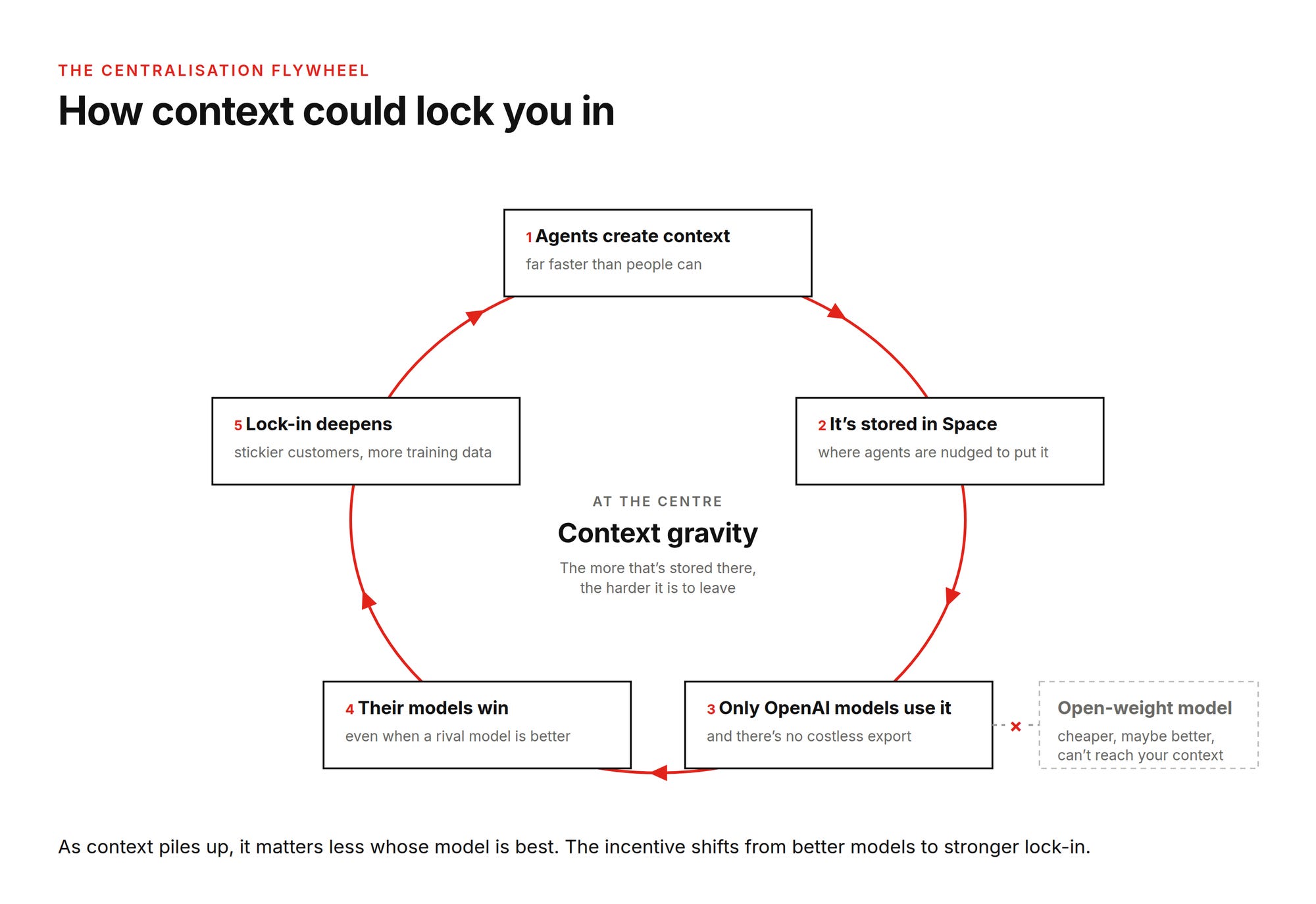
AI and agents work incredibly fast and produce inhuman levels of context. So, the question shifts rapidly away from “Where is my context right now?” to “Where is best for my AI to read and write context?”
I think that OpenAI, and the previously cited commentators, are correct to identify that existing tools are not AI or agent native, and therefore new platforms will be better for AI-heavy collaboration. (Factually, they were all developed pre-agents.)
Clearly, OpenAI also has the power to strongly nudge or direct (via system prompt) ChatGPT and Codex to be biased towards storing context in ChatGPT Space as opposed to other places.
Therefore, there is a very real prospect of OpenAI accumulating a huge amount of context from individuals and companies via ChatGPT Space.
Since ChatGPT Space is only compatible with OpenAI models, this becomes a centralisation flywheel for OpenAI.
There might be a strong, cheap and quick open-weight model that comes out. But, if all your valuable context is all trapped on OpenAI’s servers, then you’re still going to get far more value from OpenAI’s models, even if their model is worse.
This stickiness and lock-in increases the more deeply your context becomes entrenched in OpenAI. Then, before you know it, you’re a ‘hostage‘.
At that point, the commercial incentive for OpenAI isn’t really to keep innovating in models. It’s to keep strengthening their lock-in on you.
I think that, to many readers, it will be obvious why we shouldn’t want to be hostage to OpenAI and why it’d be dystopian for them to have that level of control.
However, there’s two ‘objections’ I can see readers having:
It’s not dystopian, as long as we get good outcomes (e.g. a cure for cancer)
It might be dystopian, but it’s unavoidable, so we need to accept it rather than complaining
I’ll come back to the second of these, but focus on the first here.
Here’s two sketches of why it’s dystopian if we end up in a world of ‘centrally allocated intelligence’ (where 1-2 private companies have near-full control over who gets access to intelligence, and what they get to use it for).
[P]eople do get very uneasy about a small number of companies having so much power and a company deciding turn off this scientist and not that one, turn off this government and not that one. [...] And that is really scary. And I think we feel a lot of responsibility to be a reliable, dependable, fair actor.
Sam Altman, Vanity Fair interview
Sam Altman talks about wanting intelligence to become a utility, like electricity, and he notes that “your electricity company is not the one making decisions about what kind of appliance you can plug in and not“.
However, today, they are making these decisions.
They’re tough, delicate decisions (and ‘neutrality’ is in practice itself a decision), which they need to make.
The problem is, in a concentrated market, these would be decisions made on behalf of all of us.
Here’s a true story which shows why this could be concerning.
Two months ago, I shared a different essay of mine (~80% human-authored) with ChatGPT for feedback.
The essay was critical of AI lab power dynamics. At the time, I naively didn’t consciously consider the risks of sharing that with OpenAI.
The next day, my OpenAI account was banned. I was given no warnings, no explanation and no refund.
I appealed the same day. A few days later, I contacted someone I knew at OpenAI. I still have not heard back, and my account remains deactivated.
I checked their Terms of Use. It includes the following: “We reserve the right to suspend or terminate your access to our Services or delete your account if we determine [... that] [y]our use of our Services could cause risk or harm to OpenAI“.
In some ways, that’s a fair cop on me. I wanted to warn people about the dangers of being dependent on 1-2 AI labs; it wasn’t to harm AI, but I can see why OpenAI might deem it to be a risk to their commercial interests.
But, even so, I still find that troubling. OpenAI is an incredibly powerful actor. I’m literally one person writing a blog post. Is it really proportionate or necessary to do an immediate suspension? That’s the approach of a totalitarian surveillance state, not a company committed to liberty.
To be clear, it’s not necessarily ‘sinister censorship’, because there are other possibilities. For example: my essay was written shortly after the notorious Hugging Face incident, and references their technical research. It’s possible that OpenAI had dialled up their cyber-sensitivity classifiers, and so even merely referencing that incident would trigger an zero-warning account suspension. (If you’re hyperscaling, capacity-constrained and have high-profile incidents, this is a very rational trade-off to make: “Let’s tolerate more false positive suspensions in order to minimise misuse.”)
But this is an extremely dangerous power dynamic for the rest of us in a highly concentrated seller market. If OpenAI wrongfully suspends you, it’s both: (a) of very little commercial significance to them; and (b) incredibly devastating to you, since your other options are incredibly limited.
This gets much worse with ChatGPT Space and OpenAI’s move to own your key context. You’re not just cut off from a key resource - you’re also marooned from your data.
Even if there’s no malice in this, it’s simply too high-stakes for us to accept this power dynamic. What if you’re depending on your access to intelligence to help you navigate your healthcare? You can be locked out in a critical moment, with your data completely accessible, and no recourse.
Your access to your context, and your ability to use it when you need it, should not be dependent on whether an AI lab deems you to be a priority audience or not.
At their most optimistic, the frontier labs like to talk about ‘abundance’. To take it at face value, these labs will solve scarcity itself.
But, here’s the subtext of the power dynamic: AI labs will own the means of abundance, and our access to abundance is dependent on their grace and benevolence.
This strikes me as somewhat of an oxymoron: “We’re going to solve scarcity! Everyone can have abundance! But only on the terms we set, for the uses we approve of.“
Solving scarcity would be a phenomenally profound gift to humanity. Solving it, and then artificially re-imposing it, would be... something else.
There’s two generous views we can try to take here.
The labs intend to be incredibly benevolent. They will use their control of abundance to make it ‘effectively free’ for almost all reasonable use cases.
The labs intend to give up control. Their sincere plan is to solve abundance, then unilaterally donate it to humanity as a gift, relinquishing their power.
On the first of these: if we must have AI overlords, I’m hoping for kind ones, but what if we didn’t need to have overlords? Do we really want the lives that we lead to need central blessing as an ‘AI lab approved lifestyle’? Are we really going to make ourselves dependent on the graces and whims of these institutions?
On the second of these: whilst voluntary self-restraint is entirely conceivable, the broad sweep of recent dictator history shows that, in several cases, those who accumulate power end up developing a fondness for maintaining it.
This isn’t a comment on specific firms, or individuals. Nobody - not you, not me, not the leaders of AI companies - should have central control of abundance.
Inspired by Hanlon’s razor, here’s something I’ve been thinking about: “We need not ascribe malice to behaviour that is adequately explained by economic incentives.”
OpenAI has people I know and respect, and I don’t wish to make ungenerous assumptions about the people I don’t know. (If I had to assume, I would guess that a high proportion of OpenAI’s ChatGPT Space team have sincere motivations to help you and your team do more with AI.)
I think their work has substantial merit, because I do genuinely think there’s a significant life and work improvement from having all of your context in one AI-native place, shareable with your team. I just also believe that it’s important for you to own and control that context. Unfortunately, OpenAI have a clear commercial incentive to the contrary.
I believe that thinking in terms of incentives can be empowering. We’re not in control of OpenAI’s intentions, but we might be able to shift the incentive dynamic if we’re structurally creative.
OpenAI want their models to be Pareto optimal at every intelligence and price level. I want their incentives to be aligned towards competitive innovation on the models, not around context control and vendor lock-in.
(Perhaps even they want their incentives to be aligned there! Sam Altman has commented, “I think the fight of the current moment is: are we going to head to a world of AI authoritarianism or liberty? [...] Every time that humanity has traded off its liberty for safety, it’s been a long-term net loss.”)
This is what I want to cover in my next essay: this dystopia is avoidable, because we can change the incentive structure.