I want to start a writing project. I have the ideas. I have the skills. I have the roadmap to it becoming a full-time thing. I have the desire for this to be the next step in my career. I also have not even taken the first step.
I tell everyone how much I’d love to write for a living, then spend my free time on Reddit. I seem to sabotage every attempt to spend even 10 minutes on something I supposedly want more than anything.
Productivity apps didn’t help. Blocking the time on my calendar failed. Telling others for accountability didn’t help. Relieving the pressure and “letting it flow” and enforcing tough discipline got me the same result (nothing, if you wondering). Even 3 dedicated therapy sessions did nothing!
I claim to want this writing project, yet I stay stuck behind the starting line. It’s the same for many friends of mine: One friend has been launching his app “next month” for the past two years. Another has told me for years how he’d automate busywork to half his work hours with the same income. Yet another has been wanting to write a memoir for so long the memories are starting to fade.
If they asked me for advice, I’d tell them they already know what to do and how to do it, so maybe just block out some time on your calendar? And then I’d remember: None of that advice worked for me either.
Another podcast, self-help book or to-do list won’t do it. If it would, it would’ve worked the first 86 times we tried. For me, it was time to understand the deeper mechanics. In writing this essay, I tried to answer the question: Why don’t I do the thing I claim to want most?
Below are my personal answers. Maybe you find them useful for your own exploration. But if you struggle with this same thing, I hope that they spur you to your own exploration.
Writing this essay taught me a lot. Enough, apparently, to actually finish and publish something again (you’re reading it!). Here’s what I discovered.
I’m not describing anything new. This phenomenon is called procrastination. But there’s a difference: I’m not talking about biology homework I’m forced to spend 2 hours on. This is my creative work, something I claim to want to do all day!
This is a core difference: A biology-homework-plagued student would be liberated if they could never do any more biology homework. But I’d be mortified if I’d be banned from ever writing again. Yet I feel a similar level of resistance to both of them.
The underlying mechanic is what Joe Hudson frames as emotional avoidance:
We avoid the activity because we avoid the emotion it surfaces. For homework, that emotion is straightforward: boredom, maybe obligation. Annoying, but nothing like the emotions writing brings up:
It requires sustained focus, which is uncomfortable in our dopamine-saturated digital environment.
I compare my writing to my best work, but my own work doesn’t pass my high standards, so I feel inadequate.
I face how many of my promises (to myself) I broke when I see for how long I haven’t written.
I see how far (and seemingly unrealistic) it is to be a full-time independent Substack writer, which saps my ambitions.
My relationship with writing is complicated. It’s not a simple aversion (like homework). More like a friend you love, but can’t stop talking about conspiracy theories after a beer or two.
Of course, none of the discomfort I described above holds up against reasoning. Rationally, I know even long journeys start with the first step, you have to grow 1% each day, you have to trust the process, the best time to start was 10 years ago, the second best time is now…
But you can’t think your way out of a feeling problem.
I could give you a moment-by-moment timeline of how I promise myself to write 2 hours a day and then spend 3 perfectly good writing hours on Reddit instead (and one on online chess, but who’s counting?). But the same way a Physics PhD might understand how engines work without being able to perform an oil change, knowing the steps of the cycle is necessary, but not enough.
It’s why calendar-blocking, to-do lists, goal-setting and systemizing never worked for me. I didn’t need more rational tools, but more emotional ones.
So, what does work? Another Joe Hudson quote I like is “you’re already experiencing the feeling you’re afraid of.” (not his exact words).
If I’m avoiding writing because I’d feel insufficient, then the insufficiency is already there. I’m just not letting myself experience it. So I wasn’t avoiding the feeling, I was experiencing it differently. The inadequacy was there when I thought about writing, my resistance just contorted it into avoidance. And what we resist, persists.
Seth Godin has a simple take on this:
“How do I get rid of the fear?” Alas, this is the wrong question.
The only way to get rid of the fear is to stop doing things that might not work, to stop putting yourself out there, to stop doing work that matters.
No, the right question is, “How do I dance with the fear?”
We can lower our standards until there’s no more resistance. For me, that would mean publishing marketing, growth and copywriting how-tos for marketers. There’s no fear, inadequacy or avoidance there. But there’s also no “what if?”, no excitement, no hope.
Those two seem to come together. Dancing doesn’t mean merging with your partner. But dancing doesn’t mean ignoring your partner either. When I let the difficult emotions be there and put words on the page, I neither merge with the feelings, but neither do I ignore them.
Most importantly, dance is play. It’s not life-or-death serious. You get to experiment. Great dancers don’t look stiff, cramped or forced, they look effortlessly attuned to their partner.
This is precisely what works for me in sitting down to write. It’s to notice what’s happening inside, frame it as a process playing out in the mind and to not merge with it. Accept it without letting my hands leave the keyboard.
A more practical thing that’s been extremely useful in this has been morning pages. Every morning (okay, sometimes night), I write 2 pages (okay, sometimes 1) by hand. It helped me create without judgment and to realize writing is just writing, not a sacred ritual.
But I’ve also seen myself and others struggle on a deeper level.
When we create, our imagination collides with reality and shatters into a million pieces. Whenever I’m obsessed with what I think is a bulletproof idea that only needs to be condensed into an essay, writing it down reveals it as a loose collection of thoughts full of logic holes.
What I thought was an architectural drawing in need of construction reveals itself as an unformed blob of clay in need of sculpting.
The essay reveals itself as I write it and shows me what I didn’t know I knew. But picking up the pieces of your own idea is hard. Especially when it extends to our identity.
I tell myself I want to be a writer. That what I truly love to do is writing. Give me a billion dollars and I’d spend all day reading and writing. But if you could review how I spend my free time, you’d conclude I enjoy scrolling Reddit or playing online chess a lot more than reading and writing.
The label writer is an aspirational identity. I get to imagine a perfect creative life where I sit in cafes on weekday mornings, pondering the great ideas of our time with friends and publishing my refined opinions to my raving (and well-paying) fans whose reactions stimulate me intellectually (and, of course, pay me handsomely).
Few full-time writers live that life (and none all the time). Novelists go on publicity tours. Professional Substackers worry when subscribers cancel as they try new creative avenues. The writers I admire probably sometimes dream of a comfortable job and stable income. Some of the writing I enjoy was probably written by someone with a tight deadline, just putting words on the page.
The dreamy idea of “The Creative Life™” has tradeoffs. If the vision of the perfect creative life served as a form of escapism from current dissatisfactions (as it does for me), the less-than-perfect reality of doing that creative work tarnishes these hopes.
So my mind evades actually writing to conserve the hope that there’s one thing (becoming a professional writer) that will solve all my professional and financial problems forever.
This raises the stakes of writing: If we find out that that life, too, is imperfect, how much worse would things get?
This dynamic tends to be dressed up in “I don’t have time”, “I don’t have the [insert unnecessary expensive equipment here]” or other excuse. But once I dismantled all of those, I realized it’s simply that the fantasy of perfection is often more pleasant than the imperfection of reality.
Rationally, I know that being a professional writer (on Substack or elsewhere) would be a tradeoff: I’d stress about the fact that my subscribers are expecting something in 8.34 hours and I haven’t even started. I’d be underbooked, then overbooked. I’d sometimes wish to be back in the exact spot I’m in now.
But yes, I’d also have creative freedom and do what I love most. And that feels like it’s worth many (not any) tradeoffs. And it seems like an adventure, and how many of those do we get in life?
Nothing is more infuriating than when other people accidentally accomplish the things you struggle with most. Lenny Rachitsky is one of Substack’s highest-earning creators, something he never intended to accomplish. After working at Airbnb, he took time off to figure out what’s next. For fun, he published an article on Medium.com, which instantly got thousands of views. Then he kept writing on Substack. His articles caught on, his following grew and he now makes millions a year.
That’s not to diminish his accomplishments. He works hard and has made great decisions along the way, remained disciplined in regularly publishing, etc.
But even he seems surprised by how rapidly he grew in the beginning. To some part of me, this feels unfair: Lenny didn’t study the craft of writing or put in his dues writing lawnmower reviews for 19 year-old affiliate marketers. Yet he became a far more successful writer, far more quickly than me.
I’ve always wondered about this: Why do some people fruitlessly struggle for accomplishments that others accomplish without even trying?
Privilege can explain part of this: a famous actor’s daughter will get easier access to acting school and movie roles than a single mom in a rural area. But in those cases, both are still intentionally pursuing that path.
I think it’s that the contortions we make when we’re desperate for something obstruct the object of our desire.
I note this when I make random drawings. I recently doodled this at a friend’s house while in a conversation.
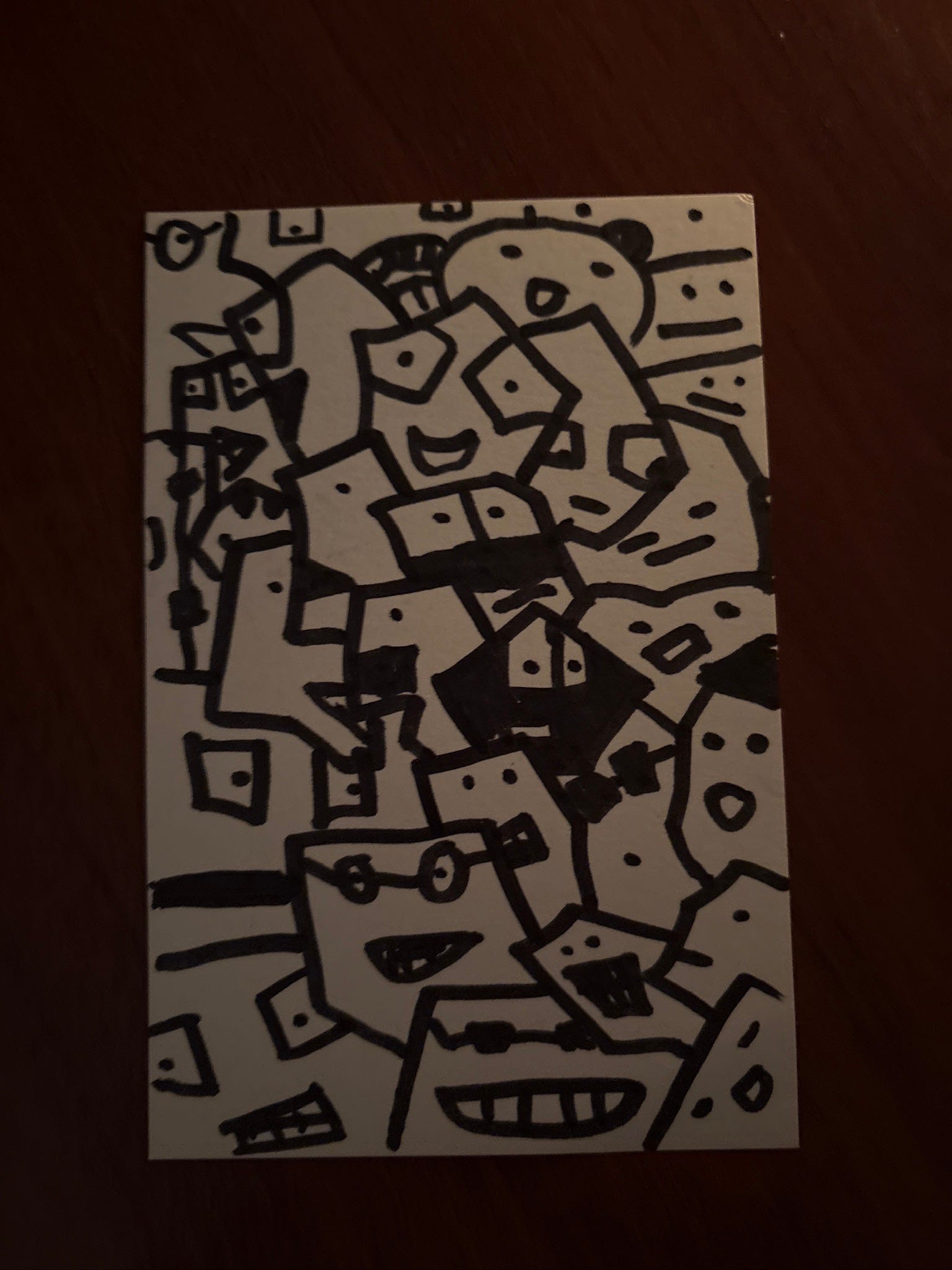
This isn’t some great artwork or anything I’d inherit to my children, but the point is the process: just stroke after stroke of the marker on the paper. It felt effortless because there were no complications in my mind. There was no attachment to what it “should” look like or what I want to get out of doodling this.
I reckon this is one of the reasons Lenny Rachitsky saw quick success (besides a lot of right place, right time). He could experiment, see with a clear eye and not succumb to perfectionism.
He didn’t seem to overthink it. He “just” wrote. To get to the point with anything where you “just [do creative thing]” is incredibly hard. It’s like in meditation, where we have a goal state, but any attachment to that goal state in itself obstructs it.
It’s hard to tap into this state because you can’t make it happen on command. I can’t give advice, except that I’m following the process to find it.
And that’s the biggest reward of all. My wish for 2026 is for things to flow more, to dance with the resistance and publish more.