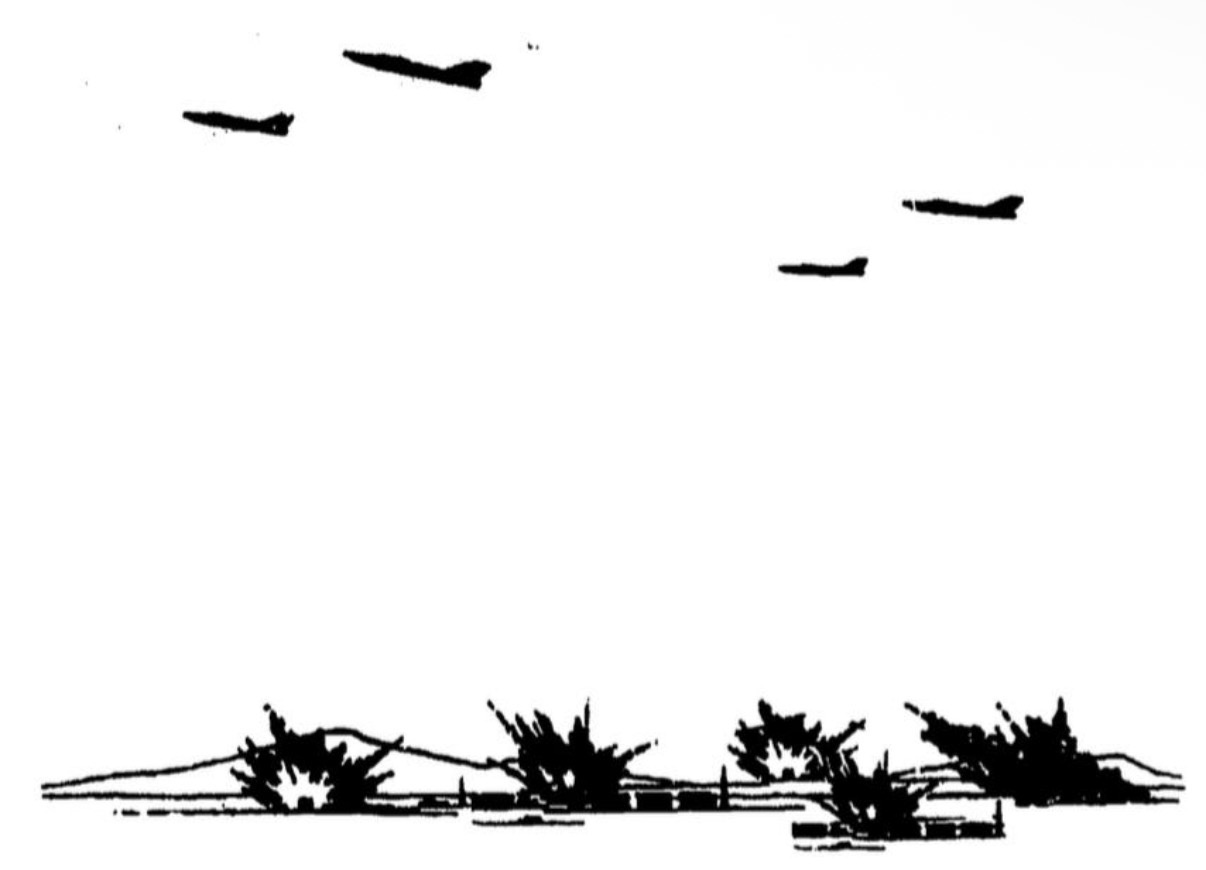
The Washington Post reported a few days ago that a confidential CIA assessment had concluded Iran retained roughly seventy-five percent of its prewar mobile launchers and seventy percent of its prewar missile stockpiles after weeks of intense American and Israeli bombardment.1 This appears to have undercut the Trump administration’s claim that Iran’s missile arsenal had been “mostly decimated.”2 President Trump had told reporters that perhaps eighteen or nineteen percent of Iran’s missile capability remained; the intelligence community concluded that the inverse was closer to the truth.3 More striking still was the agency’s finding that the regime had reopened nearly all of its underground missile storage facilities, repaired damaged missiles, and even completed assembly of new ones whose construction had been interrupted by the war. This was augmented by reporting from The New York Times that stated Iran has “restored operational access” to 30 of the 33 missile sites it maintains along the Strait of Hormuz.4
Unsurprisingly, the broad public reaction is to read this as a massive failure: too few sorties, the wrong munitions, faulty intelligence, and the entire campaign costing $29 Billion (so far).5 The more uncomfortable conclusion is that air forces have been here before, and that the problem of finding and killing mobile launchers and missiles from the air may be less a tactical shortcoming than a structural feature. Two campaigns separated by 50 years—the Anglo-American CROSSBOW campaign against German V-weapons in 1943–1945 and the “Great Scud Chase” of Desert Storm in 1991—suggest that what is happening over Iran today is not a deviation from the norm but simply a repeat of it. As Colonel Mark Kipphut argued in his 1996 study comparing the two campaigns, the failure to internalize CROSSBOW’s lessons was itself one of the reasons those same failures were repeated in 1991; the present campaign against Iran suggests we might still not have learned them.6
The first lesson of CROSSBOW is that fixed infrastructure is easy to destroy and that adversaries do not stay fixed for long. British intelligence had received “reliable and relatively full information” on German long-range weapons as early as November 1939 two months into the war.7 It wasn’t till four years later, in 1943, that Allied photo-reconnaissance first identified the German “ski-sites” in northwestern France, named for the curious shape of one of the buildings on each launcher complex.8 Within weeks, the U.S. Strategic Bombing Survey would later report, ninety-six sites had been cataloged, and a sustained bombing offensive against them had begun. Of these ninety-six sites, no more than two were ever used operationally.9 On its face, this was a complete victory. Allied airpower had, by direct attack, denied the Luftwaffe permanent launching infrastructure before the V-1 campaign could begin.10
The Germans drew the obvious conclusion. The Survey noted that during the period of the Allied counterattack, the Germans developed methods for launching V-1s and V-2s from small, inconspicuous sites that required minimal engineering work and freed firing operations from the elaborate sites originally planned.11 These were the “modified sites,” first photographed on April 26, 1944, which were well camouflaged, dependent largely on prefabricated buildings, of which more than sixty had been identified before the first V-1 was launched in England in mid-June.12 The “modified sites,” the Survey concluded plainly, were “heavily bombed without marked effect on the scale of effort.”13
Kipphut, working from the same primary documents, formalizes the consequence as a two-phase division of the campaign. CROSSBOW I, running from April 1943 to early June 1944, was a qualified success: it delayed the start of V-weapon attacks by an estimated three to six months and so allowed OVERLORD to proceed before the full weight of Hitler’s missile arsenal could be brought to bear.14 Eisenhower himself wrote that had the Germans perfected the weapons six months earlier, the invasion of Europe would have been “exceedingly difficult, perhaps impossible,” and that a sustained V-weapons attack on the Portsmouth-Southampton embarkation area could have caused OVERLORD to be written off entirely.15 CROSSBOW II, however, the campaign to suppress launches once they had begun, was in Kipphut’s assessment a “dismal failure”; despite thousands of sorties against more than 250 targets in the critical summer of 1944, the Germans averaged just over 80 launches per day, and German sources contend they never failed to launch on account of either Allied air attack or weapons shortages.16
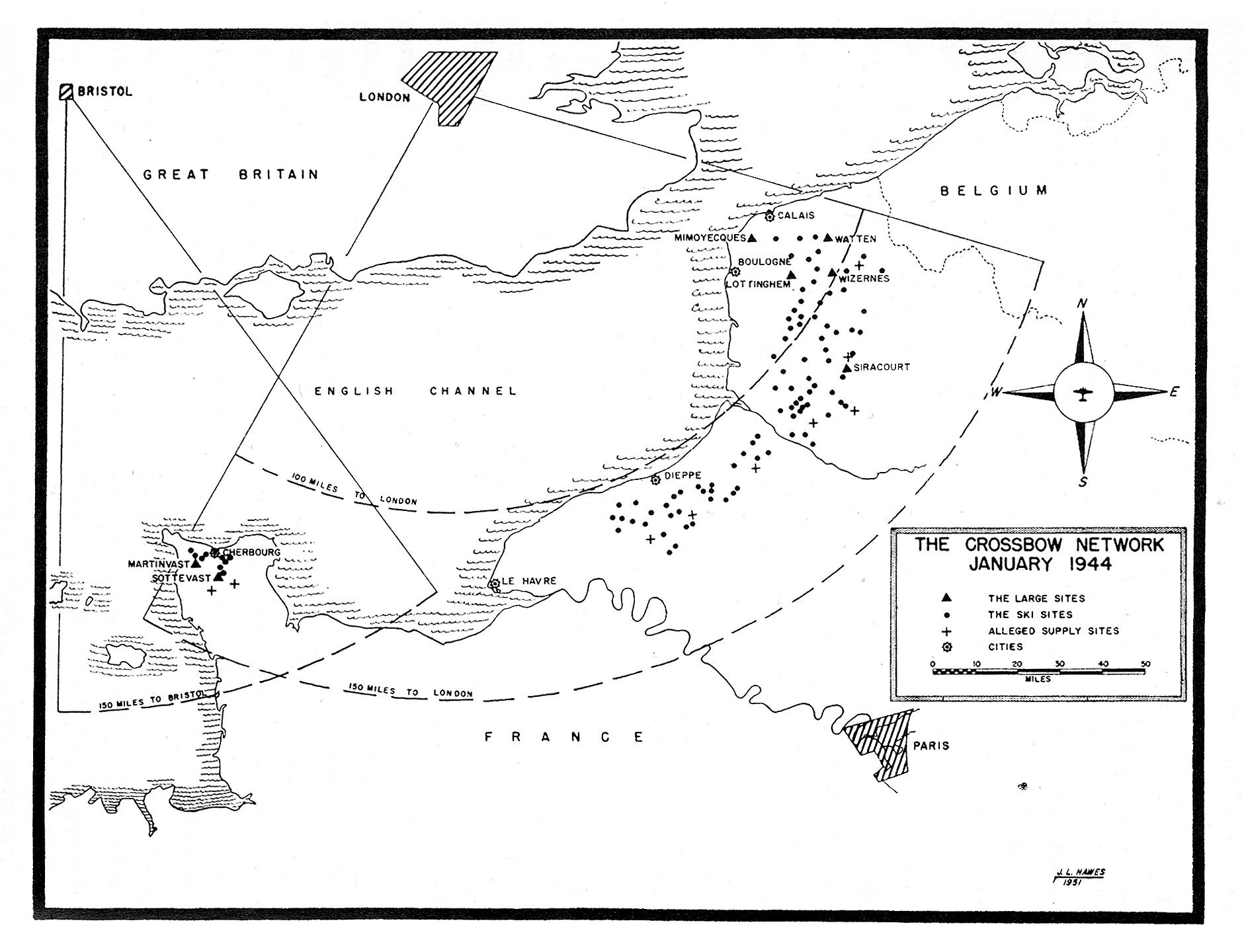
The implications for Allied resource allocation were severe. Between the beginning of May 1943 and the end of March 1944, nearly 40% of Allied reconnaissance sorties over Europe were devoted to supporting CROSSBOW, with those planes taking more than 1.25 million photographs and servicemembers preparing more than 4 million prints for study and analysis.17 Over the course of the campaign, U.S. and British air forces flew approximately 68,913 sorties against CROSSBOW targets and dropped roughly 136,789 tons of munitions.18 During the thirteen-month peak period from August 1943 to August 1944, the joint strategic-bomber effort absorbed 13.7% of its sorties and 15.5% of its tonnage on V-weapon targets.19 By the autumn of 1944 and into the winter, RAF Fighter Command devoted 79% of its offensive sorties to CROSSBOW.20 Eisenhower, faced with the apparent failure of CROSSBOW II to suppress the launches that began on D-Day plus seven, directed that V-weapon suppression take priority over all other Allied air operations, including direct support to the Normandy lodgment and the Combined Bomber Offensive.21
That bombing, which failed against the dispersed V-2 launch sites, was almost overdetermined. The Survey concluded bluntly that after the initial Allied success, the firing sites for V-2s were small, well camouflaged, and made poor targets for bombers.22 No comparable problem arises with a factory complex. The V-2 launcher, like the modified V-1 ramp, was small, mobile, and concealable, and the strategic-bomber instrument was designed and procured to flatten large, stationary targets. In the end, Kipphut notes, silencing the V-weapons required ground forces to overrun the launch sites.23
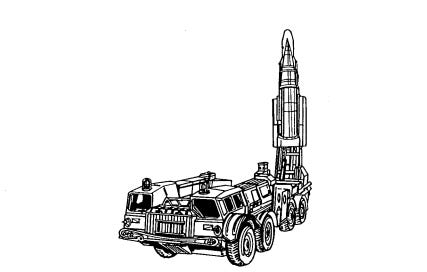
Half a century later, in a campaign in which Coalition air forces enjoyed advantages of intelligence, precision, and surveillance technology that the Eighth Air Force could scarcely have imagined, the same problem reappeared in nearly identical form in what became known as “The Great Scud Chase.”24 The Iraqi air force had been swept from the sky within days. Yet from January 18, 1991, when Iraq launched its first ballistic missiles against Israel, until the close of the war, the suppression of Saddam Hussein’s mobile Scud launchers became, in the words of the Gulf War Air Power Survey, “undoubtedly the most frustrating and least satisfactory aspect of the air campaign.”25 The Survey’s statistical volume, taking stock after the fact, recorded a total of eighty-eight Iraqi Scud launches over the course of Desert Storm and concluded, in its summary line, that the launchers proved “particularly difficult to detect and were never fully suppressed.”26
The pattern of CROSSBOW recurred at the strategic level. Allied intelligence had identified 64 fixed launch positions in western Iraq, and these were destroyed or neutralized in the war’s opening days; the Iraqis never attempted to launch from them.27 Kipphut argues, plausibly, that the fixed sites may in fact have been an elaborate deception—an inheritance from Iraq’s relationship with Soviet doctrine—since the Scud was an area weapon for which a presurveyed mobile position offered nearly equivalent accuracy.28 Whatever their original purpose, the fixed sites absorbed the heaviest weight of opening-night strikes while the launchers that actually mattered were already on the road.
The mobile threat proved impervious to the same treatment. Postwar analysis estimated that Iraq possessed roughly 36 mobile launchers, augmented by an unknown number of East German–manufactured and locally produced decoys; American intelligence, the Defense Intelligence Agency conceded after the war, had no accurate accounting of either the number of mobile launchers or their locations.29 What is most damning, given the subsequent recriminations about “intelligence failure,” is that the relevant operational facts had been understood before the war. A USCENTCOM situation report of December 28, 1990, three weeks before Desert Storm began, recorded that the Iraqis were protecting their Scuds by dispersing the mobile launchers, moving them mainly at night for launches near sunset or sunrise, and concealing them in buildings or earth-covered trenches.30 The DIA Scud Cell at the Joint Intelligence Center had likewise provided CENTCOM and CENTAF in December with a full appraisal of Iraqi missile capabilities, including presurveyed launch points in the western desert, the use of dispersed logistical support, and the approximate size of the mobile launcher force.31 A pre-war flight test code-named Touted Gleem had demonstrated that F-111Fs, F-15Es, and LANTIRN-equipped F-16s—the very platforms that would later constitute the Scud hunt—had less than a 50% chance of acquiring a TEL even when given precise target coordinates, and that a TEL was “virtually impossible to find” when its missile was not standing.32 Theater planners read the evidence and decided to live with it; Schwarzkopf called the missiles “militarily irrelevant,” Horner called them “lousy weapons,” and Glosson called them “not militarily significant.”33 No pre-war search-and-destroy plan for mobile Scuds was devised.34
When the missiles flew anyway, the Coalition response consumed an extraordinary share of its airpower. The strategy that emerged in the first week settled into three concurrent lines of effort: attacks on fixed facilities, storage bunkers, and known launch sites; twenty-four-hour combat air patrols over the “Scud boxes” in western and eastern Iraq, using onboard sensors to locate and attack suspected launchers; and armed reconnaissance to find and strike Scud equipment and facilities.35 By the war’s end, the Scud hunt had absorbed nearly 20% of all F-15E sorties; F-16s, F-111Fs, A-10s, B-52s, A-6Es, A-7s, F-117s, F/A-18s, and Tornado GR-1s were all diverted to the effort, with roughly 1,500 Coalition strikes against Iraqi ballistic-missile capabilities and another 1,000 “Scud patrol” sorties planned against mobile launchers that ended up attacking other targets.36 Daily Scud hunting averaged between s75 and 160 sorties; counter-Scud strikes exceeded those flown for suppression of enemy air defenses, for destruction of military production, or for the interdiction of Iraqi lines of communication to Kuwait, with only counter-airbase and ground-force missions consuming more effort.37 On a single night, between 1800 on January 23 and 0800 on January 24, four F-15Es loitered on airborne alert near the western launch baskets while eight more stood ground alert; four LANTIRN-equipped F-16s did the same in the east, backed by eight more; A-10s worked the launch boxes around the clock.38
Even this volume of effort ran into operational frictions that no additional sorties could resolve. The principal frustration was weather. Adverse weather “precluded effective identification of Scud locations from space and hampered the subsequent aerial hunt for Scud launchers,” in the words of the Survey’s summary, and after-action reporting from the 4th Tactical Fighter Wing (Provisional)—the F-15E wing that bore the largest share of the Scud hunt—observed that the Iraqis routinely launched under the protection of low cloud ceilings, sharply restricting Coalition quick-reaction air attacks.39
The yield from this enormous investment was close to zero. A postwar Defense Intelligence Agency assessment cited in the Gulf War Air Power Survey could not confirm a single Iraqi mobile launcher kill resulting from U.S. aircraft attacks.40 Of the roughly 100 mobile launchers reported destroyed by Coalition aircraft and special-operations forces, almost all appeared to have been decoys, tanker trucks, or other vehicles whose infrared signatures resembled launchers.41 Bedouin tents and fuel trucks bound for Jordan paid in lives and equipment for sharing the heat signature of a TEL. The disconnect between sighting and engagement is captured in a single statistic that Kipphut draws from the GWAPS effectiveness volume: on forty-two separate occasions during the war, Coalition pilots visually observed a Scud launch, and in only eight of those cases were they able to maintain enough contact with the launch site to employ weapons.42
Iraqi launch rates did decline over the course of the war. After firing 49 missiles in the first ten days, Iraq launched only 39 over the remaining thirty—a real, if modest, suppression effect.43 But the Gulf War Air Power Survey attributes this to operational disruption (interdiction of the routes between storage and launch baskets and the imposition of risk on launch crews) rather than to attrition of the launchers themselves.44 Iraq, indeed, recovered launch rates in the war’s final two weeks.45 The strategic objective of the Scud hunt was achieved—Israel did not enter the war, in part because the Patriot batteries and the visible American effort offered political reassurance—but the tactical objective of destroying the launchers was not.46 The political stakes of that distinction were illustrated by the single most lethal Iraqi strike of the war: a Scud that struck a U.S. Army barracks in Dhahran on February 25 and killed 28 American soldiers and wounded 97, more dead in one blow than were killed by Iraqi fire in the entire four-day ground campaign that followed.47 Whatever pressure the Scud hunt had imposed on Iraqi crews, it had not closed the door.
The most useful conceptual framework for understanding why the Scud hunt failed comes not from the airpower literature but from a 2001 International Security article by Daryl Press, which challenges the consensus that airpower was “decisive” in the Gulf War. Press’s larger thesis, that the rout of the Iraqi army was the work of Coalition ground forces, not the air campaign, is contested. But his diagnosis of why airpower struggled against a particular subset of Iraqi targets, in a section nominally about the broader campaign, doubles as the clearest available explanation for the Scud failure.
Press argues that the targets’ airpower struggles with a common signature problem. Static, defensively oriented forces emit little heat, noise, or radio traffic, and from an aircraft at 10,000 feet a half-buried tank is hard to distinguish from “a sheet of corrugated metal half-buried in the sand.”48 The problem compounds in two ways. First, the same low signature that makes a stationary vehicle hard to find makes a freshly destroyed vehicle hard to distinguish from a live one, leading to repeated strikes on the same target and inflated battle-damage estimates.49 Second, cheap decoys exploit exactly this ambiguity; Iraqi forces, Press notes, learned to place wreckage next to operational vehicles to make them appear already destroyed.50 The Scud TEL is the limit case of this problem: it is small, it is mobile, it operates from concealment, it emits a brief and ambiguous signature only at the moment of launch, and the Iraqis built and bought decoys specifically to mimic it. Add the operational reality that the Iraqis preferred to launch under cover of darkness and low cloud, and the difficulty becomes structural rather than tactical.
The corroboration came in Kosovo eight years later. Press, writing while the dust was still settling, observed that the same problems that frustrated Coalition airpower in 1991 had hamstrung NATO efforts against Serbian ground forces in 1999. After eleven weeks and thousands of sorties, NATO had publicly claimed roughly a third of Serbian armor destroyed; postwar inspection by NATO’s own analysts found fewer than twenty Serbian tanks, a similar number of artillery pieces, and fewer than ten armored personnel carriers actually knocked out.51 Serb forces had used concealment and decoys that, from 10,000 feet, looked very much like the real thing. The technology had advanced considerably between 1991 and 1999; the gap between claimed and confirmed kills had not closed at all.
Read alongside CROSSBOW, the Scud chase, and Kosovo, the leaked CIA assessment on Iran is not all that surprising. Iran is reported to have entered the war with roughly 2,500 ballistic missiles and thousands of drones, distributed across an extensive network of underground storage and dispersed mobile launchers.52 The American and Israeli campaigns evidently destroyed substantial fixed infrastructure and degraded Iranian command and production capacity. But the figures that have leaked—75% of mobile launchers and 70% of missiles surviving, underground storage facilities largely recovered—describe precisely the same residual problem that the V-2 launch teams in occupied Holland, the Scud crews in western Iraq, and the Serbian tankers in Kosovo posed to their adversaries.53
It should be noted there is still the fog of war in this campaign. We do not know how many sorties have been flown against Iranian missile infrastructure, how much ordnance has been delivered, or against which target sets it has been concentrated; the leaked CIA bottom line is the only systematic accounting we have, and it is necessarily a single snapshot. Two readings of the 75%t figure are therefore possible, and the open-source record cannot adjudicate between them. Either the United States and Israel have devoted comparatively little ordnance to the mobile launcher problem, in which case the surviving Iranian arsenal is partly an artifact of effort never expended, or they have devoted a great deal and the campaign has nonetheless produced the same result the Coalition produced in 1991, in which case the historical pattern is reasserting itself.
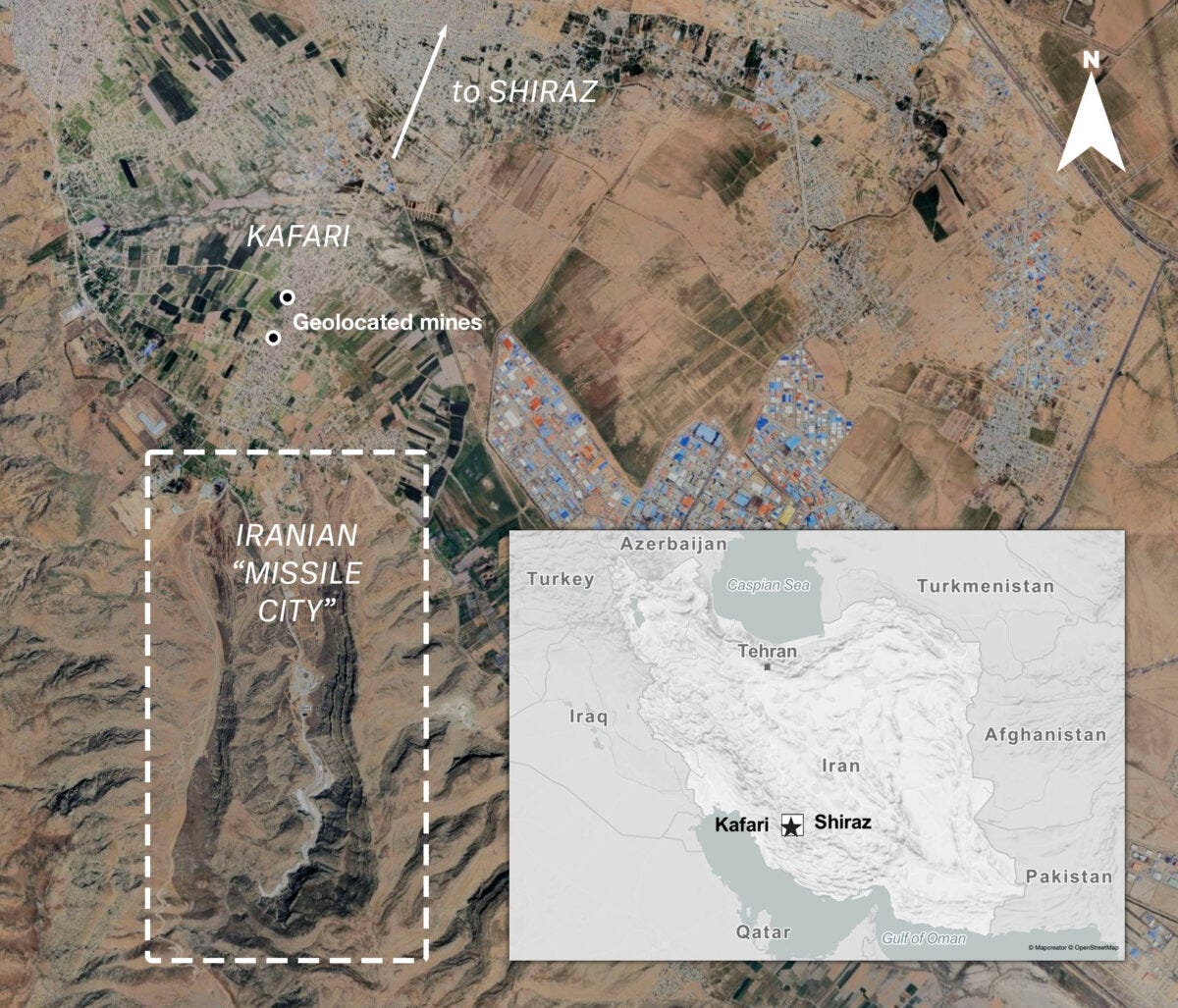
At the very least, what is publicly visible suggests that American and Israeli operations have not been confined to the strike sortie. A detailed Bellingcat investigation from March documented an extensive U.S. effort to mine the road networks leading out of suspected Iranian missile facilities.54 That is the same operational logic the Coalition adopted in western Iraq in 1991, when CBU-89 area-denial mines were used to interdict the routes between storage bunkers and launch baskets, and the same logic that GWAPS judged to be the actual source of whatever launch-rate suppression the Coalition achieved. The operating environment, however, is far less forgiving than the western Iraqi desert. Iran’s ballistic missile operating areas are vast, the terrain is mountainous rather than flat and open, and there are nowhere near enough MQ-9 Reapers to maintain persistent coverage of even a fraction of it, particularly in airspace where Iranian air defenses remain a credible threat to slow, low-flying ISR platforms.55 The 75% figure may therefore reflect not only the structural difficulty of hunting mobile launchers from the air, which is the burden of the historical record, but the additional reality that the present campaign has not enjoyed the permissive air environment and concentrated geography that made the Scud hunt, for all its failures, a comparatively favorable test case.
Four lessons recur across all four cases and deserve to be stated plainly.56 First, the destruction of fixed launch infrastructure and production facilities, while militarily worthwhile, does not translate into the destruction of mobile launchers, because the adversary will adapt by dispersing onto pre-surveyed roadside positions or into hardened underground storage. The Germans abandoned the ski-sites and built modified sites; the Iraqis abandoned their fixed launchers and used the highways; the Serbs dispersed into the Kosovar countryside; the Iranians, by all available accounts, are doing the same. Second, the diversion of resources required to hunt mobile or hidden targets is enormous and is often paid for in opportunity costs to other strategic objectives. The 8th Air Force forfeited up to a quarter of its monthly effort to CROSSBOW; the Coalition diverted 20% of its premier strike platform to the Scud hunt; the 1995 Roving Sands exercise consumed 17% of friendly air effort against simulated ballistic missiles over its first five days and still managed to degrade the enemy missile infrastructure by only 40%.57 American and Israeli planners over the past two months have presumably paid a similar tax. Third, the metric of success that political leaders demand is precisely the metric the campaign is least likely to deliver, and the metric most likely to be inflated when delivered. Both the GWAPS finding that nearly all reported Scud kills were decoys and the Kosovo finding that NATO had overestimated Serb armor losses by an order of magnitude suggest that air-borne battle-damage assessment has been a chronically unreliable instrument when the targets in question are small, mobile, and concealable.
The fourth point, more uncomfortable than the first three, is doctrinal. The professional airman’s instinct is to fight the war the air force is designed and procured to fight: against the adversary’s fixed-wing aircraft, his airfields, and his fixed installations.58 Mobile missiles fit poorly into that paradigm and are accordingly underweighted in planning until the political pressure of an ongoing missile campaign forces them to the top of the air tasking order.59 Schwarzkopf, Horner, and Glosson regarded Scuds as a nuisance until Washington made it clear they could not. The pattern in the Iranian war appears to have been similar: the administration’s confident pre-campaign claims about the destructibility of Iran’s missile force have been overtaken, on the available evidence, by the same realities that overtook CENTAF in January 1991, SHAEF in June 1944, and NATO over Kosovo in 1999.
What the present Iranian campaign appears to have demonstrated is not a new problem but the durability of a very old one. There is, on the available evidence, no reason to believe that another two months of bombing would produce a fundamentally different result. The CIA’s assessment that Iran can sustain the blockade for three to four months, combined with its findings on the surviving missile arsenal, points to the same conclusion that the U.S. Strategic Bombing Survey reached in January 1947, that Williamson Murray reached in 1993, that Mark Kipphut reached in 1996, and that Daryl Press reached in 2001: airpower can do many things to a missile force, but reliably destroying its mobile launchers from the air is not among them.60 The instruments have gotten better, but the targets have gotten better faster.