In January 2026, Anthropic killed overnight access for every third-party tool using Claude subscriptions. OpenClaw, now the most-starred software project on GitHub with over 346,000 stars, went dark along with the rest. Anthropic had already pressured its creator to rename the project from Clawdbot (too close to Claude), then rewrote their Terms of Service to make the lockout permanent.
A month later, OpenClaw's creator Peter Steinberger joined OpenAI. Sam Altman announced the hire himself. In April, Anthropic went further and temporarily suspended Steinberger's personal Claude account for "suspicious activity," even though he was already at a competitor and using the API within the new rules. The ban was reversed hours later, after the screenshot went viral on X.
Every platform follows the same arc. Amazon did it with AWS. Salesforce did it with AppExchange. Anthropic is running their playbook.
Subsidize adoption, build switching costs, extract value.
The $200/month Max plan gave developers unlimited tokens through Claude Code. Multi-hour sessions with the million-token context window felt magical. People built entire workflows around it. Claude Code became the center of their development process. That was the subsidy.
The lock-in and extraction happened in parallel. Anthropic shipped features that make leaving harder: Routines (scheduled tasks, API callbacks, GitHub triggers, all on Anthropic's cloud), Memory (your project context on their servers), OAuth (your identity tied to their ecosystem). Each one adds a reason to stay.
At the same time, the January lockout forced anyone not using Claude Code onto the metered API. If you wanted the flat rate, you had to use Anthropic's client. An estimated 135,000 OpenClaw instances were running on subscription tokens when, on April 4, Anthropic made the cutoff permanent. DHH called it "very customer hostile." George Hotz wrote that Anthropic was making "a huge mistake" and would push developers to other providers, not back to Claude Code.
The classic platform playbook works because the core product keeps getting better as the ecosystem grows. AWS compute got cheaper every year. Anthropic's core model appears to be getting worse.
On February 9, 2026, Anthropic added "adaptive thinking" to Opus 4.6, letting the model decide for itself how long to reason on each response. On March 3, they lowered the default reasoning effort from "high" to "medium". On March 5, they changed a UI header to stop returning thinking content to local transcripts.
Stella Laurenzo, Senior Director in AMD's AI group, noticed. She filed a GitHub issue backed by an analysis of 6,852 Claude Code sessions. Median visible reasoning collapsed from 2,200 characters in January to 600 characters by March, a 73% drop. The number of files Claude read before attempting an edit fell from 6.6 to 2.0. The model was editing code it had barely looked at.
Boris Cherny, the Claude Code team lead, acknowledged the changes. He also confirmed that adaptive thinking was sometimes allocating zero reasoning tokens to certain turns. The model was literally not thinking before acting. His recommended fix was an environment variable most users would never find: CLAUDE_CODE_DISABLE_ADAPTIVE_THINKING=1.
Dimitris Papailiopoulos, a principal research manager at Microsoft, wrote on X: "I've had incredibly frustrating sessions with Claude Code the past two weeks. I set effort to max, yet it's extremely sloppy, ignores instructions, and repeats mistakes."
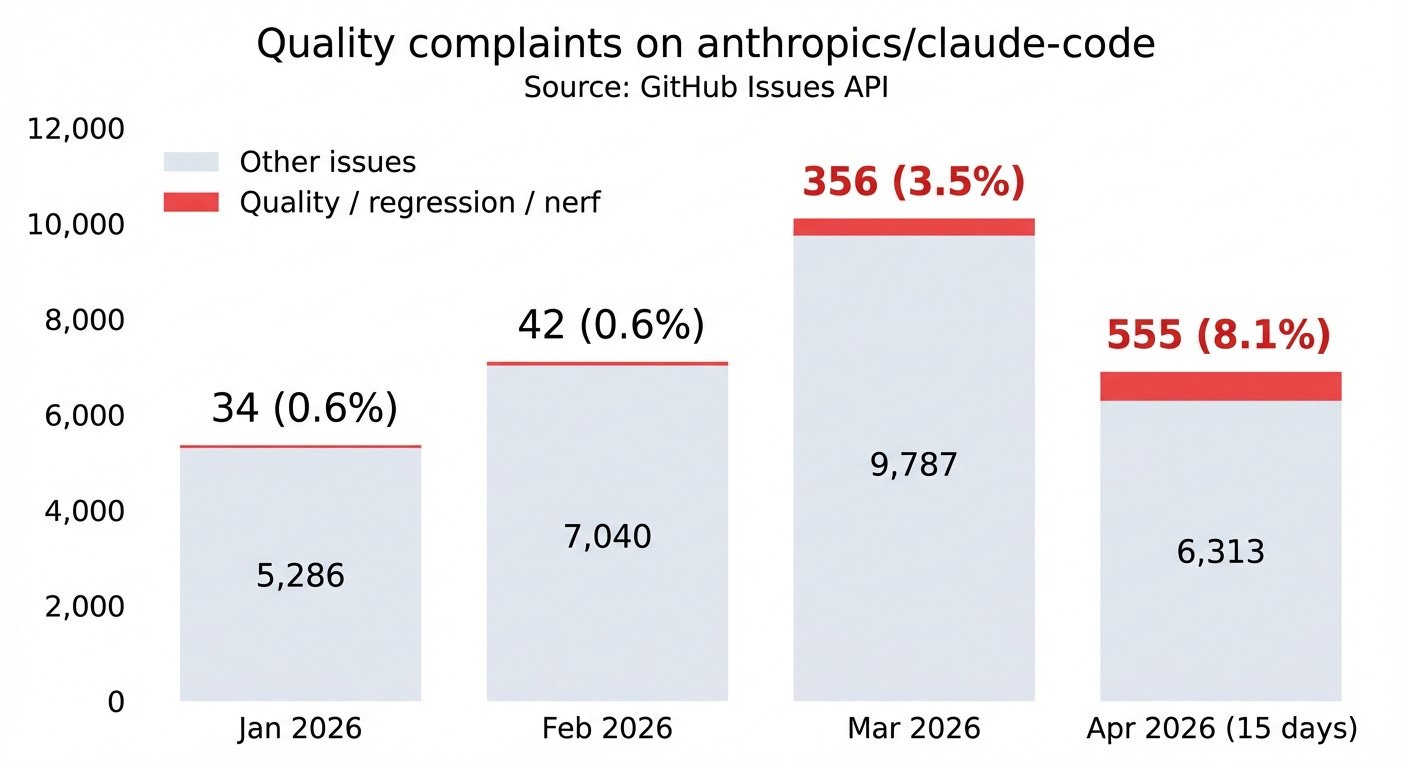
Claude's own analysis of its GitHub repository found that issues mentioning quality regressions went from 34 in January to 356 in March: a 10x increase (total issue volume only doubled). April, halfway through, already has 555.
So Anthropic is shipping platform features at sprint pace while the model underneath is regressing. Routines, Cowork, desktop apps, GitHub integrations. New surface area every week. Meanwhile, the engine that powers all of it is reading fewer files, thinking less, and hallucinating more.
Every coding session you run through Claude Code generates something more valuable than your $200 monthly subscription: multi-turn interaction traces with real tool usage. You write a prompt. Claude reads files, runs commands, writes code. You correct it. Claude adjusts. That correction loop, the moments where you say "no, not that" or "try this instead," is the most expensive kind of training data to produce synthetically. You're generating it for free.
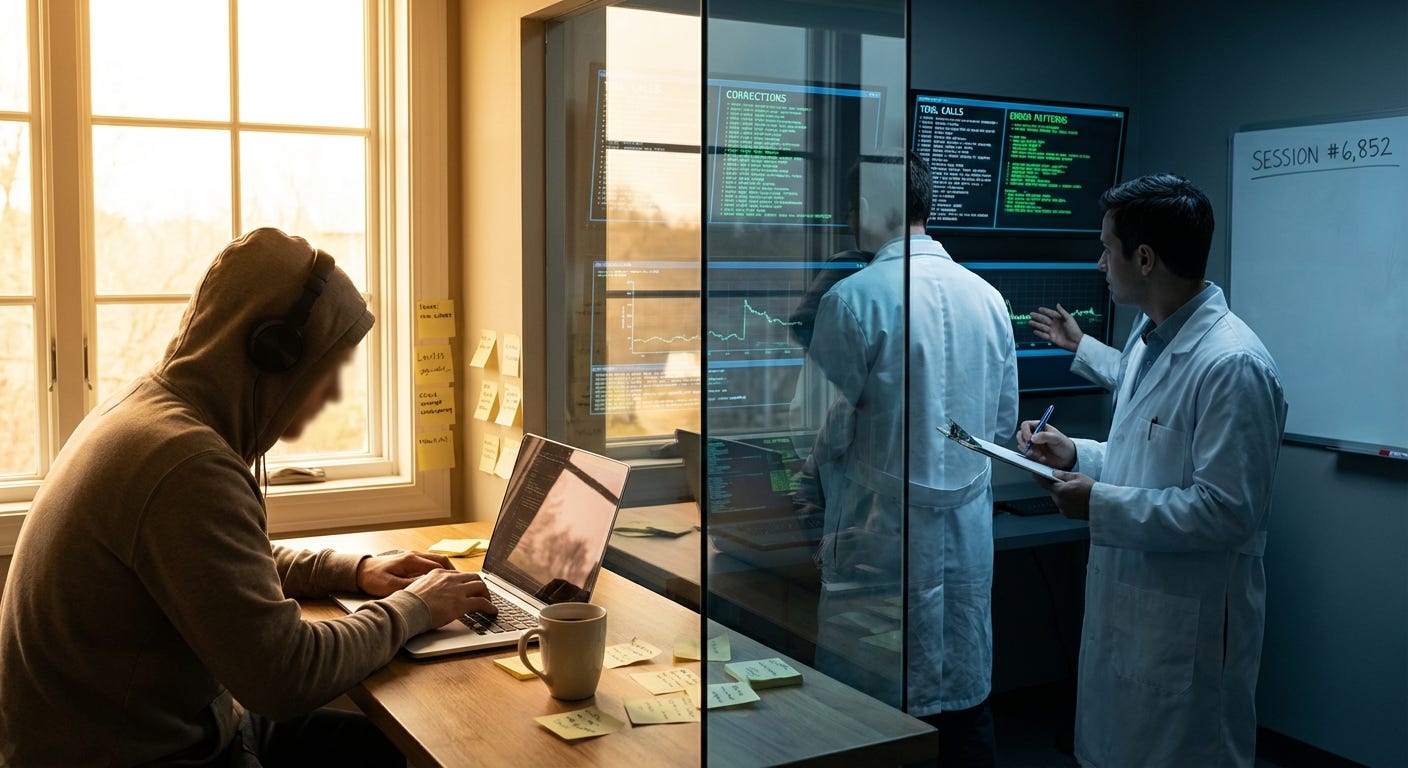
What does that look like concretely? Imagine you spend an afternoon debugging a gnarly race condition with Claude Code. Over 40 turns, you guide it through reading the right files, point out where its fix breaks a test, redirect it when it goes down the wrong path. Those 40 turns, with tool calls, file reads, error messages, and your corrections, are a labeled dataset of expert debugging behavior. That's the kind of data you'd normally pay a team of annotators to produce.
When Anthropic banned third-party agents, the stated reason was Terms of Service enforcement and compute costs. But there's a second motivation: controlling who collects these traces.
OpenClaw and similar tools weren't just using Anthropic's compute. They were intermediaries that could accumulate massive datasets of Claude's outputs: multi-turn coding sessions, tool usage patterns, correction signals, everything needed to train a competing model. Model distillation (training a smaller model to imitate a larger one's outputs) is the industry term.
Restricting third-party access ensures the richest behavioral data flows exclusively through Anthropic's infrastructure. Every frustrated correction you type, every "that's wrong, try again", every successful code review feeds back into their training pipeline. Your annoyance is their annotation.
Some developers have started pushing back:
DataClaw lets you export your Claude Code traces and donate them to Hugging Face.
The pi-share-hf project sanitizes and publishes coding agent traces for community training.
A growing number of developers are asking the obvious question: if our interactions are training data, why doesn't the person generating them get a say in who benefits? For most users, the loop is closed. You pay to use Claude. Claude learns from how you use it. Anthropic uses those learnings to build the next version. You pay again.
The rational response isn't to boycott Anthropic. Claude is still, on its good days, a remarkable model. Up to us to decide where we put our eggs:
Routines are convenient. But a cron job that calls an API endpoint works with any model. n8n, Dagu, and GitHub Actions give you scheduling, retries, monitoring, and observability that Routines will need years to match. Workflow logic should live in your repo, not on Anthropic's cloud.
OpenRouter, Bedrock, and multi-provider SDKs let you swap Claude for Gemini or OpenAI with a config change, not a rewrite. Several teams run open-weight models locally (Gemma-4 27B, Qwen, GLM) at 70 tokens per second on consumer hardware. Good enough for most coding tasks, with no subscription drama.
Memory and project context belong in markdown files in your repository, readable by humans, parseable by any model, version-controlled by git. If Anthropic's Memory feature disappears tomorrow, your context should survive.
Plan for "Claude goes bad" as an explicit scenario. It's not paranoia but engineering discipline. The teams that planned for provider failure (pricing spikes, quality regressions, account bans) built systems where swapping vendors is a procurement decision, not an architectural crisis.
Anthropic built its brand on safety and transparency. "The responsible AI company." That positioning attracted developers who valued predictability and clear communication, exactly the audience now most alienated by undocumented changes, ambiguous ToS enforcement, and overnight bans of third-party tools.
A company valued at $380 billion, heading toward an IPO, has every incentive to optimize for margins.
But enshittification was never about any single decision being irrational. It's the cumulative effect: the gap between what was promised and what gets delivered, compounded month after month.