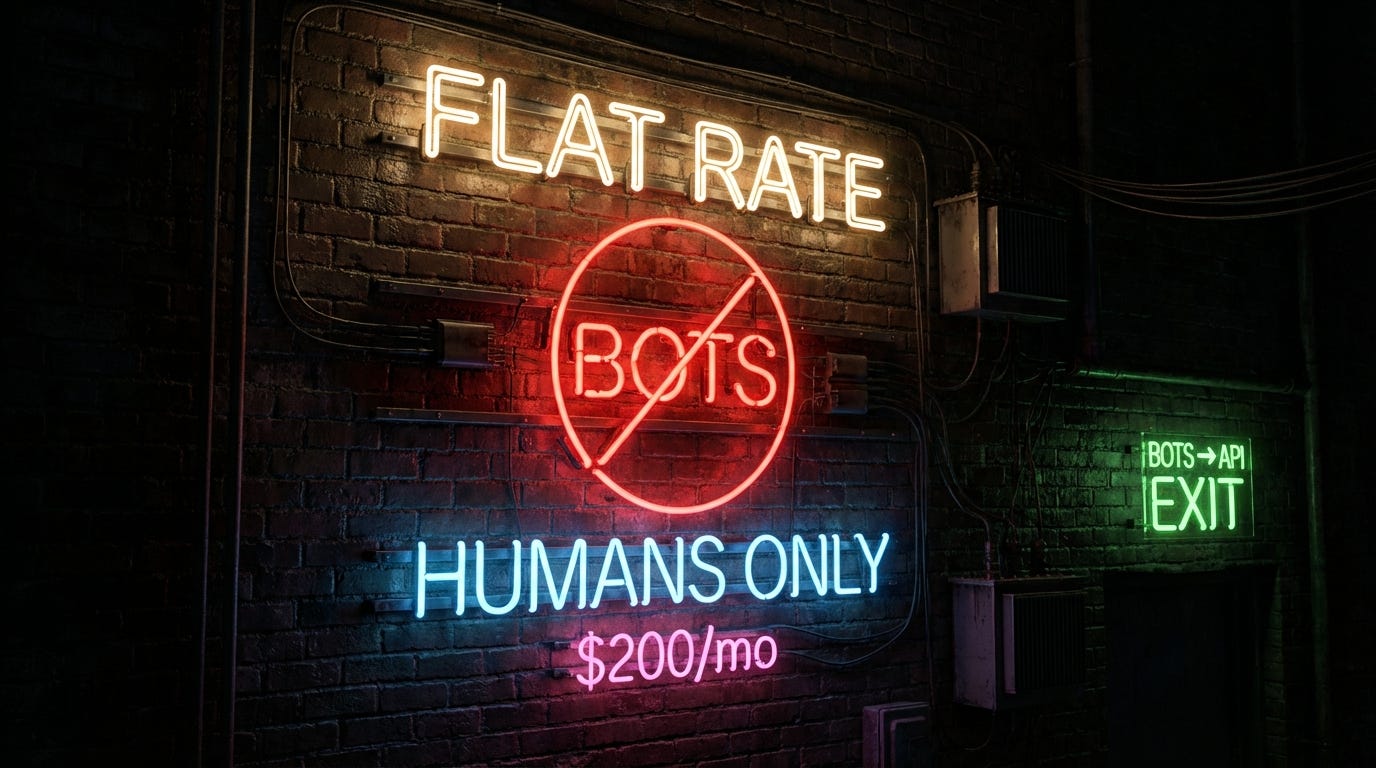
A developer instrumented their Claude Code Max usage by capturing network logs over a week. Projected to a full month at API rates: $3,650. Their Max subscription cost: $200.
On April 4, 2026, Anthropic cut off 135,000 OpenClaw instances from flat-rate Claude subscriptions. Third-party coding agents like OpenClaw, OpenCode, and Cline can still use Claude through the API at standard per-token rates, but the cheap, flat-rate subscription path is closed. Boris Cherny, head of Claude Code: "Our subscriptions weren't built for the usage patterns of these third-party tools."
He's right about the economics. As I wrote when the ban dropped: these subscriptions aren't pre-purchased token buckets. They're discounted, oversubscribed access tiers whose economics assume human-paced, bursty usage. But the economics are only half the story. On SWE-bench Verified (the standard benchmark for AI coding), three different agent frameworks running the same model got different results: the best one solved 17 more problems than the worst, out of 731. Same model, different agent, different outcome. And that agent layer is what Anthropic is locking down. How they got here matters more than the ban itself.
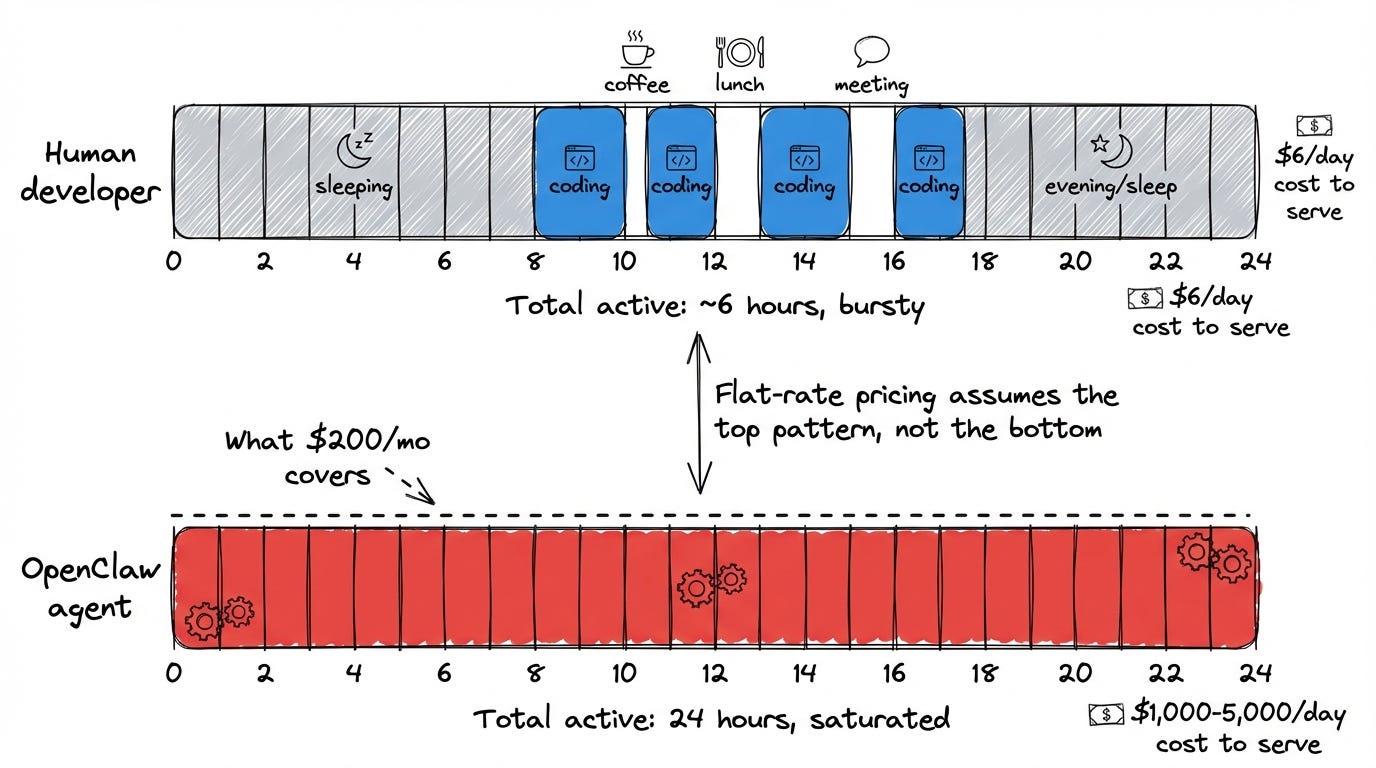
Every flat-rate AI subscription works like a gym membership. The provider sells more capacity than it can serve simultaneously, betting most users won't max out. Gyms sell 5,000 memberships for a facility that holds 300 people because most members barely show up. The industry calls it oversubscription.
For human-paced coding sessions, it works. Anthropic's data shows the average Claude Code user costs about $6 per day to serve. At the 90th percentile, it's still under $12. Even the $20/month Pro plan is profitable for Anthropic at that level.
Flat-rate works because most humans don't often saturate their 5-hour windows. We pause, think, context-switch, go to lunch. An OpenClaw instance does none of that. It's configured to fill every available slot, queue the next request the moment the previous one finishes, and run around the clock. It doesn't under-utilize, and that's the issue. Estimates put heavy users at $1,000 to $5,000 per day in API-equivalent compute on a $200/month plan.
It's not just about tokens. Claude Code is optimized for high prompt cache hit rates: repeated context (project files, conversation history) gets served cheaply from cache. Third-party agents bypass this caching, consuming more infrastructure at the same output volume. This is Anthropic's strongest claim for preferring its own client, and it's also an argument that users get better value through Claude Code.
Same thing for OpenAI if you remember: in January 2025, Sam Altman admitted OpenAI was losing money on its $200/month ChatGPT Pro tier. He'd personally set the price thinking they'd make margin on it. The industry-wide capex-to-revenue gap makes every flat-rate plan a bet that usage stays human-shaped.
Github Copilot now charges metered "premium requests" for advanced models: a Claude Opus interaction costs 3x a standard request. Free tier gets 50 premium requests/month, Pro gets 300 for $10/month, Pro+ gets 1,500 for $39/month.
Timeline:
November 2025: Peter Steinberger launches "Clawdbot," an open-source agent framework built on Claude. It goes viral (247K GitHub stars and 47.7K forks by early March 2026).
December 25-31, 2025: Anthropic runs a holiday promotion: double usage limits, using idle enterprise capacity. Users calibrate their expectations to the inflated limits.
Late January 2026: Anthropic raises trademark concerns over "Clawdbot" (too close to "Claude"). Steinberger renames it twice in three days: Clawdbot to Moltbot, then to OpenClaw. Around the same time, Anthropic starts blocking third-party tools from using Claude Pro/Max OAuth tokens.
February 15, 2026: Steinberger joins OpenAI.
February 2026: Anthropic clarifies its Terms of Service: OAuth tokens from Free, Pro, and Max plans are restricted exclusively to Claude Code and claude.ai. Using them in any other tool is a violation. (The Register notes this policy language existed since at least February 2024 in Section 3.7 of the Consumer Terms.)
April 3, 2026: Semafor reports that Anthropic is building its own OpenClaw competitor. Chief Commercial Officer Paul Smith: "They are [asking us to build an OpenClaw]... it evolved pretty quickly."
April 4, 2026: Full enforcement. 135,000 instances cut off.
Steinberger's response: "Funny how timings match up, first they copy some popular features into their closed harness, then they lock out open source."
Where is your moat if the LLM + AI agent provider take your good ideas and integrate them as a first-class citizen into their product?
There is a real economic problem: when your average user costs $6/day and your outliers cost $5,000/day, something has to give. Subscriptions are priced on the distribution of use, not on the theoretical maximum. Anthropic offered mitigation: one-time credits, a 30% discount on pre-purchased extra usage, and full refunds for anyone who wanted out.
Also a massive security gap: 341 malicious "skills" found in ClawHub, OpenClaw's plugin marketplace. But Anthropic didn't ban OpenClaw after ClawHavoc. They banned it later, the same week they launched Claude Code Channels. Security was a justification.
Charging for agentic workloads isn't the issue. Metered billing is probably the right model, and Anthropic's API has always been there for exactly this. What was done poorly is the execution: quiet limit reductions communicated via engineer tweets, overnight OAuth blocks with no warning, a holiday promo that inflated expectations right before the crackdown, legal threats against OpenCode, and marketing Claude Code as a composable CLI while restricting who could compose with it.
A network effect of openness with restrictions?
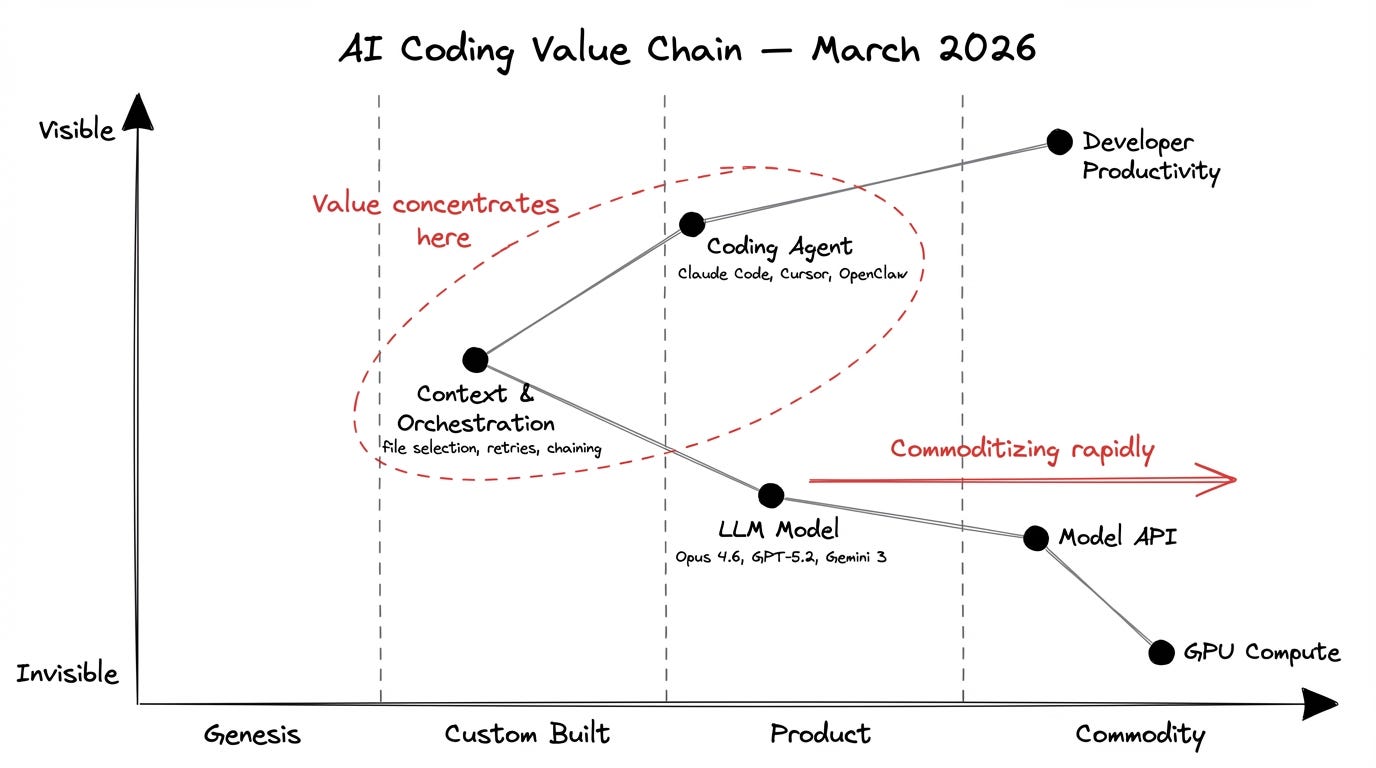
In a February 2026 SWE-bench test, three agent frameworks running the same model got different results: the best solved 17 more problems than the worst, out of 731. Same model. The difference was how each agent selected files, managed context, and chained sub-tasks.
The model matters. But the agent around it matters more for daily coding work. And this is only going to accelerate: we're passing through a Wardley Map transition where models move from Product to Commodity. Flat-rate pricing was meant to explode adoption and figure out economics later. Now the price corrects to pay-what-you-consume, and the differentiation moves up to the agent layer. That's what Anthropic is trying to control with Claude Code.
On the other side, OpenAI. Their Codex for OSS program explicitly supports OpenCode, Cline, Pi, and OpenClaw. Staff have said they're "100% invested in supporting a flourishing ecosystem of agentic coding tools." OpenAI will face the same economic pressure eventually but today, OpenAI is buying developer loyalty, banking that builders won't leave when metering arrives.
Developers are already voting with their setups. OpenRouter has 4.2 million users routing across 300+ models. OpenCode hit 112K GitHub stars. Cursor passed $2B in annual recurring revenue. IDE-integrated agents like Cursor and Windsurf, CLI tools like Aider and OpenCode, they're all provider-agnostic by design. People want to pick models without picking sides. Anthropic is asking them to pick sides.
If you go down this path, use a coding agent that can swap providers: (OpenCode, Aider, Continue, Cursor, or build on OpenRouter). Your prompts, tool definitions, and context management should be portable and not linked to the format expected by a specific provider.
Run routine work locally. Open models have crossed the threshold for most coding subtasks. Gemma 4 31B dense hits 80% on LiveCodeBench v6. Qwen3-Coder-Next scores 70.6% on SWE-bench Verified. Llama 4 Scout fits on a single 24GB GPU using Unsloth's 1.78-bit dynamic quantization. These handle boilerplate, refactors, test scaffolding, and simple utilities at zero marginal cost. They're just not good enough for complex multi-file reasoning or architecture decisions, yet.
Finally, define budget tokens in the agent itself, not at the provider level: max context windows, max calls per hour, and fallback providers in your agent config. If your agent burns through its Claude budget, it should fall back to Codex or a local model automatically. Vendor-side caps change without notice.
GitHub Copilot already moved to hybrid billing. Anthropic's "extra usage" tier is a step in the same direction. What the AI providers want: a base subscription for human-paced work and metered overage for agents. The flat-rate all-you-can-eat plan for AI coding agents is dead.
Anthropic is already building its own OpenClaw competitor. Semafor reported it the day before the ban, and Claude Code Channels launched the same week. Whether developers will trust Anthropic's version after the way they treated the open-source one is another question.
Provider-agnostic coding agents will keep growing. Not because they're better for any single task, but because developers won't bet their workflow on a provider whose rules can change overnight. The Stack Overflow 2025-2026 survey captures this: 84% of developers use AI tools, but trust has dropped from 40% to 29%. High adoption, low trust. When people use a tool but don't trust the company behind it, they start looking for exits.
The real battle is the orchestration layer. Whoever controls the spice, err, the routing and composition of agents makes the model replaceable.
The OpenClaw ban isn't about OpenClaw. It's about whether you rent your workflow from a model provider or own it. Anthropic just showed you what renting looks like when the landlord changes the locks.