[Note: Nothing in the following post should be construed as a defense of the China government. I oppose all forms of authoritarianism. Rather it is a critique of misinformation, which I see as fueling a counterproductive cold war.]
I use the plural of “myth” because there are numerous ways that the American government and media make inaccurate, exaggerated or misleading claims about China. Unfortunately, this misinformation poisons public opinion and contributes to the ongoing cold war between the US and China.
To be clear, most of the accusations made against China are not completely fabricated. There is often a bit of truth to claims about Chinese behavior. Rather the bigger problem is that many of the claims are either wildly exaggerated or presented in a highly misleading fashion that is out of context.
When I was young, the US government and our media often sugar-coated the situation in China, which was horrifically bad. Many of the current claims made about China do apply to the China of the 1960s and 1970s. Maoist China was a totalitarian state where the government controlled almost every aspect of life.
At the time, much of the American reporting on China was actually quite favorable. Our government and our media wanted us to have a positive view of China because we increasing saw them as an ally in our cold war with the Soviet Union. People who expressed negative views were viewed as McCarthyite cold warriors, out of touch with the times. The lovable panda was a symbol of our post-cold war infatuation with the Middle Kingdom.
Today’s China is vastly superior to Maoist China in every single respect. Obviously, it is much richer. But it’s also much freer. In the 1950s, America fought a brutal war with China. Today, that sort of war is almost unthinkable, unless the US does something very foolish (which thank God we avoided doing in Ukraine.)
China critics are so anxious to smear China’s reputation that they often make completely contradictory claims. Thus, pundits complain that China shirks its responsibilities on global warming by falsely claiming to be a developing country with a per capita GDP of only $13,687 ($28,978 in PPP terms), compared to $89,105 for the US. They suggest that China is obviously a rich country—look at all those skyscrapers and high-speed trains.
Then a week later you see China critics complain that the Chinese fake the economic data, and that satellite photos “prove” that China’s GDP is much lower than the level claimed by the Chinese government. They say that China is poor when it suits the critics to suggest poverty: “See how bad their system is!” They claim that China is rich when it suits them to do so: “See what a military threat China is!”
1. Mercantilism, subsidies and state capitalism
Mercantilism is a poorly defined term that is not particularly useful. Nonetheless, China is not especially mercantilist by any plausible definition of the term, whether it be tariffs, informal trade barriers, or trade surpluses.
According to the World Bank, China’s (weighted) average tariff rate is 2.18%, which is above Mexico and Indonesia, but well below other important middle income economies such as Brazil, Argentina, India, Turkey, Thailand, and South Africa. Other sources put the average rate somewhat higher, but even so China clearly has a relatively low tariff rate by the standards of countries with similar per capita GDP. Most developed countries have slightly lower average tariff rates, but Trump’s tariffs will push the US average tariff rate up to a level far above China’s rate.
Non-tariff barriers are harder to measure, but imports as a share of GDP provide one indication. In general, small countries have much higher import shares than big countries. Thus, the US imports 14.0% of GDP while Canada imports 32.7% of GDP. Japan imports 23.3% of GDP while Belgium imports 79.2% of GDP. China’s import share is 17.2% of GDP, which is lower than for most other countries. But that ratio doesn’t seem particularly low for such a vast country. The US is widely viewed as an economy that is quite open to imports, and yet our import ratio is even lower than China’s.
China runs a fairly large trade surplus by global standards in absolute terms, but as a share of GDP China is not at all exceptional. As a general rule, the countries of northern Europe and East Asia run big current account surpluses, and the rest of the world tends to run deficits. China’s official current account surplus is 1.9% of GDP (the same as Russia). Even if the actual figure is significantly larger, as some have argued, it would not be at all unusual by East Asian or Northern European standards. Taiwan current account surplus is 18.5% of GDP. Germany is at 5.4% of GDP. East Asian and Northern European countries are high savers, thus you see big trade surpluses even in countries with very high wages and free trade, such as Switzerland.
China does provide some subsidies to various industries, but these don’t have the effect that many people assume. We know from Lerner Symmetry that export subsidies tend to offset import taxes. Just as you cannot raise yourself up by your bootstraps, you cannot subsidize your economy into prosperity. Each subsidy helps some sectors and hurts others. The overall effect on GDP is usually negative, with a few possible exceptions such as funding R&D. Just as the Biden administration subsidies did little for the US economy, China’s subsidies primarily hurt the Chinese economy. Why should we care?
We are constantly being told that China built up the world’s most formidable industrial sector by cheating. But if it actually were that easy, why didn’t India do the same? How about Brazil? How about the Philippines? The truth is that China has a huge comparative advantage in many types of manufacturing, and subsidies explain very little of China’s success in this sector.
Xiaomi moved beyond cellphones to EVs in 2021 and quickly became one of the world’s great car companies. The Biden and Trump administrations adopted “industrial policies”, and thus far we have little to show for it. My home state of Wisconsin provided enormous subsidies to Foxconn and this is what happened:
That “eighth wonder” was a sprawling new manufacturing plant, to be built in Mount Pleasant by a giant Taiwanese tech company called Foxconn, which promised to hire more than 13,000 local people to build high-definition TV screens.
Local and state officials said it would be the beginning of a technological renaissance in the area, which they planned to call “Wis-con Valley.”
It never happened.
But, over the past seven years, the toll it took on Mount Pleasant residents, the billions of dollars it sucked from state and local coffers and the virtually-barren land that’s been left in its wake are a painful lesson on what can happen when public officials jump on an opportunity without really studying a company’s history and listening to citizens, before committing more than $1 billion of those citizens’ money on a project that didn’t make a lot of sense in the first place.
Because almost every big project receives some government subsidies or tax breaks, it’s easy to look at those projects that were successful and attribute the success to subsidies. Even if a company knew its project was a winner, however, the CEO would be doing a disservice to the shareholders not to ask for government subsides.
Losers often have a hard time admitting that they lost fair and square, and thus they tend to look for scapegoats. China has become the biggest scapegoat of them all. Before he went all in with MAGA, JD Vance was a fairly astute intellectual:
We talk about the value of hard work but tell ourselves that the reason we’re not working is some perceived unfairness: Obama shut down the coal mines, or all the jobs went to the Chinese. These are the lies we tell ourselves to solve the cognitive dissonance—the broken connection between the world we see and the values we preach.”
―J.D. Vance,Hillbilly Elegy: A Memoir of a Family and Culture in Crisis
The accusations made against China are especially puzzling in the age of Trump. We accuse China of engaging in “state capitalism” even as our own administration adopts many of the same policies. We claim that ByteDance is not “truly independent” of the Chinese government. In the year 2025, do you know of a single large American corporation that is truly independent of our federal government? Is it normal for companies to “donate” revenues earned by exporting to the government? Is it normal for a major company to simply give 10% of its shares to the government? Is it normal for a big company to give the government a “golden share” which provides veto rights over corporate decisions?
There is an increasingly widely held view that recent American policy is moving us closer to the Chinese economic model. Ryan Bourne has a good piece making this argument. So does Greg Ip of the WSJ:
The U.S. Marches Toward State Capitalism With American Characteristics
President Trump is imitating Chinese Communist Party by extending political control ever deeper into economy
I have never taken seriously the idea that China was likely to become a ”hegemonic power”. But it is also worth thinking about why that would be such a bad thing. Some pundits suggest that a powerful China might attempt to impose its system on the rest of the world. Presumably that would be a very bad outcome. If so, then why are we doing it to ourselves? Here’s David Henderson, from an article entitled Chinese Ideas “Conquer” the US Economy:
In 1899, William Graham Sumner, a sociology professor at Yale University, gave a speech titled “The Conquest of the United States by Spain.” Why the timing? In 1898, the US government, under President William McKinley, had attacked Spanish forces in both Cuba and the Philippines. Was Sumner getting the attacker and the “attackee” backwards? No. Sumner maintained that the US government was imitating those Spanish governments by engaging in its own conquests. In other words, the US government had given up on its non-imperialist tradition and had, therefore, imported a Spanish idea that was totally antithetical to traditional American ideals. To the extent the US government acted on this new interventionist approach, it was giving up on the ideas that had animated the Revolution that had formed this great country. It was being “conquered.”
China got America to adopt state capitalism without even having to fire a shot.
(My grandad was a professor named William Sumner. Alas, not that Sumner.)
2. Is China an expansionist power?
As with economic policy, some of the claims made about China’s foreign policy are true. In particular, China occasionally bullies smaller countries in an unfortunate way. But just as with economic policy, complaints about China’s foreign policy are either misleading or widely exaggerated. China is not an unusually aggressive great power and never has been. (Note the emphasis!)
I wish China was less aggressive in the South China Sea. Nonetheless, the US government and media present a wildly distorted picture of the situation. To begin with, the islands being contested are uninhabited and were ignored throughout most of history. No one can be certain who owns those tiny coral outcrops. Given that ambiguity, the International Court of Justice ruled in favor of the closest inhabited country—the Philippines, and against China, which had based its claim on an old map with a famous nine-dash like. Thus, I don’t view my position as “pro-China”, I would have ruled in favor of the Philippines.
But the media treats this like a contest between the evil CCP and the much smaller neighboring countries like the Philippines and Vietnam. In fact, The Republic of China (Taiwan) makes the exact same claim, and the ROC military occupies the largest island in the archipelago. China may be wrong about its sovereignty over the islands, but it’s a very longstanding claim. The following is from a recent paper by David C. Kang, Jackie S. H. Wong, and Zenobia T. Chan:
As Julian Ku notes, “The nine-dash line was not controversial between 1949 and 2009 because no one ever spent time talking or thinking about it.” In fact, Taiwanese President Tsai Ing-wen predictably criticized a 2016 Hague tribunal ruling that broadly rejected China's claims in the South China Sea. The day after the ruling, Tsai sent a Taiwanese warship through the South China Sea area that was under dispute: “The mission of this voyage is to display Taiwan people's resolve in defending the national interest….[The ruling] ‘gravely harmed’ Taiwan's rights in the South China Sea.”
Consider the following thought experiment. At one time, there were disputes between the US and Canada over the ownership of various islands. For instance, in the 1800s there was a dispute over the San Juan Islands near the Puget Sound, which led to a skirmish called the “Pig War”. Eventually the dispute was given to an international arbitrator:
Among the results of the treaty was the decision to resolve the San Juan Island dispute by international arbitration, with German Emperor Wilhelm I chosen to act as arbitrator. Presenting for the United States in the subsequent San Juan arbitration case was the American historian, diplomat and former U.S. Secretary of the Navy, George Bancroft. Wilhelm I referred the issue to a three-man arbitration commission which met in Geneva for nearly a year. Finally on October 21, 1872, the commission decided in favor of the United States' offer.
Now imagine that there were still a group of islands for which the claims of sovereignty had never been resolved. Do you think President Trump would send the dispute to the ICJ, and risk losing to Canada, or would he send in the US Marines? Keep in mind that Trump won’t even rule out the use of force against Denmark in order to seize Greenland, over which (AFAIK) there have never been any claims of US sovereignty.
Again, I don’t support China’s position in these minor border disputes, but this is hardly “exceptional” behavior for a great power. Once again, here’s Kang, Wong and Chan:
China's aims are not only unambiguous, trans-dynastic, and long-standing, they are also not increasing in scope. In fact, the PRC has resolved many of the issues that it inherited in 1949. At its apex, the Qing dynasty comprised 13 million square kilometers. Today, the PRC is 9.42 million square kilometers. The PRC's willingness to codify almost all of these borders is evidence of its view of the legitimate sovereignty of its counterpart states. In other words, the PRC is not making irredentist claims over almost 4 million square kilometers of territory. While the precise borders in East Asia have expanded and contracted over the centuries, China supports other countries' right to exist and does not dispute their legitimacy. Gilbert Rozman notes that China's view toward East Asia has been oriented toward maintaining stability rather than expanding: “It was common to identify greatness, the peak of the cycle, with China's ability to stabilize tributary relations with the peoples around its borders. In the absence of strong competing states, however, the Chinese empire tended to look inward.”
China has fewer territorial claims today than it did in the 1950s. Indeed, China participated in a spate of negotiations in the 1960s and the 1990s. As of 2025, the five remaining disputes pertain to the Indian border, Taiwan, the Paracel Islands, the Senkaku Islands, and the Spratly Islands. Far from not doing anything when it was weak and doing a lot when it is strong, China's claims are the same today as they were in the mid-twentieth century when it was desperately poor.
Here’s China at its peak, in 1760:

I do not support China’s position on these border disputes, but this is not particularly expansionist agenda by the standards of great powers. Within China itself, about 91% of the population belongs to the Han ethnic group. (This is what many people mean by “Chinese”.) Of the remaining 9%, the vast majority live in the midst of Han people in the eastern half of China where there is no dispute over sovereignty. Only 2% of China’s population live in Tibet and Xinjiang, which were traditionally non-Han dominated areas. And nearly half of those residents are Han. But even they were historically a part of Qing-era China.
Western foreign policy analysts often give the impression that only a CCP stooge could view Taiwan as being a part of China. And yet at one time this was the standard view, even before the CCP gained power. Here are Kang, Wong and Chan:
At the 1943 Cairo Conference, a joint declaration by ROC leader Chiang Kai-shek, U.S. President Franklin Roosevelt, and British Prime Minister Winston Churchill specified that “all the territories Japan has stolen from the Chinese, such as Manchuria, Formosa [i.e., Taiwan], and the Pescadores [Penghu Islands], shall be restored to the Republic of China.” When Japan surrendered in 1945, the ROC regained sovereignty over Taiwan in what is known as retrocession (光復 ), which means “honorably recovering lost territory.”
I would be strongly opposed to a Chinese invasion of Taiwan, which would be a major disaster. But I’d also oppose a unilateral Taiwanese declaration of independence, which could trigger a war.
Kang, Wong, and Chan also argue that (unlike the US), China has no desire to bully other countries into adopting its system:
As Kaiser Kuo puts it: “Chinese exceptionalism differs from the American version in at least one very important way. Whereas Americans see their values and institutions as possessing universal validity, the Chinese tend to see their values and institutions as particular to their nation—the product of China's unique history, geography, ecology, and society.”
The Chinese term for hegemony (霸权) is almost exclusively pejorative—it implies that the actor depends on power and is a bully, rather than implying justice and virtue. Its meaning is not nearly as benign or neutral as it is in English.
My one criticism of Kang, et al, is that they gloss over the extent to which China bullies smaller nations. In a number of cases, China has responded to what they perceive as anti-China statements with trade sanctions. (The Australian government’s comments on Covid were a good example.) This sort of bullying is certainly undesirable, but hardly “exceptional” for a great power. In recent decades, the US has dramatically increased the extent to which it bullies smaller nations over a wide variety of issues. Here’s just one example:
A resolution to encourage breast-feeding was expected to be approved quickly and easily by the hundreds of government delegates who gathered this spring in Geneva for the United Nations-affiliated World Health Assembly.
Based on decades of research, the resolution says that mother’s milk is healthiest for children and countries should strive to limit the inaccurate or misleading marketing of breast milk substitutes.
Then the United States delegation, embracing the interests of infant formula manufacturers, upended the deliberations. . . .
The Americans were blunt: If Ecuador refused to drop the resolution, Washington would unleash punishing trade measures and withdraw crucial military aid. The Ecuadorean government quickly acquiesced.
We frequently bully nations that we perceive as tax havens, even as some of our state governments allow anonymous LLCs. Here’s Wikipedia:
In 2010, the United States implemented the Foreign Account Tax Compliance Act; the law required financial firms around the world to report accounts held by US citizens to the Internal Revenue Service. The US on the other hand refused the Common Reporting Standard set up by the Organisation for Economic Co-operation and Development, alongside Vanuatu and Bahrain.[2]
This means the US receives tax and asset information for American assets and income abroad, but does not share information about what happens in the United States with other countries. In other words, it has become attractive as a tax haven.
The Tax Justice Network ranks the US third in terms of the secrecy and scale of its offshore financial industry, behind Switzerland and Hong Kong but ahead of the Cayman Islands and Luxembourg.
We frequently bully foreign countries that refuse to adopt the same punitive sanctions as we do. But when sanctions begin to harm our own economy, we quickly back off:
the Trump administration has, at times, imposed sanctions without appreciating the consequences of its actions. Its crackdown on Rusal, Russia’s biggest aluminium producer, in April was aimed at punishing Oleg Deripaska, a Russian oligarch, who owns it through EN+, a company recently floated in London. But it caused immediate disruption of the world’s aluminium market, of which Rusal supplies about 6%.
Higher aluminium prices hurt carmakers, manufacturers of cans and other users of the metal, leading to a strong lobbying effort in Washington. Less than three weeks later, the Treasury watered down the sanctions by extending the “wind-down” period for firms to finish doing business with Rusal.
We recently put heavy tariffs on India in response to its refusal to stop importing oil from Russia. But the US continued to import Russian fertilizer and uranium, despite the Ukraine War. I guess we’ve decided that it is unacceptable to inconvenience affluent Americans, but poverty-stricken India needs to suffer in order to further American foreign policy objectives. (I happen to agree with our opposition to Russia’s war on Ukraine—so I’m not taking Russia’s side here, just pointing out that we do plenty of bullying.)
The US government has decided that our national interest includes everything from European hate speech laws to Romanian election procedures, to Brazilian courts prosecuting a former Brazilian president accused of plotting a coup attempt. Whatever you think of these individual cases, this is a vastly more “hegemonic” policy approach than anything contemplated by the PRC.
3. The demonization of China
The US government and our media have become increasingly one-sided in their reporting on China. Every flaw is scrutinized, and often exaggerated, while successes receive relatively little attention. In some cases, accusations are made with no supporting evidence. Thus the US government claimed to have evidence that Covid escaped from a Chinese research lab, when in fact no such evidence exists. It was a lie. In contrast, there is abundant evidence that the virus escaped from an animal market, as documented by Peter Miller. As a result of this misinformation, most Americans now believe in the highly unlikely lab leak theory.
Trump praised Xi Jinping numerous times during February 2020 for his aggressive attempts to stop Covid. Meanwhile the US sat on its hands, making almost no preparations for the pandemic. When it finally hit us and everyone saw that we were unprepared, Trump started blaming China, concocting stories of a “lab leak”. Losers love to blame others for their mistakes.
Pundits accuse China of stealing intellectual property, without putting the claims into any sort of context. The public is not told that it is normal for developing countries to steal intellectual property. We are not told that American IP rules are far too restrictive, and that a certain amount of IP theft is optimal once corporations have earned vast profits from developed economies. We are not told that when America first industrialized it stole a great deal of intellectual property from Britain. We are not told that the primary inventions that allowed for European global dominance were stolen from China (paper and printing, gunpowder, the compass, etc.) We are not told that much of the so-called “stolen” IP was voluntarily provided by our big corporations so that they could earn large profits doing business in China.
There has been widespread criticism of China’s Belt and Road initiative based on a few anecdotes, and little coverage of its many successes. Much of the right-wing criticism of Belt and Road sounds like warmed over Marxism—Chinese investments in poor countries represent “exploitation.”
We are told that China doesn’t innovate, despite the fact that by almost any metric it is one of the world’s top two innovators.
We are told that China is full of ghost cities, but there are very few follow-up reports when many of those cities later fill up with residents.
We are told that China has lots of concentration camps in Xinjiang, but few Americans know that our own president told Xi Jinping that he approved of that policy.
The US government issues travel warnings for China, which has now become one of the safest places to visit on the planet. This scaremongering dramatically reduces travel between the US and China, which is bad for future relations between the two countries.
We are told that India is a democracy while China is not, but not the fact that women’s rights in China are vastly better than in India.
There was widespread coverage of a high-speed rail accident in Fujian province back in 2011, which killed 40 people. But only a total of 41 people have died in Chinese high-speed rail accidents, compared to 181 in several major European accidents. This despite the fact that China’s system is far larger and carries far more passengers. After the Fujian accident, the media suggested that the entire Chinese system was unsafe due to poor construction standards. They were wrong. The media also focuses on the supposedly shoddy quality of Chinese goods and buildings (which used to be true), but much less coverage of that fact that building and product quality in China is now vastly improved. Our own government won’t allow us to buy the best EVs in the world (BYDs), only the Mexicans are allowed that sort of luxury:
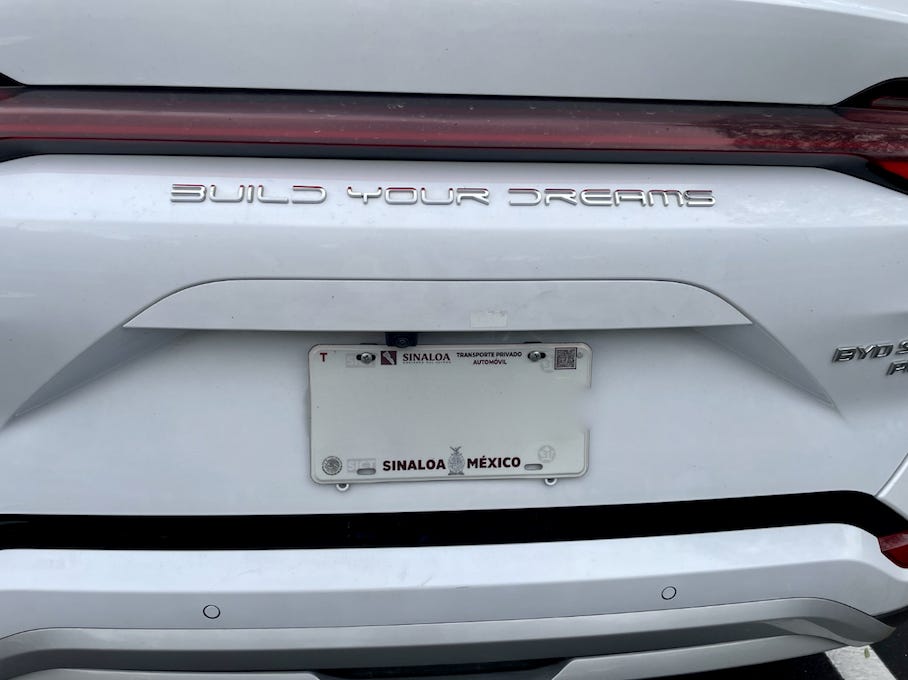
(A picture I took in Tucson)
We keep being told by financial commentators that China’s economy is a bubble about to burst, but there is little follow-up coverage asking the China bears why they keep being wrong, over and over again.
We were told how awful the air pollution is in China, but very little coverage of how dramatically cleaner the air has become in recent years.
We are told that travel though the South China Sea is crucial to the world economy, even though the economy did fine after the far more important Red Sea was closed off with only minor effects. Avoiding the Spratly Island area by going around the Philippines is much easier than going all the way around the Cape of Good Hope. (BTW, I support the US official position that we have a right to use the South China Sea, I’m merely suggesting the issue is being hyped way out of proportion. Nor do I expect China to close the area to shipping—why would they?)
There is very little coverage of the extensive social liberalization that has occurred in China, on everything from gay rights to the end of the one child policy. Instead, all we hear is about how China is becoming more repressive. It is more repressive with respect to free speech, but there’s much more to life than speech.
We are told that China is evil because its government abstained on UN resolutions condemning Russia for invading Ukraine, whereas almost all civilized nations voted “yes”. But the US (and Israel) didn’t even abstain, they voted no, along with Russia, North Korea and Iran. And Israel only voted that way because . . you guessed it . . . American bullying.
We’re told that China is cutting off the export of “rare earths”, but are not often told that these metals are not particularly rare, or that China is doing this in response to previous American economic attacks, such as cutting off the export of various types of American (or Dutch, or Japanese, or Taiwanese) technologies. What’s good for the goose . . .
Our government and media complain about Chinese spying on the US but rarely discusses American spying on China.
People complain that China is the world’s largest emitter of greenhouse gases but overlook the fact that China has more than four times our population. Or the fact that China is currently at the most energy intensive stage of its development. Or that China is currently building vastly more nuclear, solar, wind and hydro energy than the US. Or that as China completes its buildout of infrastructure and housing, its energy demand will fall substantially, and at that time it will rely far more heavily on clean energy than does the US. Or the fact that our own government is now actively trying to stop solar and wind energy projects, going so far as the stop a Rhode Island wind facility that is 80% complete.
The government and media tell us that China has a large trade surplus with the US, but there is much less coverage of the fact that almost all economists view bilateral trade deficits as completely meaningless, and indeed most economists don’t even worry about overall trade deficits.
The US demands that our allies tell us what they’d do if Taiwan were attacked, but the US government refuses to say what it would do. We criticize Honduras for switching its recognition from the Republic of China to the People’s Republic of China, even though the US has already made the exact same decision. Don’t you dare act like us!!
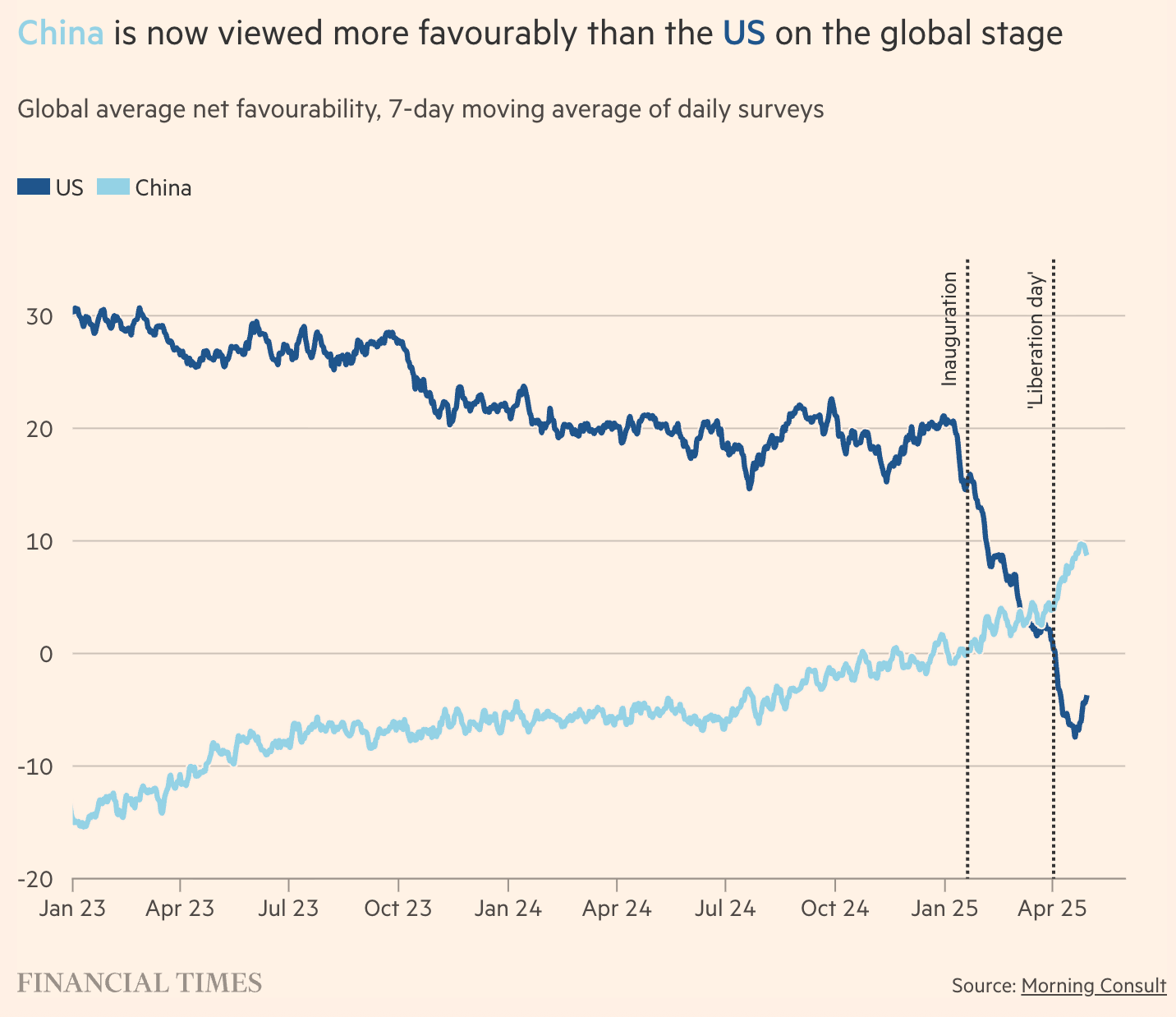
All of this American hypocrisy may be contributing to China now becoming viewed more favorably than the US:
4 The best thing that ever happened
I am continually amazed at how little most Americans know about China. Very few people seem to understand that China was desperately poor under Mao, with suffering far beyond human comprehension. Or that the post-1980 economic boom was probably the best thing that ever happened, at least in terms of improving aggregate human well-being. And yet I see people bemoaning the fact that we helped China to develop because they are now a geopolitical rival to the US. Are these people actually so cruel that they put this sort of consideration ahead of the well-being of 1.4 billion people? Probably not—they are simply not well informed. I still recall an academic I spoke with in the 1980s (who shall remain nameless), who approved of China’s one child policy. Good people often take the most appalling positions on issues, mostly out of ignorance.
People complain that I should stay in my lane, that I’m not an expert on China. Guilty as charged. But I’ve noticed that the people with the greatest knowledge of China, including Yasheng Huang, Dan Wang, Steve Hsu and Peter Hessler, tend to have much more nuanced views than the typical Washington DC China hawk. That doesn’t me that they agree with the points in this post (or each other), but they are at least a bit skeptical of the claim that we need to adopt a highly antagonistic stance toward China.
All of this misinformation has consequences. The demonization of China has led some states to try to limit Chinese enrollment in their universities. Other states have banned Chinese people from buying property—the new McCarthyism.
Throughout history, anti-foreigner propaganda is often a prelude to war. In general, the public doesn’t wish to fight and die in useless wars. Governments and the media must whip up a war fever by spreading misinformation about the “enemy”. “Remember the Maine!” “Weapons of mass destruction!” “The Gulf of Tonkin”
I’ll end with a few quotes from Dan Wang:
For example, a question I would pose to US policymakers would be: Do you judge it is in America’s interest that China is richer, or is America better off if China is poorer? Having that answer would help structure many subsequent policy choices.
A few weeks later, Wang answered this question while being interviewed by Jordan Schneider:
The US should not be seen as being in a position to constrain China’s growth. It would be disastrous for the US if the Chinese earnestly believed that the US government was trying to hold down China’s innovation prospects or economic growth prospects, because that would seem very dramatically unfair. Now, there are some people in Beijing who already believe some version of this, but that’s not necessarily consensus.
It’s important for the US government to communicate that it wants a good future for Chinese people everywhere. There’s nothing Trump would lose by saying that he wishes the people of China can be rich, well off, and happy.
Here’s another excellent quote, this time Dan Wang and Arthur Kroeber:
Washington’s failings extend across administrations for a reason: American officials, Democrats and Republicans alike, have not taken China’s competence seriously. “China doesn’t innovate—it steals,” wrote Arkansas Senator Tom Cotton on social media in April, epitomizing how Americans trivialize Chinese accomplishments. Too many U.S. leaders continue to believe that a more exquisite export control regime will halt China’s technological momentum. They are sending lawyers into an engineering fight. They need to realize that no matter how hard the United States squeezes, it will not break China’s industrial and technological system.
What Washington should do is strengthen its own capacity. That means starting the hard work of building up the United States’ deep infrastructure. Washington should not try to replicate Beijing’s massive and often wasteful investments in all systems. But it should do better than Biden’s ad-hoc, sector-by-sector approach. And it must abandon Trump’s strategy of hoping that the tariff cudgel will force a reshoring of industry, and his focus on old heavy industries such as steel.
I expect our sanctions to be about as effective as China’s Great Wall.
PS. David Levey’s excellent Substack provided many of the links used in this post.