Recently, an account on X/Twitter posted a claim that the basic income pilot in Finland proved that basic income doesn’t reduce crime. They cited a new study analyzing the data which found a “null result” on crime impacts. Elon Musk—the guy most likely to become the world’s first trillionaire who allegedly supports UBI but says he doesn’t until people buy enough of his robots and robotaxis to cause mass unemployment—boosted this signal to his massive following, replying “Correct” to the sentiment that if you think basic income fixes crime by reducing poverty, you’re deluded, and that the real problem is low intelligence and low self-control.
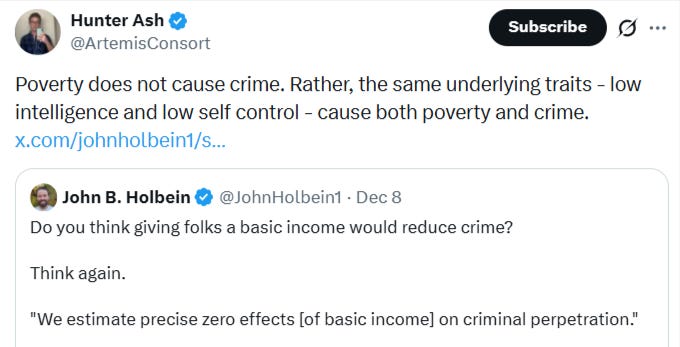
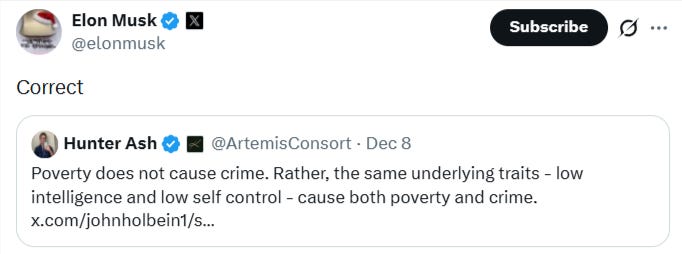
Now it’s even being amplified by Noah Smith on his blog. This really pisses me off.
It pisses me off because it is a classic case of using a specific, highly nuanced data point to tell a broad, dangerous lie. It allows cynics to dismiss the suffering of millions with a “Well, actually” based on a study they haven’t properly read.
The claim that “Universal Basic Income doesn’t reduce crime” isn’t just wrong; it is actively contradicted by decades of evidence from Alaska to Namibia, and from Canada to North Carolina. But to understand why the Finland study showed what it showed, and why actual UBI significantly reduces crime, we have to look at the details that the headline-skimmers routinely ignore.
Let’s start with the “Fact” layer of our Truth Sandwich: Poverty, insecurity, and inequality are the primary drivers of crime. When you alleviate those, crime rates go down.
So, why did the Finland pilot show a “null result”? If you give people money, shouldn’t crime drop?
The answer lies in the experimental design. The Finland experiment was not a test of Universal Basic Income (UBI). It was a test of a slightly more efficient unemployment system for 2,000 unemployed people.
In the Finnish trial, the treatment group received €560 per month. But here is the critical context: This money was instead of the same amount of their normal unemployment benefit. Finland already has a robust social safety net. The people in the experiment were already receiving money from the government; the experiment simply removed the bureaucratic conditions and means-testing attached to that money to see if it would encourage them to take low-paying jobs without fear of losing some of their benefits.
If you take a group of people who are already getting €560/month with conditions, and you switch them to getting €560/month without conditions, why would you expect less crime? Their material circumstances haven’t shifted. They just have less paperwork.
To put this in perspective, imagine we wanted to test if raising the minimum wage reduces crime. But instead of raising the wage, we took 2,000 workers earning $15/hour and simply changed how they were paid—maybe via direct deposit instead of a paper check—but kept the amount exactly the same. If crime didn’t go down, would you conclude “Higher wages don’t reduce crime”? Of course not. You’d conclude that you didn’t actually raise their wages.
The Finland pilot was a test of bureaucracy reduction, not poverty reduction.
There is another massive flaw in using Finland to argue against UBI in the United States: Finland doesn’t have our level of desperation.
Right now, there are approximately 13 million Americans living in poverty who receive absolutely nothing from the federal government. They don’t qualify for TANF (which is notoriously difficult to get). They’ve exhausted SNAP and unemployment insurance or never got them. They are completely outside the system.
These are the people most likely to engage in “survival crime.” When you have $0, and your child is hungry, you don’t care about the law. You steal food. You sell drugs. You engage in sex work. You do what you have to do to survive.
The Finland pilot didn’t study these people because, in Finland, desperate people largely don’t exist due to their strong safety net. Finland’s poverty rate in 2022 was 0.3%. A real UBI in the United States would reach the millions who are currently excluded. It would be the difference between $0 and $1,000 a month.
When you actually make that change—when you move people from “nothing” to “something,” or when you boost the income of the working poor who are barely holding on—the data shows that crime drops like a stone.
When we look at experiments that actually increased people’s incomes rather than just shuffling their paperwork, the verdict is undeniable.
1. The Plasma Center Effect
A fascinating recent study looked at what happens when blood plasma donation centers open in a neighborhood. In the US, selling plasma is one of the few ways people with no income can generate cash quickly. It serves as a grim sort of market-based safety net.
The researchers found that when a center opens, there is a 10% to 12% drop in crime in the surrounding area. Property crime and drug offenses plummeted. Why? Because when people have a legal, accessible way to get the cash they need to survive, they don’t need to break the law to get it. It’s not rocket science. It’s basic economics.
2. Namibia’s Crime Collapse
In the Otjivero UBI pilot in Namibia, the entire village was given a basic income. This was a “saturation” pilot, meaning everyone got it (around 1,000 people), creating a community-wide floor. The results were staggering.
Overall crime fell by 42%.
The illegal poaching of animals for food/money fell by 95%.
When everyone had enough to eat, nobody needed to steal their neighbor’s livestock. The “survival” incentive for crime evaporated overnight.
3. The Mincome Miracle
In the famous “Mincome” experiment in Dauphin, Manitoba, an entire town was guaranteed a basic income for about five years. Researchers found a 15% drop in overall crime and a large 37% drop in violent crime.
Much of this reduction was driven by a decrease in domestic abuse and alcohol-related offenses. Financial stress is a pressure cooker. When you turn down the heat, the pot stops exploding.
4. Domestic Violence in Kenya
In a study by GiveDirectly in Kenya, providing unconditional monthly income to women reduced the instances of physical and sexual violence from their partners by 51%.
Money is power. Financial independence gives people the power to say no, the power to leave abusive situations, and the power to de-escalate household stress before it turns into violence.
The Earned Income Tax Credit (EITC) shows this too by the way, with 21% fewer counts of physical or sexual violence as the result of an additional $1,000.
5. The Oh Look I Have Healthcare Now Effect
If you want to know what happens when you stop punishing poverty and start treating it, look at the data on Medicaid expansion. In a massive 2022 study, researchers analyzed FBI crime data from over 3,000 counties to see what happened after the Affordable Care Act allowed states to expand Medicaid.
The results were undeniable. States that expanded the safety net saw a 20% to 32% drop in overall arrest rates compared to states that didn’t.
Drug arrests fell by 25-41%.
Violent crime arrests fell by 19-29%.
This is the “prevention” argument in action. When people can access healthcare—including mental health services and addiction treatment—without financial ruin, they don’t spiral into the criminal justice system. A UBI would be a universal preventative care system for poverty that stops crime before the police are ever called.
It’s also a reason to do universal healthcare too.
One of the most insidious arguments against UBI is that it’s a waste of money. But when you look at the cost of crime, UBI is actually a savings plan.
The Smoky Mountains Study
In North Carolina, the Eastern Band of Cherokee Indians began distributing a portion of casino profits to all tribal members in 1996. Researchers had already been studying the youth in that area for unrelated reasons, giving them a perfect “natural experiment.”
The results? The children whose families received the income boost saw massive behavioral improvements over the next few decades. As they grew up, they committed less crime. By the time the cohort reached age 21, the number of “minor crimes” committed by the youth had dropped considerably. By age 26, the researchers calculated that the Return on Investment (ROI) was 3 to 1.
For every dollar given to families, society saved three dollars—mostly by not having to pay for police, courts, and jails. It was also the result of better health leading to less need for medical treatment, and better educational outcomes leading to better jobs.
The SSI Cliff
Conversely, we know what happens when you take money away. A study published in the Quarterly Journal of Economics looked at children who received Supplemental Security Income (SSI) for their disabilities but were removed from the program when they turned 18.
The study compared kids who lost the income to kids who kept it. The result? The number of criminal charges for the group that lost the income increased by 20% over the next two decades.
The researchers noted that the “savings” the government achieved by cutting these kids off were almost entirely wiped out by the increased costs of enforcement and incarceration. We are stepping over dollars to pick up pennies, and ruining lives in the process.
Critics love to claim that “criminals are just criminals” and that money won’t change their behavior. This is the “bad blood” argument, and it is scientifically bankrupt.
In the United States, the recidivism rate is horrifying. About 70% of formerly incarcerated people are rearrested within three years. Why? Because we release them with $50 in their pocket if anything, a criminal record that makes them unhireable, and no housing. We practically force them back into survival crime.
But look at what happens when we change the environment:
The Just Income Pilot: In Gainesville, Florida, a pilot provided a guaranteed monthly income to formerly incarcerated people. The recidivism rate wasn’t 70%. It dropped by 31% compared to the control group.
CEO’s Returning Citizens Stimulus: Another program giving cash to returning citizens found consistent reductions in new convictions.
Even in Alaska, studies have shown that property crime drops specifically in the weeks after their Permanent Fund Dividend checks arrive. The larger the check, the larger the impact. When liquidity is available, theft becomes less necessary.
We need to stomp out the eugenicist notion that crime is caused by low IQ or “bad genes.” This kind of thinking is not only racist; it is biologically wrong.
Scarcity changes how your brain works. Sendhil Mullainathan and Eldar Shafir wrote the book Scarcity, detailing how economic insecurity essentially lowers your functional IQ.
One study showed that Indian farmers performed significantly better on cognitive tests after the harvest (when they had money) than before it (when they were broke). Another study in a mall showed that just getting poor people to think about a large car repair bill caused a drop in cognitive function equivalent to losing a night of sleep or 13 IQ points.
Economic insecurity is like a glitched app running in the background of your phone, draining the battery and slowing down the processor. UBI closes that app.
When we reduce poverty, we aren’t just filling bank accounts; we are freeing up bandwidth. We are reducing the chronic stress and cortisol spikes that lead to impulsive decision-making and violence. We know that inequality is actually more strongly linked to homicide rates than poverty alone. UBI attacks both.
Finally, we have to look at the bigger picture. We are currently living in a K-shaped economy. The top 10% are consuming half of everything, while the bottom 50% are fighting for scraps. Inequality is spiraling, and history tells us that extreme inequality inevitably leads to social unrest and crime.
UBI is not just a crime reduction policy; it is an economic stimulus package for the people who actually spend money.
Unlike the Finland pilot, a real UBI would boost the disposable income of the bottom 60% to 90% depending on tax details. That money doesn’t disappear; it cycles through the local economy. It creates demand. Demand creates jobs.
In Alaska, their UBI has been shown to increase overall employment. Why? because when people have money to spend, local businesses have customers. If Finland had done a real UBI—giving money to everyone in a town and comparing it to a town that got nothing—they likely would have seen the same 15%+ drop in crime seen elsewhere, driven by a booming local economy and higher employment.
Let’s be honest about how we talk about crime.
When a poor person steals baby formula, we call it a character flaw. When a rich person steals millions in wages from their employees—which, by the way, accounts for more lost money annually than all shoplifting, burglary, and robbery combined—we call it a “smart business practice.”
Nobody looks at a billionaire committing tax fraud or crashing the economy via subprime mortgages and says, “It must be his genetics.” We understand that the rich commit crimes because they think they can get away with it, or because they simply want more. We need to understand that the poor often commit crimes because they need more.
The Finland study is a valid data point about bureaucracy and employment incentives within a specific welfare state, but it is a terrible data point about the relationship between poverty and crime.
If you actually look at the mountain of evidence—from the plains of Namibia to the towns of Canada, from the plasma centers of the US to the tribal lands of the Cherokee—the signal is clear: Poverty is a policy choice, and crime is one of its side effects.
UBI also isn’t just about money. It’s about reducing the inequality that tears the social fabric apart. It’s about increasing trust in our neighbors, our politicians, and our government—something the Finland pilot did successfully prove, by the way.
We have a choice. We can keep spending trillions on prisons, police, and punishment to manage the symptoms of poverty. We can keep believing the lie that crime is an inherent trait of “those people.”
Or we can look at the actual data. We can invest in the cure. We can build an economy that serves the needs of the many rather than the wants of the few.
Crime is not a trait. It is not a gene. It is not a skull shape. That is the intellectual on-ramp to eugenics and racism, because it treats social outcomes as biological destiny and uses that story to justify punishment instead of prevention.
Crime is a set of behaviors that responds to incentives, stress, opportunity, necessity, and the degree of inequality and social cohesion in a society.
Elon might be satisfied with a “Correct” tweet, but we should demand the whole truth. And the truth is that universal basic income builds a safer world for everyone.
If you enjoyed this article, please share it and click the subscribe button. Also consider making a monthly pledge in support of my work to have your name appear below.

Special thanks to my monthly patrons: Gisele Huff, Haroon Mokhtarzada, Steven Grimm, Bob Weishaar, Judith Bliss, Lowell Aronoff, Jessica Chew, Katie Moussouris, David Ruark, Tricia Garrett, A.W.R., Daryl Smith, Larry Cohen, John Steinberger, Philip Rosedale, Liya Brook, Frederick Weber, Dylan Hirsch-Shell, Tom Cooper, Joanna Zarach, Mgmguy, Albert Wenger, Andrew Yang, Peter T Knight, Michael Finney, David Ihnen, Steve Roth, Miki Phagan, Walter Schaerer, Elizabeth Corker, Albert Daniel Brockman, Natalie Foster, Joe Ballou, Arjun Banker, Tommy Caruso, Felix Ling, Jocelyn Hockings, Mark Donovan, Jason Clark, Chuck Cordes, Mark Broadgate, Leslie Kausch, Juro Antal, centuryfalcon64, Deanna McHugh, Stephen Castro-Starkey, David Allen, Liz, and all my other monthly patrons on Patreon for their support.
Thanks for reading Foreword to Civilization! This post is public so feel free to share it.