
Forty-Hz auditory stimulation increased amyloid clearance markers in aged primates and produced lasting effects, supporting its potential as a non-invasive Alzheimer’s therapy.
Scientists at the Kunming Institute of Zoology (KIZ) of the Chinese Academy of Sciences have shown for the first time in non-human primates that sound stimulation at 40-Hz can significantly increase β-amyloid levels in the cerebrospinal fluid (CSF) of aged rhesus monkeys. Notably, this effect lasted for more than five weeks after treatment ended.
The findings, published in PNAS, provide the first experimental evidence in non-human primates that 40-Hz stimulation could serve as a non-invasive physical approach for Alzheimer’s disease (AD). The study also highlights important differences between primate and rodent models, which are often used in preclinical research.
Led by Dr. Xintian Hu at KIZ, the research team worked with nine elderly rhesus macaques (Macaca mulatta) between 26 and 31 years old. These monkeys naturally developed widespread amyloid plaques in their brains, closely resembling the Aβ pathology seen in human AD. Because of this similarity, they offer a valuable model for testing potential therapies before moving to human trials.
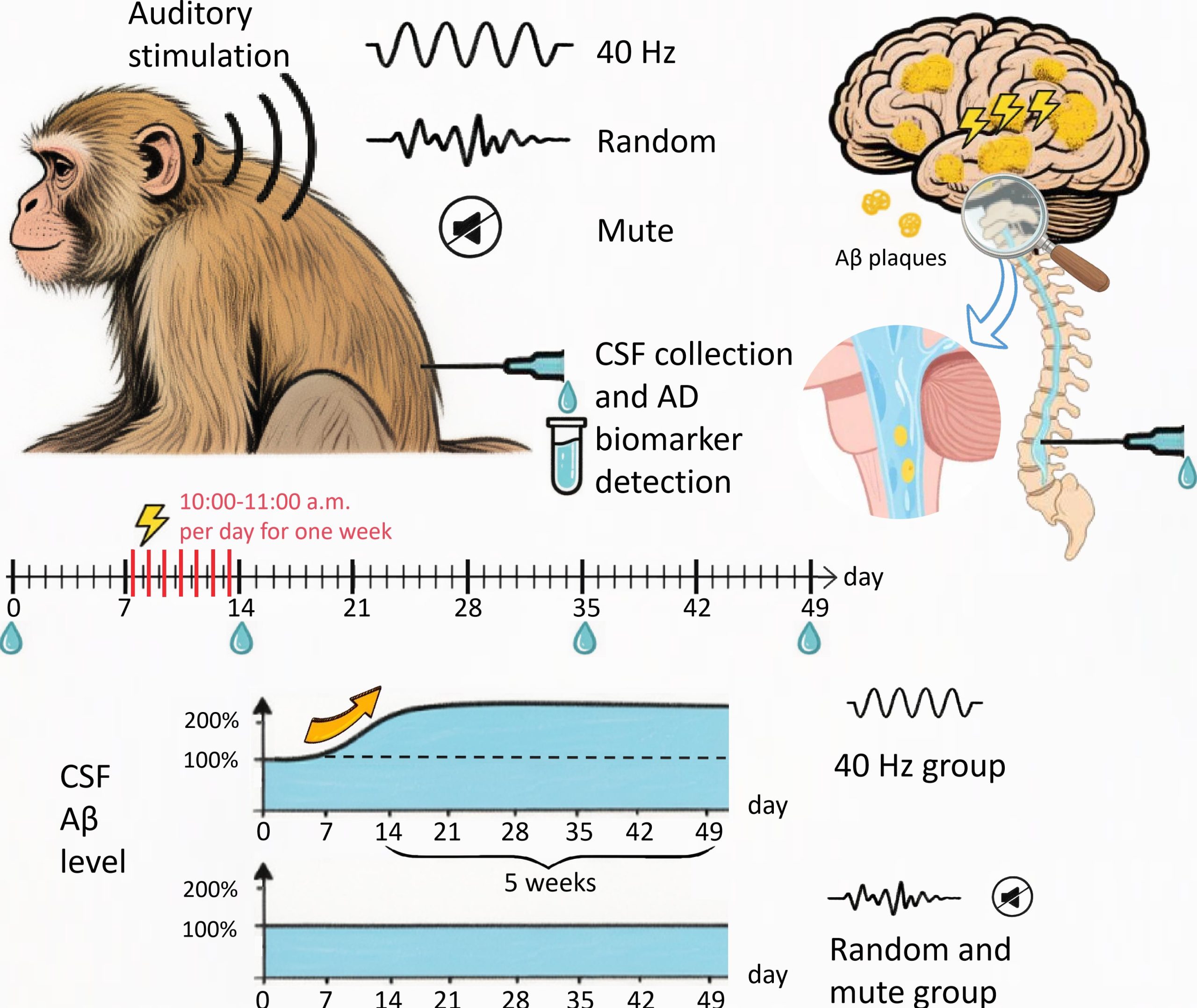
Auditory stimulation drives amyloid shift
In a randomized controlled design, the experimental group received one hour of 40-Hz auditory stimulation using a 1-kHz pure tone each day for seven consecutive days. After this treatment period, concentrations of Aβ42 and Aβ40 in the monkeys’ CSF rose by 205.61% and 201.00%, respectively, with statistically significant differences compared to baseline. These changes align with earlier findings in mice and support the idea that 40-Hz stimulation may promote the movement of β-amyloid from brain tissue into the CSF, a process thought to reflect enhanced clearance.
Importantly, when researchers measured CSF Aβ levels again 35 days after the stimulation ended, the concentrations remained elevated and did not significantly decline from the immediate post-treatment values. Such a prolonged effect has not been documented in mouse studies. This long-lasting response strengthens the case for 40-Hz stimulation as a potential non-invasive therapy for AD and emphasizes the relevance of aged rhesus monkeys in translational Alzheimer’s research.
A non-invasive alternative to antibodies
Currently approved anti-Aβ monoclonal antibody treatments can slow the progression of early-stage AD, but they carry risks such as cerebral edema and hemorrhage.
By contrast, 40-Hz auditory stimulation is a low-cost, non-invasive intervention that may offer therapeutic benefits with fewer safety concerns. These results suggest it could be explored as a complementary or alternative strategy in the management of Alzheimer’s disease.
Reference: “Long-term effects of forty-hertz auditory stimulation as a treatment of Alzheimer’s disease: Insights from an aged monkey model study” by Wenchao Wang, Rongyao Huang, Longbao Lv, Xia Ma, Zhenhui Li, Yuhua Zhang, Jing Wu, Shihao Wu, Jianglei Xu, Yingzhou Hu, Christoph W. Turck, Hao Li and Xintian Hu, 5 January 2026, Proceedings of the National Academy of Sciences.
DOI: 10.1073/pnas.2529565123
Never miss a breakthrough: Join the SciTechDaily newsletter.
Follow us on Google and Google News.