Scientific compute for agents · API and MCP native
Give your agents the power to do real science.
Your agent sends a prompt and the data. ScientistWorkbench runs the analysis in an isolated Linux sandbox with a curated life-science stack, an independent reviewer checks the report against what actually ran, and you get back a summary, figures, tables and the code.
No seats, no installs, no subscription required. One API key works for HTTP and MCP.
Give your agents a real scientific stack
24
life-science databases
UniProt · PDB · ChEMBL · PubMed · DepMap · ClinicalTrials.gov …
Publication-ready figures
Real fits on real data, saved as PNG and PDF with the code that made them
pass plate Z′ reproduced
warn outlier excluded in refit
pass IC50s match to 0.01%
Built-in reviewer
Every claim in the report is checked against what actually ran
How it works
Submit
One prompt plus input files (xlsx, csv, fasta, PDFs …) over HTTP or an MCP tool call. Returns a job_id immediately.
Sandbox
A fresh Ubuntu sandbox per job with the full scientific stack below pre-installed and network access plus query guides for 24 life-science databases. Nothing shared between jobs or tenants.
Reviewed report
The agent writes summary.md (Objective · Method · Results · Assumptions · Files). A separate reviewer audits every claim against the execution log.
Collect
Summary, figures, tables, scripts, execution log and reviewer findings — as JSON, as files, or inline in your agent's context. Run hundreds in parallel.
Supercharge your agents with the power to do scientific analysis and access 24 life science databases
Every job starts in a fresh Ubuntu sandbox with this stack already installed, plus a skill that teaches the agent how to query each database directly (REST, with retries and a provenance log of every query). Package managers stay available, so anything else on PyPI or apt is one install away.
Compute stack
 SciPy
SciPy pandas
 statsmodels
 scikit-learn
 matplotlib
 Biopython
 RDKit
RDKit
| numerics & stats | numpy, SciPy, pandas, statsmodels, scikit-learn, pyarrow |
|---|---|
| figures | matplotlib, seaborn (publication-style defaults via the figure skill) |
| sequences & phylogenetics | Biopython, MAFFT, IQ-TREE, FastTree, HMMER |
| structure | TM-align, PDB/AlphaFold fetch helpers |
| chemistry | RDKit |
| files | openpyxl, xlrd, CSV/Parquet, PDF text extraction, LibreOffice headless |
| languages | Python 3 and shell; Node, Go, Rust, Java available |
24 life-science databases
Reachable from inside the sandbox, each with a skill page the agent reads before querying.
| proteins & genes | UniProt, Ensembl, InterPro, PDB, AlphaFold |
|---|---|
| variants & expression | gnomAD, ClinVar, dbSNP, GEO, GTEx |
| cancer & targets | DepMap, cBioPortal, Open Targets, Reactome |
| chemistry & drugs | PubChem, ChEMBL, BindingDB, openFDA |
| literature & trials | PubMed, Europe PMC, OpenAlex, bioRxiv, medRxiv, ClinicalTrials.gov |
UniProtEnsemblgnomADClinVarOpen TargetsPDBAlphaFoldGEOcBioPortalPubChemChEMBLBindingDBopenFDAOpenAlexPubMedEurope PMCClinicalTrials.govbioRxivmedRxivDepMapGTExInterProdbSNPReactome
What a job costs
Prepaid tokens, no seats. A job uses tokens in proportion to what it reads, computes and writes. Measured on the production engine:
Built for agent frameworks, not chat
API- and MCP-native
Nine MCP tools (science_submit, science_wait, science_result …) and a plain HTTP job API. Works from Claude Code, Claude Cowork, Cursor, Claude Desktop, the Agent SDK, or curl.
Durable job ids + provenance
Every artifact has a sha256 and a stable science:<job_id>/<file> ref. Transcript, execution log and reviewer record ship with every result.
Parallel by default
Submit and poll. Each job is its own sandbox; concurrency is a setting, not a queue you wait in.
Isolation
Per-job sandboxes, per-tenant storage keys, read-only mounted inputs, no shared state, no training on your data.
Real runs
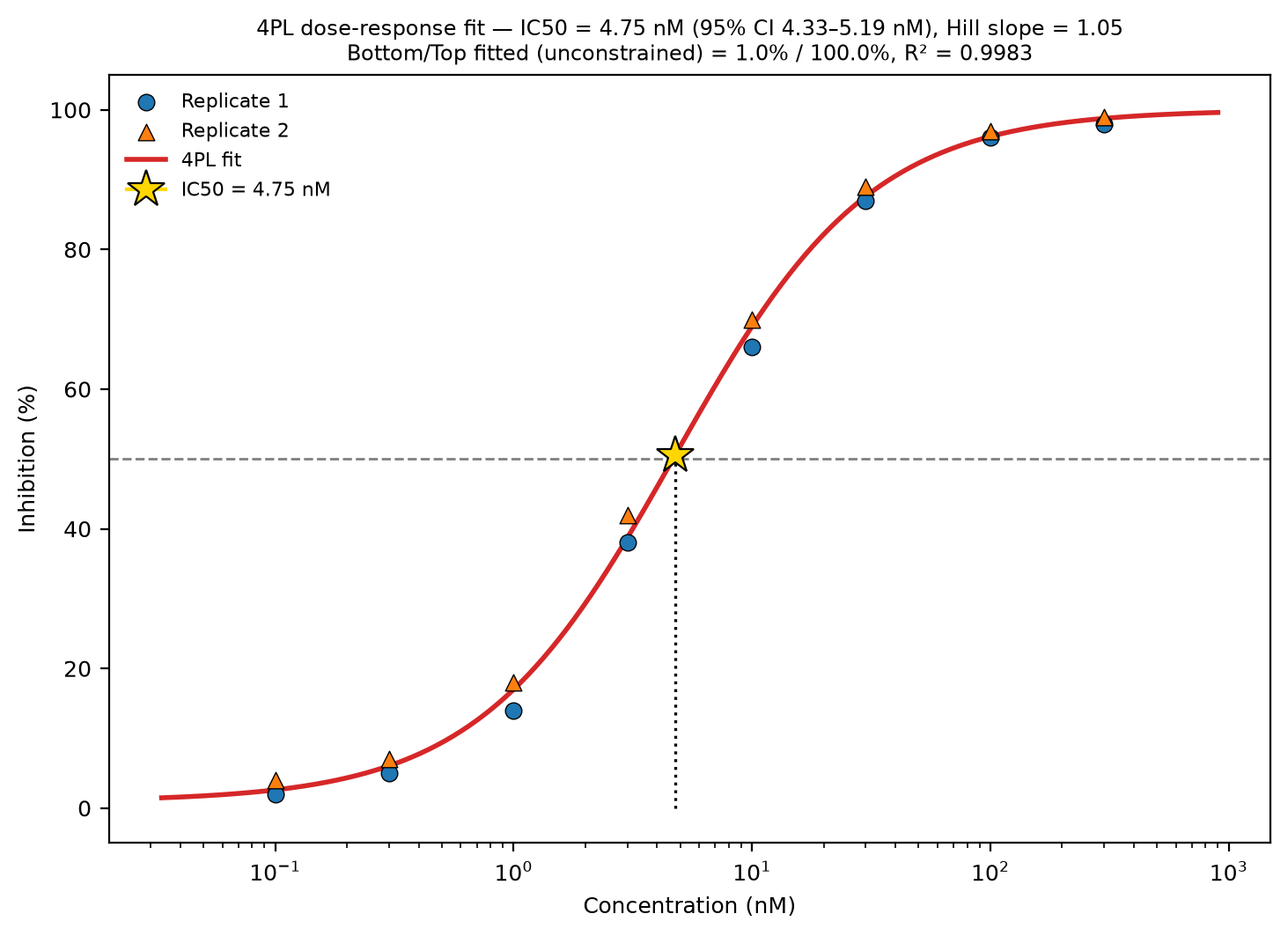
Dose-response fit from eight numbers in the prompt
specialist · standard model · 3 min · 1 figure · 59k tokens
“Fit a four-parameter logistic curve to this dose-response data (concentration in nM, % inhibition; duplicates): 0.1: 2, 4 · 0.3: 5, 7 · 1: 14, 18 · 3: 38, 42 · …”
AI-generated analysis. Outputs may contain errors; verify numbers against the execution log and source files before relying on them. Not a substitute for review by a qualified scientist, and not medical advice: any use affecting patient care or healthcare decisions requires review by a qualified professional.