
[The following post is a polished transcript of a speech I recently gave to a private gathering of American technologists. Its contents may be of interest to a larger audience. -TG.]
THE CHINESE SOCIO-POLITICAL SYSTEM differs from our own. From the perspective of the topic of this conference, here is the most salient distinction: the Chinese system has a telos. The Chinese party-state is fundamentally a set of goal-oriented institutions. This is not unique to China—it is in fact a distinguishing feature of all Leninist systems. I sometimes think of Leninist systems as a little bit like that bus in the movie Speed. Who here has seen it? For those who haven’t, here is basic gist of that film: an extortionist attaches a bomb to the speedometer of a bus. If the bus ever slows below 50 miles per hour, everyone blows up. So it is with your average communist system. Either it hurtles towards some clearly defined goal or things start to fall apart.1
In the early days of Mao, the overarching aim of the communist system was to seize state power, first through subversion and insurgency, then through more regular combined arms warfare. In the later days of Mao the newly established Chinese state and the society it intertwined were oriented around class struggle, both at home and abroad. From the 1980s through the 2010s the Chinese system orbited a different yet still very explicitly stated goal: getting rich. In theory, if not always in practice, every action taken by every cadre, every soldier, and every state employee was subordinate to this larger, unifying aim. We must make China rich.
That is no longer the animating telos of the Chinese system. There is a new goal, one that has been articulated with great clarity by Chairman Xi and the Chinese central committee: In 2026, the aim of China’s communist enterprise is to lead humanity through what they call “the next round of techno scientific revolution and industrial transformation.”2 The Chinese leadership believes humanity stands on the cusp of the next industrial revolution. China can only be restored to its ancestral greatness if it is the pioneer of this revolution. All machinery of party and state bend towards this end. All 100 million members of the Communist Party of China, all 50 million government employees of the PRC, all two million soldiers of the People’s Liberation Army, and ultimately all of the 1.4 billion people that call China home must be mobilized to accomplish this aim. That is the ambition. China will be the greatest scientific power the world has ever seen—or bust.3
The communists are deadly serious about their pursuit of this aim. Statistics provide one window into the seriousness of their intent. Now I don’t intend for the remainder of this speech to be a laundry list of numbers, but I think the numbers are useful for helping us see the scale of what China has already accomplished and the speed with which they have accomplished it. They are also strong signal of future intent—it is difficult to survey the numbers and not appreciate just how ironclad China’s commitment to scientific achievement really is.
Now scientific achievement is difficult to measure. One common metric is to count the so-called “high impact papers” – journal articles highly cited by other leading lights in a given scientific field. Count up these papers over the course of a year, see who wrote them, see where those authors work, and—voila!—you have a ranked list of which institutions are putting out the most high-impact science in a given year. Had you done this counting exercise in the year 2005, you would have discovered that six of the world’s ten most productive universities were in the United States.4 Today only one of those universities is in the United States. That university is Harvard, coming in at spot number three on the list. At spot number one? Zhejiang University.
How many of you have heard of Zhejiang University? Can I get a show of hands?
And of course, Zhejiang University is just one of the Chinese institutions on this top ten list. China claims not just the number-one spot, but also the number-two spot. And not just the number-one and number-two spots, but also the fourth, fifth, sixth, seventh, eight, ninth spots go to the Chinese.5
The scientific publisher Nature makes a similar catalog on a slightly more granular level, looking at specific fields of science. According to Nature’s most recent rankings, 18 of the top 25 most productive research institutes in the physical sciences, 19 of the top 20 in geosciences, and a full 25 out of 25 in chemistry are Chinese. Only in the biosciences do American scientists still have a lead—but even on that list three of the top ten are Chinese.6
The kicker is, none of that was true even just a decade ago.
The most granular analysis of all is published by the Australian Strategic Policy Institute, or ASPI. ASPI publishes a neat research tracker that surveys new publications in 74 distinct high-end technologies. Unlike the statistics I just discussed, their tracker includes research published by scientists working in national laboratories and private institutions as well as those published by academic scientists. For each category they make a list of the ten institutions that are publishing the most high-impact science in that particular topic. What have they found? For 66 of the 74 categories tracked, a majority of the institutions that are now publishing the highest-impact science are Chinese. In many areas of science the dominance is total: For example, ten of then most productive research institutions in the fields of nanoscale material manufacturing, photonic sensors, chemical coating, drone operations, automated swarms, and undersea communications are Chinese. The number is nine out of ten for work on supercapacitors, advanced composite materials, inertial navigation systems, and satellite positioning, eight out of ten in advanced optical communications, advanced radiofrequency communications, and new chemical coatings, and seven out of ten for directed energy technologies, nuclear engineering, and nuclear waste treatment.7
The scale of Chinese scientific production is in part a story about people. China graduates five times the number of medical and biomedical students than we do every year, seven times the number of engineers, and two-and-a-half times the number of undergraduates with research experience in artificial intelligence. Last year China graduated almost double the number of STEM PhD students than we did—and that number is actually worse than it sounds because—depending on the exact year you do the counting—between one sixth and one fifth of our STEM graduates are themselves Chinese.8
Many of these researchers go back. They go back partially because they are well compensated for doing so. They also go back because of the research opportunities afforded to them. A recent study found that returning Chinese scientists go on to become the lead author on 2.5 times more papers than their colleagues who stay in the United States.9 Many Chinese research labs have 30 or 40 people attached to them—the equivalent to a commercial research lab in the United States. Ask any scientist who has gone to China in the past three years to visit academic colleagues and they will tell you how astounded they are at the quality of the laboratory equipment and machinery that their Chinese colleagues have access to. If in the not-so-distant past Chinese localities competed with each other to lay the most asphalt, now that funding pours into laboratory equipment, scientific instruments, and advanced scientific facilities. Thus China now has the world’s most sensitive ultra-high-energy cosmic-ray detector, the world’s largest and most sensitive radio telescope, the world’s strongest steady-state magnetic field, the world’s fastest quantum computer by computational advantage, and the world’s most sensitive neutrino detector. Just yesterday an attendee at this conference informed me of another I should add to my list: the world’s largest primate medical research center.
Now I can already hear some of your objections. “Tanner, these measures don’t include classified research. They don’t include the proprietary research by private companies—that is the stuff that actually pushes technology forward. American companies are not publishing billion-dollar trade secrets in the latest journals. The Chinese scientists are under insane publish or perish pressures—they are far more likely to lie and cheat. Don’t you know Chinese scientists take part in citation cartels? Haven’t you read those bitter critiques of the new system written by China’s own disgruntled scientists?”
My main response to this: you guys have lost the thread. I am reminded of a similar style of argument we often see in AI development. Every time a new model is released people play around with it for a bit and then start to catalog the flaws of this model. But the real story, the story historians will tell a generation from now, is never about the model of the moment. What matters is movement between those moments. History is made by the trend-line. What capabilities did the models have four years ago? What capabilities do they have now? What might they reasonably be expected to have in a decade hence?
Something similar might be said for science and China.
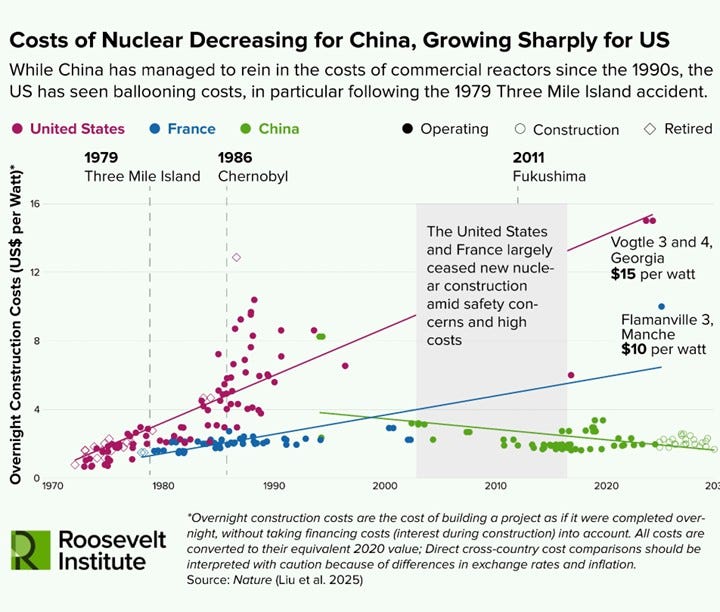
Moreover, it is not hard so hard to find examples of dominance in the scientific literature leading to dominance in the world of applied technology. More than a decade ago Chinese researchers began to dominate academic work on batteries. Today China produces 80% of the world’s battery cells.10 Around that same time Chinese researchers took the lead on factory robots and factory automation. Today Chinese firms buy more robots than the rest of the world combined. They have a higher robot density than almost every other country in world, despite being the world’s second largest nation.11 Another example: China is the only place where the unit cost of building a new nuclear reactor has gone down over the last decade.12 Do you think this is unrelated to the number of nuclear engineers they train and the amount of basic research they publish on nuclear engineering? Again I beg you to look at the trend-line: In 2026 China has 102 nuclear reactors either in operation or under construction. How many did they have 15 years ago? Less than 30.13
Why is China pouring so many resources into scientific and technological advance? Here is a 30-second thumbnail sketch: Xi Jinping and those around him have a specific view of history.14 Like most Chinese, they remember with fondness past eras when their nation was the centerpiece of human civilization. They mourn China’s fall from those grand heights. They remember with bitterness the “century of humiliation” in which their people were exploited by foreign powers and wasted by vicious warlords. The Communist Party of China was founded to save China from that fate. From its inception it has seen itself as the vehicle for the salvation of the Chinese nation and thence the restoration of this nation to its rightful place at the center of the human story.
But why was China displaced from its spot “at the center of the world stage” in the first place? Chinese intellectuals have been asking this question for more than a century. Here is their most common answer: science and technology. Today Party-affiliated thinkers often describe modern human history as punctuated by discrete revolutionary moments when a new technological regime comes into being. They call these moments “rounds of techno-scientific revolution and industrial transformation.” In such moments the material basis of human civilization changes. Those who master this transition master… well, just about everything.
Thus Britain, author of the first industrial revolution, was the most powerful country of the 19th century. Thus the United States, whose technologists pioneered both the second industrial revolution and the computer revolution, was the 20th century’s most powerful nation. Now it is China’s turn.
Xi Jinping insists that we have reached one of these rare hinge points in human history. The material basis of human civilization is about to change. Humanity stands at the cusp of a revolution—and it is China that will lead humanity through it. By these means China’s sovereignty may be secured, China’s economic troubles will be resolved, and the Chinese nation will return in glory to its proper place at the center of the human pageant. And if China fails in this great enterprise? Well, his countrymen need only look at their nation’s own history to see the viciousness that visits those who fall too far behind the technological frontier.
So that is what China is trying to do. China’s communist leadership clearly believes that scientific dominance will deliver all sorts of boons to their nation. They have bet the growth of their economy, the strength of their military, and the health of their citizenry on this quest. I do not have space within my allotted time to discuss whether or under what conditions that bet might pay off—so on that count I will say only the following: even if you believe that political instability or economic uncertainty might arrest China’s upward climb, that might not change the trajectory of Chinese science. All of those Chinese scientists and engineers will still be there. Their labs and facilities have already been built. Their equipment and instruments have already been bought. Their technicians are already trained. That will still be true if Xi Jinping dies of a stroke tomorrow.
The more relevant question, especially for this audience, is what does all of this means for us? I encourage you to ponder what China’s scientific trajectory means for yourselves, your research fields, your companies, and our country. Does it matter if the Chinese are the pioneers of the 21st century’s greatest technologies? What would it take for America to come back in this “race?” How will your life be different if the future of science is Chinese?
————————————————————-
Your support makes this blog possible. To get updates on new posts published at the Scholar’s Stage, you can join the Scholar’s Stage Substack mailing list, follow my twitter feed, or support my writing through Patreon. If you found this post worth reading, you might find some of my other essays on Chinese attitudes towards science worth reading: “Mr. Science, Meet Mr. Stability,” “Xi Jinping’s Plan to Save China Through Science,” and “Wang Huning and the Eternal Return to 1975.” I have also written about the history of science and technology more generally: “Science Proceeds One Question at a Time,” “Has Technological Progress Stalled?,” “For God and Progress” and “Lessons from the 19th Century.”
—————————————————————-