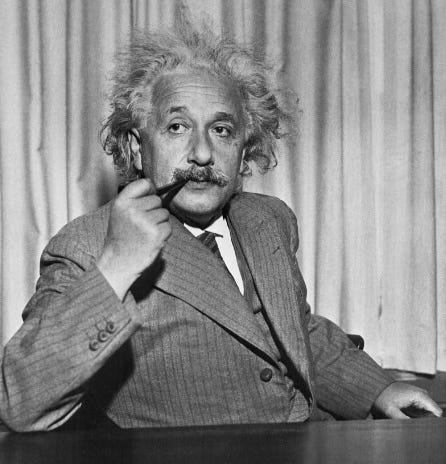
“Everything is determined, the beginning as well as the end, by forces over which we have no control ... Human beings, vegetables or cosmic dust, we all dance to a mysterious tune, intoned in the distance by an invisible piper.”
— Albert Einstein
Einstein believed that if you knew all the initial conditions for the system you could predict the outcome, so it’s natural that he would lean toward determinism. But I think it’s worth mentioning that your own volition, will, and intention are the seeds that will ripen into your own experiential harvest in your own corner of the cosmos, and that your choices and intentions constitute these “initial conditions” just as much as the placements of the stars and planetary orbits. The shared reality appears to have a geometric interpretation, hence the success of General Relativity, but the inner world to which we are each individually privy, is fresh territory even for Einstein. I think it’s folly to assume that things are predetermined, as you forfeit a lot of power in doing so. Consider a new take on the Faustian Bargain or Pascal’s Wager, but for free will: If free will is real and you assume it’s not, you lose power, If you assume it is and it’s actually an illusion, no harm is done. Therefore it makes sense to assume you have free will no matter what the actuality is. So at the very least I think it makes sense to assume we have free will. But in addition to that, I think we can all see in our own lives how choices and decisions we made led to outcomes, personal outcomes and social outcomes, as well as environmental/environs outcomes. Sure, there are factors that seem to have greater energy in their sum compared to our own willful power, but do not underestimate the potential in self-determination to steer a course of our own choosing. Naturally, we are sometimes ushered through situations with little autonomy, but in a majority of life moments we always have the ability to choose, reflect, weigh, consider, and not be taken off and away with the flow of things. Determinism, further, would also render the passage of time unnecessary and irrelevant, would render the whole of experiential reality but a squishy byproduct of the colliding of unstoppable forces, and this is a view I cannot in my core support, it lends towards nihilism and annihilation as a world-view which I find to be patently wrong, misleading, misdirected, and unhelpful to the flourishing of the body and the spirit. I may not be able to alter the fact that the earth is made of stone and sea, but I can choose myself how to navigate the waters and the terrain. I may not be in charge of building the carriages and the ships, but I can and will decide how to steer them and lend wisdom to others on how best to steer theirs. Just because a lot can be determined, like the path of the planets in relation to the sun, does not mean all is determined. We must, through our actions, reclaim the soul’s perfection, and doing so is a process of will and skill. If the universe is physical first and immaterial second, Einstein is right - the physical world is primary and our scopes and apertures into it are guided by great disinterested forces from the outside, but if the immaterial is primary, and the physical world secondary, then so much more relies on your goodwill and intention than can be fathomed, and it is this view that I hold, that consciousness is primary, and the physical world secondary. Mind you, consciousness primary and physical secondary is also in accord with quantum physics, something Einstein was very resistant to embrace, because it disrupted the beautiful geometry of General Relativity and the curvature of the spacetime [manifold of four dimensions: x,y,z and t for time]. If he were alive today, Einstein would have to concede that consciousness is, like how Plato said of the soul, “ungenerated and immortal” and that in itself signifies that it precedes the physical world, marked by generation and decay, regeneration from the compost and the ashes. Physicalism is great when we never peek under the curtain of instrumentation and ask, who is it who is observing? A theory of everything (ToE) must take into account subjective experientiality, governed not by cosmological constants and geometric curvature, but by volition.