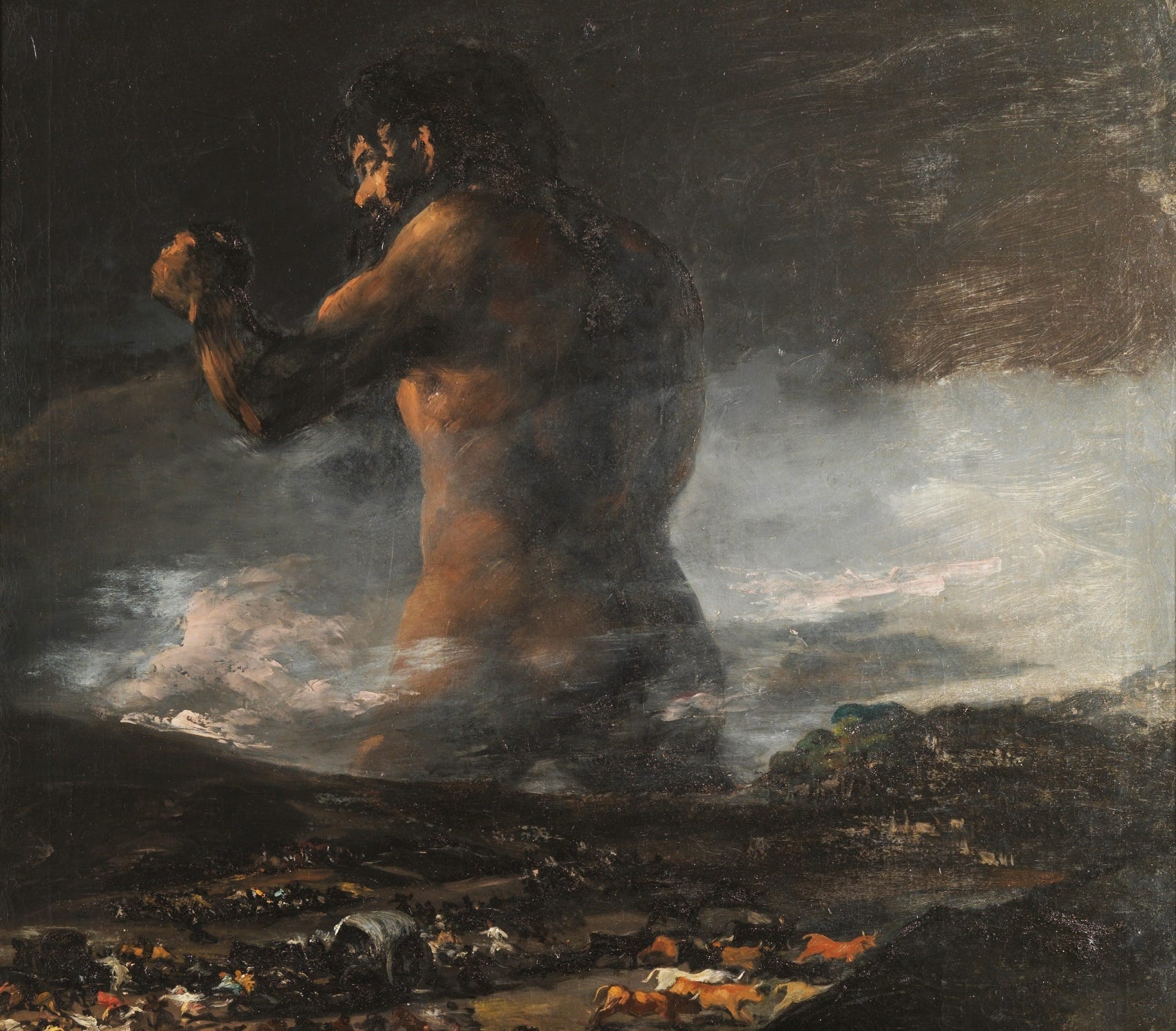
How many apricots do you think you can fit in your mouth?
Five? That’s how many apricots the average person can fit in their mouth. One stuffed in each cheek, plus three in the middle. If the average person tries to shove a sixth apricot in there, they start to gag. Eyes water, nose runs, eventually a thin dribble of orange pap escapes from between the teeth. Too many apricots feels like burning. Before long they’re gasping and retching and puking up great slimy globs of apricot flesh. That’s the average person. Are you an average person?
Before you answer, you should know what it’s like out there for the average person. They’ve started putting up positive messages in my local privately-owned public space. Big free-standing billboards that say things like YOU’RE NEVER TOO MUCH and IT’S OK NOT TO BE OK and HAVE YOU LOVED YOURSELF TODAY? and WE’RE ALL A BIT MESSY SOMETIMES. One of them contains, in smaller letters, a sort of poem about ADHD. ‘Lateness as a creative act. Splicing a little chaotic obsession into the world’s mind-numbing order. Loving us for how intensely, sincerely—inconveniently—we show up.’ Supposedly these are all about being different and unique, but really this is just how the powers of the world now address the average person. Once, before anyone can really remember, they spoke in the hysterical register of duty and sacrifice and law; now it’s this. Come on, let’s all have a bloody great chat about our mental health. You will be interpellated as small sad bean, who needs help from some shadowy consortium of private interests to help manage all the sad feelings floating around in their head. You are assumed to be in a state of ambient unwellness. You’re suffering from a mental distress that’s bad enough to require some kind of outside help, but not so bad that the outside help has to consist of anything other than a big yellow sign that says TAKE A DEEP BREATH. YOU’RE DOING GREAT. That’s the average person. That’s what they think you are. So I’ll ask again. How many apricots do you think you can fit in your mouth?
You need to be apricotmaxxing. You need to be cramming upwards of ten or twelve apricots in your mouth at a time.
Apricotmaxxing isn’t difficult. The techniques are well established; they’re just not very pleasant. With willpower and meditation you can suppress the pharyngeal reflex and get another apricot in there, maybe even two, but all that mental bullshit will only get you so far. Are you serious about this? Do you want to spend your life dithering in the fat central slice of the standard distribution, like every other loser? Don’t you know that when the great bifurcation comes, all the ordinary people will be rendered down into biofuel to power Elon Musk’s infinite child porn generator? Want to avoid that? Then you need to expand your jaw. If you’re trying to fit more apricots in there the only way is to expand your jaw. The procedure is called Surgically Assisted Rapid Palatal Expansion, or SARPE. As you might know, there are two bones above the roof of your mouth, which slowly come together and fuse during adolescence. In a SARPE procedure, the surgeon cuts through the palate and pries them open again. Then, orthodontics are fitted with a spring across the width of the mouth to gently push the bones apart. If you can get a surgeon to perform SARPE, that’s great. If not, there are other options. You can do it yourself. You can put a butter knife in your mouth, gently find the line where the maxillary bones meet, and in one smooth motion push it upwards into your skull.
Self-SARPEing is only the beginning. Serious apricotmaxxers know that you need to loosen your cheeks. You can achieve a little extra slack by injecting medically inadvisable doses of corticosteroids, which inhibit the production of collagen and lead to baggier, wrinklier skin across the entire body. But eventually you’ll have to resort to cheek-slashing. Good deep cuts; really slice through the buccinator muscle, so when it heals it heals scarred and weak. After three rounds of cheek-slashing your cheeks will be so loose and jowly you can fit three apricots in each with room to spare. Having thirteen apricots in your mouth will be completely doable. You are beginning to apricotmog the taut.
Of course, as a successful apricotmaxxer, you will not look normal. You will have the face of a dying bloodhound. Cheeks dangling like huge scrotums against your head. The skin will hang off your body everywhere, covered in fine wrinkles like an unironed shirt or an ancient banknote, and there’ll be dense scribbles of scar tissue where you’ve mutilated yourself. If something went wrong during the self-SARPE, and it probably did, you’ll also have damaged the trigeminal nerve, which means it’s now agony for you to attempt to eat, drink, or speak, and sometimes you get flashes of excruciating neuralgia that strike like lightning bolts in your head at random throughout the day. Maybe you were wrong to try apricotmaxxing. But don’t worry. There are other ways to become exceptional. Consider this: how many anchovies do you think you can fit in your nostrils?
Most people, being average, do not understand what maxxing really means. Look at me! they squeal. I’m sleepmaxxing! They mean that they’re trying to get eight hours a night. Or they’re proteinmaxxing, which means they’ve bought a big tub of whey powder. I’m such a houseplantmaxxer, they tell the fiddle-leaf fig they ordered online. It’s fun to play around with a new word. But sleepmaxxing does not mean getting a red light and taping your mouth shut; it means putting yourself in a medically induced coma. There is only one way of proteinmaxxing, which is to get one hundred percent of your daily calories from lean protein. Anything else would, by definition, be less than fully maxxed. Doctors will tell you that eating only protein causes something called ‘rabbit starvation,’ and if you keep at it you’ll experience vomiting, seizures, and death in fairly short order. They’re right, but the proteinmaxxer accepts his fate. Meanwhile the houseplantmaxxer has thick mats of algae sliming over every surface, the walls, the ceilings, swallowing the sofa, digesting the bookshelf and all its contents, blobbing and dribbling, wet in the middle of the bed, green on the windowpanes, covering everything except the UV lights and the massive pans of water left on a constant boil in every room, so the air stays oppressively, Cretaceously thick.
This is what it means to be a maxxer. We are a long way away from the optimisation of the self; to maxx is an intense form of asceticism. The maxxer is the person who willingly sacrifices every aspect of their lives except one, the maxximand, which is extended to infinity until it begins to develop the distance and vastness of a god.
Probably the world’s most prominent maxxer is a man called Braden Peters, who calls himself Clavicular. Clavicular is a looksmaxxer; his austerity is to make himself as beautiful as possible. If you’re good looking enough, you can ascend, break out of your genetic destiny and into a new order of being, where the subhumans will crawl after you with lolling tongues. Clavicular started looksmaxxing at the age of fourteen, injecting himself with testosterone. He also shoots anabolic steroids, human growth hormone, peptides, botox, and crystal meth. He’s had multiple plastic surgeries. His other secret is bonesmashing, which is exactly what it sounds like: he smashes his own cheekbones with a hammer so they grow back bigger. It’s impossible to know what he would have looked like if he hadn’t done all this, since his ‘before’ pictures all show a prepubescent child, but it’s hard not to conclude that he’s utterly ruined his body. He didn’t go through a normal puberty; his glands are completely incapable of producing testosterone by themselves, and if he ever stops taking the hormones he’ll rapidly decompose into a genderless lump. The various injections have also left him totally sterile; his balls are almost certainly fucked up in ways we can barely imagine. He is a meth addict. And while he really does have legions of lesser beings crawling after him with lolling tongues, they do all seem to be men.
Clavicular lives in a sort of nightmare clown world, where he is constantly being approached in ordinary shopping centres by small, strange, awkward men who say things like ‘I’m known in Orlando as the Asian Mogger. I would have the honour if you could verify me as the Orlando Asian Mogger.’ There are various misshapen freaks of nature, men with shoulders wider than they’re tall, sinister stalking giants on artificially lengthened legs, who travel across the country to stand next to him and compare physiques. Like a mythical gunslinger, the great mogger needs to constantly watch the horizon for whoever’s coming to mog him. Other men adore him in more nakedly eroticised ways. In one video, he’s live-streaming a fun casual hangout with Andrew Tate, Tristan Tate, Nick Fuentes, a bunch of other people sitting in silence looking at their phones, and menial staff vacuuming in the background. One of the men is berating a woman sat in Clavicular’s lap. ‘You are not an 8. You’re not an 8. You’re a thirsty 7, you’re asking for validation, and you’re sitting in a 10’s lap.’ ‘That’s kinda rude,’ she says. ‘That’s kinda rude,’ agrees Tristan Tate. ‘Clavicular’s at least an 11.’ Clavicular doesn’t say anything. What gives the scene its particularly haunting resonance is that throughout this exchange, he seems to be eating soup.
In all his interactions with women that aren’t directly supervised by a Tate brother, Clavicular is painfully passive and awkward. The women who like him are all of a type: hot but autistic beyond belief, brainrotted, barfing up a constant stream of overenthusiastic tryhard 4chan nazi jargon that he seems to find deeply embarrassing. Normal women treat him with undisguised contempt. He is constantly having his cortisol spiked by foids. It turns out that being maximally beautiful is not actually the same as maximising your chances of getting laid. Clavicular will never be a female sex symbol; that role goes to men like Slavoj Žižek and Danny DeVito. But maxxing is not optimisation. The maxxer is not trying to have an enjoyable life. He’s trying to reduce himself to a single principle.
Things get confused when the maxximand is also a generally upheld value like beauty. But every maxxer has his shadow, the person maxxing the opposite principle. Clavicular’s shadow is someone who calls himself The Crooked Man. The Crooked Man is a looksminimiser, which is another way of saying he’s an uglymaxxer. His strategy has been to spend a year working out only one side of his body, which has left him with an enormous bulging trap on one shoulder and nothing at all on the other. He looks like a cartoon monster. He stands around shirtless in his empty millennial-grey house, adrift in some suburb somewhere, grey walls, grey carpet, no decorations except cables snaking around on the floor, making video content. He is a kind of Platonic ideal of the maxxer, far more than Clavicular. The Crooked Man’s house appears to get zero natural light. All his gym equipment is at home; you can see him benching 225 on one side only in one of its many large and empty rooms. Plastic Venetian blinds. It’s night outside. It’s always night outside. The sun never shines on The Crooked Man. Incredible things are happening in America.
There’s a reason Clavicular has become the media’s go-to symbol for maxxing, even though The Crooked Man is a much better exemplar. He keeps things on a very comfortable terrain. Maxxing, the line goes, is an outgrowth of incel culture. It’s about men, the problem with men, the crisis of masculinity; it’s about how men are now facing the kind of toxic body politics that women have had to deal with forever, and how they’re developing their own hysterias in response; it’s about online extremism, it’s about the harmful narratives that seduce young men into various forms of misogyny; before long it’s about how we all need to put the kettle on and have a proper talk about our men’s mental health. They’re not entirely wrong; there really is a crisis of masculinity, it really is expressing itself through the mainstreaming of misogyny and the proliferation of a diseased relation to the self. It’s just that maxxing comes from something else entirely.
Despite what you might have heard, the word maxxing is not originally incel slang. Incels might have appropriated it, but it began with another kind of loser altogether, the tabletop role-playing gamer. When you’re creating a character in a game like Dungeons and Dragons, you get a limited number of points that can be spread over various attributes, intelligence and dexterity and so on. Most players go for a generally realistic spread with a few minor specialisations, and then spend their weekends happily pretending to be an elf who goes on adventures. But from the moment the game was published in the mid-1970s, another kind of player started spontaneously emerging. These people were called min/maxers, and instead of playing normally they would dump as many points as possible into a single stat and leave the others empty. They were generally uninterested in the storytelling aspect of the game; the characters they built were essentially just mathematically calibrated tools, and usually impossible to roleplay. They would do absolutely nothing until they saw an opportunity to deploy their one hypertrophied skill, at which point they would use it and instantly ruin everyone else’s fun. The min/maxers did not seem to be having very much fun themselves either. Whatever they were doing, it was governed by something more mysterious than enjoyment.
Maxxing is not about feelings. It’s not from inside us. It can’t be corrected with a healthier body image. It’s much less boring than that. Maxxing emerges as a strategy within a certain kind of game. Dungeons and Dragons is one such game; evolutionary processes are another. Nature is full of organisms that have adopted some form of maxxing as a reproductive strategy, even if they’re not usually very impressive. Extremophile bacteria are natural maxxers; so are some parasites and symbionts. Male fig wasps are wingless and blind; they spend their entire lives in the dark sweet world inside a fig. Their role is to mate with the female wasps that hatch alongside them and then chew a way out of the fig so the females can escape; afterwards the males are slowly digested by the fruit they were born in until they dissolve into its flesh. The females spend a few hours flying around in search of another fig to lay their eggs in, and then they’re consumed too. This is how figs are pollinated. The wasps are figmaxxing in a way that will forever be beyond us. But we are, in our own minor way, playing a similar game.
It wasn’t always this way. Maxxing is not a natural feature of human life; though most of human history it could barely exist. Take the early Middle Ages. Chris Wickham estimates that in the period 400-800 AD, around ninety percent of the European population were rural peasants, and almost everything they consumed was produced inside the household. Food, obviously: grain markets did exist, but they were generally used by landlords to offload surpluses; aside from armies, which are generally market-dependent, the only people who bought their own food were pastoralists. Textiles too; peasant women would have had to spend essentially every spare second spinning. The act of spinning fibre into thread took up around four-fifths of the labour that went into any garment, but we know weaving was also performed inside the home. Archaeological digs in early-medieval English villages keep unearthing loom-weights—stones with holes bored in them, used to keep threads taut—in sufficient numbers to imply that every household was producing its own cloth. To make effective nonporous ceramics you need an energy-intensive kiln, which peasant households running on a strict fuel budget can’t really afford. A lot of the time, instead of specialising, peasants simply chose not to have any nonporous ceramics. Pottery shards from the era were usually fired in bonfires instead of kilns. Where specialisation was unavoidable, like in the production of metal tools, or cash crops like wine or olives, the specialists would usually also need a grain field for their own subsistence needs. In such a situation, maxxing is almost impossible. It doesn’t matter what you think about women; you can’t reduce yourself to a single principle when you need to be able to farm crops, build and thatch a house, sew clothes, and occasionally die in someone else’s aristocratic squabble. You would starve long before you managed to extend your maxximand anywhere near infinity.
The only exception was a dedicated caste of pietymaxxers. These were, like all maxxers, celibate. In the early part of this period they would usually hermitmog the sincels by starving themselves in the desert; eventually this was formalised into a network of monastic hype houses. Throughout the medieval period, pietymaxxers would swear off food, whip themselves, or become anchorites, walled like a fig wasp into a tiny cell attached to their local church. It makes sense that this would have its germ in religion; if a maxximand is a principle extended until it resembles a god, then God can equally be described as a maxximand that’s lost all qualities except infinity. But the clergy could never really sustain it; the infrastructure wasn’t in place yet. Instead, there was a well-established monastic treadmill, in which new orders would spring up, committed to poverty and the mortification of the flesh, but within a generation they’d all be rapacious landlords drinking from silver goblets. There’s nothing more repulsive than a larping maxxer. Clergymen who’d decided to start living more holistically were frequently massacred in chiliastic peasant revolts.
What changed things was capitalism, but not in the way you might think. It’s entirely possible to have specialisation without capitalism; Richard Britnell concludes that by 1300, thirty to forty percent of all the grain grown in England was sold on the open market, and even subsistence farmers were actually getting a sizeable chunk of their food commercially, using the time saved to specialise in cash crops or artisan trades. You can imagine a noncapitalist world that still has people zooming around, delivering hamburgers to shutins who are so fixated on their own collarbones they’ve lost the ability to prepare their own food. But a division of labour isn’t enough; a game can only produce maxxing as a strategy if all players are formally equal.
Under feudalism, a landowner would never need to adopt maxxing, since they’re already in a superior position for reasons entirely unrelated to their individual qualities. A peasant would never bother, for basically the same reasons. A looksmaxxed villein is still just a villein. The only people who engaged in the practice were the first estate, who were vaguely committed to the notion that all souls are judged equally by God. Under capitalism, though, there’s a completely different kind of inequality. Everyone is an ultimately interchangeable stage in the realisation of capital; the difference between master and slave is a neutral and indifferent number. Suddenly, maxxing is viable. You can game the hierarchy by making yourself different, because under conditions of formal equality actual inequalities become massively significant. The most obvious thing to maxx is money itself, which is, like God, a kind of universal, abstract maxximand. But in time, those who don’t moneymaxx will end up in a similar position anyway, thanks to the rationalisation of industry.
In the early medieval system, everyone has to perform the exact same broad and variegated collection of tasks, which produce a range of totally unique objects. (The only product subject to industrial mass-production and standardisation was money; every coin needed to have the exact same weight and carry the exact same stamp.) The Taylorist high-industrial production line is the exact opposite. A basically infinite number of consumer goods are available, but all of them are regularised and identical. Individuals are unique, performing a completely different function, but that function is incredibly narrow. The vast range of human capabilities could be reduced down to a single motion, which the worker would have to repeat hundreds or thousands of times a day. The unity of the self is irrevocably cracked open; from now on it’s possible to keep just one function and discard everything else.
As you might have noticed, work in the developed countries is no longer dominated by production lines and time and motion studies. It’s worse. The palaeotechnic worker could at least pretend that it was only their body being broken down into a collection of possible movements, while their mind was still integral and intact. Not any more. The contemporary subject is a bundle of saleable traits and incompetencies. In a highly plastic and fluid labour market, what matters aren’t even your specific skills, since at any moment one of these could be automated into uselessness by AI. It’s a market in disembodied aspects, from ‘team player’ to ‘highly agentic.’ Although it’s pursued with less fervour now, it’s still possible to isolate and extend your sexuality or ethnic background, while the rest of you withers away. The aspects you extend don’t have to be strengths; it’s actually encouraged to specialise in being in some way incapable, which is how you end up with public spaces covered in bad poetry about having ADHD. We’re all playing the game that generates maxxers. But we are not all maxxers ourselves.
The difference between a maxxer and an ordinary striver or optimiser is infinity. Ordinary people have broken themselves apart into a bundle of miserable attributes, but all of them are contingent. At any point, the rationalised factory worker can be moved to a different station and subordinated to a different set of motions. But the maxxer only has one thing. Everything is on the line and nothing is in reserve. No cracks in the maxxer’s surface. They are whole and complete in a way the fractured masses are not; they’ve burned off everything about themselves other than their obsession. All that’s left is the need to be the most, to touch the furthest point of excess. When someone is under the spell of infinity, there’s an electricity about them. We might love them or despise them, but we’re obsessed with maxxers. Few people agree with Clavicular, but he’s got more people furiously thinking about the meaning of beauty than anyone since Kant. We write essays about maxxers; we blunderingly ape their behaviours; we spike their cortisol while they’re jestergooning at the club. This has nothing to do with what they merely are. If someone just happens to be extremely tall, that’s briefly interesting, but only for a moment. Every village has its gangly man. But if someone keeps undergoing surgeries to make themselves taller, if they’re constantly breaking and resetting their femurs, if they’re injecting black-market somatropin directly into their spinal column, suddenly we’re transfixed. The appearance of something superlunary in the world.
The twenty-first century is going to be a century of the maxxer. It won’t take many maxxers to make a century; when you drag yourself to the absolute furthest point in a distribution tail you leave a lot of turbulence in your wake. The twentieth century was a century of the masses, class and ethnic conflicts, nationalism and the great contests of history. The realist novel, the personal essay, the strip-mining of ordinary life for patterns and insights. Our century will not make nearly as much sense. All of us will be held hostage to the obsessions of a small group of mentally deranged and self-destructive freaks. Someone will emerge out of nowhere and start tonguemaxxing, and suddenly entire political orders will rise and fall on the density of the President’s circumvallate papillae. The kind of Marxist-historicist critique I’ve half-mockingly resurrected here is already becoming impossible. Already it’s crowded out by screeching eroticised resentment. Brief storms of interpretative fury. The future will not understand itself. There’s only one way to escape the magnetic chaos that’s coming, and live in a world that still holds together. You need to start maxxing yourself. You need to find a principle, any principle, and destroy yourself for it. How many apricots do you think you can fit in your mouth?