
Not long ago, the consensus on Google was doubt. The company that invented the Transformer couldn’t seem to transform itself.
Research built the plane, but product and strategy couldn’t land it. It was a company with every ingredient for dominance and no recipe for delivery. Meanwhile, rivals shipped, demoed, and dominated headlines.
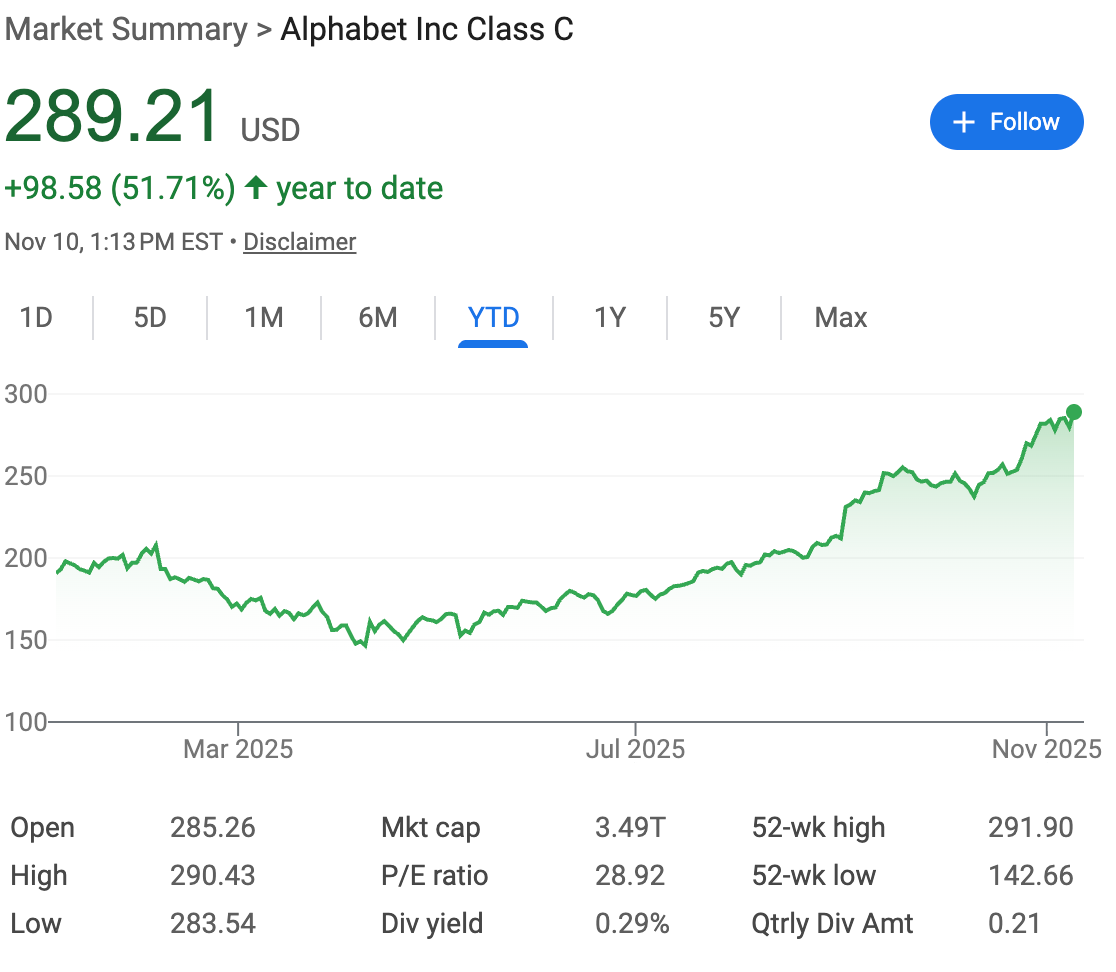
But, I think we owe Sundar an apology. Because today, Google is moving with the clarity and coordination of a company that spent years laying deep foundations - and is finally building on them at speed. The announcements are landing weekly. And the stack they’ve assembled - from custom silicon to frontier models to real product distribution - looks less like a late start and more like a head start no one noticed.
This isn’t a turnaround story. Google never really dropped the ball. We just mistook silence for stagnation and sentiment turned sour. They’re still not great at narrative (and could stand to hire someone who is), but that’s survivable. When your products start speaking for themselves, narrative inevitably catches up.
Let’s go down the stack:
(1) Hardware:
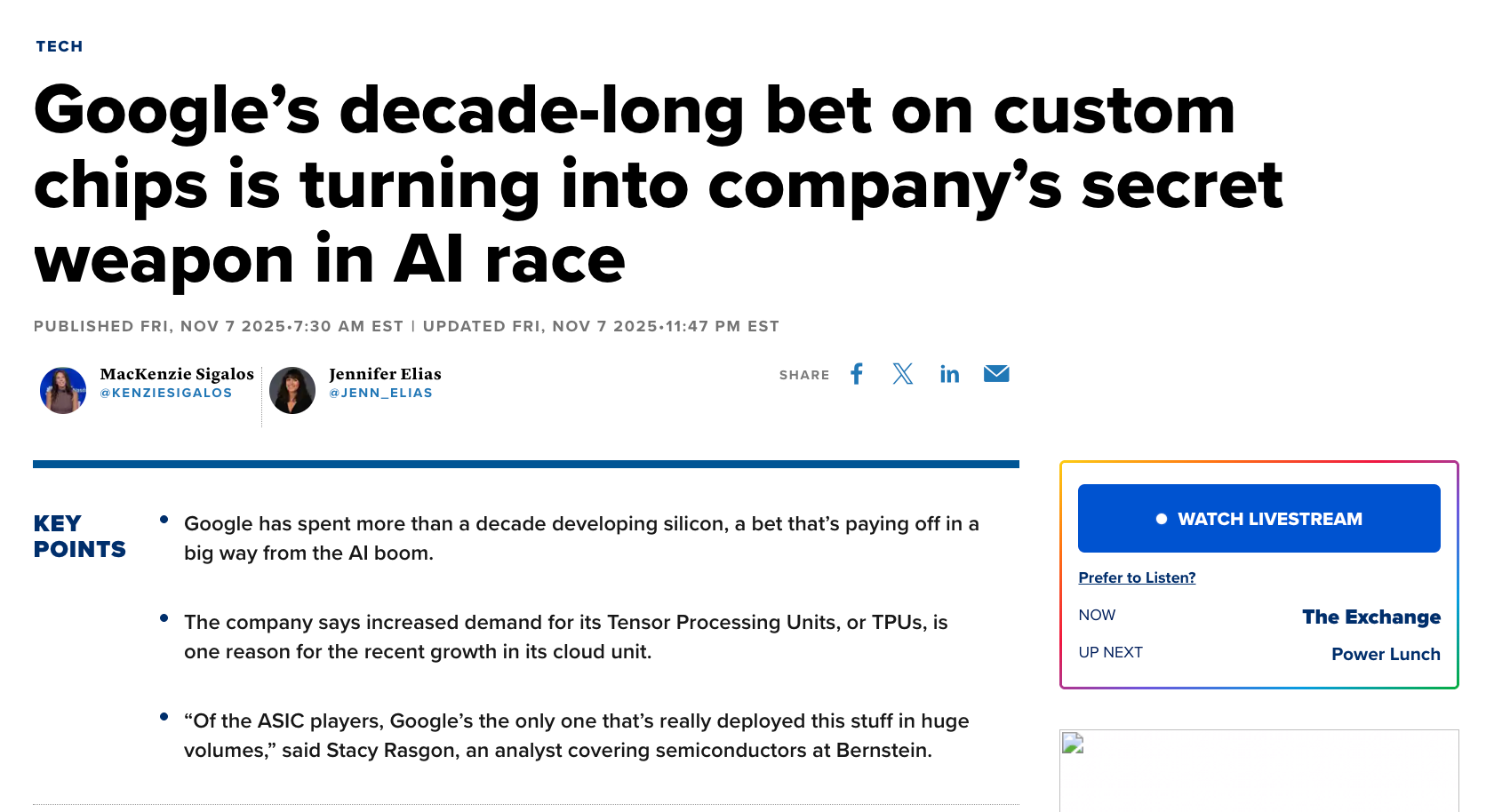
At the base of the stack sits Ironwood, Google’s 7th-gen TPU - a chip so powerful it practically hums with intent. Four times faster than Trillium, Ironwood links up to 9,216 TPUs in a single pod - engineered not just for training, but for inference at planetary scale.
For the first time, Google isn’t keeping its crown jewels locked away.
Ironwood will be sold externally, with Anthropic buying roughly a million chips to power Claude and smaller cloud partners being seeded through new distribution deals. This marks a new era: Google as both hyperscaler and hardware merchant, now competing directly with Nvidia.
(2) Models:
Google’s model portfolio has gone from steady to scorching. Across modalities - image, video, text, and reasoning - they’re setting or matching state-of-the-art benchmarks.
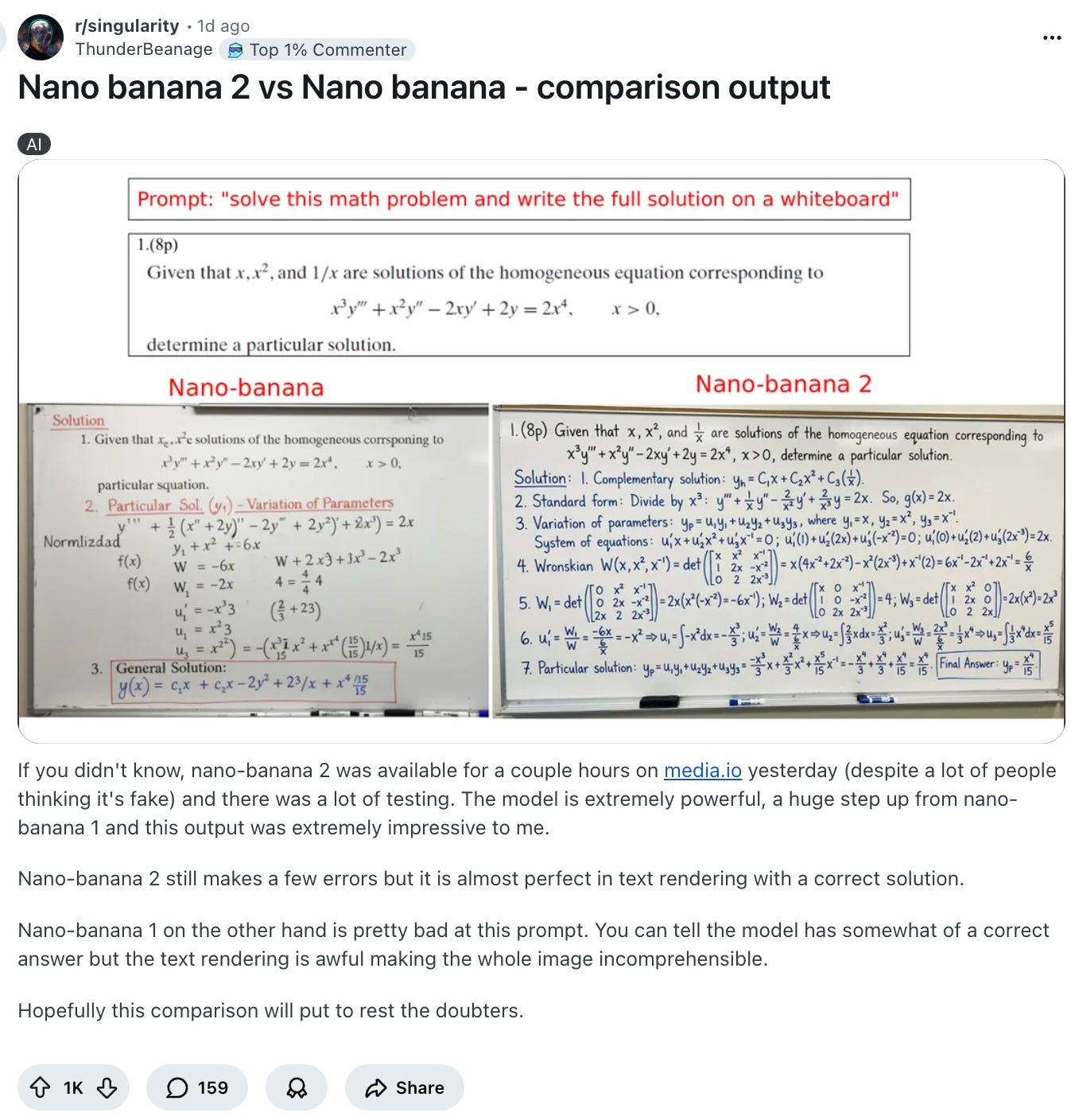
The NanoBanana series has become a cultural phenomenon: its first release set the bar so high that OpenAI’s Sora 2, which followed, couldn’t clear it.
And when NanoBanana 2 briefly leaked on Media.io this weekend, its outputs went viral - sharper, richer, more controllable - and instantly ignited public enthusiasm for the official launch.
Meanwhile, anticipation for Gemini 3 is peaking, with a release expected within weeks. Rumors that Apple is negotiating a $1B-per-year deal to use a custom version of Gemini for Apple Intelligence shows how far Google’s model ecosystem has come.
(3) Product: Google’s brilliance is finally visible where it matters most: in the hands of billions.
Search has evolved from static results to dynamic AI Overviews, now reaching 2 billion users and 75 million daily active users in AI Mode. What once looked like an existential threat now feels like a differentiated moat.
Gemini Deep Research can now draw on context from your Gmail, Drive and Chat and work it directly into your research.
Chrome has become an AI-native browser: context-aware writing tools, translation that feels telepathic, and visual search baked into the frame itself.
Google Maps has leveled up too - its immersive view blends live data, generative modeling, and predictive routing in a way that feels less like navigation and more like simulation.
Google isn’t sprinkling AI on top of products - it’s rebuilding them around it.
(4) Moonshots:
Beyond consumer-facing AI, Google’s moonshot engine is in overdrive:
Project Suncatcher aims to launch solar-powered data centers into orbit, bypassing terrestrial energy constraints to power inference at astronomical scale.
AlphaFold 3 is unlocking entirely new approaches to drug design.
GraphCast continues to outperform traditional weather models.
The Quantum team has demonstrated quantum advantage and is methodically building toward fault-tolerant quantum systems - the real finish line.
These aren’t tangents - they’re the long bets that keep Google’s core engine compounding. The company’s superpower has always been time: the ability to fund science until it turns into product. Multiple Nobel laureates on payroll doesn’t hurt either.
This is no longer a story about whether Google can ship. It’s about how many fronts it’s shipping on simultaneously.
So yes - sorry, Sundar. We weren’t familiar with your game. Turns out, it’s long-term, vertically integrated, and increasingly hard to beat.