
Last week, Microsoft reported a quarter most companies would frame and hang on the wall:
~$240B revenue base growing 15–17% YoY
Operating margins expanded ~160 bps to 47%
EPS up 21% constant currency
Commercial RPO up 110% YoY
Azure growth beat guidance, M365 Copilot adoption accelerated, and margins beat consensus. Yet the stock sold off.
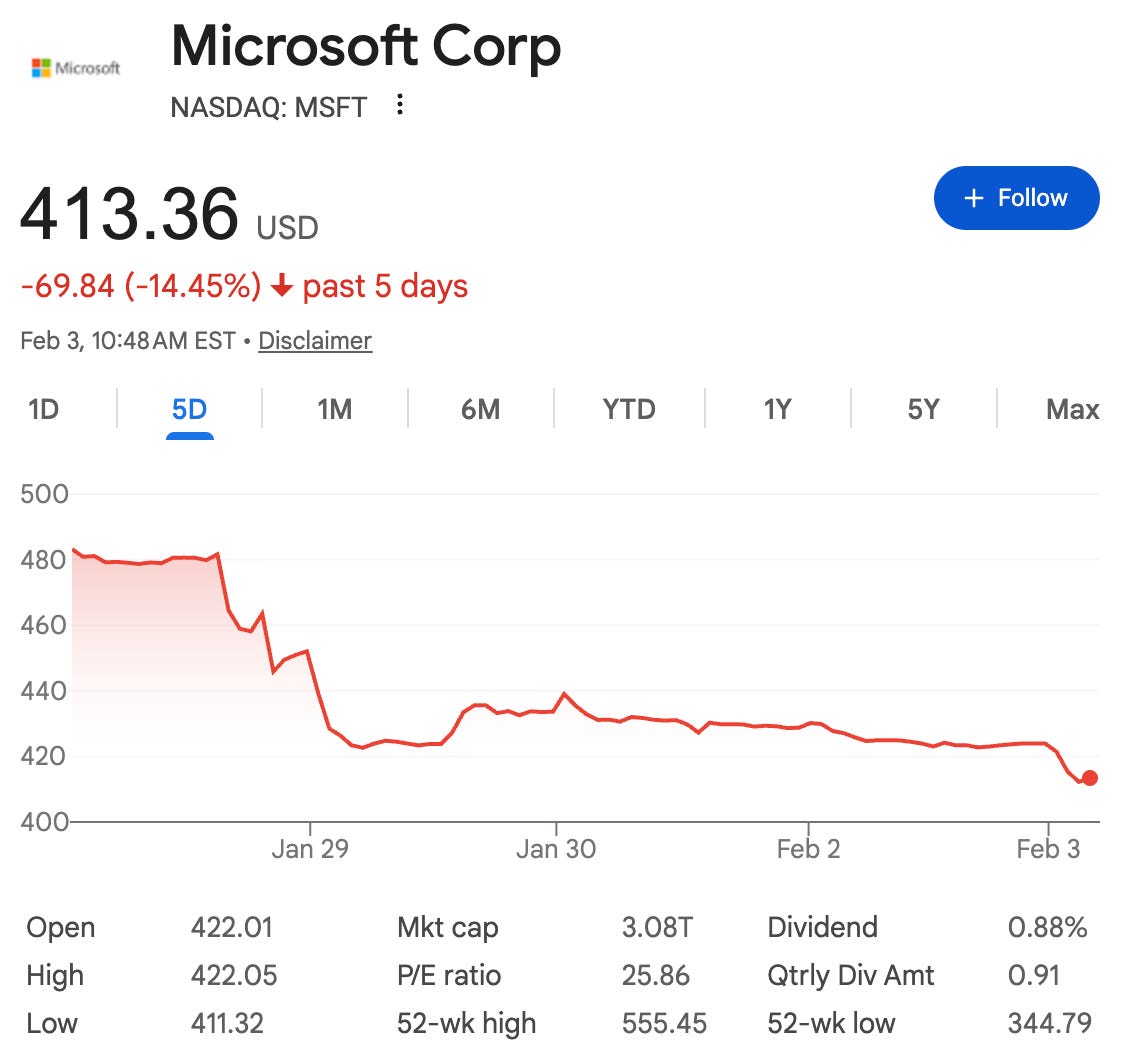
The reaction says far more about the market’s time horizon than Microsoft’s fundamentals. The market is trading the quarter while Microsoft builds the decade. Here’s my take on what’s going on:
The market is anchoring to a single KPI: Azure % growth
Investors came in expecting
(1) Azure to beat guidance by 2–3 pts and
(2) a clean mapping from AI CapEx → Azure revenue acceleration.
Instead they only got a 1pt beat as Azure grew at 38% YoY. Good by any historical standard, but disappointing relative to a narrative priced for acceleration.
But the thing is, Azure didn’t underperform - it was rationed. Management was explicit: capex is outrunning Azure revenue by design. In a supply-constrained environment, GPUs are being allocated deliberately:First to first-party AI products (M365 Copilot, GitHub Copilot, Security, Dragon)
Second to internal R&D
Only then to third-party Azure workloads
If every incremental GPU had been pointed at Azure, the growth number would have printed higher. But Microsoft is not optimizing for a single segment KPI - it is optimizing for portfolio lifetime value.
Investors are misreading CapEx as margin destruction, not value creation The second source of market anxiety is CapEx. Microsoft spent ~$37.5B this quarter, with roughly two-thirds in short-lived assets (GPUs and CPUs). The knee-jerk takeaway is familiar: capex is exploding faster than revenue, so where is the ROI? The reality that management shared:
The majority of AI infrastructure is already contracted for its useful life
Margins improve over time as utilization rises
CapEx is being allocated to products with structurally higher gross margins than Azure
This is pre-sold multi-year monetization, not speculative spend. It’s just not monetized in the segment Wall Street is obsessing over.
The market is underweighting the application layer, where Microsoft has a right to win
The most underappreciated data point in the quarter lives above the infrastructure layer. Microsoft now has ~15m paid M365 Copilot seats against a 450m M365 user base. DAUs are up 10× YoY. Large enterprise deployments are accelerating, with seat counts moving from the tens of thousands into the high five figures. Copilot is increasingly positioned as the primary ARPU lever.
These products are early in their penetration curve. Looking only at topline misses the shift underway. Copilot will reshape the revenue mix before it visibly reshapes the growth rate. It lifts ARPU, embeds switching costs, and positions Microsoft as the default AI interface for enterprise work.
Competition is real, but incumbency still counts in enterprise
Microsoft will no doubt face fierce competition in enterprise from Anthropic, much like Google did in consumer from OpenAI, but you cannot rule out the incumbent when
The first rule of enterprise buying is inertia
Microsoft controls identity, data, security, and workflow
And a leader like Nadella is running the show
The Information reports that internal Microsoft teams are already building Claude-style coworker agents using a mix of OpenAI and Anthropic models. Nadella himself is reportedly testing Openclaw. This is not a company standing still or betting on a single horse.
OpenAI narrative risk ≠ Microsoft fundamental risk
Ironically, the OpenAI relationship that once looked like Microsoft’s greatest advantage is now being reframed as a risk as sentiment around OpenAI cools.
That framing overstates the downside. The AI race is long and the laps are short. At any point, we are about one model drop or product launch away from turning ‘its so over’ into ‘we’re so back’. Even setting that aside, Microsoft is increasingly model-agnostic, with relationships across providers. And OpenAI still has the capital, demand, and incentive to make good on its Azure commitments. This is not a fragile dependency.
If Azure demand were genuinely rolling over, it would show up in bookings and backlog, but leading indicators are at record highs.
Microsoft is making a conscious set of tradeoffs:
Don’t maximize Azure growth at the expense of first-party AI
Don’t chase quarterly upside in a supply-constrained world
Do build the highest LTV AI portfolio across infrastructure + apps
The market is penalizing Microsoft for doing the right long-term thing. It is being traded like a single-metric cloud stock in a quarter-to-quarter momentum market while it is actually executing a multi-layer AI platform transition with exceptional financial discipline.
That’s the cost of patience.
Disclosure: These are my personal views, not investment advice. For transparency, my husband works at LinkedIn, which is part of Microsoft.