Recently I shared a Macquarie estimate on X that captures the scale difference in U.S.–China AI power capacity planning:
Current forecasts through 2030 suggest that China will only need AI-related power equal to 1–5% of the power it added over the past five years, while for the U.S. that figure is 50–70%.
In other words, China has added at least twenty times the power its AI sector is expected to require in the next five years; the U.S., by contrast, will need to expand at a dramatically steeper slope.
This aligns with a point I made back in August—which unexpectedly went viral—that China has effectively “solved” the domestic AI power problem, at least for the near term. And the broader industry conversation has only moved further in that direction. As Microsoft CEO Satya Nadella and others have noted, the real bottleneck for AI is increasingly electricity and energized data center capacity, not the number of GPUs a company has on order.
Still, the underlying story is more nuanced than any single chart or quote suggests. The piece below—translated from our friends at Weijin Research—offers a useful, grounded look at how the U.S. and China are encountering very different power constraints as AI scales.
I’m keeping their article intact below. For those who want the key points, here is the summary.
The power gap is material: in 2023 the U.S. added about 51 GW of new capacity, while China added 429 GW—more than eight times as much.
China already produces over 9,000 TWh of electricity annually, more than double U.S. generation. For large-scale AI, physical power availability is becoming the primary constraint.
China’s immediate challenge is not lack of power, but how efficiently that power converts into usable compute.
Huawei’s current systems can perhaps match Nvidia on raw FLOPs, but independent analyses suggest they consume well over 100% more energy per unit compute to get there.
In a simplified scenario comparing Huawei’s CloudMatrix to Nvidia’s GB200, the lower energy efficiency more than offsets China’s cheaper electricity. Under those assumptions, China’s per-FLOP electricity cost ends up around 140% of the U.S.
What the Weijin analysis makes clear is that beneath the AI narrative, a much larger industrial story is unfolding. Power availability, grid design, and energy-to-compute efficiency are becoming core determinants of national capabilities. As intelligence scales, these physical foundations increasingly shape what is possible.
And it is precisely because of this shift that I’m genuinely excited that we’re curating more investor and executive trips to China around new energy next year. Over the years we’ve done deep dives on EVs, robotics, AI, and the consumer internet, but the upcoming program in January 2026 is our first that devotes all five days entirely to the energy system itself. Chinese companies sense this as well—they are moving fast to export their technologies across the full stack.
With that context, here is the full Weijin Research piece in translation.
Published November 5, 2025
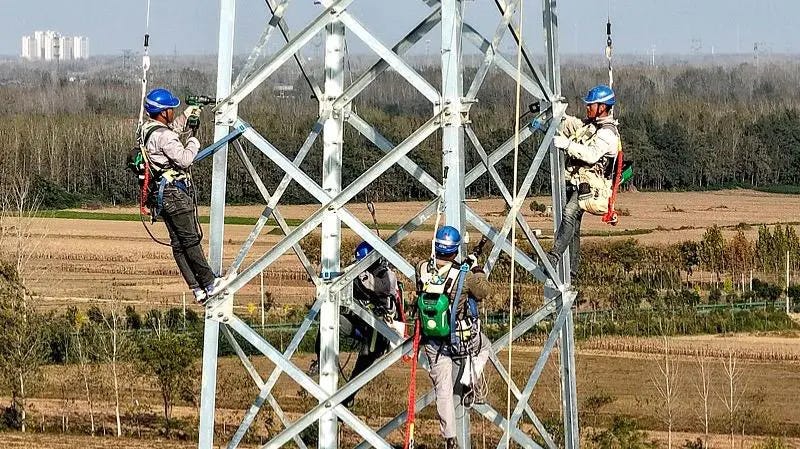
China and the United States both need massive amounts of electricity to realize the promise of token economics. But the underlying problems they face are very different.
In the U.S., the bottleneck is simply a lack of power. Electricity generation and grid infrastructure lag behind demand, so the scale of token output is capped by the scale of available power.
In China, the bottleneck is the opposite: converting electricity into compute. The relative inefficiency of domestic hardware pushes up the per-token cost.
In an interview last week, Microsoft CEO Satya Nadella said that instead of saying “we’re short on GPUs,” it is now more accurate to say “we’re short on power.” The speed at which electricity and nearby data centers can be built directly limits both token production and monetization. If the power is not in place — if the buildings are not energized and ready (“warm shells”) — it does not matter how many GPUs you have. They will just sit idle.
The new wave of AI infrastructure investment among U.S. tech giants has essentially turned into a power race. Mark Zuckerberg has said that if Meta could secure more energy, it could build clusters far larger than what it has today. That power might come from the public grid, behind-the-meter self-generation, or a mix of both. None of these paths are easy. And the rise of large-scale ChatGPT agents is creating compute monsters requiring millions of GPUs. U.S. data centers are steadily moving from the 1-gigawatt era toward 10-gigawatt scale. Crusoe, for example, claims its Wyoming data center under construction has an initial target of 1.8 GW and a long-term target of 10 GW.
At present, no tech giant’s off-grid self-generated power has reached even the 1-GW level. Building that kind of capacity requires large natural gas pipelines, supporting infrastructure, and turbine deployments. And even if most of the power still comes from the public grid, scaling grid capacity fast enough is extremely difficult.
Research firm EpochAI notes that because the market periodically worries about an AI bubble — and utilities worry that demand may suddenly evaporate — U.S. utility companies are reluctant to sign very large power purchase agreements or to commit capital to major transmission upgrades. And, as Sam Altman noted last week, big consumers of power also hesitate to sign long-term power contracts because “if extremely cheap energy comes online suddenly, you can get trapped by your own long-term deals.”
Another issue: as data center loads grow, they stress the aging U.S. grid. John Ketchum, CEO of NextEra, the largest utility company in the U.S., said that meeting a 1-GW load is manageable, but 5 GW requires “a lot of work,” and 10 GW is even more challenging. Even the highest-capacity 765-kV double-circuit transmission corridors in the U.S. can only carry about 6–7 GW over long distances.
Tech giants have repeatedly appealed to the White House for supportive industrial policy. In its response to the White House’s AI Action Plan request for comments, Google’s first recommendation was that the main infrastructure issue is the power system. Google is effectively saying that future innovation must shift urgently from the chip layer to the grid layer. The White House later incorporated this idea, writing into its “Building America’s AI Infrastructure” section that the U.S. must “develop a grid that keeps pace with the speed of AI innovation,” including exploring new ways to maximize existing capacity, prioritizing reliable dispatchable power, and embracing cutting-edge new energy sources.
Last week, OpenAI again urged the White House that if the U.S. wants to compete with China in AI, it must add 100 GW of new power capacity every year. Last year, the U.S. added 51 GW, while China added 429 GW — a massive “power gap.”
China, for its part, generates more than twice as much electricity as the U.S. and has a far more robust grid. But China’s AI infrastructure has its own “power problem.” It relies heavily on domestic chips, which still lag in energy efficiency. As multimodal models and agentic workflows proliferate, Chinese tech giants will inevitably hit compute demand in the millions-of-GPUs range as well. Any hardware inefficiency will scale painfully. ByteDance’s daily token calls, for example, doubled from 16.4 trillion in May to 30 trillion in September.
In token economics, token cost is a critical factor. For market-driven internet giants, token cost is AI infrastructure competition: software and tools on top of hardware, the hardware itself, and of course the electricity and cooling systems needed to run all of it.
Long term, China — constrained by limited access to top chips — is pursuing national-level breakthroughs in chips and compute efficiency. One of the country’s major strategic goals is to maintain a healthy, competitive domestic compute ecosystem.
On the industry side, companies like DeepSeek are pushing chipmakers toward tighter hardware–software co-design.
On the capital side, A-shares are speeding up IPOs for Moore Threads and Muxi, with Biren, Lisuan, and Enflame also progressing.
On the policy side, the government is encouraging data centers — especially those run by central SOEs and government agencies — to adopt domestic chips.
This means that if Chinese internet giants choose domestic chips for long-term strategic reasons, they must bear the short-term cost of lower energy efficiency. In China, a mainstream cloud vendor’s annual electricity bill for a 1-GW data center is roughly 8–9 billion RMB.
Earlier this year, Huawei’s CloudMatrix 384 was seen as a classic example of “trading electricity for compute.” Compared with Nvidia’s then-new GB200 NVL72, CloudMatrix delivered about 1.7× the total compute but with 3.9× the energy consumption. Looking only at energy per unit of compute (ignoring memory and bandwidth), the GB200 NVL72 operates at about 0.81 pJ/FLOP, while CloudMatrix runs at ~1.87 pJ/FLOP — meaning CloudMatrix consumes 130% more electricity per FLOP.
Later in the year, Huawei showcased new Ascend AI chips and the more powerful Atlas 950 and 960 SuperPoDs, which surpass Nvidia systems in card count, total compute, memory size, and interconnect bandwidth. But Huawei did not disclose energy efficiency numbers, and given China’s lag in advanced semiconductor process nodes, the per-FLOP efficiency gap is unlikely to close soon.
Still, subsidies and industrial policy can be used to support the domestic ecosystem. Provinces like Gansu, Guizhou, and Inner Mongolia have industrial power rates about 30% lower than China’s coastal regions. With subsidies for domestic-chip data centers in national compute hubs, electricity prices have already dropped below 0.4 RMB/kWh (≈5.6 cents/kWh). By comparison, U.S. industrial electricity averages about 9.1 cents/kWh.
This means that even with lower hardware efficiency, China’s AI ecosystem currently spends about 140% more electricity per FLOP than the U.S. — even before factoring in the extra cooling needed for inefficient chips.
But once China and the U.S. expand their AI competition globally, subsidies alone will not sustain an advantage. China will have to rely more heavily on improvements in model efficiency, chip efficiency, and the synergy between its rapidly expanding renewable energy and storage capacity exports.