When I got my utility bill a couple months ago, I was shocked to find it’d nearly doubled compared to the prior month. How was that possible? The weather was mild the first half of the month, so we didn’t use our AC/heating units. I do have some housemates, but most of us were traveling and weren’t home. This was the highest utility bill I’d ever seen.
I’d previously been a data scientist, so like any half-decent one my initial instinct was to bury my face in my hands and ask “where’s the fucking data for this?” to nobody in particular. It was a peculiar situation because our landlord was the one on the utility account, not us, so I couldn’t immediately log in to see what was going on.
To get to the bottom of this, I called up my utility provider to have the account transferred from my landlord to myself. I was hoping to track my energy use in real-time and get notified if my usage was abnormally high, particularly if it coincided with high energy prices. But as I Googled around, I became skeptical my utility would provide access to real-time usage information. What I wanted to do was pretty simple, but it didn’t seem like the utility made it very easy to do.
Utilities operate at a glacial pace, so getting the account transfer squared away was taking longer than I had patience for. While I waited, I found myself wondering about why utilities are the way they are.
For example, utilities vary by geography and have funny names. Why do they resemble mafia fiefdoms? When I lived in the Bay Area, it was PG&E. Now I live in New York where it’s ConEd. I’m embarrassed to admit I didn’t realize until recently that “ConEd” is a portmanteau of “Consolidated Edison.” I thought they were just being upfront about sometimes conning people.
Unless there’s a severe grid blackout (like the one that happened in Texas a couple years ago), I don’t know if the average American pays much attention to their utility provider. Do most people understand how the utility sets prices? They send you a bill, it seems reasonable (or not), you pay it, you move on with your life. It’s only when things go wrong that we begin to appreciate the grid’s brittleness.
To pass the time while I was on hold on the phone with ConEd’s customer support, I picked up The Grid by Gretchen Bakke. Never did I think “engrossing” is how I’d describe a book about our electrical grid, but I had a tough time putting it down.
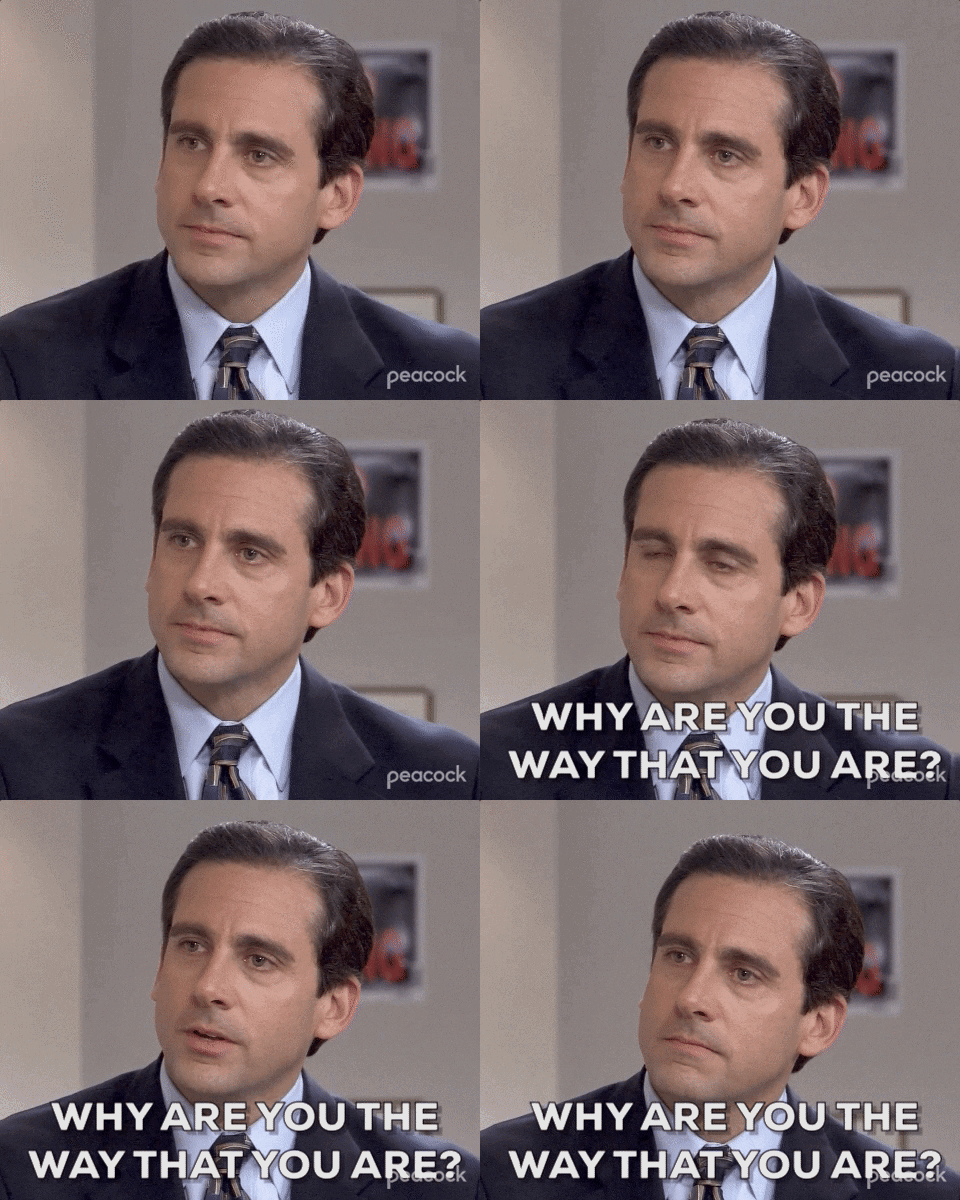
I’ll try to answer “why are you the way that you are” about the utilities and our grid in three parts:
Why the utilities are government-protected monopolies
What contributes to the grid’s fragility
What a more resilient grid might look like
We take it for granted, but for a while it wasn’t clear what electricity could be useful for. Despite being able to “produce electricity…since Michael Faraday’s experiments in the 1830s,”1 it wasn’t until 1870 that people realized it could be used for lighting. And it took until the 1940s to lay the groundwork for household appliances to go mainstream. Makes you wonder which innovations without a strong use case today will in hindsight look obvious.
But not only was it unclear what electricity might be good for, it was also unclear why it'd be used beyond a small group of people. Bakke writes2:
In the early days of electrification…this sense of power as a common good was not how electricity was made or marketed. It was by definition an elite product, not for everybody but for those who could afford it. This was not simply because electricity hadn’t yet spread to the masses, but because the masses were not considered a market worth reaching until later in our nation’s history.
Mass electrification was partly born out of necessity — utility entrepreneurs needed to find new ways to make money from electricity, and that required reimagining the entire population as a potential market. "Not elite light, but popular light, popular heat, popular power."3
Part of the challenge was the grid’s deep fragmentation. Even with widespread adoption of alternating current in the late 19th century,4 grids across the nation resembled “tiny islands of networked power in a vast sea of flickering candle and gas lamps.” In 1907, only 30% of the nation's power was generated from city- or government-owned power companies.5 The remainder came from private plants — think transit companies using their own generating plant to supply electricity to their fleet of streetcars.
So how did we get from flickering candles and fragmented power to the grid we have today? We can thank Samuel Insull — Edison’s former personal secretary and a very savvy businessman in his own right. After Edison retired to his home in New Jersey, Insull stepped up to take the top job at Chicago Edison.
Insull wanted to emulate in electricity the monopolies built by Rockefeller and J.P. Morgan, but he was clever enough to recognize that electricity is different from gas and steel in critical ways — something even Edison had missed6:
Since [electricity] can’t be stored it can’t be stockpiled; since it is indivisible, it is difficult to count and accurately bill for; since it is lethal, it requires a highly trained workforce to manage; and since it is utterly inseparable from the infrastructure that carries it, one has to bear the cost of building and maintaining that infrastructure…It had to be produced, sold, delivered, and used all at once, which meant that the plant supplying it needed the capacity to deliver the total maximum load demanded by customers at any given moment.
Electricity’s very nature lent itself to monopolization, and Insull was sharp enough to exploit it. But first, he needed to iron out a couple things: (1) how to create demand for electricity at all hours of the day (like when people left work and went home to light candles and turn on gas flames), and (2) how to get people to buy power from him specifically and not generate it themselves7:
What Insull wanted and strove to build was an infrastructure the inverse of what he was saddled with upon his arrival in the Midwest. Instead of many little generating stations, with many different owners, running intermittently, he wanted one that he owned and which ran all the time…He needed streetcar companies to buy from him at dusk and dawn, residential customers for the late evenings and early nights, municipal streetlights for nighttime, businesses for late afternoons and early evenings, and most important of all, industry for midday. He wanted to make a lot more power, make it round the clock, and sell it all — every last watt.
How to convince all these different customer segments — people with different needs, interests, and uses for electricity — to buy from him? Insull did something simple: he just radically lowered the price of electricity. He started by halving the price of electricity and each subsequent year, he would drop the price by 1¢/kilowatt-hour. For factories and industrial customers especially, it would’ve been dumb not to make the switch to grid electricity. It was way cheaper to buy from Insull compared to the cost of generating and maintaining their own private plant. Not surprisingly, the customers served by Chicago Edison exploded.
But how did this work financially in Insull’s favor? You can’t just slash your prices without your cost structures taking a hit.
Except for Insull, his unit economics actually improved from slashing prices. It cost him the same amount to run his power plants at full capacity 5% of the time as it would to run at full capacity 95% of the time.8 In other words, his costs stayed the same regardless of how much electricity he sold.
Insull’s business was so lucrative that utilities around the nation rushed to take a page out of his book. It was a literal land and expand: smaller utility companies consolidated into big ones and mid-sized utility companies expanded their geographical reach. From this, the modern map of regionally monopolized utility companies was born.
Utility providers around the country emulated Insull in another critical way. To avoid being broken up by anti-trust regulation, Insull cut a deal with the government: Chicago Edison would agree to be heavily regulated in exchange for two things: (1) long-term, low-interest construction loans and (2) protection from competition — the government would give the utility “a guaranteed service area, within which no other electric utility would be issued a charter to function.”9
Utilities are an odd kind of monopoly. Unlike the Rockefeller/J.P. Morgan variety, utilities were content (perhaps begrudgingly so) to carve out their turf and stay inside it. In this respect, “utilities bore a resemblance to modern-day street gangs…One simply doesn’t offer one’s product in territory claimed by someone else.”10 I wasn’t kidding earlier when I compared utilities to mafia fiefdoms.
Today the grid is still dominated by localized monopolies, but its defining characteristic is its fragility, not its bigness.
For instance, trees are the biggest threat to our nation’s grid infrastructure. Inclement weather can cause trees to fall in ways that impact power lines, and that can cause power outages. It’s also how fires can start.
But despite knowing how the elements can impact the grid, utilities have intentionally scaled back on foliage maintenance to cut costs (and expand executive pay).11 Seemingly trivial measures like adjusting tree trimming schedules from every three years to every five years and lobbying to shorten the clearance between treetops and power lines have been played a role in causing wildfires.12
Why the penny pinching? It's one of the few things utilities can still control. Revenues have waned in the last few decades, largely due to legislation from the early aughts that separated electricity generation from transmission.13 Before, utilities would both generate and transmit electricity. But now they're out of the generation side almost completely. Privately owned plants have proliferated the grid, many of which are renewable sources of electricity generation, like wind, solar, and hydro. This has left the utilities to make money from just the distribution and metering of electricity.14
That’s tough for the utility’s bottom line, and it doesn’t help that our grid wasn’t designed to support generation from intermittent sources like wind, solar, and hydro. Prior to wind and solar, utility men would get together and estimate just the right amount of electricity to match the demand for electricity, and this generally went without hiccups15.
Not true anymore. The grid is unwieldy, difficult to manage, and tough to model in real-time. Nothing prepared the utility men of yesteryear “for a means of power generation that not only varies from minute-to-minute, but which they do not own, cannot control and have no plan for.”16:
Power plants that make electricity out of unpredictable fuel sources like the wind, sun or waves — is a problem. It doesn’t matter which end of the system escapes control. It can be us, using too much power all of a sudden (like when we all come home after a long day’s work and simultaneously turn up our air-conditioning just as the wind slackens), or it can be cloud cover, stripping the generative capacity from solar panels. Regardless, the utilities and other balancing authorities have to act very quickly to set things right again. Otherwise there just isn’t enough power on the lines to keep the lights on. Lots of blackouts start this way.17
Since we don’t have viable grid-scale electricity storage, we still rely on (largely coal) power plants when the wind stops blowing — many of which are dirty, were state-of-the-art decades ago, should’ve long been decommissioned, and are usually sitting idle. That's not cheap:18
To run these otherwise hibernating electricity factories the utilities need to make sure there’s enough fuel sitting around ready to combust…They need enough trained staff on call and ready to go to fire it up and keep it running, and they need to ensure that it is in good working order despite sitting idle most of the time. This is massively expensive for them, and it is a simple and constant drain on their bottom line.
So what does this have to do with tree trimming? Well, the other place utilities still have full control (besides tree trimming) is us. This is why smart meters were introduced. The utilities needed a way to limit usage during peak demand, like when everyone’s blasting their ACs on a hot summer day. That’s why nearly 75% of American households have a smart meter installed. It’s the main way utilities have combated declining revenues. And it's how utilities avoid disaster on those few days a year when usage is high, unpredictable, and a blackout is likely19 :
‘Balancing’ load is for the most part a dull and nondramatic business. People use a little more electricity; the utilities produce a little more electricity. Demand is usually within limits the utility can meet. In fact, 98% of the time this is the case. The problem is that 10% of the utilities resources are devoted to the other 2% of the time. The few days a year that are causing all the problems are the reason utilities like Xcel, CenterPoint, PG&E, and ConEd are paying so much money to wire up their service districts with smart meters. These are the days when demand is neither modest nor predictable.
The smart meter passes the utility's costs — like firing up those old and dirty power plants — on to us. It shows up in how energy is priced differently based on the time-of-day.20 Passing the cost to us in this way lets them transform “peak demand from a moment of crisis...for the grid, into a moment of peak revenue.”21 It allows the utility “charge us a lot more money for electricity that is more expensive for them to make” and “recoup expenditures forced upon them by our proclivity to engage in the same power-hungry behaviors at the same time.”22
And that right there is the main problem: the issue is when we make peak demand, not how much demand we generate. Remember Insull's key insight: it costs the same to run the plants at full capacity for a few hours vs. running at full capacity 24/7. The utility would rather we use electricity consistently at all hours instead of firing up extra plants to match peak demand at 5 P.M only to have us use no electricity from midnight to 6 A.M.23
So how do we chart a cheaper and more resilient path? We might take inspiration from those who’ve moved to the edges of the grid.
We’ll never run out of cute names for hurricanes but we will run out of power when they hit.
Natural disasters have crushed our infrastructure and left millions without power, sometimes for up to a week. Whether Hurricane Sandy, the Great Gale of 2007, or the winter storm that blitzed Texas in 2021, there will be a next one. So it’s no wonder that small pockets of the country have taken resiliency into their own hands — it’s a fool-me-once kind of situation.
A resilient grid means bouncing back even after getting punched in the mouth. Unfortunately, that’s not how our grid was designed. It’s an engineering marvel and perhaps the most complex machine we’ve ever created, but that complexity has a huge cost. So how do we inject resiliency into the grid?
Instead of one giant grid (like what we have), we can create a network of smaller, self-contained, little grids called “microgrids.”
Microgrids use distributed energy resources like solar panels, electric vehicles, local battery storage, natural gas generators, smart thermostats, smart(er) meters, and even induction stoves, all working in concert with one another. It adds resiliency because it has many ways of making power, and it can run autonomously from the big grid24:
[Microgrids] are designed to remain connected to the big grid most of the time. It is only in moments of duress that they disconnect and run on their own. The rest of the time, their flexibly produced electricity is available to all the grid’s customers, and their load can be counted upon for balancing the big grid’s production with consumption.
It’s not a pipe dream. Microgrids are what allowed SUNY Stony Brook, the South Oaks Hospital in Long Island, NY, and NYU to all stay up and running during Hurricane Sandy. Tech companies and the military have been using them for years. Your home could be a microgrid by using rooftop solar to draw energy during the day, then using energy from a battery storage in the evening when energy prices are higher. The grid of the future might mirror the “islands of networked power” from Edison’s time25 (we can even keep the flickering candles, we’ll just trade gas stoves for…never mind).
When it comes to solar, Hawaii’s a great example. Hawaii's utility supplied electricity is really expensive because it's generated from oil “floated over on tankers from the mainland.”26 Because of that, Hawaii “has the second-highest penetration of rooftop solar in the country.” It's resulted in a “home-owned rooftop solar system [that] will pay for itself in just about four years.”27
It helps that price of both solar and batteries have plummeted and are cheaper than ever. Still, most people probably won’t pony up for a giant battery storage for their home. This is part of why it's important we hit a tipping point for electric vehicle adoption: they're just giant batteries on wheels. Unlike backup coal plants (and normal cars) that sit idle most of the time, electric vehicles use their battery to give and take energy from the grid when plugged in. This helps smooth bumps in peak demand28:
The mass adoption of electric vehicles would thus help to provide a significant nighttime load that could be discharged during daytime hours when these vehicles are sitting in parking lots. In addition to helping establish nighttime load, peak shaving, and helping control jitter — those tiny second-to-second shifts in quantity and quality of electricity on the grid — the widespread deployment of car batteries would allow us to integrate as many renewables as we wanted: the cars would hold the excess energy these systems make until it was needed, at which point the grid would automatically suck that power back out.
For all that to work, we need more from our smart meters. A smarter meter would use real-time data to “respond to the ebb and flow of power on the grid with a degree of timeliness and nuance that a human simply cannot match.”29 Sometimes you don’t need to disconnect from the big grid, you just need your smart meter to better manage your energy use. This already exists in some form — the issue is with navigating fragmentation:30
The problem is getting all the necessary components into the mainstream (the cars most notably are still lacking, but smart appliances would make a big difference too), getting them all to speak the same language, and figuring out how to move through the regulatory regimes and ownership blockades still in place from the twentieth century’s far more proprietary and centralized grid.
If the future is one where we can disconnect from the grid on demand, where does the utility fit in? It remains to be seen. It's possible that if higher energy costs compel some of us toward the grid edge, then energy prices will go a little higher, and that'll motivate more people to defect from the grid. This is called “the utility death spiral”:31
As grid maintenance costs go up and the capital cost of renewable energy moves down, more customers will be encouraged to leave the grid. In turn, that pushes grid costs even higher for the remaining customers, who then have even more incentive to become self-sufficient.
It’s a tough balancing act. Utilities don't know how to embrace new technology without killing themselves. This might have something to do with why I feel like I should be getting more out of my smart meter than what the utility allows.
Speaking of the utility death spiral, did I mention I’m still on hold with ConEd? I’m serious. I’m on hold with ConEd’s customer support right now, as I write this, still waiting to complete the transfer of my utility account from my landlord. Should be any minute now.