 MABEL
SOMEWHERE ON EARTH
v1.0 platform release
Open hardware · open software
Made open, made repeatable.
Mobile Bimanual Robot · Open Platform
Designed for home automation.
56 functional DOF. Two 17-DOF hands, a holonomic base, and an $8,056 parts subtotal. Open hardware and software.
1. Abstract
As robot learning moves beyond the tabletop, many tasks require mobility, adjustable reach, active perception, and bimanual dexterity. Commercial platforms combining these capabilities are costly, while affordable open-source alternatives cover only a subset and require software integration. We present MABEL, an open-source anthropomorphic mobile bimanual robot with 56 degrees of freedom (DOF) and a US$8.1k parts cost. It combines two 7-DOF arms with 17-DOF hands, a pitching torso, a lift, a 3-DOF head, and a holonomic base. Back-drivable arms and torso support compliant interaction, with fingertip reach from floor level to 2.23 m. The head and torso roughly triple modeled camera coverage relative to a torso-fixed camera. Apple Vision Pro head and hand tracking enables whole-body teleoperation without handheld controllers, with 137 ms mean glass-to-glass stereo video latency over the robot's Wi-Fi hotspot. We demonstrate an end-to-end imitation learning pipeline, from teleoperated data collection to policy deployment, using a shared command interface and whole-body controller.
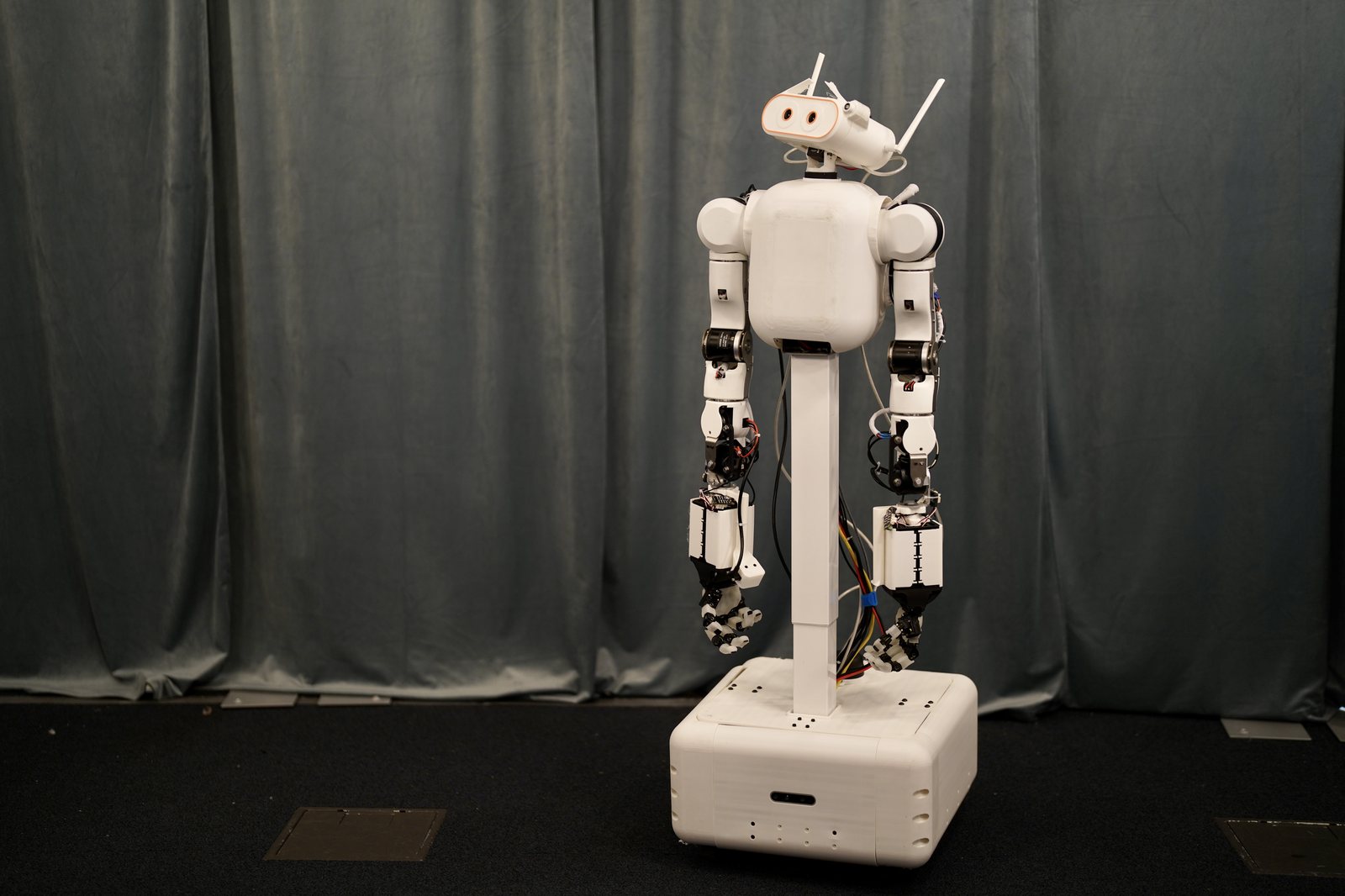
Open-source hardware
Two 7-DOF arms, a pitching torso, a 0.635 m lift, a 3-DOF head and a holonomic base. The paper reports an $8,056 parts subtotal for the essential build. Module drawings, assembly steps and the bill of materials are available in the build guide.
Explore the hardware →Whole-body teleoperation
Head and hand tracking drive the neck, torso and arms without handheld controllers. Local and global modes provide different mappings for the base and lift. Mean stereo video latency is 137 ms over the robot’s hotspot.
See teleoperation →Shared software stack
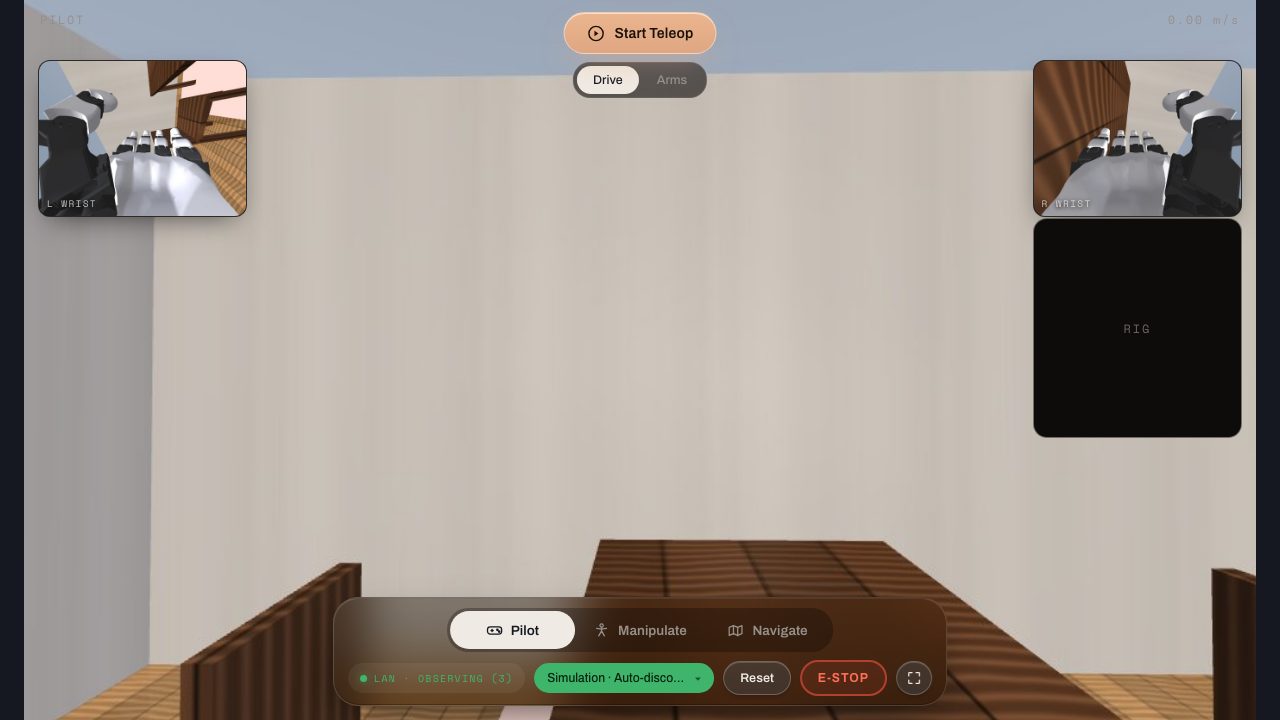
MuJoCo and Isaac Lab digital twins use the same controller and retargeter as the physical platform. Curated demonstrations export to LeRobot v3 for ACT training; policy references return through the shared whole-body controller.
Explore the pipeline →2. Real robot photos
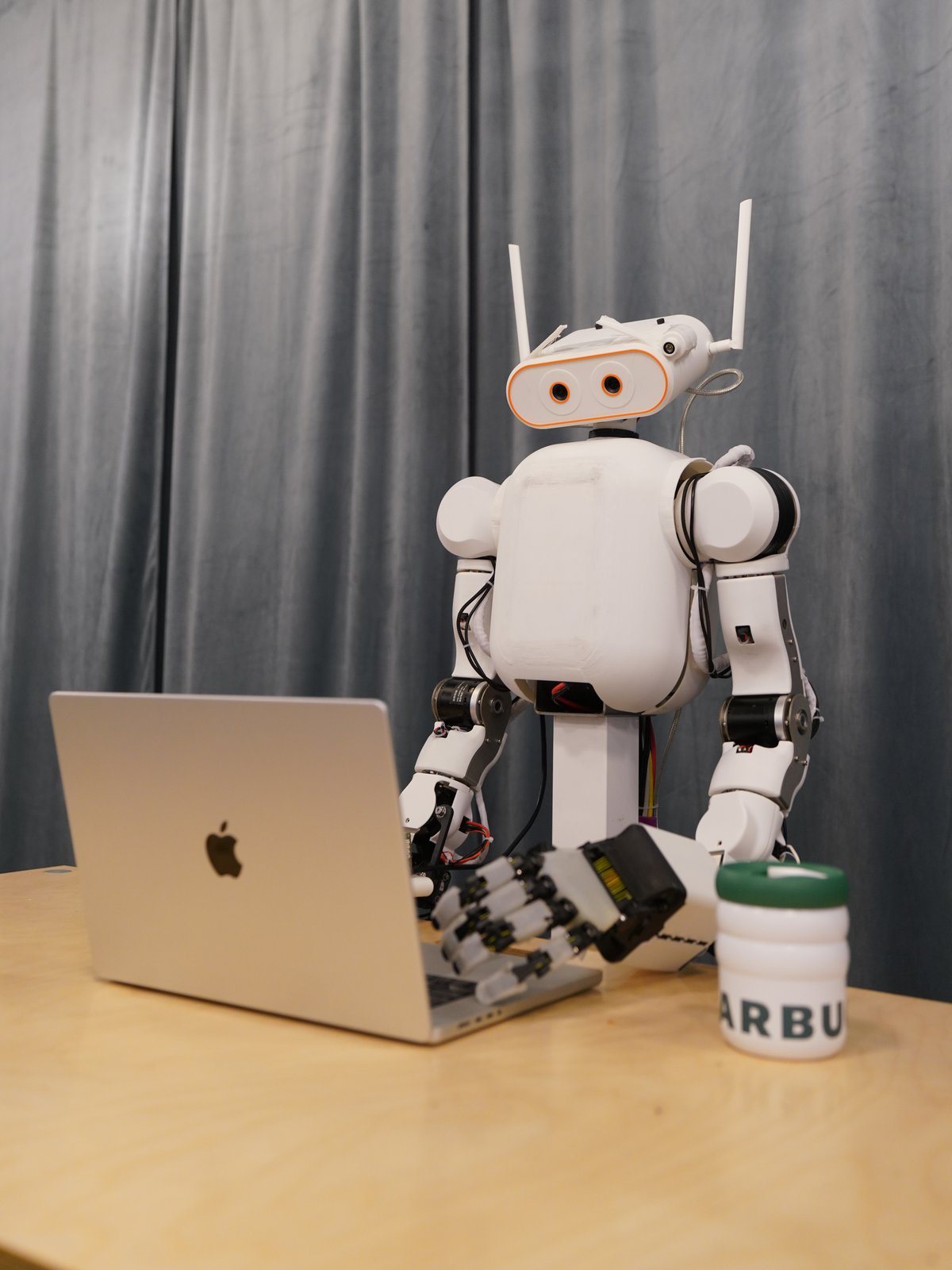
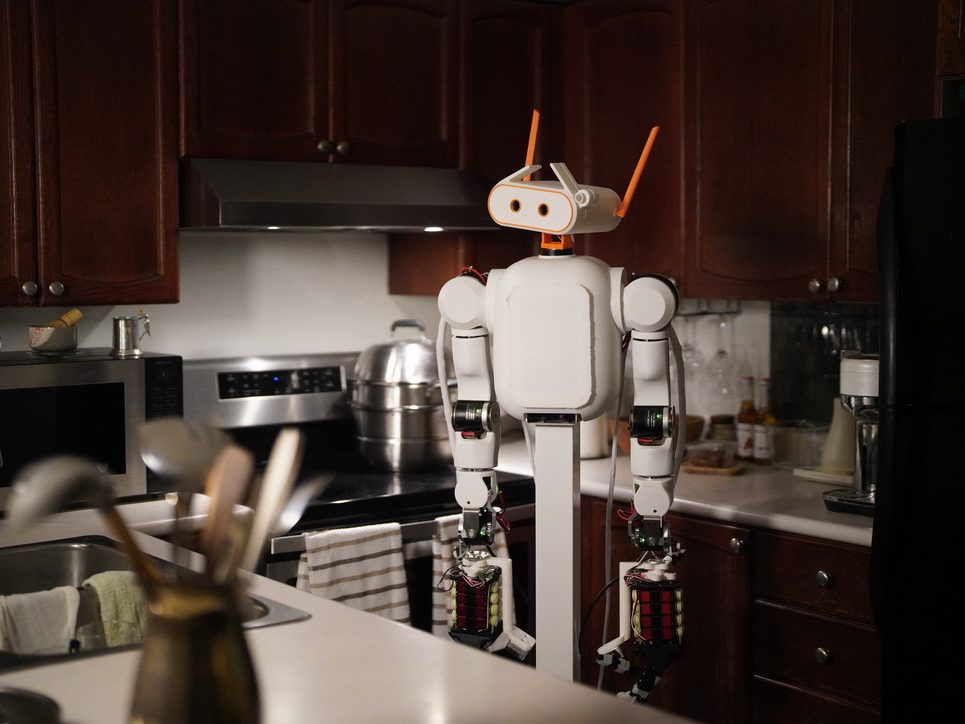
3. State-of-the-art robots
4. Hardware design
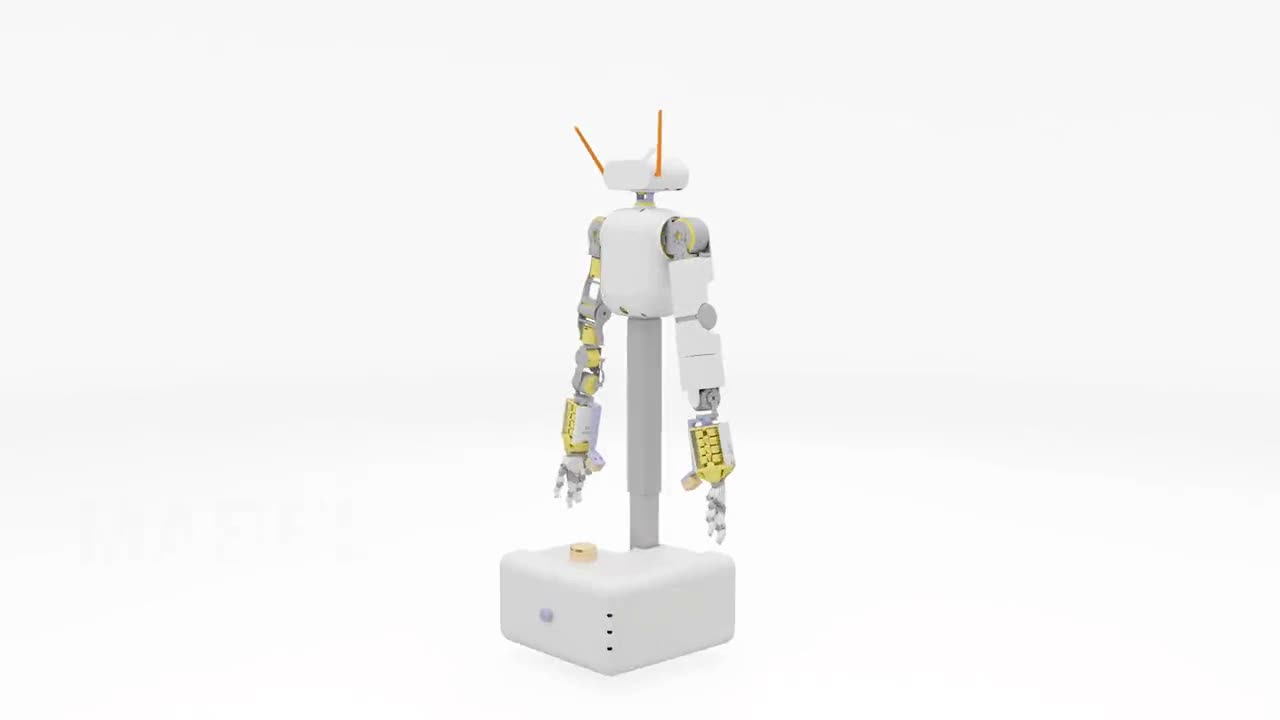
Specifications
Workspace and reach
Reach · floor to overhead
Envelope · measured
5. Teleoperation
Global mode
Tracking, cameras and latency
The Vision Pro streams head and hand poses at 60 Hz and displays the robot’s stereo view. Mean glass-to-glass video latency is 137 ms on the robot’s hotspot, 150 ms on LAN and 161 ms over Tailscale. The iOS app also provides joystick control. Teleoperation details →
6. Simulation
MuJoCo
Isaac Sim / Isaac Lab
Digital-twin model
7. Control, retargeting and motion model
Whole-body retargeting
Sparse head and hand tracking is mapped to the arms and torso, hands, and neck under their kinematic constraints.
Compliant control
Gravity and friction feed-forward support low-gain, back-drivable arm and torso motion.
Height-aware motion limits
Base speed and acceleration limits depend on lift height to reduce tip-over risk.
8. Data and learning
Record demonstrations, prepare the data, and train robot policies.
Collect demonstrations.
Teleoperate MABEL and record synchronized camera views, robot motion, and operator commands.
Open Control Studio ↗Prepare the data.
Replay recordings, trim useful moments, and align the data for training.
Open web curation ↗Train and evaluate.
Choose a policy, train on demonstrations, and test it in simulation before deployment.
Open Training Studio ↗ACT · Diffusion Policy · VLA (π0.5) ↗ · WAM
The paper
Paper and source
The system paper documents the hardware, teleoperation, control, simulation and learning pipeline. Design files, software and build documentation are available in the repository.
@misc{cheng2026mabel,
  title  = {{MABEL}: An Open Anthropomorphic Mobile
            Bimanual Platform for Teleoperation
            and Learning},
  author = {Qilong Cheng and Rooholla Khorrambakht and Mohamed Yassine Kabouri and
            Quang Nam Nguyen and Luca Macesanu and Haoran Zhou and
            Yipeng Wang and Ludovic Righetti},
  year   = {2026},
  eprint = {2611.04083},
  archivePrefix = {arXiv},
  url    = {https://arxiv.org/abs/2611.04083}
}