Open X-Embodiment Collaboration (hover to display full author list)
(Authors listed in alphabetical order)
For technical questions, please file a bug at the github repo. For any other inquiries, please email open-x-embodiment@googlegroups.com.
Contributing datasets: if you are interested in contributing datasets to the Open X-Embodiment dataset, please fill out the Dataset Enrollment Form.
Large, high-capacity models trained on diverse datasets have shown remarkable successes on
efficiently tackling downstream applications. In domains from NLP to Computer Vision, this has led
to a consolidation of pretrained models, with general pretrained backbones serving as a starting
point for many applications. Can such a consolidation happen in robotics? Conventionally, robotic
learning methods train a separate model for every application, every robot, and even every
environment. Can we instead train “generalist” X-robot policy that can be adapted efficiently to new
robots, tasks, and environments? In this paper, we provide datasets in standardized data formats and
models to make it possible to explore this possibility in the context of robotic manipulation,
alongside experimental results that provide an example of effective X-robot policies. We assemble a
dataset from 22 different robots collected through a collaboration between 21 institutions,
demonstrating 527 skills (160266 tasks). We show that a high-capacity model trained on this data,
which we call RT-X, exhibits positive transfer and improves the capabilities of multiple robots by
leveraging experience from other platforms.
pick ice cream move red pepper to A RT-2-X (55B):
one of the
biggest models to date performing
unseen tasks in academic labs
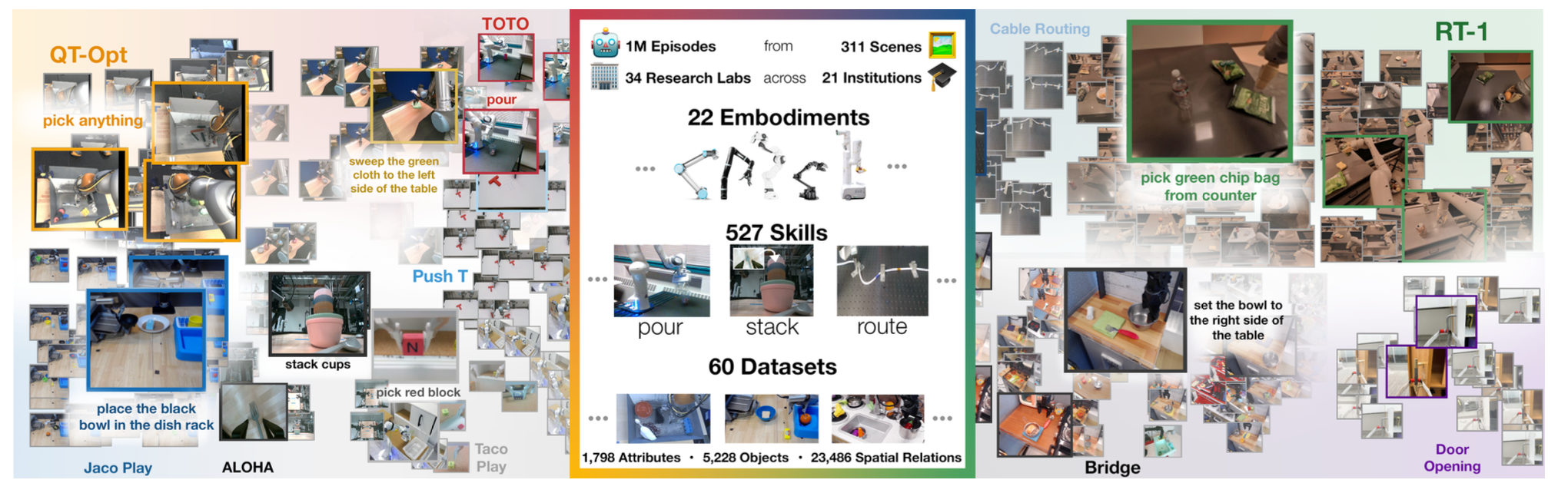
We introduce the Open X-Embodiment Dataset, the largest open-source real robot dataset to date.
It contains 1M+ real robot trajectories spanning 22 robot embodiments,
from single robot arms to bi-manual robots and quadrupeds. The dataset was constructed by pooling 60 existing robot datasets from 34 robotic research labs
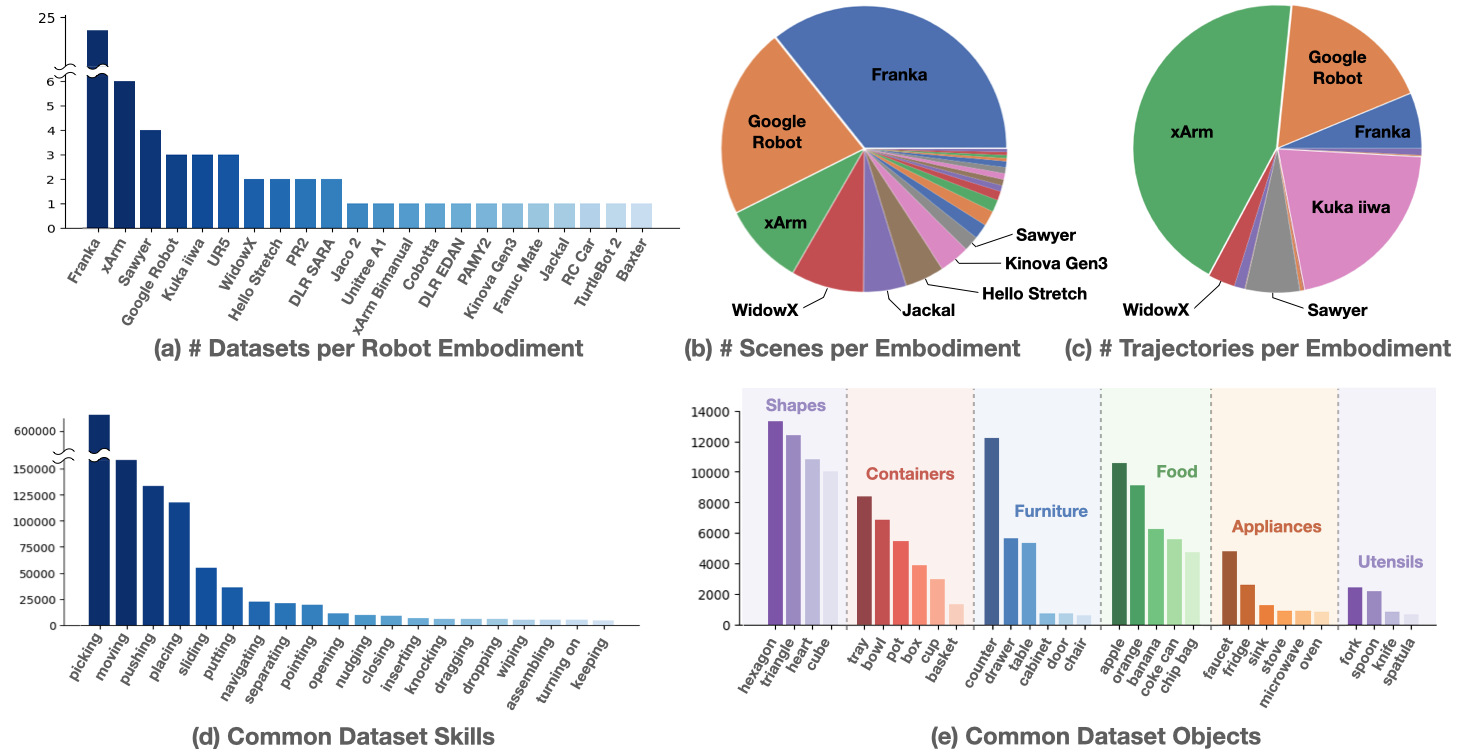
around the world. Our analysis shows that the number of visually distinct scenes is
well-distributed across different robot embodiments and that the dataset includes a wide range
of common behaviors and household objects.
For a detailed listing of all included datasets,
see this
Google Sheet.
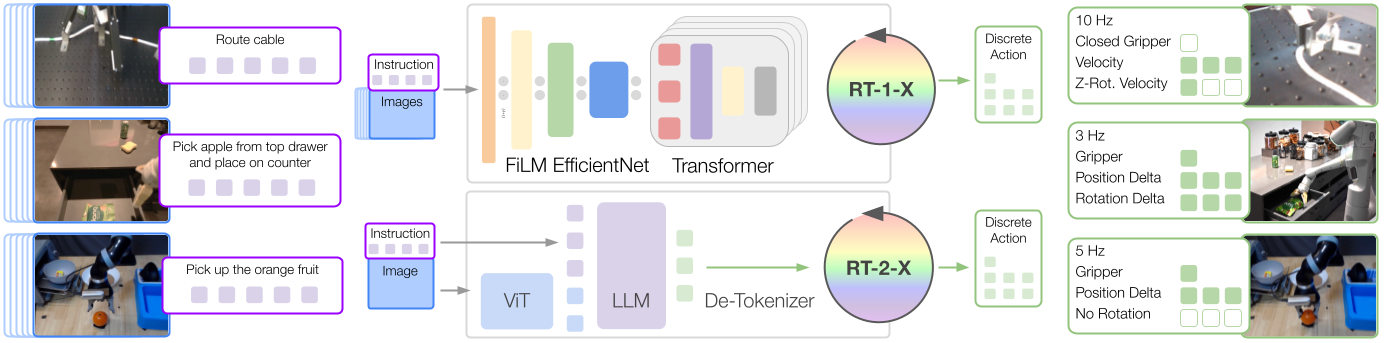
We train two models on the robotics data mixture: (1) RT-1, an efficient Transformer-based
architecture designed for robotic control, and (2) RT-2, a large vision-language model co-fine-tuned
to output robot actions as natural language tokens.
Both models output robot actions represented with respect to the robot gripper frame. The robot
action is a 7-dimensional vector consisting of x, y, z, roll, pitch, yaw, and gripper opening or the
rates of these quantities. For data sets where some of these dimensions are not exercised by the
robot, during training, we set the value of the corresponding dimensions to zero.
We refer to the RT-1 model trained using the robotic data mixture as RT-1-X,
and the RT-2 model
trained using the robotic data mixture as RT-2-X.
At University of Freiburg (AiS) At NYU (CILVR) At Stanford (IRIS) At USC (CLVR) RT-1-X
performing diverse tasks in
6 academic labs
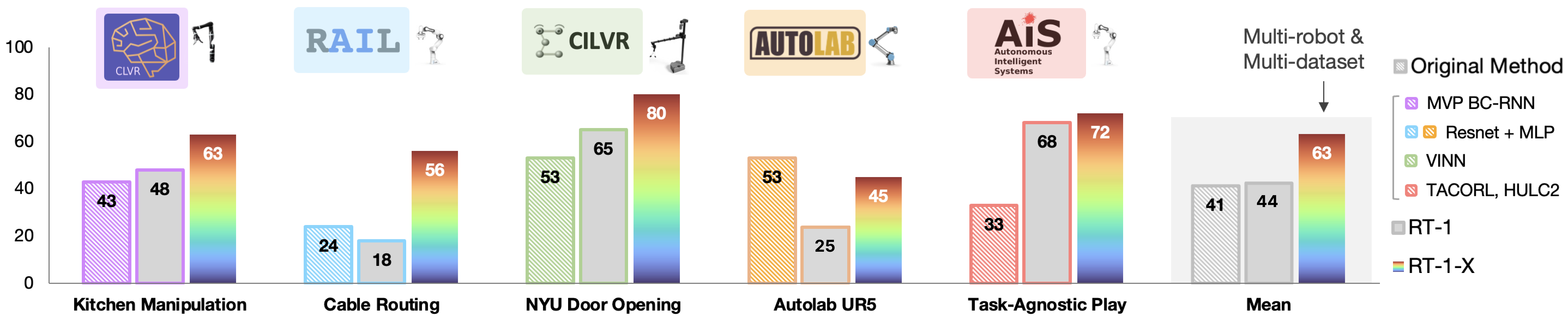
RT-1-X models
outperform RT-1 or Original Methods trained on individual datasets by
50% in the small-data domain
Original Method refers to the model developed by the creators of the dataset
trained only on that respective dataset. The Original Method constitutes a reasonable baseline
insofar as it can be expected that the model has been optimized to work well with the associated
data. The lab logos indicate the physical location of real robot evaluation, and the robot pictures
indicate the embodiment used for the evaluation.
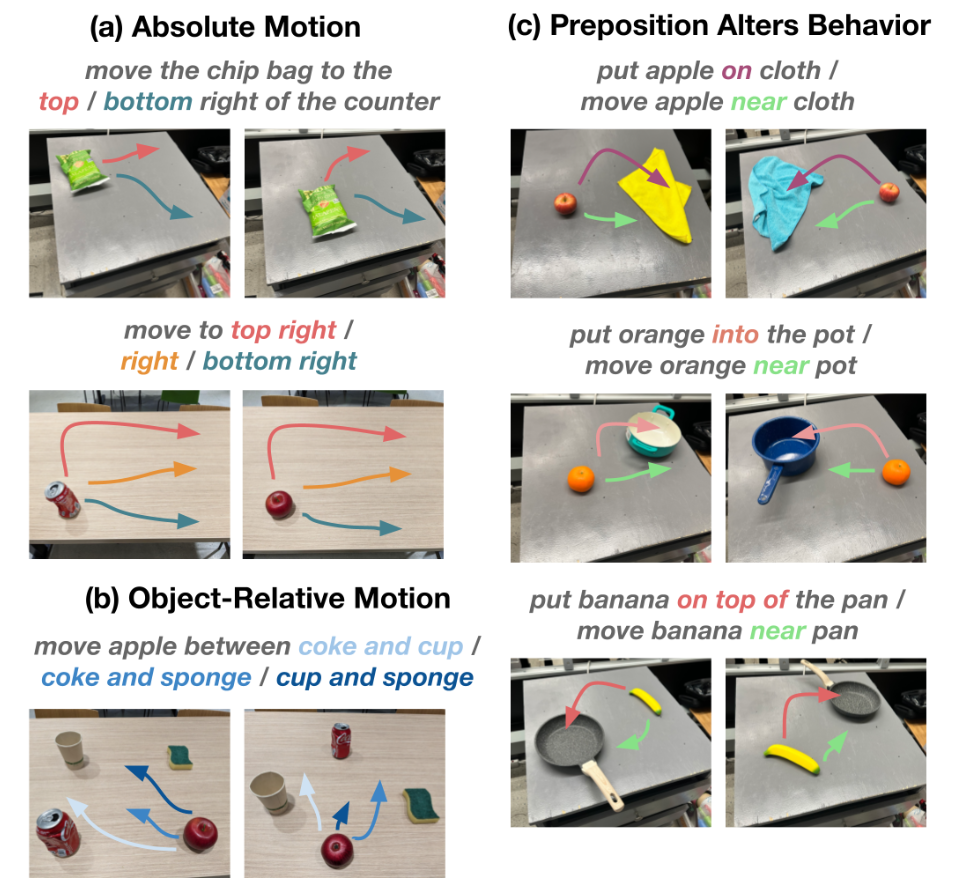
move apple on cloth move apple between can & orange RT-2-X
modulates low-level behaviors based on
small changes in prepositions (see
“on” vs “near” above) and demonstrates understanding of
spatial relationships between
objects
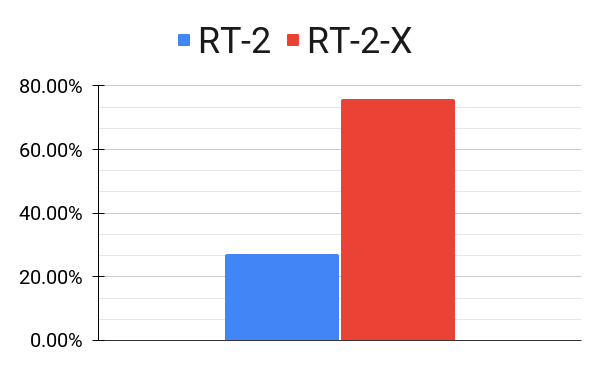
RT-2-X
outperforms RT-2 by 3x in
emergent skill evaluations
RT-2-X demonstrates skills that
the RT-2 model was not capable of previously, including better spatial understanding in both the
absolute and relative sense. Small changes in preposition in the task string can also modulate
low-level robot behavior. The skills used for evaluation are illustrated in the figure above.
If you're using the Open X-Embodiment dataset and RT-X in your research, please cite. If you're specifically using datasets that have been
contributed to the joint effort, please cite those as well.
We provide a dataset
spreadsheet with citation for each dataset for your convenience.
We would like to thank John Guilyard for the amazing animations used for this website. The authors
would like to acknowledge Yuheng Kuang, Ning Hou, Utsav Malla, Sarah Nguyen, Rochelle Dela Cruz,
Justice Carbajal, Brianna Zitkovich, Emily Perez, Elio Prado, Jodilyn Peralta, Tran Pham, Deeksha
Manjunath, Samuel Wan, Jaspiar singh and the greater Google DeepMind team for their feedback and
contributions. The authors would like to thank Sanah Choudhry, Michael Griessel and Jon Small for
their legal advice.
The website template was borrowed from Jon Barron.

Abstract
Dataset Overview
Model Overview
Results
RT-1-X evaluation on in-distribution skills
RT-2-X evaluation on emergent skills
Citation
Acknowledgements