Follow me on X at @robleclerc
I began working with neural networks and evolutionary algorithms in 1999, particularly within the field of Artificial Life (ALife). Back then, the most vexing question was how can digital systems achieve open-ended evolution—evolving systems to higher and higher levels of complexity without stagnation or running in circles.
It’s been about 16 years now since I left Academia, but about six months ago, I decided to take a dive to get up to speed on the transformer architecture to see what exactly made it so powerful and I kept noticing something strange: many of the concepts behind these models strangely mirrored many features and phenomena from quantum mechanics. This got me thinking, are transformers proving to be so powerful because they’ve inadvertently captured key design principles of nature, giving them their open-endedness?
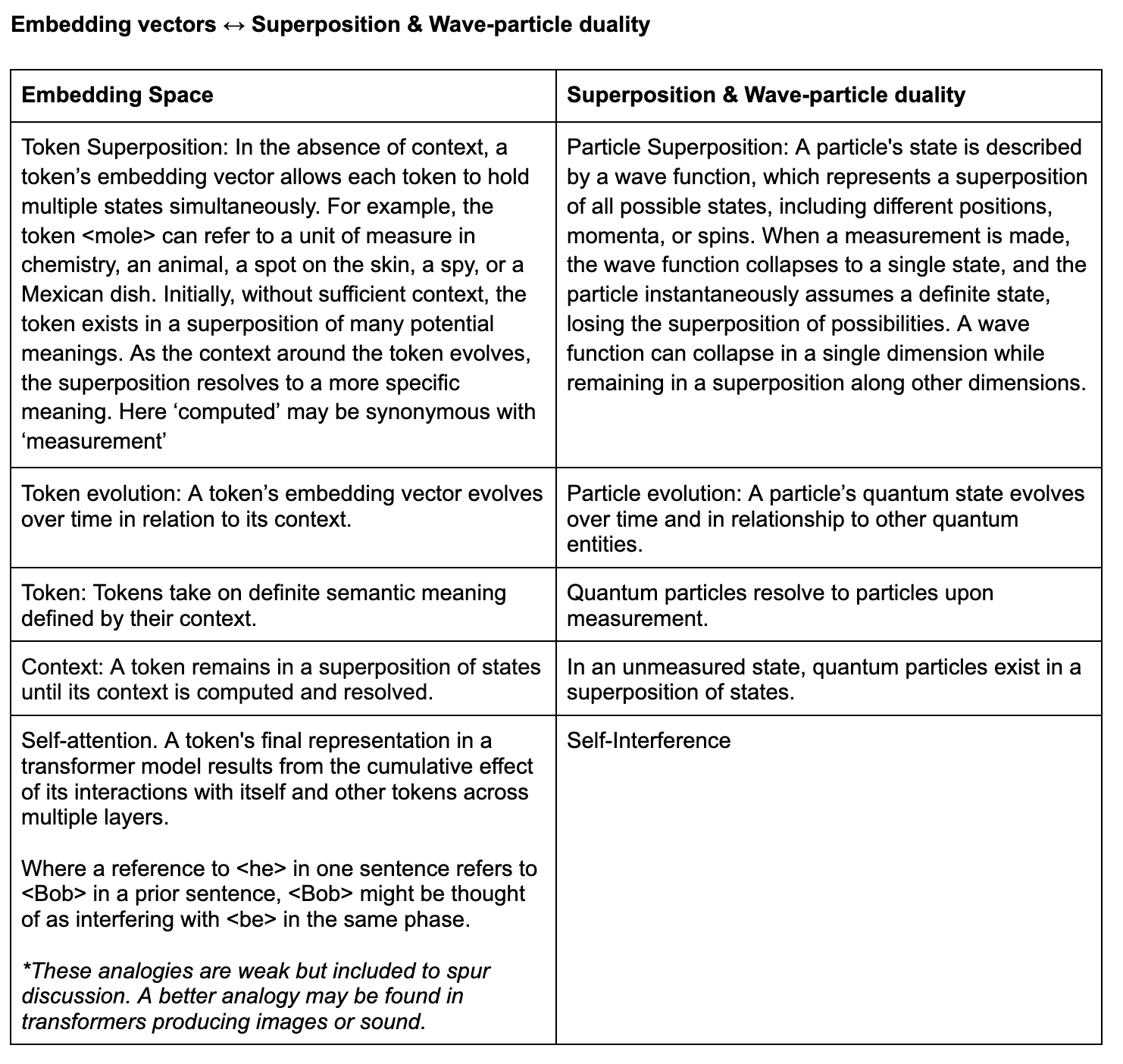
Take tokens, for example. Before context clarifies their meaning, they linger in a kind of semantic superposition—like particles existing in multiple states at once. Similarly, self-attention heads bind words across sentences like quantum entanglement, where “he” in one paragraph instantly locks onto “Bob” in another, no matter the distance. Even embedding vectors, those high-dimensional containers of meaning, behave like probability waves that collapse into definite interpretations.
These parallels aren’t perfect (and I’m not claiming transformers literally run on quantum rules). But the overlap feels too coincidental to ignore. Below, I’ve tried to map out the analogies side-by-side (screenshots of tables, because Substack is annoyingly allergic to table formatting). I’d love to hear your thoughts.