The dark secret of Engineering Managers in the AI era? During the day, we use AI to summarize meetings and write Jira tickets. But on the weekends, we are actually building.
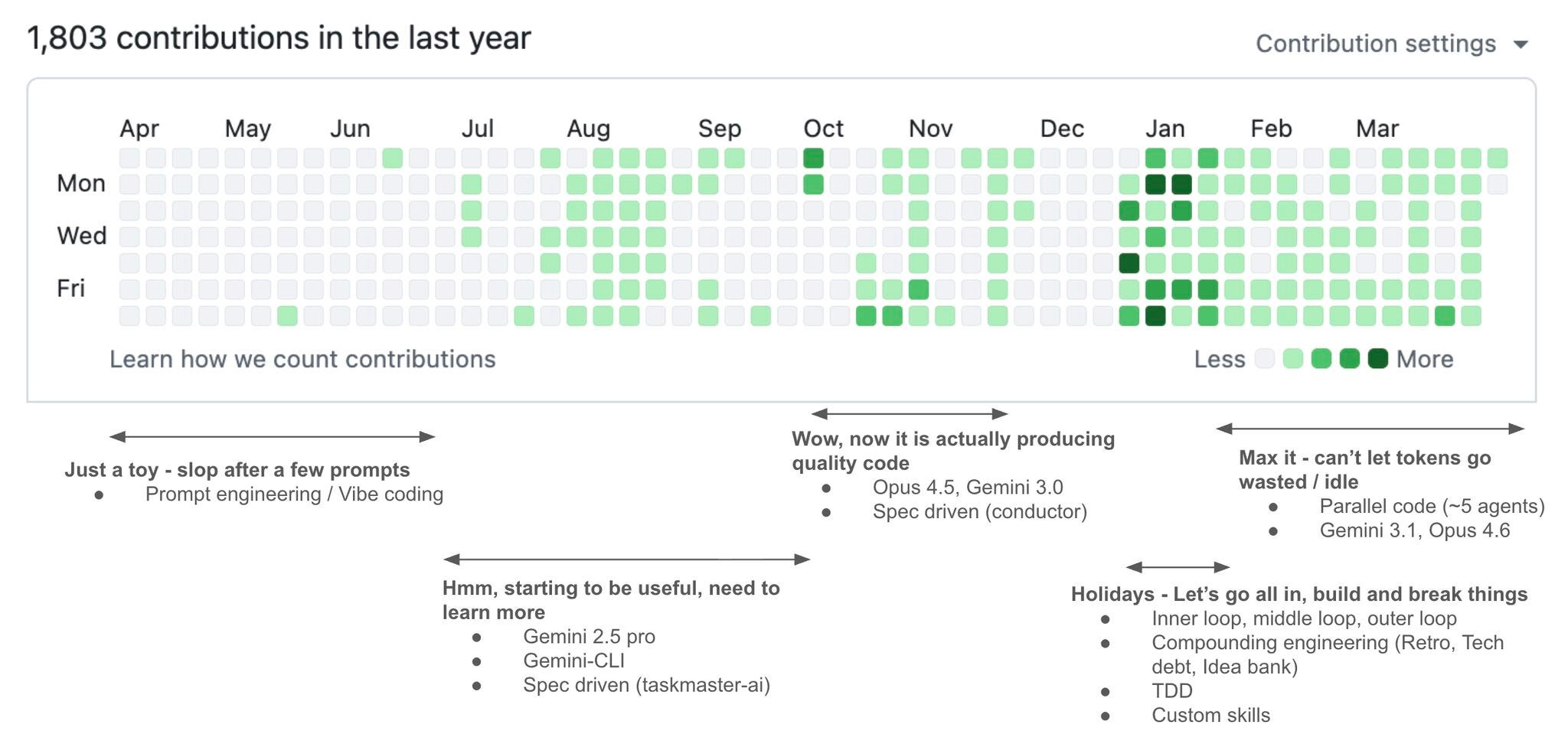
My GitHub contribution graph has completely shifted over the last 12 months. If you look at the sheer volume of green squares, particularly the 1,800 contributions packed mostly into the last six months, it looks like I have been coding non-stop.
The frustrating truth? 99% of those commits happened in my spare time.
I am an Engineering Manager first, and I enjoy my day job. Having great conversations, unblocking my team, and watching them grow, both as professionals and as people, is incredibly rewarding. If I can play even a small part in their success, I am proud and happy.
But there is a very real tension in engineering leadership right now. During the standard workweek, my calendar is full. Meanwhile, the biggest shift in software engineering we have ever seen is happening, and the only way I can get my hands dirty and actually build with it is by burning my nights and weekends.
I am by no means an agentic coding guru. I am just a manager having an absolute blast hacking in my free time. But the journey from being a complete skeptic to orchestrating parallel agents has fundamentally changed how I view software development.
Here is how that evolution actually happened.
A year ago, I was highly skeptical of the AI coding hype. My early experiences consisted of basic prompt engineering and vibe coding. The result was almost always the same. It produced slop after just a few prompts. It felt like a neat trick or a toy, but certainly nothing you could rely on for serious engineering.
Over the late summer, everything clicked. I started experimenting with Gemini 2.5 Pro and the CLI, but the real game changer was moving to spec-driven workflows.
I stopped treating the AI like a magic wand and started treating it like a system that needed clear, rigorous instructions. Suddenly, the output became… useful. That single insight shifted me from a skeptic to an informed evangelist. I saw where this technology was heading, and I started actively encouraging my team to embrace agentic coding tools before the industry left us behind.
As the fall progressed, the models improved dramatically with the release of Opus 4.5 and Gemini 3.0. Paired with more mature spec-driven tooling like the output flipped from useful to quality and production-ready code. The friction was disappearing.
When the Christmas holidays rolled around, I decided to go all in on my personal projects. I realized I could not let my API tokens sit idle.
I built out an environment with an inner, middle, and outer loop. I introduced compounding engineering practices like automated tech debt management, retrospectives, and idea banks. I integrated Test-Driven Development and gave my agents custom skills. Today, I am running about five agents in parallel using Gemini 3.1.
The velocity at which you can build advanced solutions solo right now is staggering. It is completely intoxicating.
And that is exactly why it is so frustrating when Monday morning rolls around.
I have fought incredibly hard to bump my IC agentic coding time at work, but my management responsibilities will always rightfully take priority. That is not just about supporting my team. It is the constant coordination, aligning with stakeholders across the organization, communicating with peers, and handling the necessary administration, etc., that comes with leadership.
Engineering management is a 360-degree job, and the calendar simply does not leave room for the kind of focus required to orchestrate agentic coding workflows.
I am 100% confident I am not the only engineering leader feeling this tension right now. We know what these tools are capable of, we have felt the velocity firsthand, but we are trapped in meetings while the landscape shifts beneath our feet.
How are the rest of you balancing this? Are you resigning yourselves to weekend hacking just to satisfy the itch and stay ahead of the curve, or have you actually figured out how to carve out real agentic coding time during your standard work hours?
I’m committed to keeping this content free and accessible for everyone interested in data platform engineering. If you find this post valuable, the most helpful way you can support this effort is by giving it a like, leaving a comment, or sharing it with others via a restack or recommendation. It truly helps spread the word and encourage future content!
You can also connect with me or follow my profile on LinkedIn, where I share shorter-format thoughts and daily reflections on data platform and agentic engineering.
Full disclosure: I am a Google Developer Expert, but I am a Google customer first. I maintain a critical eye when exploring and evaluating Google’s services.