Source: https://www.jcer.or.jp/english/is-japan-really-short-of-labour
For a dozen years, the Bank of Japan, the government, and stockbrokers have all been promising that a labor shortage in Japan will soon push up wages. And that faith is behind the BOJ’s decision that it’s time to normalize interest rates. Here’s the argument. Due to the declining working-age population, companies in 2014 offered 1.2 jobs for every job seeker. By 2019, the ratio had climbed to 1.6 and is now 1.2. So, it is argued: when demand exceeds supply, wages must inevitably rise.
And yet, for the same dozen years, these forecasts have proved false. On the contrary, real annual earnings for a full-time worker were no higher in 2024 than they were in 2014: just $46,500 in real purchasing power parity dollars. In fact, these earnings are barely higher than 36 years ago when the lost decades began.
This apparent paradox leaves only two possibilities. Perhaps the labor shortage is not as severe as some statistics make it look. The alternative is that labor market rigidity prevents the forces of supply and demand from working as expected.
Japan’s leaders and stockbrokers point to the first explanation. BOJ Governor Kazuo Ueda contended that so many women and the elderly entered the workforce during 2012-24 that this offset the decline in the working-age population. The reason for the influx, in my view, is that wages and pensions were so stagnant that more people needed to work just to keep household living standards from falling. Now, argues Ueda, the reserve supply has been exhausted, and from now on the number of employed people will decline (see chart below). Consequently, the BOJ promises that this time the forecast will come true: Japan is headed toward an era of 3% nominal wage hikes minus 2% inflation, leaving 1% real wage growth.
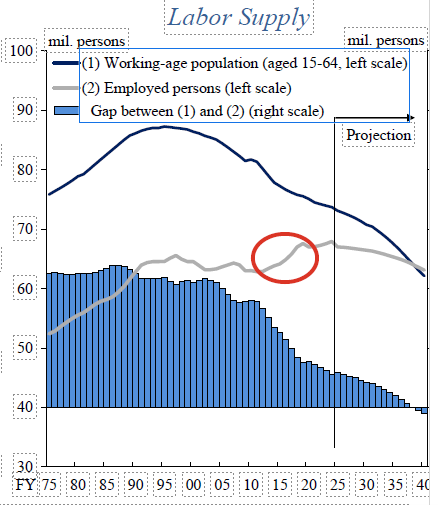
Source: https://www.boj.or.jp/en/about/press/koen_2025/data/ko250824a1.pdf Note: Red circle is the Abenomics era
While this explanation may be part of the story, I believe a bigger part is a case of “market failure,” and that this obstacle remains. It’s a staple of orthodox economics that excess demand for workers can only raise wages when workers are free to move to another company paying more. That forces companies into a bidding war. Without such competition, a labor shortage and flat wages can co-exist. I’ll explain the economic theory on this at the end.
In fact, the reason that Japanese employers began creating “lifetime employment” in the late Meiji Era was precisely to end a bidding war. In the 1910s, 80% of blue-collar workers switched jobs every year in search of higher wages. In response, employers created a no-poaching pact: they’d stop luring workers away via a higher wage, or refuse to hire those who left for any reason. To bolster this ploy with propaganda, employers fabricated the story that loyalty stemming from a “feeling of company as family” was an age-old facet of Japanese culture. There were certainly times, e.g., the high-growth era, when the benefits of lifetime employment outweighed its harms, e.g., worker acceptance of labor-saving technology. Today, however, the costs outweigh the benefits. For details, see Chapter 11 of The Contest for Japan’s Economic Future.
Competition For Workers And Wage Hikes
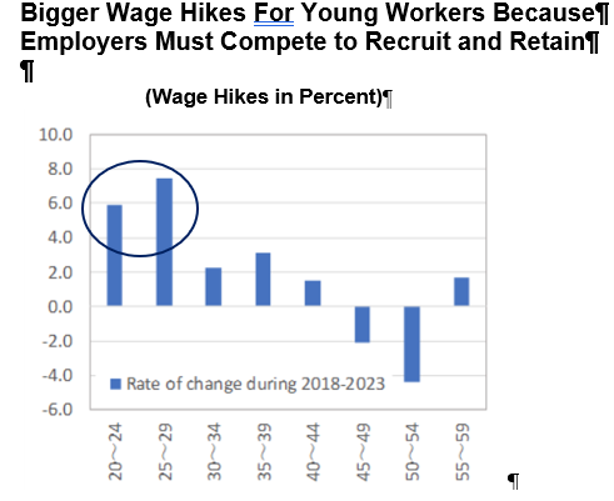
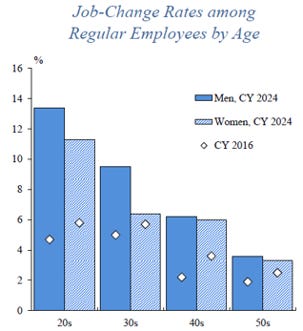
For markets to work, they must be embedded in market institutions, and robust competition is one of the most fundamental of them. Insufficient competition in the labor market explains why Japanese wages remain below free-market levels. Compare the wage hikes between younger workers just starting and regular workers trapped in lifetime employment. As we can see in the chart at the top of this blog, workers in their 20s got nominal wage hikes of 6-7% per year during 2018-23, whereas those in their 30s and early 40s received wages of just 1-3%, and most workers over age 45 suffered wage cuts. The reason is that job changes are far more prominent among younger workers than veterans (see chart below).
Source: https://www.boj.or.jp/en/about/press/koen_2025/data/ko250824a1.pdf
New workers hired out of high school or college have a choice of where to work. Moreover, the first few years are a probation period for both sides. So, companies must compete not just to hire them, but to retain the ones they like. Low wages are a big issue for these younger workers.
By contrast, older workers with a regular job find it much harder to find another regular job in the same industry. Switching to a different industry is even harder and rarer because their skills have been developed to fit their current employer, rather than providing marketable skills in an occupation that suits a wide range of companies.
Moreover, workers have been given an incentive to prioritize job security over wages because a job loss could mean being relegated to a non-regular job. That means a monthly pay cut of at least 25% at small companies, 30% at medium-sized ones, and 40% at big ones (even more when bonuses, retirement packages, and other benefits are considered). Worse yet, once one falls out of regular status, it’s very hard to return. The bottom line is that employers have less need to hike wages to retain veteran employees unless those individuals have a very valuable and rare skill, e.g., a software engineer.
Not surprisingly, highly skilled younger workers are much more willing to switch jobs and much more willing and able than they were 10 or 20 years ago. Women are far less willing to leave a regular job than men because they face a greater risk of losing promotion opportunities or ending up in a non-regular job.
The good news is that, across all ages and both genders, workers are more willing and able to switch jobs than they were ten years ago (see the chart above again).
Firms Want Cheap Labor
Firms complain that they cannot find the workers they need. In reality, they cannot find enough workers at the wages they are willing or able to pay. They’d rather hire non-regular workers who are less skilled than regulars but cost less. The ratio of job offers to applicants is 2.0 for non-regular workers, but just 0.99 for regulars. These firms also invest less in training non-regulars. Hence, this practice not only suppresses wages but also hurts productivity.
Companies That Cannot Pass Wage Hike Costs Onto Customers
Lots of companies, especially the small and medium enterprises (SMEs) that employ 70% of all employees, insist they cannot afford to hike wages. For many, this is true. According to a 2024 survey by Teikoku Databank, Japanese companies were able to pass on to customers just 32% of their wage hikes. Including hikes in other costs and the overall pass-through rate tumbled to 39% in 2024, the lowest since the survey began.
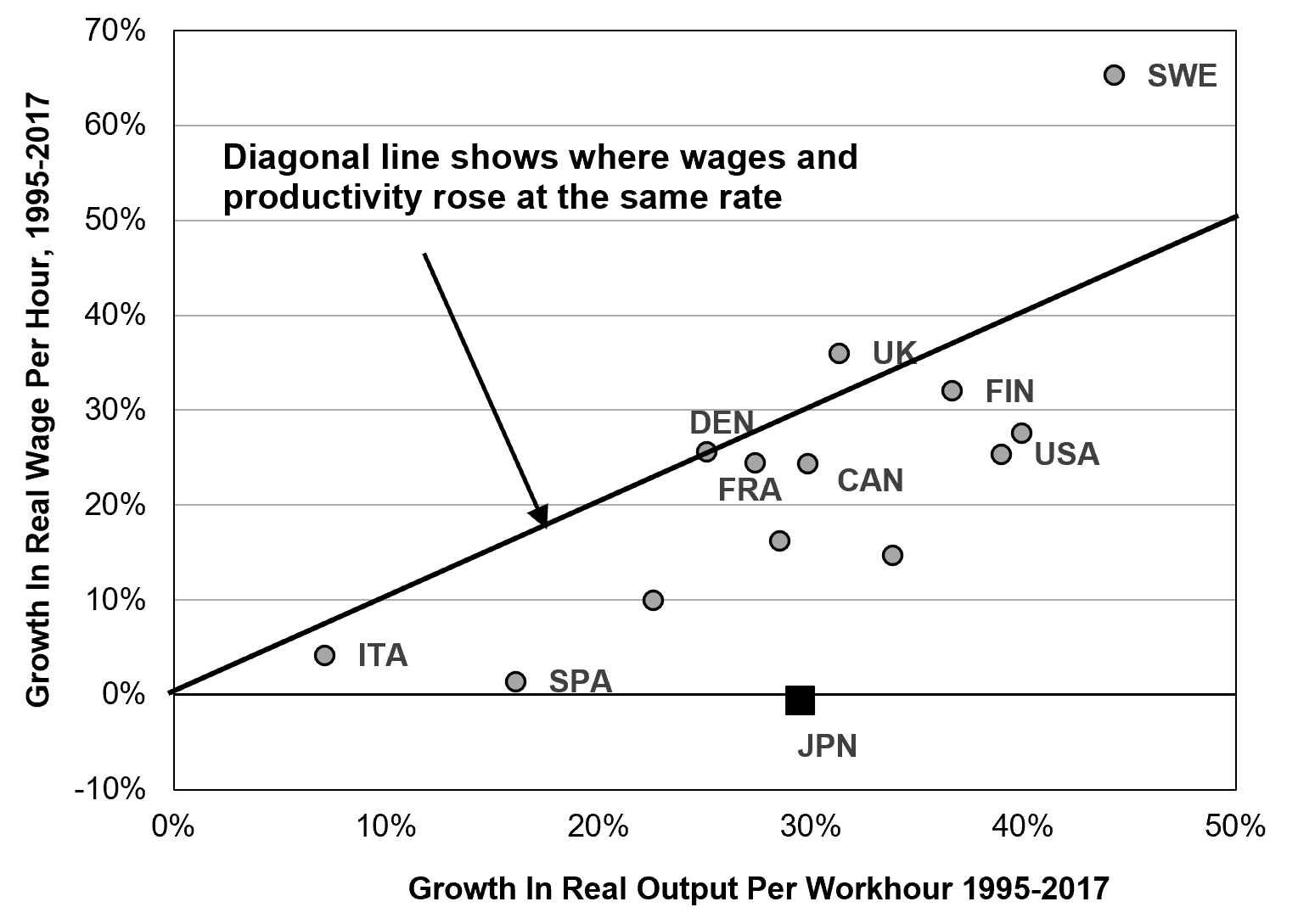
Moreover, the average firm does not even raise wages in response to hikes in labor productivity. Suppose a company can produce 101 units with the same amount of labor as it employed when it produced just 100 units the previous year. It can raise wages 1% with no loss of profits. That used to happen in Japan during 1970-94. But during 1995-2021, they increased wages by just 0.36% for every 1% hike in productivity. That’s because they have the market power to suppress wages. During 1995-2017, real GDP per hour rose 30%, but real wages per hour did not rise at all, the worst record in the OECD (see chart below). Instead of raising wages, they are enjoying soaring profits that they don’t even deploy in new investments.
Source: http://dx.doi.org/10.1787/888933969219
To make matters worse, 29 business sectors, comprising a third of Japan’s GDP, experienced absolute declines in labor productivity during 1995-2019.
If workers were free to leave such SMEs and move to other companies able to pay better wages, then these low-productivity firms would gradually exit the market. As a result, the whole economy would enjoy both better wages and better productivity. Like the Scandinavian countries, Japan should invest in “active labor measures” to support such transitions. Instead, all sorts of measures, from credit guarantees to subsidies, are used to prop up such firms as a kind of disguised unemployment.
Some people claim Japanese wages are low because labor productivity is low. But the converse is at least equally true: productivity is low because wages are kept low enough to sustain low-productivity SMEs.
Skills Mismatch vs. A Broad Macroeconomic Imbalance
In a few sectors, like Information and Communications Technology (ICT), there is a genuine physical shortage because of a “skills mismatch.” Japan produces at least half a million fewer ICT professionals than companies need. IT companies are offering four times as many new jobs as there are applicants to fill them. In response, companies are bidding against each other for the talent. Consequently, ICT is one of the few sectors where wages have risen. Nominal wages are up 40% since 1997.
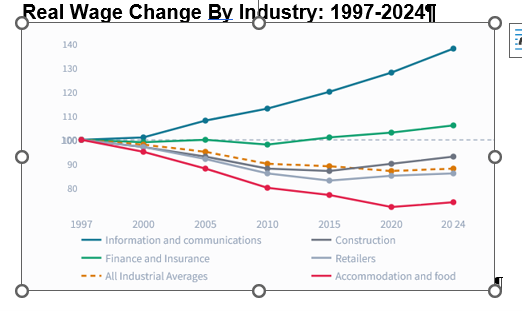
Source: https://isvd.or.jp/columns/real-wage-industry-30year-comparison
By contrast, the economy-wide labor shortage is a completely different phenomenon. Companies in all sorts of sectors that are willing to pay the prevailing wage, or even more, are unable to secure workers. The BOJ insists this is just the vestige of a deflationary mindset that is gradually disappearing. I believe it’s not a psychological issue, but the consequence of barriers to labor market competition. I’ll turn to that next.
A Bit Wonkish: How Weak Competition Can Combine a Labor Shortage With Flat (Or Falling) Real Wages
Many readers will still find it counterintuitive that a labor shortage would fail to raise wages eventually. Bear with me as I do something for the first time: use supply-and-demand diagrams. My explanation is part of orthodox economics taught in every mainstream textbook. Just as monopolists can charge above-market prices for what they sell, monopsonists, including employers, can pay below-market prices for things they buy.
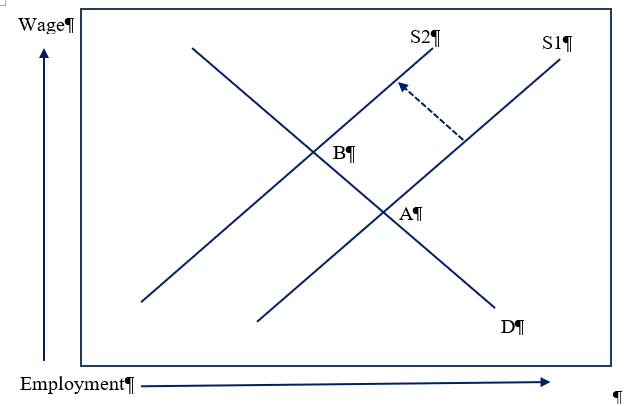
The first figure below shows a labor market with free competition. The demand curve (D) means that, when wages are lower, companies will want to hire more workers. The supply curve (S) means that, if wages are higher, more people will seek work. At the initial supply curve, S1, demand and supply equalize at Point A. Now, suppose the supply curve shifts to S2 because, as in Japan, the working-age population shrinks. There are fewer people available to work at a given wage. In that case, supply and demand will equalize at Point B: fewer total jobs but at higher wages. At Point B, every company willing and able to pay the prevailing wage can hire as many workers as it wants. Companies that cannot pay will go out of business, freeing up workers to be employed at higher wages elsewhere. The BOJ’s entire strategy depends on its faith that Japan is moving toward this situation.
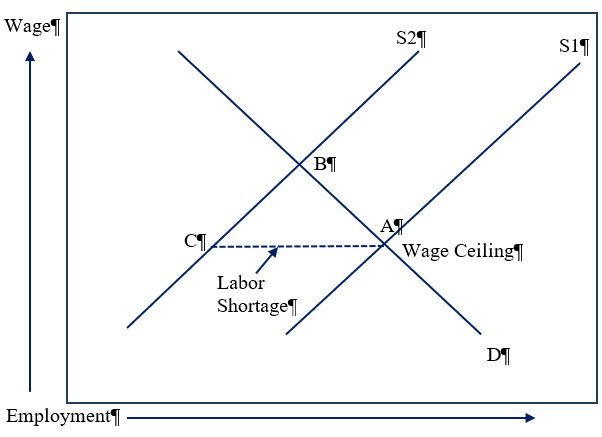
The next figure shows what happens when a rigid labor market keeps wages below the free market level. We have the same leftward shift in supply as in the figure above. However, barriers to competition keep wages at the same level as at Point A. This is what happened in Japan from 1990 to 2024, as shown in an earlier chart. But the number of people able and willing to work at the 1990 wage has decreased: it has moved from Point A to Point C. As a result, companies suffer a “labor shortage” equal to the distance seen in the dotted line between A and C. The problem is not an absolute shortage of labor, but a shortage of cheap labor, the failure of wages to rise to Point B.
Unless Japan promotes reforms that make companies compete for labor—such as enforcing its laws on equal pay for equal work between regulars and non-regulars, and between men and women—the coexistence of a labor shortage and wage stagnation is likely to continue.
Next: The BOJ claims workers are leaving low-wage jobs and moving to higher-wage jobs. I’ll look at that claim.
Paid subscribers will be eligible for my new memos, an addition to these regular posts. Beyond that, if you feel you’ve gained insight from this blog, ever restacked it, if you ever subscribed to my previous publication, The Oriental Economist Report, and certainly, if you or your firm have gained insights that helped guide your investments, please support the blog with a subscription or by “buying me a cup of coffee.” You can buy a cup or two on a one-time basis, or once a year, or once a month.

