I am fascinated by scriptlessness: the state of not having a script telling you what to do. I've danced around this question a lot in my writing, mostly with reference to the American middle-class life script. But I've never really tackled the phenomenon head-on.
I'll define scripts as collections of learned patterns of behavior that reliably supply both psychological and material resources for survival. These lend meaning and sustenance to power the script, respectively. Both are necessary, and any loss on one front, if not quickly reversed, usually leads to loss on the other, triggering a vicious cycle of increasingly severe script breakdown.
This is the unraveling of scripts. It is the subjective experience of collapsing social and material realities around you, leading eventually to a state of behavioral collapse: scriptlessness. Along the way you encounter all those demons poets like to talk about.
Scripts can collapse for groups and organizations, not just individuals, but let's start with individuals.
The Nature of Scripts
Let me say a little bit more about scripts before I talk about how they unravel.
A script in the sense of a performed play is more than the guiding narrative, stage directions and dialog. Actors also engage in many behaviors that are necessary to complete the performance but are not specified in the script. They may sit down, open doors, sip coffee, display appropriate expressions, and so forth. Much of the energy of the performance is actually in the highly varied behaviors that must accompany performance.
So the script induces a lot more action than it specifies, by cueing patterns of behavior that already exist in the culture (so a script is something like a program in a high-level language that makes extensive use of API calls and library functions, unlike raw machine code). In the case of improvisation, the script is also driven by these patterns. Most scripts are some mix of pre-scripted and improvised (or feedforward and feedback).
What can we say about these patterns?
- They may be unconscious habits or deliberately executed recipes.
- They may be acquired through deliberate learning or conditioning you never noticed while it was happening.
- They may work to maintain the conditions of your life (habits) or drive anticipated changes (narrative evolution).
- They may be purely symbolic and only affect meaning (empty rituals) or purely instrumental and only affect sustenance (arbitrary procedures).
We can say a lot more, but that will do for a thumbnail sketch.
If meaning erodes in a script, motivation erodes, creating the important-but-not-urgent problem of anomie. This can happen, for instance, when you move to a new job in a new city where you have no friends and suddenly realize that all meaning in your old life was derived from a few workplace friendships.
If the sustenance becomes uncertain, the material quality of life starts to deteriorate, creating the urgent-but-not-important (for individuals in reasonably developed societies) problem of immediate survival. This can happen for instance, when economic shifts make your skills worthless at age 45 and you have no savings to fall back on.
If both are eroding simultaneously, you are inching towards an existential crisis.
As the unraveling continues, not only do losses (of meaning and sustenance) accumulate, the rate of loss usually accelerates exponentially, since both meaning and sustenance are compounding processes.
Irreversibility in Script Unraveling
Scripts can unravel in irreversible ways, with losses increasing in severity as they spiral down into unsolvable problems.
On the sustenance front, your skills might be enduring and setbacks temporary. Maybe you can easily learn a new skill that takes low marginal learning effort relative to an existing skill. Or maybe your existing skills are just temporarily in recession, and might make a comeback. Savings, loans and a little learning effort will solve that kind of problem.
But the sustenance source might also be drying up irreversibly. Maybe everything you know has to do with the manufacture of photographic film and you can't think of any other use for those skills. Or your financial burdens are so high that you cannot afford the time to learn anything that can replace what you've lost. You become downwardly mobile.
Similarly, on the meaning front, you might experience a bout of transient depression and recover fully, or experience an irreversible, terminal loss of meaning -- a loss of innocence of some sort for instance.
You can usefully distinguish two kinds of irreversibility in an unraveling to a scriptless state.
The absolute kind of irreversibility is easier to understand. It is caused by lack of necessary external resources required to meet psychological and material needs. Death due to starvation/destitution/healthcare being out of financial reach, as well as suicide driven entirely by psychological trauma (say solitary confinement for a highly extroverted person, or bullying/hazing for a troubled teen with no adult support) fall into this category.
The relative kind is when the irreversibility is relative to a particular script rather than the material environment. So for example, if you cannot find a job despite your best efforts, the loss is only irreversible within a nominal script that says a job is the only way to derive sustenance. If you are willing to adopt a different script based on short-term gigs, the relative irreversibility might go away, with no material change in the environment.
If all your meaning in life is derived from community and friendships, but you are able to discover a new script that provides a different kind of meaning from solitary creative work, the irreversibility associated with loss of friends again goes away.
You can't do much about absolute irreversibilities. They have to do with fundamentally irreplaceable kinds of material or psychological resources. But fortunately they are not as common as the relative kind. In practice, relative irreversibility is by far the most important kind.
The key to tackling relative irreversibility in script unraveling is ideas. But few people seem to appreciate the subtleties of how ideas and unravelings interact, which leads to incredibly naive and inefficient use of ideas to solve problems.
So let's talk about that.
Ideas are Cannibals
The mere existence of an accessible alternative script does not mean it will be accessed, so relative irreversibility can kill just as surely as the absolute kind can.
But the reason there is more hope in the relative case is that you might be able to weave a new script even as the old one is unraveling, starting with just an idea.
Ideas are a very unique sort of resource because they can be generated entirely internally, unlike material resources. Even if nothing in the material environment changes, something might click in your head, making you see your environment differently, allowing you to solve what is, within your old script, an impossible problem.
But what exactly is an idea? I only recently realized that I've never actually attempted to define the term. I've only circled around it with near-synonyms like "insight." But here's a shot at it: ideas are cannibals.
More precisely, every idea is fundamentally a cannibalization hypothesis. I am convinced this is true of even the most abstract and metaphysical ideas (for the philosophers among you, yes this is radical empiricism in disguise).
This is obvious in simple cases involving only sustenance (breaking eggs to make omelettes).
It is harder to see in the case of meaning (as in superhero mythologies effectively desecrating religious mythologies).
It is even harder to see when an idea involves both material and psychological substitutions, simultaneously changing meaning and sustenance sources.
It is hardest to see when the vicious cycle of unraveling has progressed so far that ideas are about patterns of substitution of material and psychological resource complexes.
We call these complex beasts visions, and the process of realizing them from small, generative seed ideas missions.
But the cannibalistic aspect is what people don't usually appreciate. Simple or complex, seed ideas don't start growing into visions in a vacuum. Ideas are inextricably linked to the unraveling scripts -- destruction processes -- within which they are planted, and on which they feed.
Creation is fueled by destruction, materially and psychologically, not just accompanied by it. You only need to walk into a grocery story to appreciate the beautiful canvas of ongoing destruction of life laid out for your creative pleasure.
Script Shifts
When seeds of complex ideas are injected into unraveling scripts, behavior patterns are forced to change. The shift from coal to oil was merely a material substitution in a source of sustenance, with limited impact. But the idea of renewable resources involves replacing a script derived from the idea of endless progress with one derived from the idea of sustainability, and creating a corresponding wholesale shift in behavior patterns.
This is why human societies have continued to traffic in ideas tens of thousands of years after they first started having them. Ideas are how we cannibalize old realities to create new ones. This is why, when we resort to harsh material intervention measures when we suspect a good idea will do the trick, we call it brute force. This is why we resist brute force that we see as premature with the complaint, "are we out of ideas?"
It is also why, despite my action-oriented friends mercilessly making fun of me for being addicted to insight porn and armchair "refactoring," ideas remain the mainstay of my writing (and getting people and organizations unstuck remains my favorite kind of consulting work, even though other kinds of work pay better).
We are rarely in situations so extreme that we run out of script-switching ideas before we run out of time. The prototypical example is falling off a cliff. There are no known ideas that will allow humans to fly without specialized material resources (this is partly why Arthur Dent learning how to fly in The Hitchhiker's Guide to the Galaxy, by "missing the ground" is so funny; it is the adult version of the classic gag in cartoons for kids: characters who only fall after they notice they've walked off a cliff).
If we could rewind time, there might be no irreversible unraveling at all (that is the premise of Groundhog Day).
Whether or not they work, ideas trigger discontinuous changes in behavior, even if decline is arrested and reversed only gradually, or not at all. Since scripts are patterns of behavior, the best ideas are generally seed behaviors that can induce entire new scripts comprising a whole new universe of behavior patterns derived from the seed behaviors, with collapsing old habits snowballing into new personalities and stories.
The only problem is that generating a new script from a seed is time-consuming, while unraveling is a fast process. Creation is slower than destruction.
This seems like a timing problem: it is tempting to believe that if you seed a new script sufficiently early, with a sufficiently powerful idea, you can switch painlessly. In practice this never happens because energy reserves are almost entirely absorbed by the active, unraveling script. The pace of cannibalization to fuel new scripts is limited by the pace of unraveling of old scripts.
In other words, the pain of an irreversible unraveling is unavoidable, even when you know it is the transient kind caused by relative rather than absolute irreversibility. You can anticipate it, but not avoid it entirely.
Which is why it is worth examining the pain of unraveling more carefully.
The Painful Descent Into Scriptlessness
When you put (relative) irreversibility, sustenance and meaning together, you get eight states you might encounter on the way to complete scriptlessness. For completeness, let's include a state zero: a scriptful state that has reliable sources of sustenance and meaning.
The process is general, but I'll use labels specific to an unraveling American middle-class life to illustrate.
- Unemployment: Reversible loss of sustenance, no loss of meaning
- The Blues: No loss of sustenance, reversible loss of meaning
- Crisis: Reversible loss of sustenance, reversible loss of meaning
- Catstrophic loss: Irreversible loss of sustenance, no loss of meaning
- Burnout: No loss of sustenance, irreversible loss of meaning
- Blanche du Bois: Irreversible loss of sustenance, reversible loss of meaning
- Bartleby: Reversible loss of sustenance, irreversible loss of meaning
- Up or Out: Irreversible loss of sustenance, irreversible loss of meaning
It is no accident that it is easier to find more sharply defined archetypes as the unraveling gets more severe. This is Tolstoi's "happy families are all alike, every unhappy family is unhappy in its own way" effect. A script in an advanced state of unraveling tends to create a very unique environment, so it is easier to point out examples than describe the state in a general way. My labels for 6 and 7 represent archetypal examples rather than class characteristics.
Herman Melville's Bartleby the Scrivener can be read as the relationship between an individual approaching state 5 observing someone approaching state 8. Tennessee Williams' A Streetcar Named Desire can be read as the tragic story of an individual transitioning through states 6, 7 and 8 (the downwardly mobile Blanche duBois ends up institutionalized rather than dead, which can be considered a fall into a sub-human script).
At the risk of offending some, let me offer you what engineers call a state transition diagram. From left to right, you get increasingly unstable and unpleasant states. I have only included the most important transition paths. The state of scriptlessness is what I've labeled up or out. The corresponding diagram for absolute irreversibility would have the label death for that state.
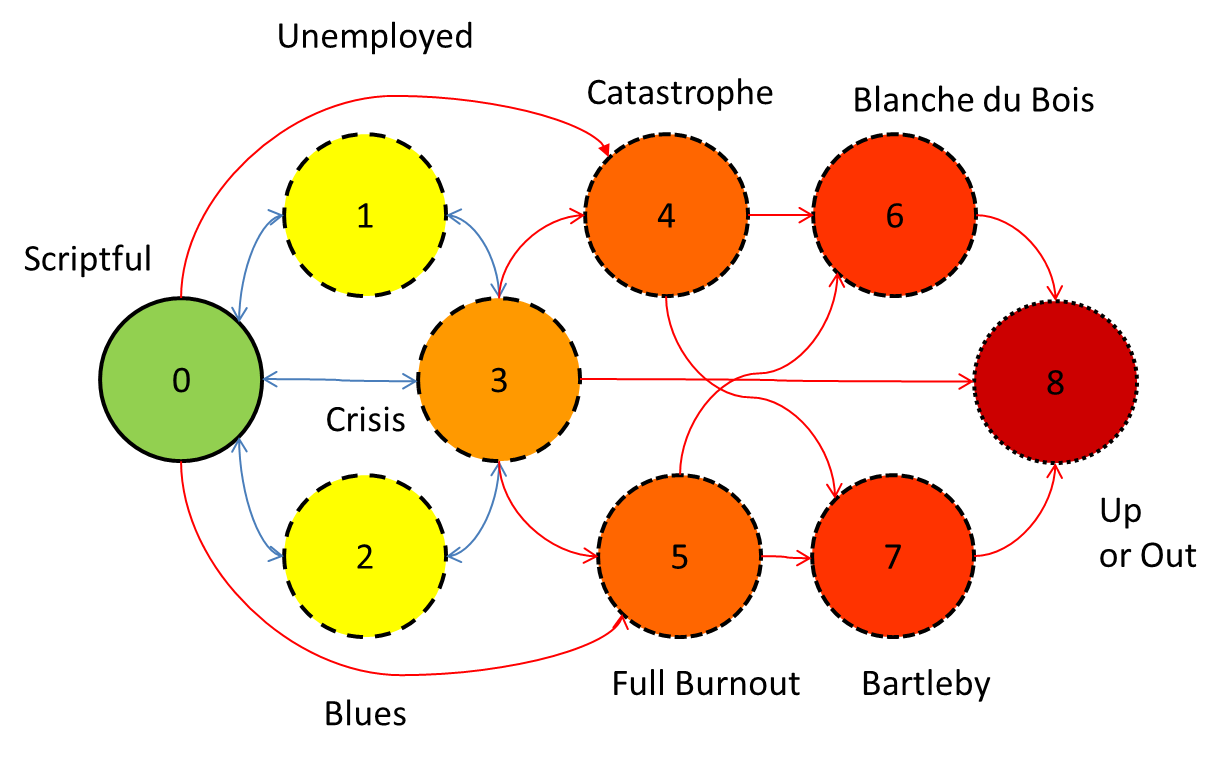
You can read this diagram in a few different ways.
- As an illustration of the details of a discontinuous "reorientation", which makes this the generative element animating the OODA loop (OODA aficionados will note the similarity between ideas as cannibals and Boyd's snowmobile motif).
- As the abstract, descriptive basic building block of social reality. By creating a compilation of such diagrams, with more situation-specific labels, you should be able to describe (for instance) "Middle Class Life in America" with almost enough formality to turn it into a psychologically realistic computer game world.
- As a description of all human thought and action based on conceptual constructs, the mode of existence that monks seek to entirely break out of.
- For those of you who have read my Gervais Principle series, this is a sort of abstract version of the ideas developed figuratively there.
- For those of you who have read my book, Tempo, this is sort of the fractal generator behind the narrative models there (the connection takes some work to understand though, since those models describe the view from the creative side).
I mainly use this sort of diagram at a pen-and-paper level to think through unraveling processes, but I have idle ambitions of someday doing a sort of "social order creative destruction genome project" based on it.
Up or Out
When you land in a scriptless state, you either need to find an idea to seed a new script before time runs out, achieve mind-like-water enlightenment, or give up and die.
When social realities are stable, seeding a new script does not take much creativity. You simply transition through increasingly powerful and meaningful scripts via formal or informal initiation and imitation. Leveling up is easy when the level already exists and there are more experienced players there to learn from.
You might spend so little time in the non-green states that you never develop an understanding of scriptlessness.
But sometimes the Game of Life breaks down.
When entire large populations are thrown into scriptless states, you get suicide epidimics. This happened in post-Soviet Eastern Europe and is starting to happen in the US with Boomers.
So Up or Out isn't just yet another gloomy thought I am manufacturing. It isn't just an obsession for writers with dark sensibilities like Tennessee Williams or Herman Melville.
It's a real thing.
But the good news is that during a period of widespread unraveling, most of the victims are victims of relative irreversibility rather than absolute. In other words, the right idea can potentially save the day. Ideas matter.
In fact, the more widespread the epidemic of individual unraveling scripts, the more powerful ideas become, and the less effective brute force becomes.
Let's talk briefly about such epidemics: the unraveling of collective scripts.
Unraveling of Collective Scripts
When a shared script is working well, you get a harmonious social order. The fortunes of members of the collective evolve in a relatively synchronized way.
But when a shared script breaks down, the unraveling proceeds at varying rates. The harmony turns into a cacophony. Small differences in individual situations lead to large differences in rates and patterns of unraveling. Often, the most perfect instances of the script unravel the fastest, while messy and noisy instances collapse more slowly.
The result is widespread fear, uncertainty and doubt -- FUD -- in subjective experiences, individual and collective, and VUCA -- volatility, uncertainty, complexity and ambiguity -- in environmental conditions.
This gives collective unraveling a very different feel from individual unraveling. When an individual script unravels within a social order that is working for everybody else, the result is a very lonely sort of tragic descent from the center to the margins of that social order. Examples are Tom Wolfe's Bonfire of the Vanities and John Updike's Rabbit novels.
But when there is a collective unraveling, individual collapsing scripts feed off each other, creating far greater turbulence in the shared material and psychological resources of the collective.
The variety of collective forms that can experience shared unraveling of scripts is dizzying, so I'll just do two examples: nations and corporations.
Nations
For a nation, the trough of collective scriptlessness is far more likely to degenerate into violence than for individuals (World War I, the French revolution, the Chinese Cultural Revolution, the India-Pakistan partition, the ongoing Arab Spring).
When collective unraveling advances, things get a lot messier. Every character in the story experiences an unraveling. Instead of the estrangement of an isolated individual from the rest of the society, you get active conflict. A great illustration is Les Miserables. The character arcs of Jean Valjean and Javert both weave tragically through a broader tragic mess (I am tempted to use a cruder phrase that rhymes with Buster duck), with their individual sorry lives made worse by their mutual conflict.
My previous examples (Bartleby and Blanche duBois) are stories set somewhere between individual and collective unravelings. Each is a story of individual unraveling at an advanced stage set in within a collective unraveling at an earlier stage.
A national unraveling is the equivalent of forest fire: a violent conflagration fueled by too much dry deadwood. Here's a picture of the same state diagram, but with different labels.
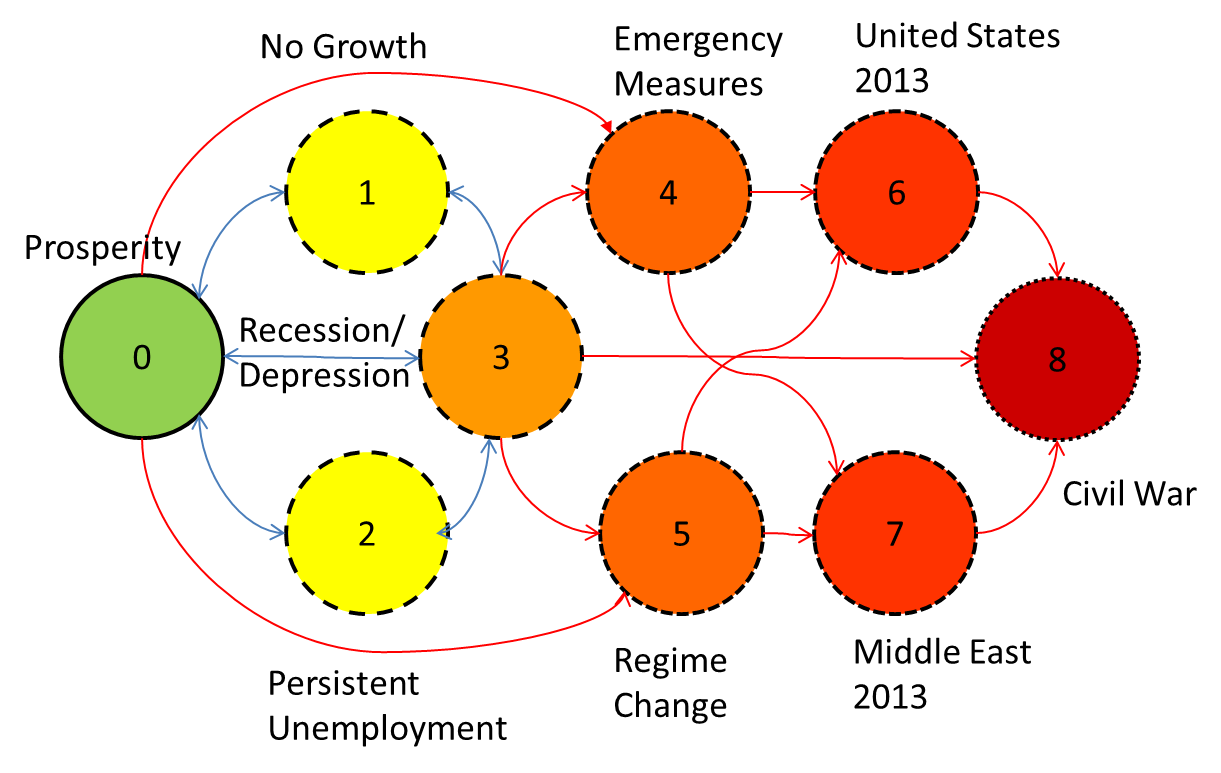
The delusion propagated by Washington, DC, that the United States is merely in some sort of reversible yellow "jobless growth" state and out of a recession is as laughable as Blanche duBois' desperate keeping-up of appearances and mad belief in the "kindness of strangers." The paradox inherent in the phrase reveals the unresolved stress in the situation.
After a decade of emergency measures, we are in a sui generis "unhappy families" state only slightly more quasi-stable than post-Communism Eastern Europe.
This is a narrative state that cannot be put into a convenient pigeonhole invented by economists. When economists invent a label like "jobless growth" suggesting an economic regime that can be understood in general terms, they create a false sense of reassurance that they know where we are, that others have been there before, and they know what is going on.
The only thing the United States in 2013 shares with others who've "been there before" like Russians in 1998, is the closeness to true scriptlessness (if you don't believe me, read the Wikipedia entries on "quantitative easing" and "Perestroika" for similar entertaining little fantasy stories about people who believe/believed they are/were in control of complex unravelings).
Along a different path of unraveling, we are nearly as close to national scriptlessness as the Middle East.
Corporate Unraveling
On a smaller scale, you can see similar processes in declining companies. It is never pretty, but it is less severe than nations unraveling, and reversals are often possible with smaller, less imaginative ideas and limited pain.
The trough to be navigated can often be delineated in stark financial terms, in terms of share price movements, revenue shortfalls and gap funding requirements to navigate a tough turnaround. Every time I talk to a veteran of a struggling company or industry, I hear the same story: a difficult change of direction framed by hard financial constraints.
Senior executives are often unable to see the situation in any way besides such stark financial portraits, which exacerbates the problem. Seed ideas that might trigger a new script are rarely found in balance sheets or delicate share-price management operations that define the state of the unraveling. But the last thing an executive in crisis mode wants to do is listen to signals from outside the boardroom, C-suite and Wall Street.
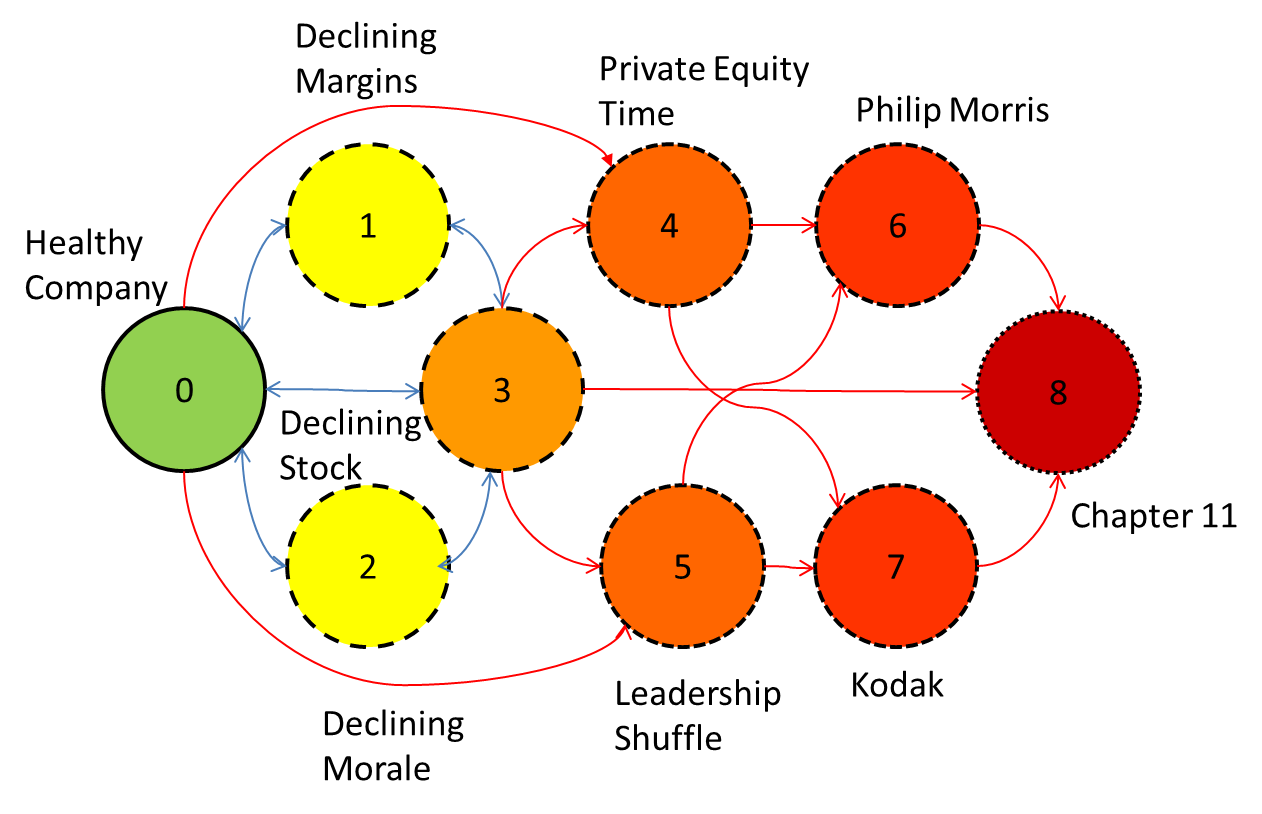
Startups aren't actually that different from large corporations trying to execute difficult turnarounds. They are merely feeding off more distant unravelings.
The Poverty of Abstract Creative Processes
This idea that creation feeds on destruction is why, I think, I am so reluctant to manufacture abstract prescriptions out of any of my ideas, and why I tend to methodological anarchy in synthesis.
Synthesis feeds on unraveling scripts. Ideas are cannibals that devour specific collapsing realities to grow. They don't grow on blank canvases. They are not built out of neat, prepared kits. Creative destruction is a flow from an unraveling reality into an emerging one.
Describing a process of creation in the form of an abstract prescription hides what must be destroyed and consumed in order to actually fuel that creation. It is like starting to cook with a recipe without looking in the fridge first to see what you have. This is why "software is eating the world" is such a good assessment of the current epidemic of unraveling, though I suspect I understand it in a far darker sense than Marc Andreessen meant it. But such acknowledgement of destruction is rare.
Ironically, the refusal to acknowledge necessary destruction -- usually out of a desire to focus on "positive" things -- exacerbates the destruction. It also slows down and risks derailment of the creation.
Is there any value in abstract prescriptions? Possibly some, in the early stages of an epidemic of similar unravelings, when you are dealing with relatively happy, relatively alike victim scripts.
But unraveling scripts get more unique as they progress (the "unhappy families" effect) and a generative seed that grows by feeding on an unraveling script is usually specific to that script.
A simple illustration is Lego model construction. What model you construct, and how you construct it, depends on what model or models you are taking apart, and how. The pieces you need may not become available according to the logic of the clearest and most elegant construction plan. You can influence the unraveling a little, but not a lot. You can anticipate the sequence somewhat, but not completely.
Another way of saying this is that creation has to be path and personality dependent because it feeds on destruction, which is necessarily path and personality dependent. The banal way of saying this in the business world is people over process and vertical first. These phrases hide deeper, messier truths.
To create, you have to deeply understand what is being unraveled. When the what is also a who, you need to become what you are trying to destroy (an idea that is very neatly explored in two science fiction books I read over a brief vacation last week, Orson Scott Card's Ender's Game and Iain M. Banks' Use of Weapons). The more you can do that, the faster you can feed on unraveling to create new realities.
If you can do it perfectly, you are a Phoenix of sorts.